Last year at AUSA, the conversations were just getting started. This year, we're coming back with a lot more to talk about.
Since we last saw everyone in DC, we've completed field exercises, launched a partnership with L3Harris Technologies on Wraith Shield, and continued pushing edge-native AI further into the tactical edge.
AUSA 2026 is almost here. Let's pick up where we left off.
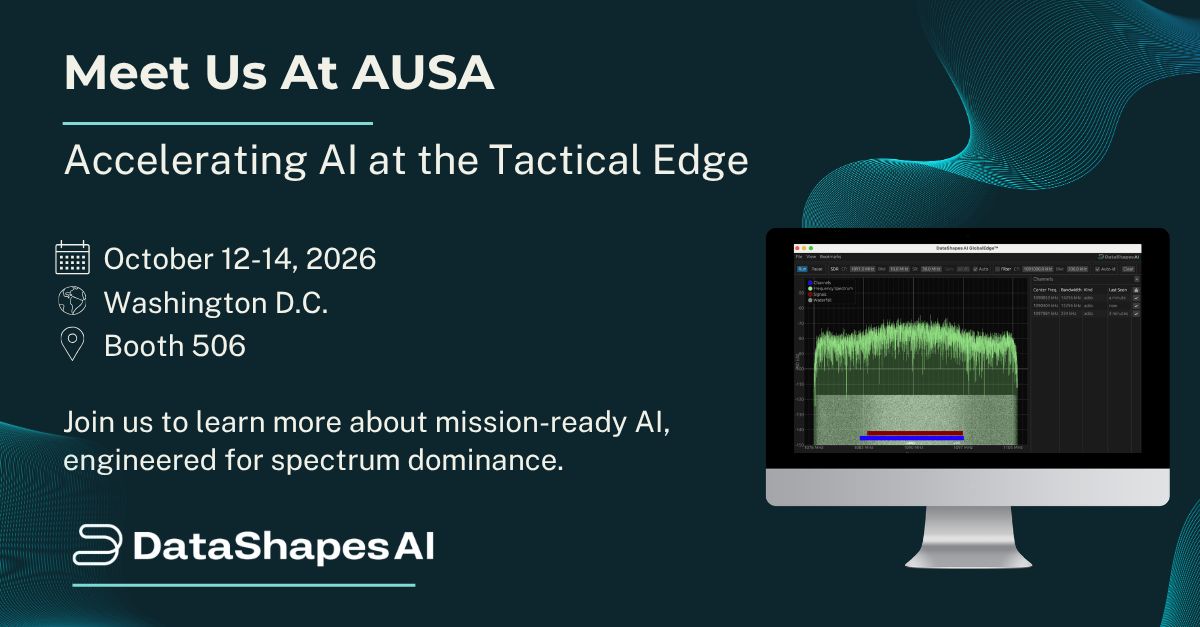
Come find us at Booth 506 to talk AI-driven spectrum awareness, counter-UAS, and what's next for distributed RF intelligence.
See you in DC.
From James Spriet's LinkedIn.
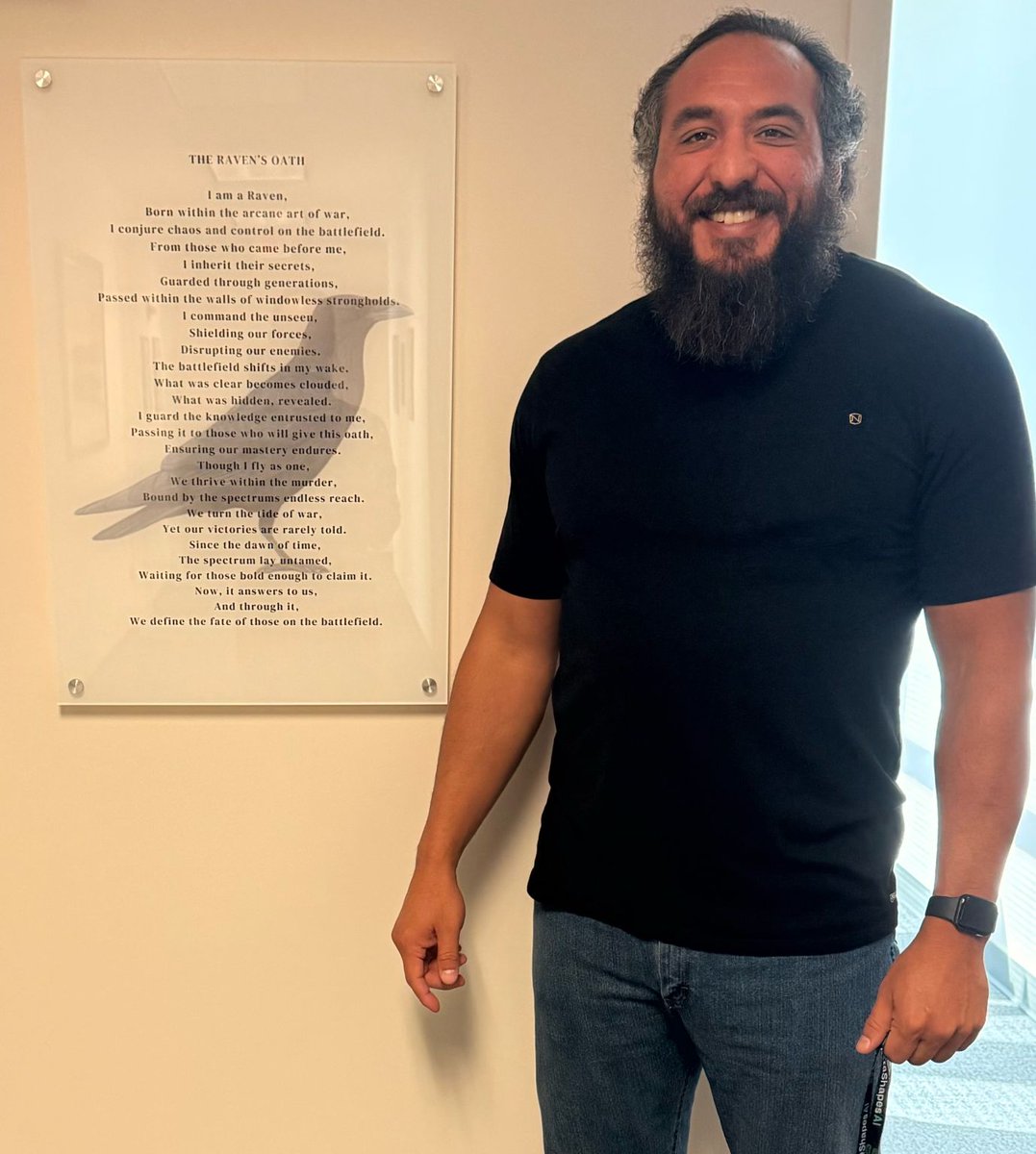
DataShapes AI put up the Raven’s Oath as a daily reminder of who we are, who’s counting on us, and why we give a damn about getting this work right.
One line hits a little closer to home now.
“Though I fly as one,
We thrive within the murder.”
Found mine.
#EW #ISR #EMSO #CUAS #SIGINT #ELINT #COMINT
Find us at AUSA. Booth 506.
In a few weeks, the defense community descends on Washington, DC for AUSA 2026—and we'll be there to carry the mission forward.
Fresh off a number of field exercises, we're looking forward to conversations about how edge-native AI is transforming distributed RF intelligence and counter-UAS at the tactical edge.
Stop by Booth 506 to talk spectrum awareness, real-time threat detection, and what's next for edge AI in defense.
See you in DC.
#AUSA2026
Building a smarter model is only half the challenge. Getting it to the warfighter is the other half.
An AI model that improves in the lab means nothing if those improvements can't reach the systems actually operating in the field. Yet this is where many capabilities stall—updated intelligence trapped in a development environment while deployed systems run on older versions.
The delivery problem is as important as the detection problem.
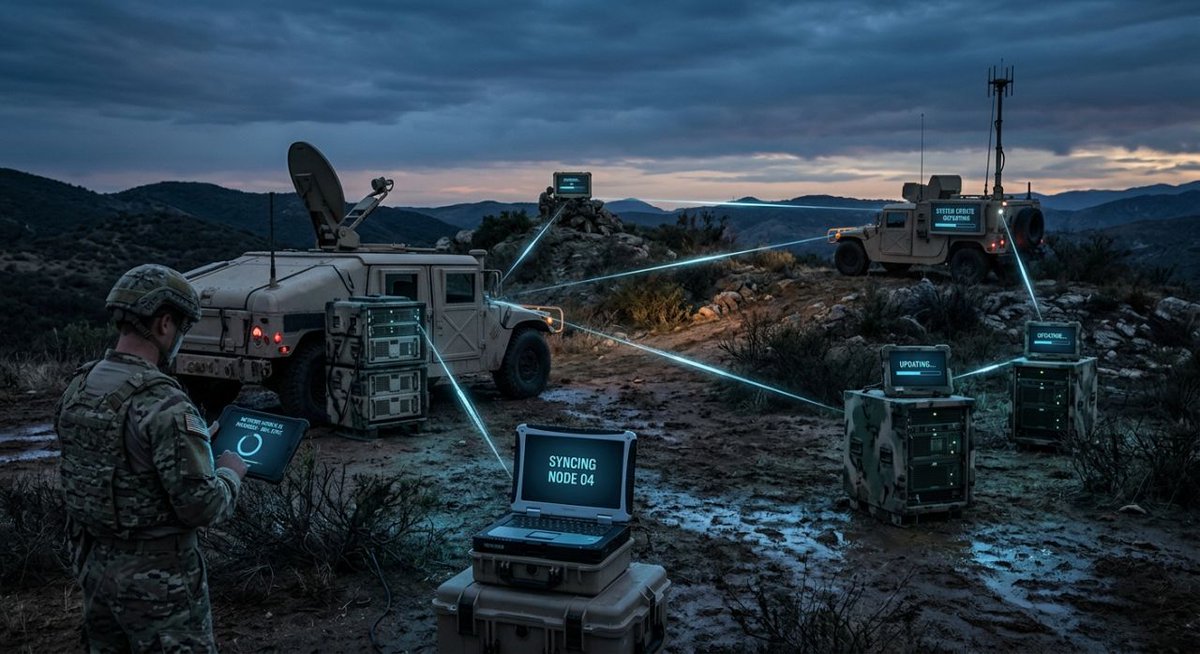
When new threats emerge and models are refined to recognize them, those updated models and signatures need a path to deployed edge nodes—including nodes operating in disconnected or intermittently connected environments.
This means designing for realistic delivery:
→ Push updated models and signatures to deployed systems efficiently
→ Support environments where connectivity is intermittent, not guaranteed
→ Ensure fielded systems reflect current intelligence, not outdated snapshots
→ Keep the loop closed between what's learned and what's deployed
The best model in the world provides zero value if it never reaches the edge.
Capability isn't real until it's in the hands of the people who need it.
From training units and letting operators run Wraith Shield themselves in Mississippi with @l3harristech, straight to @afa_air_space, Space & Cyber Conference.
Logan D. Selby, PhD, Kevin Larrabee, and I heard the same need across our @usairforce and @usspaceforce conversations. Get more capability from the radios and sensors already in the force.
What L3Harris and DataShapes AI have enabled with Falcon IV radios is opening a lot of eyes when people see it operate. With a software upgrade, the radio units already carried become AI-enabled RF sensing and effects platforms.
DataShapes AI provides detection, classification, and rapid signal learning at the edge. Wraith Shield closes the loop by allowing operators to disrupt hostile drone command links directly from the same radio. Zero additional kit. Zero hardware replacement.
It was also damn good to see so many familiar faces and discuss how this applies across different missions. I spent time with Sam Mehta and James “Zagz” Zagorsky sharing what we saw operators accomplish in Mississippi and discussing how we get Wraith Shield in front of the Air Force, Space Force, and many others.
This is quickly becoming a high-TRL capability available to get your hands on it today. As soon as I show people an existing set of radios being able to detect, identify, and defeat a drone, the conversation changes very quickly.
Keep an eye on us as we continue to spread the word.
As always
Remember our ethos “In god we trust, all others, we monitor, jam, or deceive”
#EW #ISR #CUAS #EMSO #SIGINT
Every signal in the electromagnetic spectrum has a fingerprint. The challenge is recognizing it.
A spectral signature is the distinct pattern a signal creates—its frequency behavior, modulation characteristics, timing, and structure. Just as every voice sounds different, every type of transmission has recognizable characteristics that distinguish it from others.
The problem is scale and speed.
The spectrum is crowded with thousands of signals. Manually analyzing each one to determine what it is—a commercial broadcast, a communication link, a drone control signal, a threat—is impossible at operational tempo. There are too many signals and too little time.
This is where AI-powered signature recognition changes the equation.
Instead of an analyst working through signals one at a time, AI recognizes spectral signatures automatically—converting unknown RF activity into identified, classified intelligence in seconds.
→ Unknown signals become recognized patterns
→ Classification happens automatically, at scale
→ Threats get distinguished from routine activity instantly
The spectrum stops being an overwhelming wall of noise and becomes a readable picture of what's actually out there.
Recognition is the difference between seeing signals and understanding them.
Today we remember all those who lost their lives on September 11, 2001, and the first responders who rushed in to save others.
We honor the families who have carried that loss every day since, and the service members who answered the call in the years that followed.
We will never forget.
Next week, the DataShapes AI team heads to Tartu, Estonia for EWLive 2026.
Hosted by Tangent Link with the Estonian Ministry of Defence and Estonian Defence Forces, EWLive puts EW and spectrum capabilities to work in a live environment, in front of military delegations from more than 25 NATO and partner nations. No slide decks standing in for performance.
That's the right setting for this conversation. The RF environment on NATO's eastern flank is contested, crowded, and constantly shifting, and operators need to detect, characterize, and act on signals faster than adversaries can adapt. That's the problem GlobalEdge was built to solve.
If you'll be at Ülenurme Airport September 15–17, let's connect.
The strongest position is a small company that brings its own technology and can own the larger integration.
Judge DataShapes AI by the size of the problem we can own.
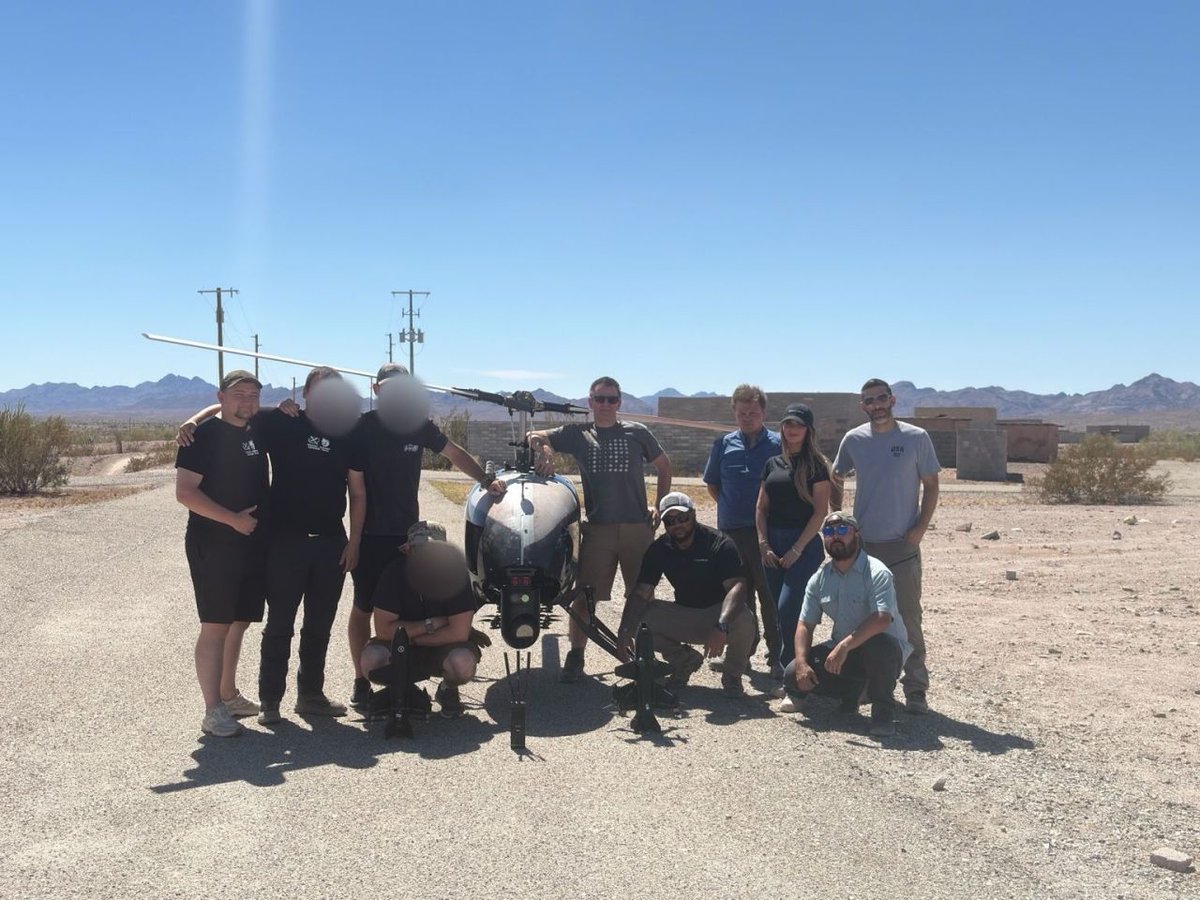
In three weeks, our team and our partners brought together a multinational distributed air-defense capability, successfully killed drones, and sent data into the government’s Lattice system.
That data integration was unique within the exercise. At Joint Interagency Task Force 401 (JIATF 401) Falcon Peak 26.2, DataShapes AI, @EvolvedAerospace , @GeneralCherry, and @PersistentSystems, LLC integrated AI-enabled Radio Frequency (RF) sensing, a long-endurance unmanned helicopter, Ukrainian combat-proven interceptors, and resilient tactical communications.
Four companies. Multiple countries. Three weeks to integrate and get to the range.
We’re a small company with our own technology and the experience to prime solutions like this. We can assemble the partners, manage the dependencies, and own the integration.
That should expand who gets considered to lead these efforts. Government customers need capabilities that work together, information that reaches their systems, and someone accountable for delivery. Those are responsibilities a small company can carry. We put that experience to work at Falcon Peak.
Our team’s backgrounds span military operations, strategic intelligence, special operations support, cyber and Electronic Warfare (EW), systems engineering, defense acquisition, and commercial AI development. We’ve led organizations, managed programs, built mission systems, and delivered them.
Our GlobalEdge software brings detection and classification to the edge. Our people bring the experience to connect that technology to the broader mission. Falcon Peak demonstrated what happens when those capabilities meet the right partners and a firm deadline.
A personal thank-you to Weapons & Tactics Alliance Group. When we needed some immediate tactical EW system support, they showed up for us and for the mission. Their team includes some of the sharpest Subject Matter Experts (SMEs) we’ve ever met, and they put that expertise to work when we needed it. You remember the people who step in when you need help getting something across the line! WepTac, your support meant a hell of a lot to this team! You helped make this happen, and we won’t forget it.
Serious credit to our partners, the US Army Yuma Proving Ground (USAYPG) Red Team pilots, and the range-testing crew.
This result belongs to the people who did the work. And to the 150+ @jerseymikes Subs that supported the effort without knowing. At that volume, they deserve a spot on the team. 😂
DataShapes AI. Small company. Very large stick.
Bring us the mission, the constraints, and the deadline. Let’s get to work.
#EW #ISR #CUAS #SIGINT #COMINT #ELINT #EMSO
Individual awareness wins engagements. Shared awareness wins operations.
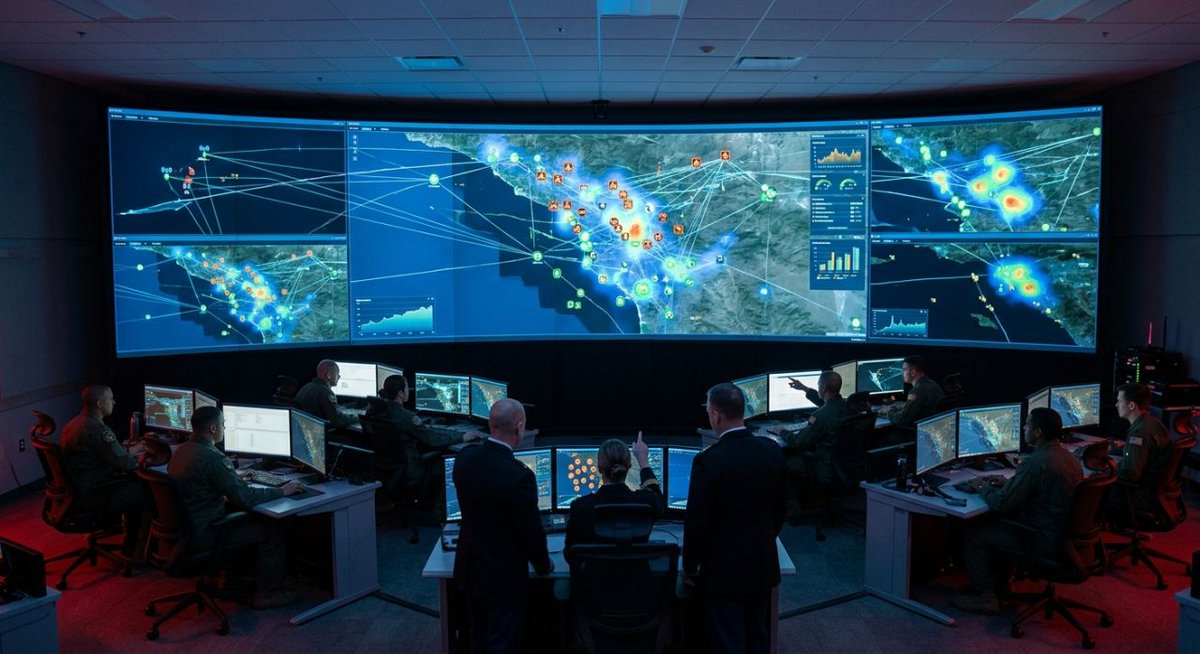
When one operator detects a threat, that's valuable. But when every unit across an operation sees the same real-time picture of the electromagnetic environment, something more powerful happens.
A common operating picture means:
→ A threat detected by one unit immediately informs all units
→ Commanders see the full electromagnetic environment, not fragments
→ Coordination happens from shared truth, not conflicting reports
→ Decisions at every echelon draw from the same real-time intelligence
Without shared awareness, each unit operates from its own partial view.
Gaps appear between what different elements know. Threats detected in one sector don't inform another. Coordination suffers because everyone is working from a different picture.
When spectrum intelligence is shared across the force—from the tactical edge to command—the entire operation moves with unified understanding.
The goal isn't just to detect threats. It's to make sure everyone who needs to know, knows—at the same time.
Distributed sensing creates the data. A common operating picture turns it into coordinated action.
One of the oldest tricks in electronic warfare is also one of the hardest to counter: frequency hopping.
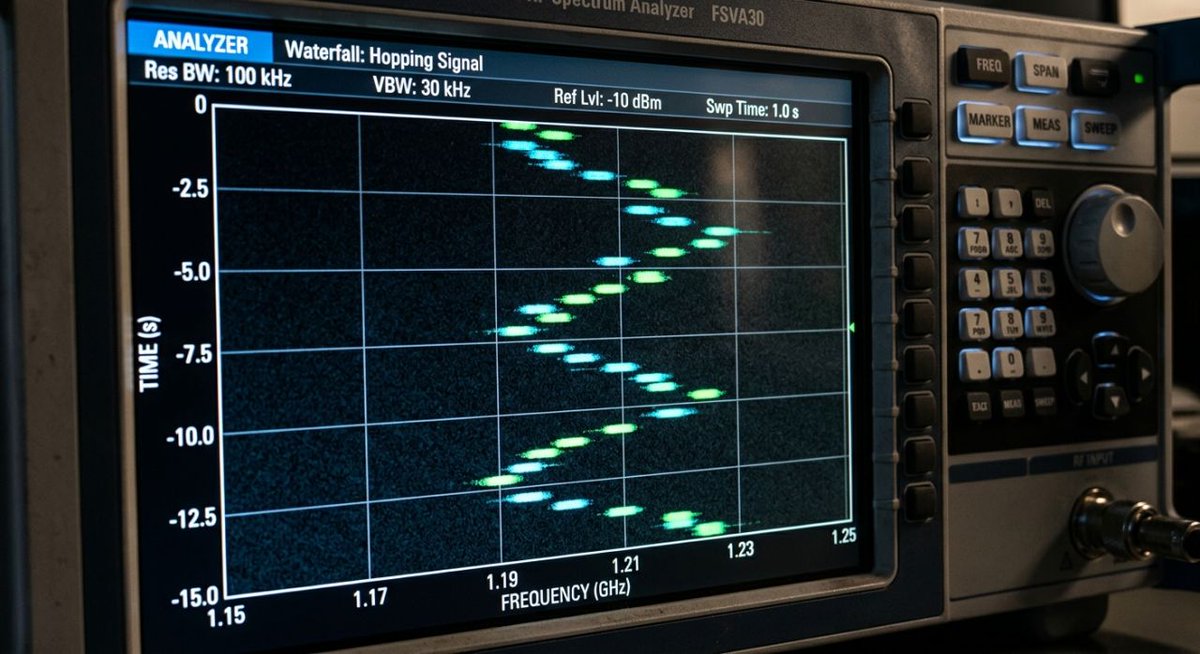
Instead of transmitting on a single, fixed frequency, a frequency-hopping signal rapidly jumps across many frequencies in a sequence, sometimes hundreds of times per second. To anyone who doesn't know the pattern, the signal seems to appear and vanish across the spectrum, impossible to pin down.
Why adversaries use it:
→ Resistance to jamming - You can't easily jam a signal that won't sit still
→ Low probability of intercept - Brief transmissions on constantly changing frequencies are harder to detect
→ Difficulty tracking - Without the hopping sequence, following the signal is extremely challenging
This is exactly what makes modern spectrum operations so difficult.
Threats don't broadcast conveniently on a single frequency waiting to be found.
They hide in complexity, hopping, shifting, blending into the noise.
Detecting a frequency-hopping signal isn't about monitoring a single channel. It's about recognizing a pattern across many.
This is where AI changes the equation, identifying the behavioral fingerprint of a hopping signal even when the specific frequencies keep changing.
Threat environments evolve constantly. The AI defending against them should be able to keep pace safely.
The traditional model treats deployment as the finish line: train the model, ship it, and it operates with fixed knowledge until the next scheduled update (often months away). In a threat environment that changes daily, that lag is a real limitation.
GlobalEdge is built to keep improving after deployment—within controlled, validated bounds.
As it operates, it refines its understanding from the signals it actually encounters. New waveforms, emerging patterns, previously unseen activity—the system incorporates what it observes and improves its classification over time.
This means the capability doesn't degrade as the threat environment evolves. It adapts alongside it.
→ New signals encountered in the field improve the model
→ Classification accuracy sharpens with operational exposure
→ Emerging threats get recognized without waiting for a lab update
The longer it operates, the sharper it gets.
A model frozen at deployment is only as good as the day it shipped. A model that learns continuously gets better with every mission.
Learn more: https://t.co/zASDbFwHqL
In fast-moving threat environments, the update cycle can be the vulnerability.
Consider the traditional path for improving a fielded AI capability: identify a gap, retrain the model in a lab, validate it, package the update, push it through approval, and deploy it to systems in the field. That process can take months.
Meanwhile, adversaries adapt in days. Look no further than the rapid technological developments in the Russia-Ukraine War.
This timing mismatch creates a persistent window of vulnerability: the gap between when a new threat emerges and when deployed systems can recognize it.
Real-time and near-real-time model updating closes that window.
When improvements can propagate to fielded systems quickly (or when systems can adapt on their own at the edge), the response timeline compresses from months to something far faster.
The goal is simple: ensure the capability in the warfighter's hands reflects the threat environment as it exists today, not as it existed when the model last shipped.
The threat doesn't wait for the next update cycle. Capabilities shouldn't either.
In spectrum operations, slow detection isn't just inconvenient it can be the difference between successful defense or significant damage.
Every second between when a threat appears and when an operator can act on it is a second the adversary uses to their advantage.
Consider the traditional detection pipeline: a signal is captured, transmitted to a central system, queued for processing, analyzed, and then the result travels back to the operator. Each step adds latency. Seconds accumulate.
In that accumulated delay, a lot happens:
A drone advances toward its target. A jammer disrupts coordination. A reconnaissance platform gathers its intelligence and leaves. By the time the alert reaches the operator, the moment to respond has often passed.
However, what if you can eliminate the lag by processing at the point of detection?
When detection and classification happen locally (at the edge, without reach-back) the operator gets actionable intelligence in near real-time. The response window opens while there's still time to use it.
Detection lag turns defense into forensics. Speed turns it back into defense.
The faster you know, the more options you have.
German firm PROCITEC GmbH and Virginia-based DataShapes AI have introduced ClassifAI, an AI-powered capability designed to help military operators identify and classify unknown radio signals for electronic warfare and signals intelligence missions https://t.co/4mdSjq1Voa
Message from our CEO, Logan D. Selby, PhD:
DataShapes AI was everywhere this week.
We supported four events across the country:
📍 Engineering Sprint for #jiatf401 — New York
📍 #TechNet Augusta — Augusta, GA
📍 #GSOF Indo-Pacific Irregular Warfare Symposium — Honolulu, HI
📍 #IWE NEXUS — Payson, Utah
Four events, four states, one team on the ground representing DataShapes.
But behind every one of those moments was a team back home making it possible.
Shoutout to Adam Fife at CenCore for putting together a great event for the #IWE. Was great to spend time with former Secretary of Defense Chris Miller.
Proud of everyone who made this week happen, seen and unseen.
Paul Craft Kevin Larrabee Andrew Fast Chris Shaw Simeon Fitch Danny Brady Patrick Brantz James Spriet Joe Edwards Sarah Cuellar Michael Lichko Angela Fincham Zachary Taliaferro Adam Brege
#ai #defensetech #cuas #dsai
We're growing and the people we're looking for aren't always who you'd expect. Yes, we need brilliant engineers, data scientists, and RF experts. But technical skill alone isn't what makes someone thrive at DataShapes AI.
The people who do their best work here share a few things:
→ They care about the mission. Not just the interesting technical problem, but who depends on the outcome.
→ They're honest. They'll tell you when something won't work, challenge assumptions, and admit what they don't know.
→ They understand operational reality or they're deeply curious about it. The best solutions come from people who know the difference between demo-ready and field-ready.
→ They move fast without cutting corners. Speed matters, but not when reliability is on the line.
We're building technology that warfighters depend on in the most demanding environments imaginable. That takes people who bring both capability and conviction.
If that sounds like you, let's talk.
Reach out at [email protected]
One sensor gives you a point of awareness, a network of sensors gives you something far more powerful. The value of distributed sensing isn't just broader coverage—it's what happens when sensors work together.
When multiple sensors share what they detect, the whole system becomes smarter than any individual node:
→ Triangulation - Multiple sensors detecting the same signal can pinpoint its exact location
→ Confirmation - A potential threat flagged by one sensor gets verified by others, reducing false alarms
→ Coverage - Gaps in one sensor's view get filled by neighboring nodes
→ Resilience - Losing one sensor doesn't blind the network; the others compensate
This is the network effect applied to spectrum awareness. Each additional sensor doesn't just add its own coverage—it strengthens the entire system's ability to detect, locate, and confirm threats.
A single sensor can be jammed, blinded, or bypassed. A distributed network adapts, cross-checks, and keeps working.
Individual sensors detect. Networks understand.
The future of spectrum awareness isn't better individual sensors. It's smarter networks of them.
"Edge computing" gets used constantly in defense tech. But what does it actually mean?
The term describes where computation happens and that location has major operational consequences.
Traditional computing (like the internet) is centralized. Data gets collected in one place, sent to a central server or cloud for processing, and the results come back. This works well when connectivity is reliable and latency doesn't matter.
Edge computing moves the processing to where the data is. Instead of sending everything to a distant server, computation happens locally on the device, at the sensor, at the "edge" of the network where the action is.
Why this matters in defense:
→ Speed - No round-trip to a server means results in milliseconds, not seconds
→ Resilience - Processing continues even when networks fail
→ Security - Sensitive data never has to leave the tactical environment
→ Autonomy - Systems function independently, without reach-back dependency
For a spectrum sensor in a denied environment, "edge" isn't a buzzword. It's the difference between a system that works when connectivity drops and one that goes dark.
The edge is wherever the mission actually happens. Computing should happen there too.
Detecting a signal is easy. Any sensor can tell you something is transmitting.
The operational value comes from classification: identifying what that signal actually is, and doing it fast enough to act.
Classification speed is where most systems fall short.
A signal gets detected. Then it goes into a queue for analysis. An analyst reviews it, or it gets sent to a centralized system for processing. Minutes pass. By the time the classification comes back, the tactical window has closed.
In modern operations, that lag can be fatal. A drone identified after it's completed its mission is intelligence, not defense.
This is why classification at the edge matters.
When a signal is detected, classified, and prioritized all at the edge, operators get actionable intelligence while there's still time to act. Not a report on what happened. A warning about what's happening.
Detection tells you something is there. Fast classification tells you what to do about it.