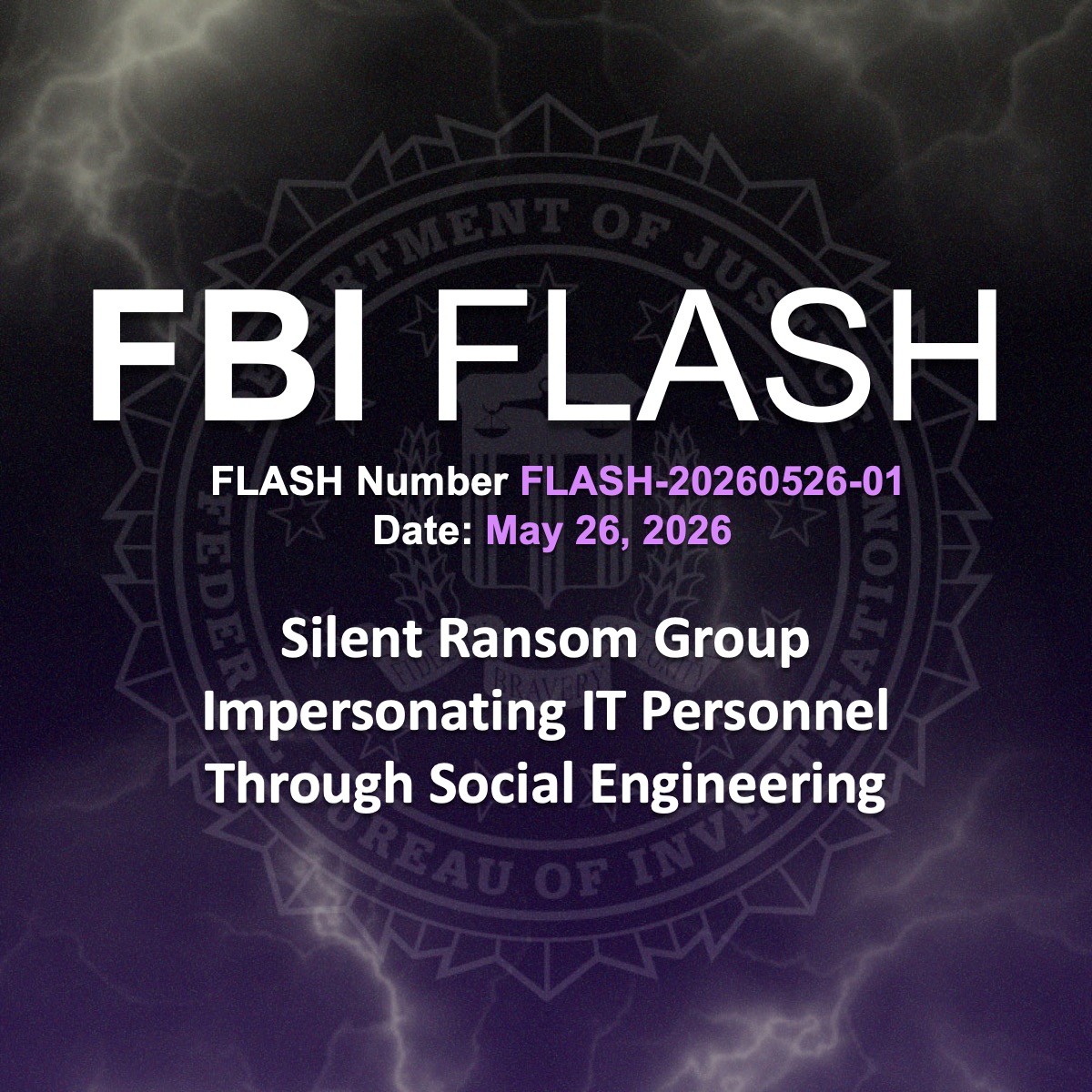
Yesterday the FBI released an advisory on the Silent Ransom Group (SRG), aka Luna Moth, Chatty Spider, and UNC3753, who use social engineering techniques like phone calls and phishing emails to access victim computers. SRG actors have been steadily targeting law firms since 2023, and they focus on accessing victim systems, exfiltrating data, and extorting their victims by threatening to release or sell the stolen data.
Since SRG actors use legitimate remote access tools, there are few artifacts of their attacks. Review the advisory to learn how SRG actors operate to exfiltrate data and potential signs of SRG activity: https://t.co/JxQXleJNC8.
Malicious cyber actors are targeting U.S.-based automatic tank gauge (ATG) systems, widely used throughout the Energy, Chemical, Food and Agriculture, and Transportation Systems Sectors. The threat actors exploit flaws in ATG systems through multiple attack vectors, compromising internet-exposed ATG systems and subsequently modify them through command execution.
The #FBI, @CISAgov, @NSAgov, @ENERGY, @EPA, @TSA, @USDOT, and @USDA urge ATG owners and operators to defend against this malicious activity by securing their ATG systems with with strong authentication and segmentation practices. Learn more: https://t.co/E7UT7bb9CH
🌊#BREAKING: As part of Operation Riptide, an ongoing #FBI campaign targeting criminals, infrastructure, and the financial networks behind cyber-enabled crime and fraud against the American people, #FBI Boston has supported the international takedown of the First VPN Service used by ransomware actors to compromise businesses here in the U.S. and around the world.
Why? Because the increase in #cybercrime threatens the financial security, personal safety, and national interests of all Americans.
Learn more about FBI Boston's work ➡️https://t.co/q23l8skZbl
Introducing Artemis III.
Four astronauts. Three launches. Two dockings. One splashdown.
In 2027, the Artemis III mission will practice docking the Orion spacecraft with two lunar landers in low Earth orbit — the capability we need to return humanity to the Moon’s surface.
Attention, current and former U.S. government employees! Foreign intelligence services are posing as employers on professional networking sites like LinkedIn to target clearance holders for recruitment. We urge you to visit https://t.co/gGc5vzAswP to learn how to mitigate the threat.
13 internet domains used to target U.S. persons, including current and former security clearance holders with access to classified and sensitive U.S. government information, were seized today by federal authorities.
“These domain seizures offer a glimpse at how foreign actors can use promises of easy money to lure Americans into revealing sensitive or classified information that they are duty‑bound to protect,” said Assistant Attorney General John A. Eisenberg. “Anyone approached online with offers of easy income for vague ‘consulting’ work should treat those overtures with extreme caution and remain vigilant for warning signs of malicious targeting.”
Read more: https://t.co/NiajtxfCY4
Get ready for Earth joy!
Earlier today, we announced the four astronauts who will go to space on Artemis III —and shared the latest updates on the future of @NASAArtemis.
Learn more about how this mission will set us up to return humanity to the Moon: https://t.co/kAvzvuYzEw
Get ready for a jaw-dropping cosmic spectacle! On July 17th, the sky is set to deliver one of the most stunning planetary parades of the decade. Six planets will line up in a breathtaking arc, creating a rare "planet parade" you'll remember for years.What you can see:Mercury, Venus, Jupiter, and Saturn — shining bright and visible to the naked eye from almost anywhere with a clear view.
Uranus and Neptune — trickier, but possible with the naked eye from truly dark skies (binoculars or a small telescope will make them pop).
This isn't just any alignment — it's a spectacular lineup along the ecliptic, like nature's own cosmic highway lighting up the twilight. Mark your calendars now, set a reminder, and find a spot away from city lights for the best show. Don't miss this once-in-a-lifetime sky event. Look up on July 17th — the universe is putting on a performance! (Pro tip: Check local weather and rise/set times for your area. Even a few days around the date should offer great views!)
A Russian psychologist spent 10 years proving that the act of talking to yourself out loud is one of the most powerful cognitive tools the human brain has, and almost nobody outside his field has read the work.
His name was Lev Vygotsky.
He worked in Moscow in the 1920s and died of tuberculosis in 1934 at the age of 37. He had no laboratory, no funding, almost no English readers, and a body of work that the Soviet government suppressed for two decades after he died.
He produced the foundational theory of how human cognition actually develops, and the central piece of that theory was a behavior almost every adult is faintly embarrassed about.
Vygotsky noticed that young children talk to themselves constantly. They narrate their own actions, they argue with imaginary opponents, they instruct themselves through tasks out loud.
The dominant theory at the time, from the Swiss psychologist Jean Piaget, said this was a sign of cognitive immaturity that children would eventually grow out of as they learned to think properly.
Vygotsky said the exact opposite.
He argued that this self-directed speech was the most important cognitive event in the entire developmental window, because it was the moment a child first started to use language as a tool to control their own mind. The child was not failing to think. The child was learning how to think by externalizing the process and listening to themselves do it.
He predicted that as children matured, this out-loud self-talk would not disappear. It would go underground. It would become silent inner speech, which is the running monologue every adult has inside their own head for the rest of their life.
The voice you hear when you read this sentence is the direct descendant of a four-year-old narrating their own block tower.
For 50 years almost nobody outside Russia had access to his work, and the few researchers who did pick it up could not get funding to test it. Then in the early 2000s the experiments finally started to pile up, and what they found was that Vygotsky had been right about something even more important than he knew.
The first major study came from Gary Lupyan at the University of Wisconsin and Daniel Swingley at the University of Pennsylvania in 2012. They ran a simple visual search experiment. Participants were shown 20 images at once and asked to find a specific object, like a banana or a chair. In one condition they searched silently. In the other condition they were told to say the name of the object out loud to themselves while looking for it.
The participants who spoke the target name out loud found the object significantly faster, with higher accuracy, than the participants who searched in silence. The effect was strongest when the spoken word matched a familiar object the brain already had a strong category for.
Saying the word out loud literally tuned the visual system to detect that thing better. The researchers called it the label feedback effect, and the implication was that the act of vocalizing a goal physically changes how the brain processes the world while pursuing it.
The second major study came out of the University of Michigan and Michigan State in 2017. The lead researchers were Ethan Kross and Jason Moser, and they used both EEG and fMRI to record what happens inside the brain when people talk to themselves while emotionally upset.
They asked participants to recall painful autobiographical memories and reflect on them in two different ways. Some used the first person, saying things like "why am I feeling this way." Others used the third person, referring to themselves by their own name, saying things like "why is John feeling this way."
The brain scans showed that the simple act of switching from first person to third person, even silently, decreased activity in the medial prefrontal cortex, the region responsible for rumination and self-referential pain. Within a single second of using their own name instead of the word I, participants showed measurably lower emotional reactivity. The shift required no extra cognitive effort. It cost the brain nothing. And it worked.
Kross described the mechanism in his interviews. Talking to yourself by name creates a small amount of psychological distance from your own experience. Your brain processes the situation more like a problem belonging to someone else, which means it can analyze it instead of drowning in it.
What Vygotsky had intuited in 1934 turned out to be even more powerful than the developmental theory he built it into. The voice you use to talk to yourself is not background noise. It is one of the most precise cognitive tools the brain has, and you can change how it works just by changing the pronoun you use.
People who talk through problems out loud are not anxious or unstable. They are running an externalized version of a process the rest of us are running silently and worse. The kindergartener narrating their block tower, the surgeon muttering through a procedure, the engineer pacing a hallway describing a bug to nobody, the athlete repeating a cue to themselves before a free throw, they are all using the same ancient mechanism that builds and steers human thought.
You can run the experiment yourself the next time you are stuck on something hard. Stop trying to solve it silently in your head. Say it out loud. Describe what you are seeing. Walk yourself through the steps as if you were explaining it to a colleague who is not in the room.
And when something genuinely upsets you, switch to your own name. Ask why this person is feeling this way, instead of why I am feeling this way.
The voice you have been told to keep quiet your entire life is one of the oldest pieces of cognitive technology you own.
Most people are still embarrassed to use it.
🚨🇺🇸BREAKING: The CIA officer caught with $40 million in gold bars allegedly invented an entire fake top-secret spy program to steal the money.
As if this story couldn't get and wilder:
-David Rush allegedly built a sham "special access program," the blackest box in U.S. intelligence, so secret even top-clearance officials couldn't look inside without authorization
-The fake program posed as "continuity of government" work, the doomsday planning that keeps Washington running after a nuclear war
-He allegedly read in two colleagues as unwitting accomplices and used a made-up government contract to funnel millions, persuading a defense contractor to buy huge amounts of gold
-The FBI raid on his home seized 303 gold bars worth roughly $40 million, $2 million in cash, and 35 luxury watches
-Investigators say he lied about his college degrees, faked being a Navy pilot, and still sailed through the CIA's notoriously brutal vetting
-A judge ordered him held as a flight risk, and several CIA officials are now on leave as the probe widens
The scheme worked because of the system, not in spite of it.
The secrecy walls built to hide operations from China and Russia hid the fraud from the CIA itself.
A man with a fake résumé ran a fake doomsday program inside the most paranoid institution in America, and for years nobody noticed...
Source: Washington Post
To combat global scams and ensure Starlink remains a force for good, the Starlink team works with law enforcement and technology companies to proactively detect and disable terminals involved in illegal activity
The U.S. Secret Service (USSS) is seeking talented Systems Engineers to serve in the Office of Technical Operations (TEC), within either the Aviation and Airspace Security Division (ASD) or the Technical Security Division (TSD). In these roles, you will support the technical security mission by applying advanced systems engineering principles across the full system lifecycle for mission-critical systems and leading technical design, integration, testing, and sustainment of complex protective technologies.
https://t.co/W79jTflJ9K
Join CIA to analyze foreign threats – from cyber warfare to emerging technology – as a Science, Technology, and Weapons Analyst.
Visit https://t.co/havFrmiaj9 to learn more about how you can apply your technical expertise to U.S. national security challenges.