I HAVE BEEN RESEARCHING ONDAS $ONDS DEEPLY AND HOLD SHARES IN THE COMPANY.
When the market looks at $ONDS, it sees a series of dilutive acquisitions. I see a modern defense prime being assembled in real time without touching the debt markets.
Ondas Holdings currently sits on a combined backlog of $757M with a fiscal 2026 revenue target of $525M to $550M.
The market is heavily discounting the stock down to 52 week lows due to share dilution. That is the entire bear case, and it is already priced in.
By using equity rather than high interest debt to consolidate autonomous drone and defense assets, management has built a clean balance sheet positioned directly in front of a $1.5T defense spending cycle.
What truly stands out is how these acquisitions, existing government customer relationships, and the strategic partnership with $PLTR are beginning to lock together. Integrating Palantir software capabilities across an expanding autonomous hardware footprint creates a multi year compounding engine.
You have rapid top line scale, a clear trajectory toward GAAP profitability, a $757M backlog, and a strategic $PLTR alliance trading at 52 week lows.
When the market focuses purely on past dilution while ignoring an inflection in earnings and defense scale, that is where asymmetric opportunities are born.
If you find this information helpful, please like, follow, and share.
THE MARKET SEEMS TO HAVE FORGOTTEN ABOUT $ONDS, BUT I HAVE NOT.
I have watched this name all the way up from $0.50, and I am starting to rebuild my position right here. Sitting near its 52 week lows gives this stock massive asymmetric upside.
The long term return potential here is generational. That said, $ONDS can still dip lower in the short term. If that happens, make sure you are buying.
Look at the numbers from this week:
🔹 Q3 Revenue surged +1,559% YoY to $167.5M
🔹 Backlog hit $835M with $820M in cash on hand
🔹 FY26 Revenue Guidance: $550M+ vs. Est. $537M
🔹 FY27 Revenue Guidance: $1.1B+ vs. Est. $1.0B
🔹 Company wide Adjusted EBITDA projected to break even by Q3 2027
Over the past 18 months, management has executed an aggressive acquisition strategy to transform into a prime defense contractor spanning counter drone systems, long endurance surveillance, precision strike, ground robotics, manufacturing, and the software tying it all together.
Trading around $5 right now with $820M in cash and a $1.1B revenue run rate ahead, the risk to reward on $ONDS is tough to ignore. Are you accumulating down here or still sleeping on it?
Great capture on the supply data. From an architectural and institutional valuation perspective, the market is fundamentally mispricing this setup.
Wall Street still models AI hardware demand using top down server unit shipments. That approach breaks down completely when compute architectures hit extreme thermal and power density limits.
On next generation platforms like the $AMD MI450, massive parallel compute creates severe transient current spikes and voltage droop risks. High capacitance, ultra small form factor MLCCs are required directly adjacent to the silicon to stabilize power integrity.
You cannot software optimize away the laws of physics. Even if overall hyperscaler capex growth decelerates past 2027, the non discretionary bill of materials per accelerator board is multiplying, keeping absolute component volume on an upward trajectory.
Unlike commodity electronics, server grade MLCCs require proprietary dielectric ceramic powders, sub micron layer precision, and specialized firing equipment dominated almost exclusively by Murata and Samsung Electro Mechanics. Qualifying new capacity takes twelve to eighteen months.
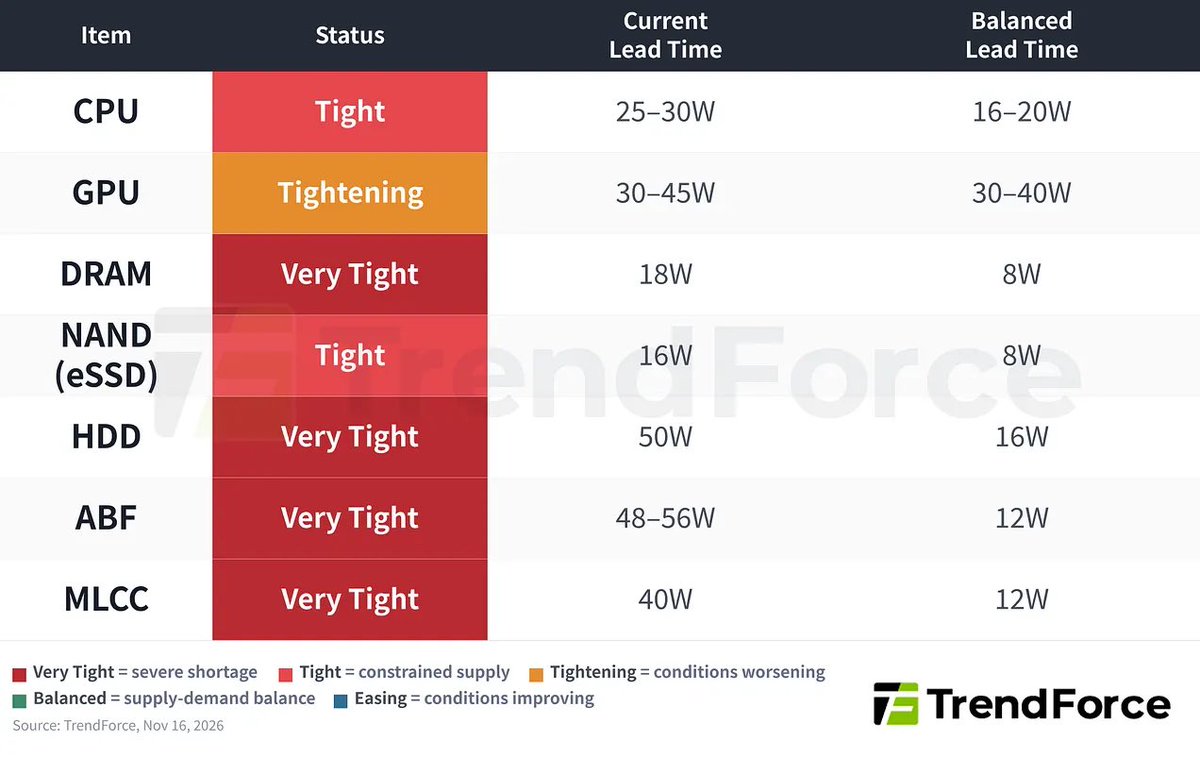
Extending lead times to forty weeks signals that tier one suppliers are shifting capacity away from low margin consumer lines toward high margin AI infrastructure. This gives them substantial pricing power and product mix leverage that consensus earnings models have not priced in.
Quantitative funds and sell side analysts are still applying historical cyclical consumer multiples to these suppliers, selling them off on macro deceleration fears. They are completely missing the structural transition from cyclical volume plays to secular engineering bottlenecks.
In semiconductor supply chains, passive component bottlenecks are one of the most reliable leading indicators. Hyperscalers and chip designers only lock in long lead time inventory against firm deployment schedules.
Severe tightness at the physical component layer confirms that next generation silicon ramps like $AMD MI450 are tracking well ahead of conservative market estimates.
I think AI is one of the few industries where investors celebrate deteriorating supply conditions.
MLCC lead times are extending per new Trendforce data… now “very tight” at 40W.
Content per system keeps going up as well (eg. $AMD using +632% more of a part for MI450 boards).
Yet suppliers from Murata to Samsung Electro-Mechanics are getting sold off to oblivion.
I will continue to make the argument that we can continue to see demand acceleration in certain bottlenecks…
Despite potential overall capex reductions past 2027. Would not conflate the two like what markets are pricing in now.
@PeterP60225459 Custom AI silicon is scaling rapidly alongside GPUs. Both Broadcom and Marvell are deeply embedded in the hyperscaler infrastructure buildout, benefiting directly from multi generational TPU demand.
OMG SHE JUST DID IT AGAIN
Cathie Wood is aggressively re-allocating across Big Tech
She is basically telling you EXACTLY which stocks to buy to get RICH
Here are the 5 companies she just traded:
1) $NVDA
ARK bought $45.9M on Thursday's dip + added more ARKW on Friday
$NBIS IS GOING TO BE A MASSIVE NEOCLOUD LEADER AND A GENERATIONAL AI INFRASTRUCTURE OPPORTUNITY.
Here is my accumulation plan on any pullbacks:
🔹 $110: Buy
🔹 $100: Add more
🔹 $90: Keep accumulating
🔹 $80: Aggressive buy
Q3 earnings proved just how fast this business is scaling from Q2 to Q3:
🔹 Revenue: $582.3M to $980.8M (+68% QoQ)
🔹 Adjusted EBITDA: $236.2M to $465.8M (+97% QoQ)
🔹 AI Cloud Adjusted EBITDA Margin: 49.7% to 53.2%
🔹 Net Loss: $190.4M to $37.5M (80% loss reduction QoQ)
By the end of September, ARR already hit $6.4B. Management commentary highlights an incredible unit economic flywheel:
🔹 Signed over $12B in new contracts since the start of Q3
🔹 Average GPU pricing jumped over 20% QoQ, cutting payback periods from 22 months down to 19 months
🔹 Q3 deals included upfront prepayments covering 100% of associated CapEx, up from 50% to 60% in Q2
🔹 Q3 contract value exceeded $25M per MW, up from roughly $20M in Q2
🔹 Year end contracted power reaching 5GW
Committed customer prepayments stand at $10B for 2026 and $17B to $20B for 2027. Combined with contract backed financing, roughly 75% to 85% of 2027 CapEx is already covered.
Beyond raw GPU capacity, Nebius is rapidly evolving into a high margin software platform through partnerships with Databricks, Datadog, Snowflake, and Palantir, alongside its own Token Factory inference platform approaching hundreds of millions in revenue.
I remain most bullish on $NBIS because the sum of its parts is massively undervalued.
If you find this information helpful, please like, follow, and share.
INSTITUTIONS ARE LOADING UP ON $NBIS.
632 institutional holders with $7.2B in disclosed positions.107 new positions vs only 85 exits.
🔹 Bank of Montreal: +102.2%
🔹 WCM Investment: +60.2%
🔹 Deutsche Bank: +18.9%
🔹 Barclays: +10.1%
AI infrastructure is the future, and $NBIS is one of my highest conviction core long holdings.
Even more importantly, the real moat of $NBIS goes far beyond pricing moving from $12 per watt year toward $25M to $40M+ per megawatt. It comes down to the massive gap between how fast Nebius recovers hardware costs and how long those GPUs actually generate cash flow.
Nebius depreciates its hardware over a 5 year useful life, yet today 1 to 3 year deals pay back in just 19 months, with customers prepaying over 100% of CapEx on new projects.
That leaves more than 3 full years where paid off GPUs keep printing cash at a 53% AI Cloud EBITDA margin while repricing higher every 1 to 3 years.
Wall Street is severely underestimating how much free cash flow Nebius can generate from the exact same GPU clusters without buying new ones.
I am buying the vision and holding $NBIS with full conviction.
If you find this information helpful, please like, follow, and share.