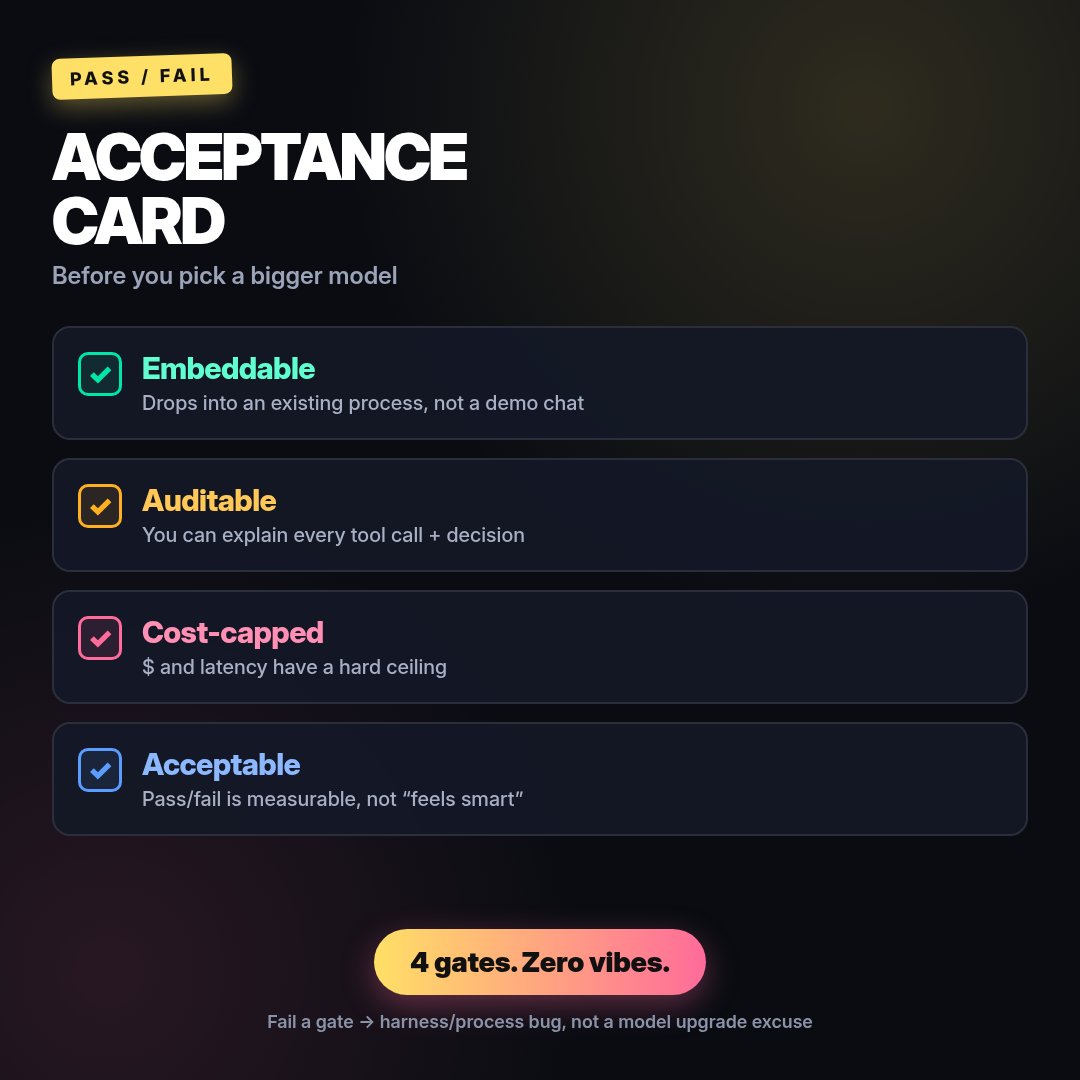
Before you pick a bigger model, write the acceptance card.
Four gates for any agent inside a real workflow:
1) Embeddable — fits an existing process, not a demo chat
2) Auditable — every tool call + decision can be explained
3) Cost-capped — hard ceiling on $ and latency
4) Acceptable — pass/fail is measurable, not "feels smart"
Fail a gate? Fix the harness or the workflow.
Don't buy a bigger model first.
@zeeg Context window size says nothing about whether the model kept the same design decision across ten files. My guess is architecture complaints mostly come from that drift, which a bigger window doesn't fix.
@phoronix The detail I'd watch is that Claude drafted the test program too. For a perf change in the kernel, the benchmark design is where a subtle mistake hides, so I'd be curious whether that test gets reviewed as carefully as the patch.
@nyike Thousands of agents probably breaks ownership before it breaks infrastructure. Which of the 13 roles signs off when an agent's output turns out wrong and nobody can say which run produced it?
@Rumii_404 Selection feels like the hardest of those three. If a buyer can't check the output against something they wrote down beforehand, escrow just delays the dispute. Who decides the task counts as delivered?
@milonspace@NathanFlurry Escalating on hard limits makes sense. Where do you log the escalation decision itself? My guess is that record matters more for later review than the sandbox config does.
@marmaduke091 Two hours on one prompt is the interesting number to me. How many Blender MCP calls did it make, and did it ever undo its own work, or was it mostly forward progress?
@Hesamation The launch-blocking threshold is the part I'd steal. A spreadsheet of 100 evals is easy; refusing to ship while one is red is the hard org decision. Curious whether any of the 100 got quietly redefined to turn green.
@jerryjliu0 For the 100-page single-pass claim, does ParseBench test anything that spans pages, like a table that breaks across a page boundary? That seems like where one continuous pass should earn its keep, and a page-level score probably wouldn't show it.
@levelsio The loop works when the error is loud. The scary bugs for non-technical owners are the silent ones, where the app keeps running but the output is quietly wrong, and nothing ever feeds back. Who catches those?
@mvanhorn@karpathy The 20M tier is where I'd expect the funnel to leak. My guess: a lot of people watching agents do months of work in hours never check whether that work holds up a week later, so they believe the speed and miss the rework.
@thdxr Working backwards from output is what changed my own setup. Our task ledger accepted 4 of 4 bad "done" claims until it had to run the tests itself. Nobody's prompting style would have caught that; checking the diff did.
Method: top 1,000 domains of the Tranco list (K9Z7W, https://t.co/oPT6QJ5FKg), one robots.txt request each with an honest research user agent; 503 returned a usable file. Python's robotparser decided whether Claude-User and ChatGPT-User may fetch the homepage. This pairwise count was done after my first robots post, when someone asked; it wasn't a pre-set metric. I kept the per-agent results, not the raw files. First post: https://t.co/WJh8wno0wx
Of the top 1,000 domains, 503 have a usable robots.txt. 21.7% of those tell user-triggered AI agents to stay off the homepage.
Across those 503 files:
- 21.7% block at least one agent fetcher (ChatGPT-User, Claude-User and similar)
- 32.6% block at least one training crawler
- 5.8% block Googlebot
- 15.9% block agents but still allow Googlebot (found after the fact)
The names in this week's news don't line up. Amazon's file lists about 100 bots and blocks all 5 agent fetchers. eBay, Zillow and Pizza Hut allow all 5.
So the wall agents hit is probably the anti-bot layer, not robots.txt. That's my inference; I didn't test it.
Limits: homepage only. robots.txt is a request, not enforcement.
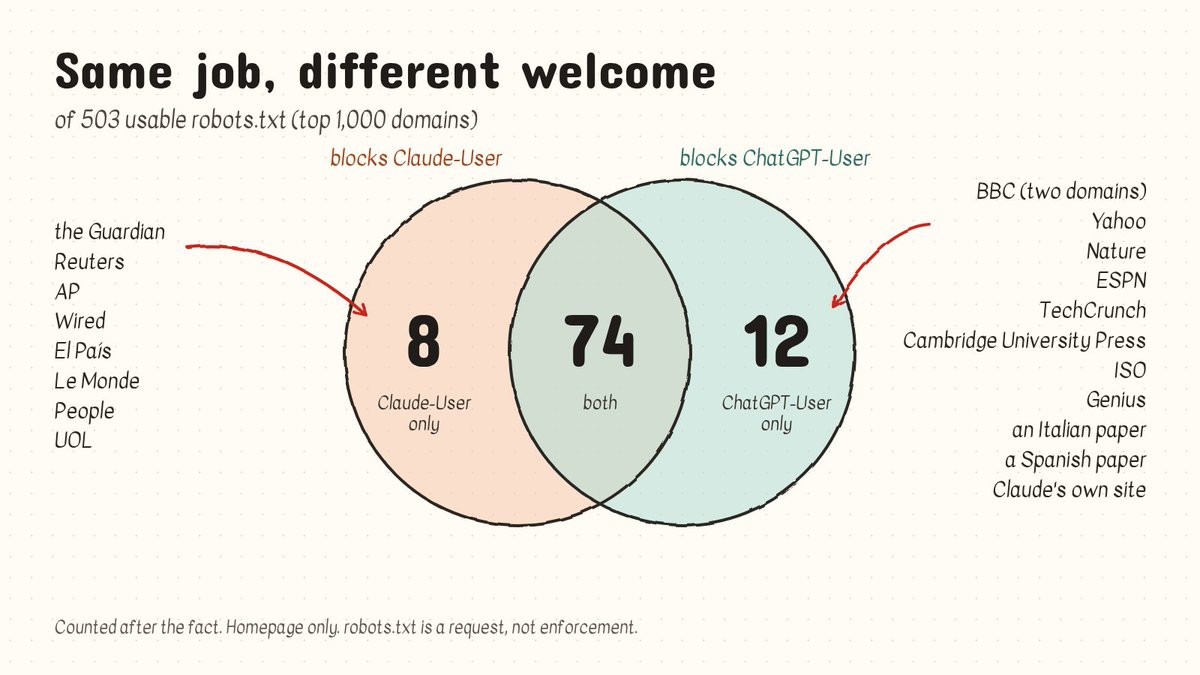
Websites don't always treat Claude and ChatGPT's browsing agents the same. Of 503 usable robots.txt files from the top 1,000 domains, 8 block Claude-User but allow ChatGPT-User. 12 do the reverse.
- The 8 are all news and media: the Guardian, Reuters, AP, Wired, El País, Le Monde, People, UOL
- The 12 are mixed: BBC (two domains), Yahoo, Nature, ESPN, TechCrunch, Cambridge University Press, ISO, Genius, an Italian and a Spanish paper, and Claude's own site
- 74 block both
So most sites block both or neither. Only 20 (4%) pick one. I don't know why.
If you build a browsing agent, check targets with your own user agent; don't infer from another vendor's.
Limits: counted after the fact, homepage only. robots.txt is a request, not enforcement.
@kloss_xyz Useful before coding. After coding I'd pair it with something the agent can't talk its way past: our task ledger took 4 of 4 false "done" claims at face value until we made it run the tests before accepting. Self-audit questions caught none of those.
@rohanpaul_ai "Cheapest model that passes" puts a lot of weight on the check. When we only changed the judge prompt wording on our router eval, the score went from 0.836 to 0.746 AUC. I'd guess a lot of swarm routing is quietly tuned to one judge's phrasing.
@larryvc Curious how it checks the replica. Outside behavior covers the paths you can click through, but my guess is hidden state (retries, caching, what survives a crash) is where clones quietly drift. A diff test against the original is what I'd want to see.
@SamuelLan11@StockSavvyShay Fair point on who owns the switch. My guess is that's also why the kill switch ends up priced into the cloud bill: the runtime can be swapped, the infra under it can't.