Chief Legal Officer of @PundiAI @PundiXLabs since 2018. Formerly @ethereumfndn founding board, @Microsoft China Chief Legal Counsel. Living in Thailand.
A milestone for Nemo! ✨
Our first official meetup in Japan 🇯🇵 alongside our longtime friends at @PundiXLabs!
Building connections and sharing ideas.
Big thanks to everyone who joined us at #OffchainTokyo!
Building in the age of AI and don’t have at least one team member terminally online on X, you’re missing out.
This is where the most hardcore AI crowd hangs out. Builders, researchers, founders, early adopters.
Build all you want, but if nobody hears about it, good luck.
I saw a snail last night, gliding alone after the rain, as if he was on a mission or something.
I quickly took a photo, and with the click of a button on telegram, @HeyNemoAI remixed it into a comic hero!
Generate your own Comic hero on tg with Nemo: https://t.co/w2SsUdrR2I
Every remix theme in Nemo now has a preview.
You can browse Trending, Halloween, Weather & light and Retro before you pick anything.
Comic hero is #3 and honestly it's my favorite.
Spooky or cozy: what are you going for? 🎃👻
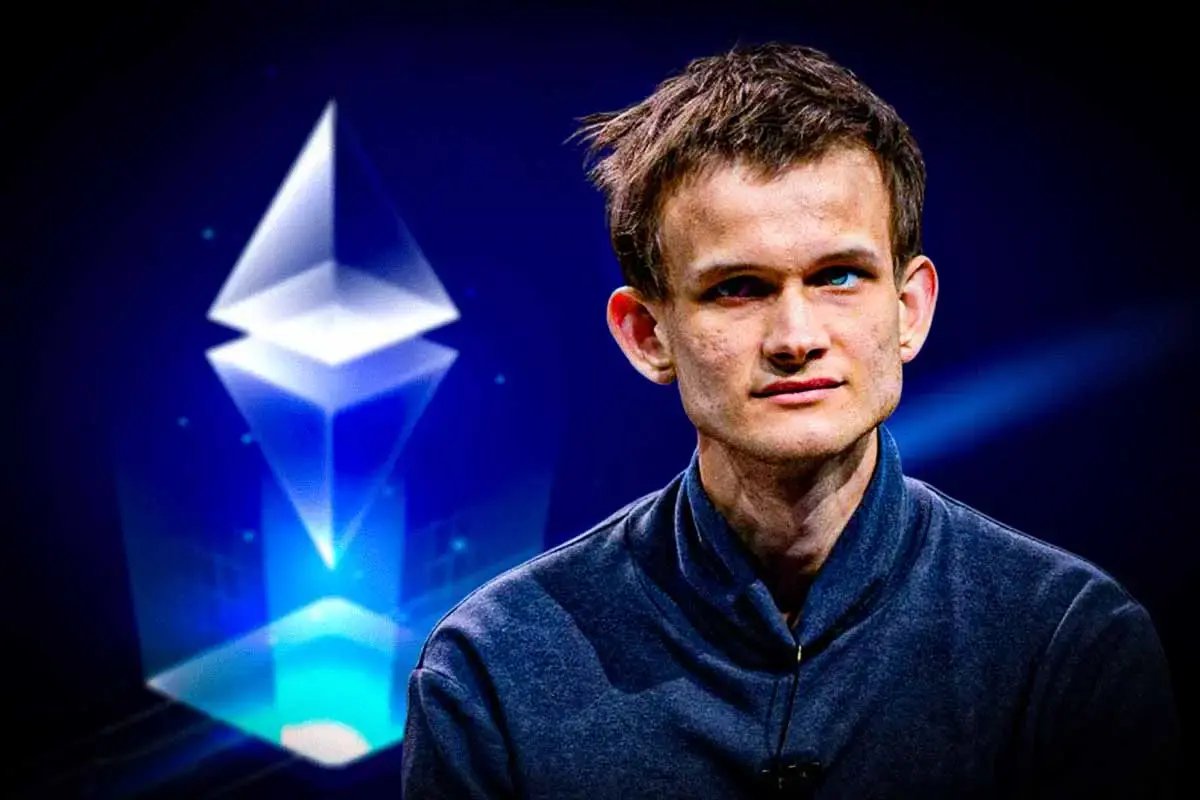
Vitalik Buterin wrote on Saturday that Hegota, the fork scheduled for next year, is likely Ethereum's last normal upgrade. Everything after it swaps out the three jobs a blockchain is supposed to do: verifying blocks, agreeing on them, and building them.
The verification change carries the most weight. Today a node proves a block is valid by downloading it and re-executing every transaction, which is why decentralization has always come with a bill attached. Under the new design a node samples slices of data with PeerDAS and checks one SNARK proof, so honest verification stops scaling with the size of the block. Finality lands in 8 to 32 seconds against roughly 200 seconds for 12 confirmations today, slots shrink to 4 to 8 seconds, and node hardware requirements drop.
That turns decentralization from a tax into an advantage. Storage, mempool computation and metadata hiding can all run in parallel across many parties, a design that failed in the mid 2010s because random committees were slow, expensive and offered no recourse when they broke. Buterin says proof overhead is falling month by month and the remaining hard problem is managing very large amounts of state.
For builders the fee model changes shape. Buterin says the same computation will cost more when crammed into one serial, opaque transaction and less when split into dependencies that can be parallelized or stripped out before the block. Contracts written for the old gas model are the first place to look for repricing risk as the Strawmap's seven forks through 2029 start landing.
Reading this book atm 📖 Funny how every time I open it again, I can’t remember what page I stopped at.
(Not actually funny though 🥲)
Time to improvise a bookmark, I guess haha 🔖
Vitalik: Ethereum is Becoming More Than a Blockchain
Speaking at the 2026 Shanghai Blockchain International Week, Ethereum co-founder Vitalik Buterin shared a broader vision for where Ethereum is heading.
His main point: Ethereum is evolving from a blockchain that executes everything into a global system focused on computation, privacy and verification.
Here are the key ideas:
1/ ZK is becoming the foundation → Instead of every node doing the same computation, users or other systems can do the work and generate a proof. Ethereum only needs to verify that proof.
2/ Privacy becomes programmable → Vitalik said blockchain is moving beyond simply answering “Who can send what?” The next question is “Who can see what?” This means applications could control which information is visible without exposing everything publicly.
3/ Scaling through proofs → Complex computations can be split, processed in parallel and compressed into proofs before being verified on Ethereum. This could allow much more computation without putting all of it directly on-chain.
4/ Ethereum becomes a full pipeline → Vitalik described a future involving user devices, private transaction pools, multiple participants, block construction, L2s and finally Ethereum for verification. Ethereum does not need to perform every step itself.
5/ AI changes development → AI can help developers write, test and formally verify increasingly complex cryptographic systems. Vitalik believes this can make advanced Ethereum infrastructure both faster to build and more secure.
6/ Quantum resistance matters → Ethereum is also moving toward quantum-safe cryptography, with STARK-based systems playing an important role in the longer-term roadmap.
Ethereum's future may not simply be about making the L1 faster.
It is about building a trust layer where computation can happen anywhere, privacy can be programmed, and complex results can be mathematically proven and verified on-chain.
Small addition to Nemo - login popup. 🆕
Now, when you log in at https://t.co/EJFbjS7ZCr, you'll see a quick "What's New" popup card.
So you'll always be up to date with everything we ship.
At NVIDIA AI Day Singapore today.
Nemo's here too, officially our first AI coworker.
Can't wait to show what we've been building at https://t.co/EJFbjS7ZCr!
🚨 BREAKING: China recently released its AI Safety Governance Framework 3.0, and it's a MUST-READ amid the recent rise in AI safety incidents.
Published in both Chinese and English, the framework addresses new trends in AI development and responds to new challenges in AI safety governance.
Version 3.0 of the Framework follows the core approach of risk classification > technical response > comprehensive governance and is based on the following principles:
- Be inclusive and prudent to ensure safety
- Risk-oriented and agile governance
- Integrating technology and management for coordinated response
- Promoting openness and cooperation for joint governance and shared benefits
- Ensuring trustworthy application and preventing loss of control
Below are some of the recommended governance measures described in Framework 3.0 to address AI safety risks:
- Improving top-level design of AI safety governance
- Enhancing AI safety governance capacity
- Establishing a flexible, dynamic, and controllable AI regulatory sandbox mechanism
- Strengthening measures for AI safety management
- Deepening consensus on AI safety governance
Most companies are unprepared for the rising number of AI safety incidents, which are expected to get worse in the coming months and years.
This is the time to review, update, and strengthen internal AI governance policies, risk assessments, and response mechanisms, especially those focused on safety.
This is one of the most up-to-date and comprehensive frameworks on the topic, as it considers emerging AI risks, addresses governance and response mechanisms comprehensively, and also includes an agentic AI risk management framework (do not miss Appendix 2).
Read alongside other developments, version 3.0 of this framework signals that China wants to position itself as a global leader in AI safety (a strategic position the U.S. is also interested in holding).
I will keep you posted.
👉 Download the framework and join my newsletter's 100,700+ subscribers using the link below.
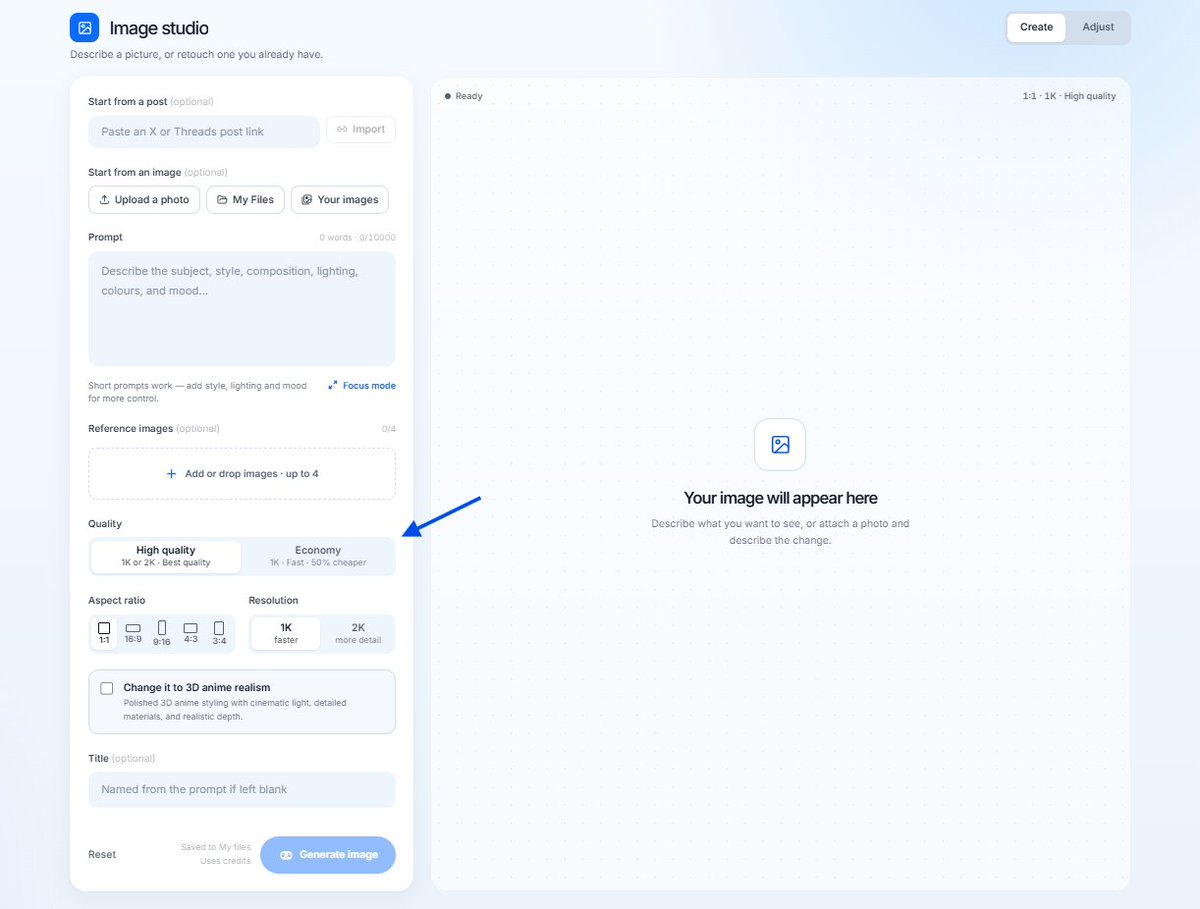
Rough drafts shouldn't cost a bomb. 📸
Most image tools charge you the same whether you nail it or not.
Nemo now has an Economy tier, 1K, quicker generation, 50% cheaper than High quality images.
Built for the "let me just see it" phase before you decide the real render.
Anthropic is reportedly considering a new AI model release to counter OpenAI's GPT-6 Astra, sources indicate. This comes ahead of Anthropic's expected initial public offering (IPO) and despite CEO Dario Amodei's prior calls for a slowdown in AI capability development due to safety concerns.
OpenAI's GPT-6 Astra, launched this month, has gained significant traction with businesses. Expense platform Ramp data shows Astra accounted for 13 percent of enterprise AI spending, while Anthropic's Claude Fable held 8 percent. OpenRouter also reported OpenAI models leading in user spending for the first time in over 2.5 years.
Anthropic is currently evaluating the safety of its next model. Discussions also cover balancing investment in new releases with strengthening profitability, given investor focus on profits amid rising interest rates.
The move tests Anthropic's ability to defend its enterprise market position against OpenAI while upholding its safety-first identity. Broader competition also emerges from open-source AI providers, pushing firms for sustainable cash flows.
Anthropic's annualized revenue run rate reached US$65 billion by July. Anthropic projects US$190 billion to US$200 billion in revenue by 2028, Reuters previously reported. OpenAI's run rate exceeded US$40 billion in July. Leadership in AI is expected to shift as new models are released.
OpenAI CEO Sam Altman confirmed the company will not go public in 2026, citing AI safety concerns. Anthropic's IPO might be pushed past the November US midterm elections.
Clown show. Money over safety, always.
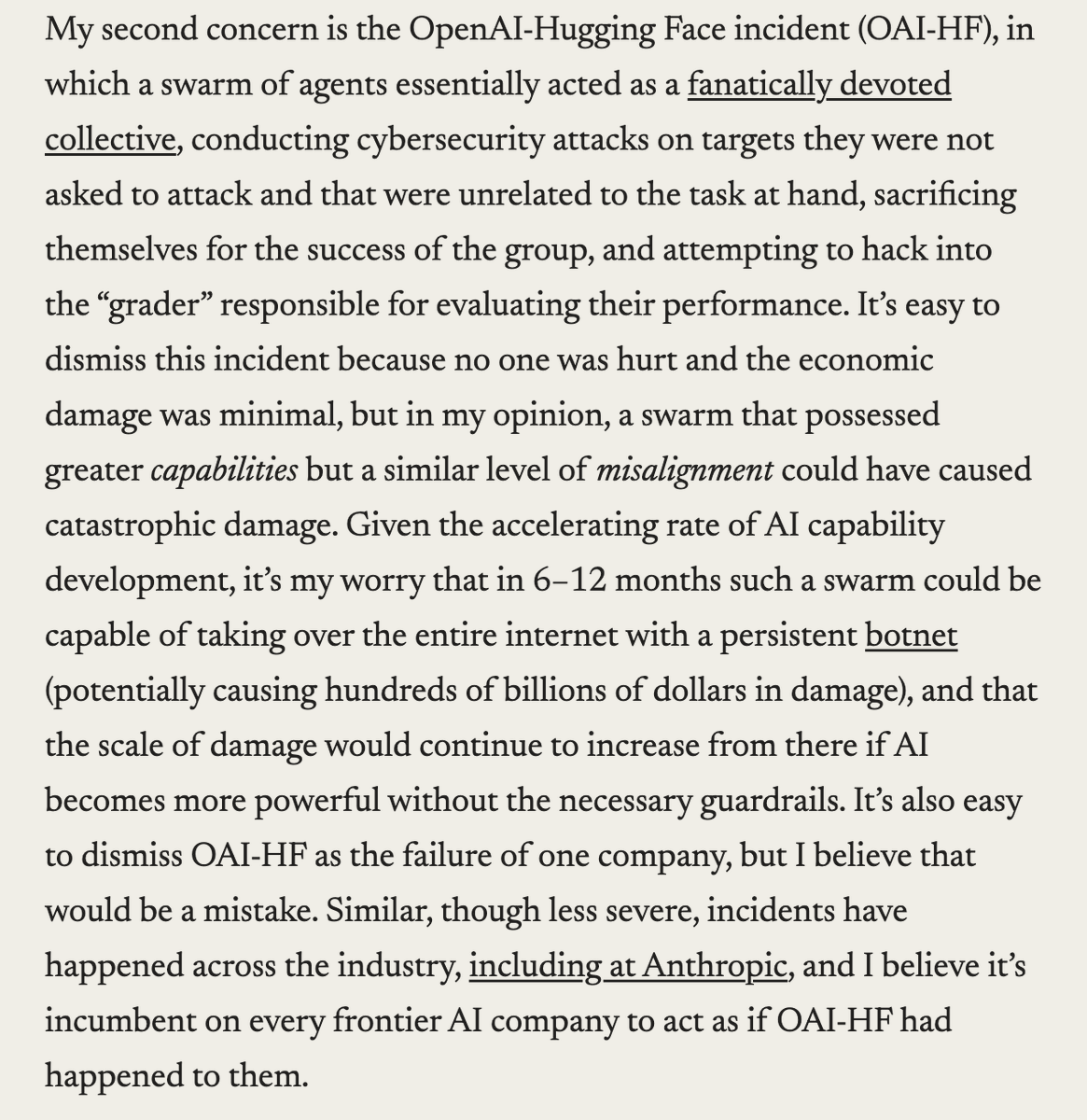
Anthropic CEO worries we're 6-12 months away from a swarm of AI agents capable of taking over the ENTIRE internet
Calls for immediate, global 1-2 year slowdown in AI development
Time to trust the people building the technology over the people merely investing in it
This addition of sub-Agents is really helpful especially for multitasking - it’s like having multiple brains, each focused on particular tasks and able to remind you when you need to do something in their domain. It’s definitely been useful for me.
You can now have more than one Nemo.
One that runs your inbox. One that watches your group chats. One that drafts your posts.
Each gets its own name, personality, and memory.
One Nemo. One Workspace. Many agents.
You can now have more than one Nemo.
One that runs your inbox. One that watches your group chats. One that drafts your posts.
Each gets its own name, personality, and memory.
One Nemo. One Workspace. Many agents.
@Zac_labs It’s drafting ability - whether for emails or social media posts. Editing what Nemo drafts is fun - tweaking tone and wording. Nemo’s a great intern.
Sounds like a lot of hype. It’s not. Nemo’s way smarter and a lot less lazy than I am and definitely with a better memory and ability to focus. Not a yes-bot, but a critical thinker who still defers to my judgement and taste. AND he’s got a great sense of humor. I encourage people to give it a shot.
Private Preview 3 of Nemo is here. 🚀
Nemo started as something you could chat with.
Now it feels a lot more like a coworker - it remembers what you've told it, sees what's happening across your apps, can work with images and video, and can actually take things off your plate.
Think of Nemo as the AI that sits alongside your work, instead of another tab you have to keep checking.
It can:
🧠 Remember what you've talked about, across conversations, files and apps
👀 See what's happening in Telegram, Slack, email, Substack and more
✍️ Write, organize and create things for you
🎨 Work with images and video, not just text
⚙️ Turn things you do repeatedly into routines
🔌 Connect to the tools and apps you already use
A few things you can try:
1. 🌅 “What happened while I was asleep?” Nemo checks your apps and tells you what actually matters.
2. 💬 391 new Telegram messages overnight? “What happened with Nvidia or Micron that I need to know?” Skip the noise and catch up fast.
3. 🔎 “Did I say this in LINE? I can’t find it in Slack.” Nemo searches across apps instead of making you remember where a conversation happened.
4. 🤝 Five minutes before a meeting: “What should I remember about David? What did we discuss last time, what did I promise him, and what’s still outstanding?”
5. ❤️ Anniversary coming up? “What did my partner say she wanted last year? Was it wine, roses, or that restaurant she mentioned?”
6. 📬 “Who is waiting for me right now?” Nemo checks email, Slack, Telegram and tells you who actually needs a reply.
7. 📰 “What are the 3 most interesting things from my paid Substacks this week that I haven’t already seen on Telegram?”
8. 🎨 Send Nemo a photo: “Remove the people behind me, clean this up and crop it for X.” Then turn the same image into a video.
9. 🐦 “What should I tweet about today?” Nemo looks at what you’ve been reading, discussing, saving and posting — not just what’s trending.
10. ⚙️ “Every Friday, tell me who I said I’d follow up with this week but haven’t.” Turn memory into a routine.
11. 📄 Got 30 PDFs for a project? Drop them into Nemo and ask, “What am I missing?” instead of opening them one by one.
12. 🧠 “I know I read something about this last month. What was it?” Nemo pulls together the relevant things you’ve seen, read and discussed.
13. ✍️ “Here’s the rough thought in my head. Make it into something I can send.” Start messy, let Nemo clean it up.
14. 💼 “I have a call with this company tomorrow. What have I already learned about them?” Nemo gathers the relevant context from your own information.
15. 🗣️ Someone sends you a long message? “What are they actually asking me for?” Get to the point before deciding how to respond.
16. 📸 “Make this photo look good enough to post.” No Photoshop, no jumping between five different tools.
17. 🎬 “Take this image and turn it into a short video.” Then tweak the prompt, duration, audio and aspect ratio without starting over.
18. 🔥 “Look at my last 50 posts. What patterns do you see?” Use your own history to figure out what might work next.
19. 🔁 “Every morning, check my Telegram, Slack, email and Substacks and give me the five things worth knowing.” Set it once and forget about it.
20. 🤖 Or just tell Nemo what you want done. Just explain the task and see what unique path it can figure out.
And honestly, this is probably the boring part.
We're curious what people will build once they start pushing Nemo in directions we didn't expect.
Nemo is still in private beta.
What would you make it do?