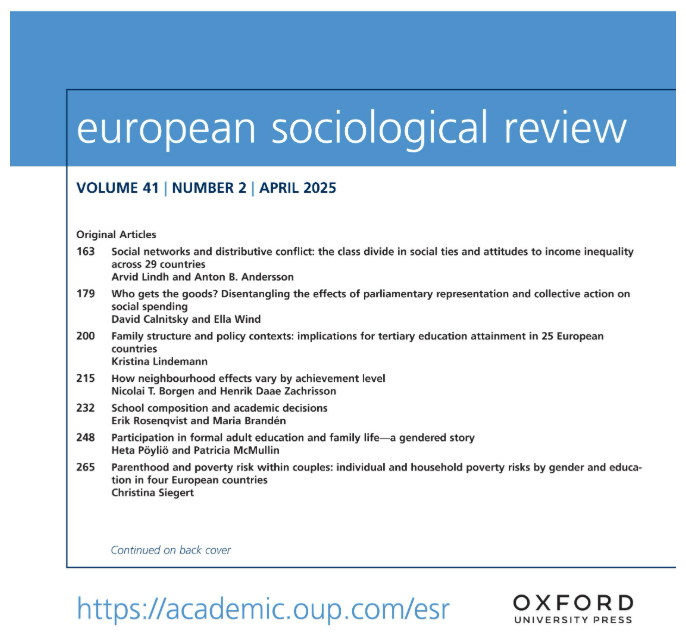
This paper, my socialist case for reformism, was just published. Any feedback would be great because I’m hoping to turn it into a book and want to hear any and all thoughts/criticisms
https://t.co/HdkK3jXWbH
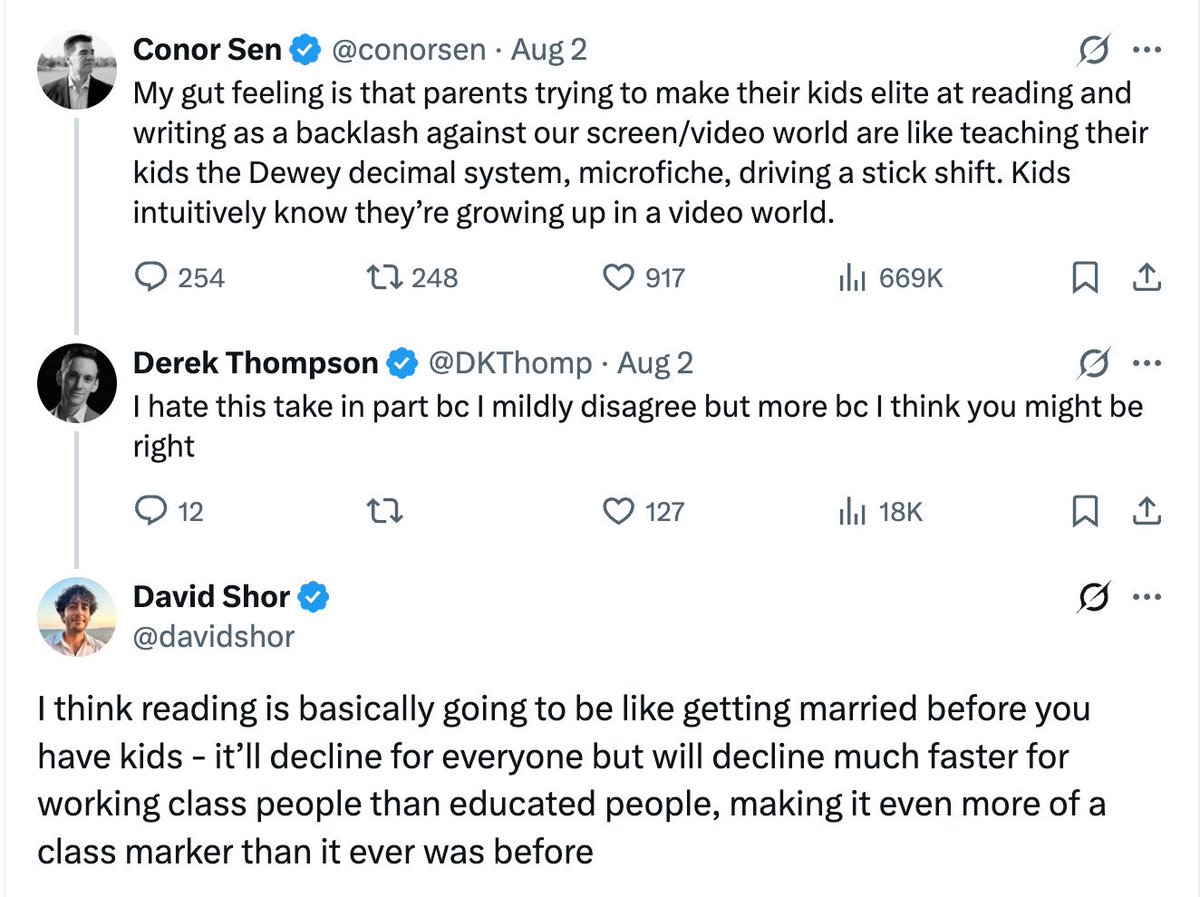
The Atlantic’s new cover story by @rosehorowitch is absolutely definitive on the end of the age of reading in America—and the emergence of a new post-literate age in modern life
Some core facts and anecdotes:
1. Reading is shrinking. The share of Americans who read for pleasure declined by 43 percent between 2004 and 2023. While Americans might see more words than ever—between all those texts, posts, emails, and captions—less than half of Americans read books, anymore. The average sentence in NYT bestsellers are one-third shorter than a century ago.
2. Americans can swallow words and sentences, but they’re losing the ability to think deeply about writing that’s longer than an Instagram post. Nearly 30 percent of American adults cannot paraphrase or make inferences from a multipage text. In 2017, that number was less than 20 percent.
3. It’s worse for the young. Fourth- and eighth-grade reading scores have slid for the past decade. From 1984 to 2025, the percentage of 13-year-olds who said they rarely or never read for fun rose from 8 to 29 percent.
4. “Every year older a child gets, the less they like to read”: Most high-schoolers consider reading for pleasure an alien practice. Margaret Rennix, Harvard’s assistant director for humanities and social-sciences support, says some students view reading as an unnecessarily burdensome way of acquiring knowledge. “By asking them to read,” she said, it's as if “professors are arbitrarily withholding information from students by forcing them to get it through this more difficult medium.”
https://t.co/kk8qktY6fd
I will soon be introducing a bill to give the public a 50% ownership stake in the largest AI companies in America.
This would guarantee that the trillions created by AI are used to improve the lives of all of us — and block oligarch decisions that harm the American people.
“In wrenching interviews, Palestinians have recounted to me a pattern of widespread Israeli sexual violence against men, women and even children,” our columnist Nicholas Kristof writes.
https://t.co/Q1DYudXMfc
New episode (1228), with Dr. David Calnitsky (@DavidCalnitsky). We talk about basic income, poverty, and socialism. #Sociology#Science
YouTube: https://t.co/KP0ELExc0f
Podcast: https://t.co/1VKQtmZqQF
Population decline is not just about human extinction.
Before it ends, human civilization will grow increasingly unpleasant — and communal ideals associated with left-wing politics will become increasingly difficult to sustain. https://t.co/pSw8MITtI2
@BenBurgis@NathanJRobinson Yeah, it’s that it will decline, and the decline is uneven geographically, and the effects can be bad. Immigration can be a partial solution, but demographers in my dept say that fertility quickly reverts to that of the local population.
We're pleased to announce that this year's BJS Prize has been awarded to @DavidCalnitsky and Kaitlin Pauline Wannamaker for their paper "The revolution next door".
Read the open access article in #BJS ➡️ https://t.co/1R5OESJ8nj
Yes.
Writing is not a second thing that happens after thinking. The act of writing is an act of thinking. Writing *is* thinking.
Students, academics, and anyone else who outsources their writing to LLMs will find their screens full of words and their minds emptied of thought.
(Continental philosopher): Without 5, we could not count to 6.
(Me): Yes.
(Continental philosopher): It could be said 6 is consequently in the 5-shadow, the forthcoming of 6 is 5-heralded, that 5 springs necessarily from the recapitulation of 6.
(Me, checking my watch): Yes.