To the Americans:
I've travelled all over the world. I've familiarized myself with many places, and met many people. And I'm a Canadian, although I’m privileged to reside once again in the States.
And here's something I've noticed, and it’s a key element of America's continuing greatness:
You bloody Americans value success, and you believe in its existence.
This is something that doesn't really happen anywhere else in the world. Even in other free democracies—the United Kingdom; Finland, Sweden, and Norway; Australia, New Zealand and Canada; Germany, France, and the Netherlands (great countries all)—a counterproductive cynicism too often reigns.
Success is equated with exploitation.
Ambition is looked upon with contempt.
This happens sometimes in the United States too—particularly among the miserable progressives, who confuse their resentment, ingratitude and unearned skepticism with wisdom.
But in your great country, by and large, striving is admired and success celebrated.
This means that more people strive and succeed in the US than anywhere else. And it's increasingly obvious. You remain stunningly more innovative and productive than any people anywhere else on the planet.
And so I say, as all should who are fortunate enough to live in the western world, let alone America:
Thank God for the United States.
Thank God for the wisdom of its founders.
Thank God for its faith in the free market and in the natural rights of man.
Happy birthday, you damn Yankees and Southerners.
Long may your admirable country dominate the world.
Long may your freedom and hope provide an example to those suffering everywhere at the hands of their malevolent states.
May your two and a half centuries of unparallelled success be just the beginning.
Your country is the light of the world, and the city on the hill.
Thank God for the USA.
Happy 250th.
Dr. Jordan B. Peterson
I stole this idea and now use it with every single employee.
It’s the best illustration I’ve seen of teaching someone to be high agency.
It says there are 5 levels of work:
Level 1: “There is a problem.”
Level 2: “There is a problem, and I’ve found some causes.”
Level 3: “Here’s the problem, here are some possible causes, and here are some possible solutions.”
Level 4: “Here’s the problem, here’s what I think caused it, here are some possible solutions, and here’s the one I think we should pick.”
Level 5: “I identified a problem, figured out what caused it, researched how to fix it, and I fixed it. Just wanted to keep you in the loop.”
Using this framework, here’s what I say to every new employee…
You will live at Level 4 from Day 1 and as we build trust you will rise to Level 5.
Being high agency doesn’t just mean tackling problems in this way. It means your entire way of working should be oriented to being a Level 4+ employee.
Plz feel free to steal it as well.
And ty @stephsmithio for the framework!
A young SpaceX employee asked Elon what happens if they fail to reach Mars in his lifetime. The room was full of engineers and the question landed heavier than anyone expected.
It was a simple question but it cut to the core of everything SpaceX exists for. The entire company, every late night, every exploded prototype, every engineer who missed their kid's birthday for a launch window, it all points at Mars. What if it doesn't happen in time?
Elon paused.
He said that the goal was never for him personally to walk on Mars. The goal was to build the infrastructure that makes it inevitable. That even if he dies before the first crew lands, the system he built would carry the mission forward without him.
He said the rockets, the factories, the team, the culture, all of it is designed to outlast any single person. Including him. Especially him.
Then he said something that reportedly moved people in the room.
He said that if he thought success depended on him being alive, he would have already failed. The whole point is building something that doesn't need its founder to keep going.
He compared it to a cathedral. The architects of medieval cathedrals knew they would die before the building was finished. They designed it anyway. They poured their life into something they would never see completed because the completion wasn't the point. The commitment was.
SpaceX is his cathedral. He may never set foot on Mars. But the road between here and there will exist because he refused to accept that nobody was building it.
The most ambitious man alive has already made peace with the possibility that his greatest achievement might happen after he's gone. That's not failure. That's faith in something bigger than yourself.
Our house rule is you don't have to go to sleep if you're reading. So my 8 year old is now reading 6th grade reading level because he likes thinking that he's getting away with staying up after bedtime. Win/win.
History's first trillionaire is a guy who catches rockets out of the sky with chopsticks and beams internet to every dead zone on the planet.
Same guy ships cars that drive themselves, humanoid robots for the factory floor, brain chips that let paralyzed people move a cursor with pure thought, and an AI running on a supercomputer his team stood up in months instead of years.
And the people crashing out about his net worth are doing it on the app he owns. The same app governments spent years trying to censor.
You cannot legislate a rocket into orbit.
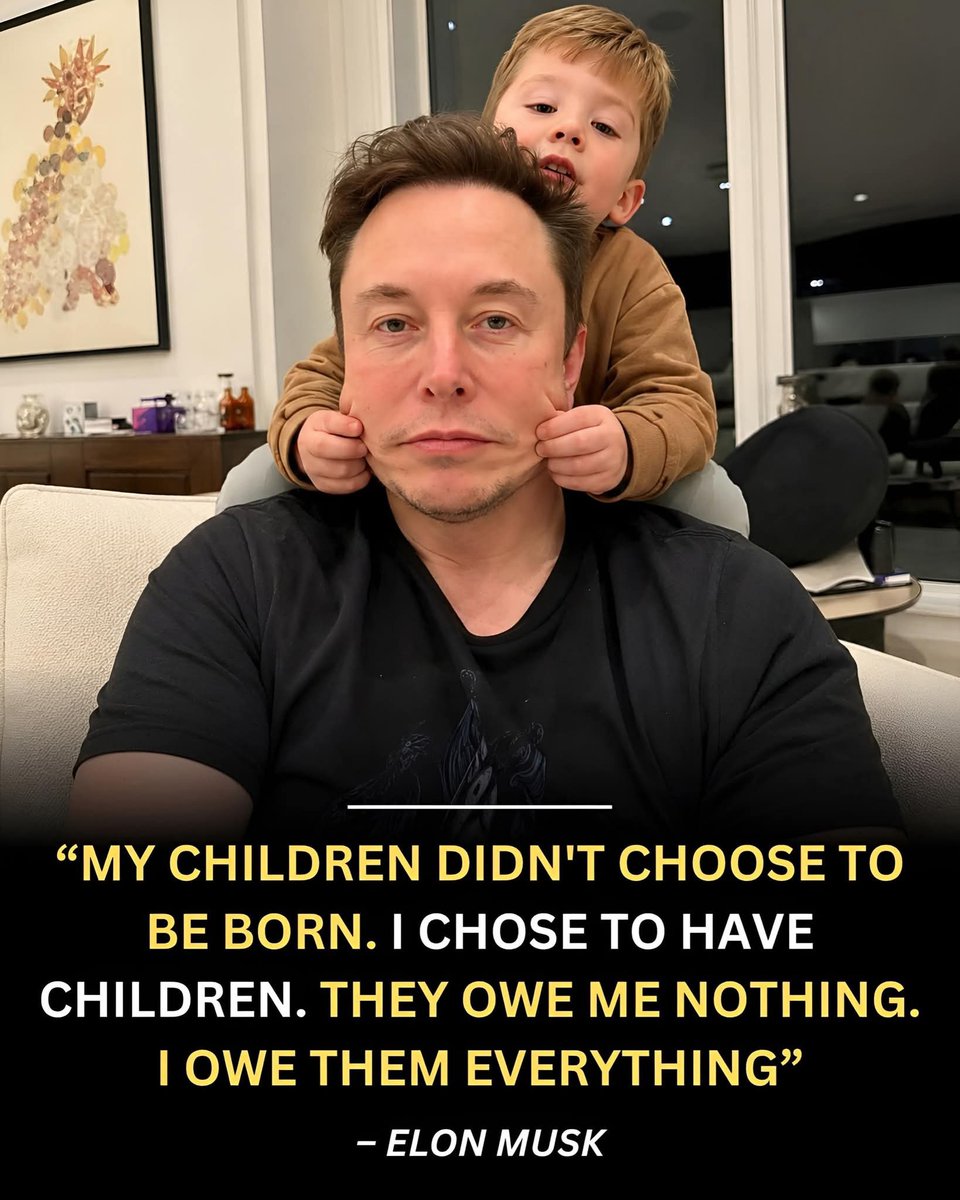
Elon Musk sparked a major online conversation by sharing a unique viewpoint on parental responsibility and choice.
He pointed out that because children cannot choose to be born, the decision to bring them into the world is made entirely by their parents.
Therefore, the people who choose to have children must take full accountability for that choice.
Under this perspective, children do not owe their parents anything in return for being raised and cared for.
Instead, mothers and fathers have an absolute duty to provide unconditional love, guidance, and support throughout a child's upbringing.
This idea completely flips traditional expectations, where parents often look for appreciation or future support from their offspring.
Musk’s comments have pushed people to rethink the deep meaning of family dynamics and what it truly means to raise a human being.
The viewpoint challenges old social habits and encourages a more selfless approach to parenting.
By removing the idea of debt from the parent-child relationship, this philosophy emphasizes that caring for the next generation is a profound duty rather than an investment meant to bring personal rewards later in life.
Image is for representation purpose only.
Our computers are still so slow. Our AIs are still so dumb. We've been gifted the highest leverage moment humanity has ever experienced. We've come from the plains, from baking cow dung under the sun for fuel. Now we tile the world in silicon, blocking out the sky with machines
Elon Musk avait dit un truc qui m'avait marqué sur l'allocation de ressources. En substance : passé un certain niveau de richesse, l'argent n'est plus de la consommation, c'est de l'allocation de capital.
Cette phrase change tout.
L'économie, dans le fond, c'est juste un problème d'allocation. Tu as des ressources finies et des usages infinis. Qui décide où va quoi ?
Imagine une cour de récré. 100 enfants, des paquets de cartes Pokémon distribués au hasard. Tu laisses faire. Très vite, un ordre émerge. Les bons joueurs accumulent les cartes rares, les collectionneurs trient, les négociateurs trouvent des deals. Personne n'a planifié. Et pourtant chaque carte finit dans les mains de celui qui en tire le plus de valeur. Le système maximise le bonheur total de la cour. C'est ça, la main invisible.
Maintenant fais entrer la maîtresse. Elle trouve ça injuste. Léo a 50 cartes, Tom en a 3. Elle confisque, redistribue, impose l'égalité. Trois effets immédiats. Les bons joueurs arrêtent de jouer, à quoi bon. Les mauvais n'ont plus de raison de progresser, ils auront leur part. Les échanges s'effondrent. La cour est égale, et morte. Elle a maximisé l'égalité, elle a détruit le bonheur.
Le problème de la maîtresse, c'est qu'elle ne peut pas avoir l'information que la cour avait collectivement. C'est le problème du calcul économique de Mises, formulé en 1920. L'URSS a essayé de le résoudre pendant 70 ans avec le Gosplan. Résultat : pénuries, queues, effondrement. Pas parce que les Soviétiques étaient bêtes, parce que le problème est mathématiquement insoluble en mode centralisé.
Quand Musk a 200 milliards, il ne les consomme pas, il les alloue. SpaceX, Starlink, Neuralink, xAI. Chaque dollar est un pari sur le futur. Et lui a un track record. PayPal, Tesla, SpaceX. Il a démontré qu'il sait identifier des problèmes immenses et y allouer des ressources avec un rendement spectaculaire.
L'État aussi a un track record. Hôpitaux qui s'effondrent, éducation qui décline, dette qui explose, services publics qui se dégradent malgré des budgets en hausse constante. Le marché identifie les bons allocateurs, la politique identifie les bons communicants.
Le profit n'est pas une finalité, c'est un signal. Il dit : tu as alloué des ressources rares vers un usage que les gens valorisent suffisamment pour payer. Plus le profit est gros, plus la création de valeur est grande. Quand Starlink est rentable, ça veut dire que des millions de gens dans des zones rurales ont enfin internet. Quand un ministère est en déficit, ça veut dire qu'il consomme plus qu'il ne produit. L'un crée, l'autre détruit, et on appelle ça redistribution.
Dans nos sociétés il y a deux catégories d'acteurs. Les entrepreneurs et les bureaucrates. L'entrepreneur prend un risque personnel pour identifier un problème, mobiliser des ressources, créer une solution. S'il se trompe il perd. S'il a raison, ses clients gagnent, ses employés gagnent, ses fournisseurs gagnent, l'État collecte des impôts. Il est la cellule de base du progrès humain.
Le bureaucrate ne prend aucun risque personnel. Son salaire est garanti. Au mieux il maintient une rente existante. Au pire il la détruit par excès de réglementation, mauvaise allocation forcée, incitations perverses qui découragent ceux qui produisent. Mais dans aucun cas il ne crée.
Regarde les 50 dernières années. iPhone, internet civil, SpaceX, Tesla, Google, Amazon, Stripe, mRNA, ChatGPT. Toutes des inventions privées, portées par des entrepreneurs, financées par du capital risque. Pas un seul ministère n'a inventé quoi que ce soit qui ait changé ta vie au quotidien.
La France est devenue le laboratoire mondial de la dérive bureaucratique. 57% du PIB en dépenses publiques, record absolu. Une administration tentaculaire, une fiscalité qui pénalise la création de richesse. Résultat : décrochage face aux États-Unis, à l'Allemagne, à la Suisse. Fuite des cerveaux. Désindustrialisation. Dette qui explose.
Et le pire c'est que la mauvaise allocation s'auto-renforce. Plus l'État prélève, moins les entrepreneurs créent. Moins ils créent, moins il y a de base fiscale. Plus l'État s'endette et taxe. Boucle de rétroaction négative parfaite. La maîtresse pense qu'elle aide, et chaque année la cour produit moins.
Dans nos sociétés, ce sont les entrepreneurs, toujours, qui font avancer la civilisation. Les bureaucrates au mieux maintiennent une rente, au pire la détruisent. Aucune société n'a jamais progressé en taxant ses créateurs pour subventionner ses gestionnaires.
La question n'est jamais qui a combien. C'est qui alloue le mieux la prochaine unité de ressource pour maximiser le futur de l'humanité. La réponse depuis 200 ans n'a jamais changé. Ce ne sont pas les fonctionnaires.
What did y'all think "the AI race will accelerate Kardashev scaling until we have Dyson swarm supercomputers" meant?
Vibes? Papers? Essays?
Extremely Bullish. Amazon Halo Services coming.
Erika Kirk: "My husband Charlie he wanted to save young men, just like the one who took his life...On the cross, our savior said, 'Father, forgive them, for they not know what they do.' That young man. I forgive him."