Rearranging Deck Chairs on a Sinking Grid: Why South Africa’s ERAA Is the Wrong Reform at the Worst Possible
The honest policy choice is not between a good option and a bad one — it is between managed costs that are visible, bounded, and sequenced, and unmanaged costs that are diffuse, compounding, and constitutionally indefensible. Four terawatt-hours of annual unserved energy is not an abstraction. It is hospitals, schools, and police stations operating in darkness — a condition the Constitution explicitly prohibits and that no fiscal constraint can retrospectively justify
https://t.co/8fCDHE4qX9
The perspective of "Architecture of Unaccountability" where the transition from a vertically integrated utility to a fragmented market model fundamentally shifts the nature of public and political responsibility is pretty much novel.
When Eskom failed, Parliament summoned the Eskom board, accounting authority and The Minister, the Executive Authority. There was a throat to seize.
Under the ERAA, when the lights go out:
· The TSO will say "we operate the market, we don't build or operate generating plants"
· The generators will say "we built and operate what the market signalled"
· NERSA will say "we regulate, we don't procure"
· The Minister will say "I have Section 34 powers, but the market hasn't failed yet"
The public will be left with no one to hold accountable. This is not a prediction—it's the design.
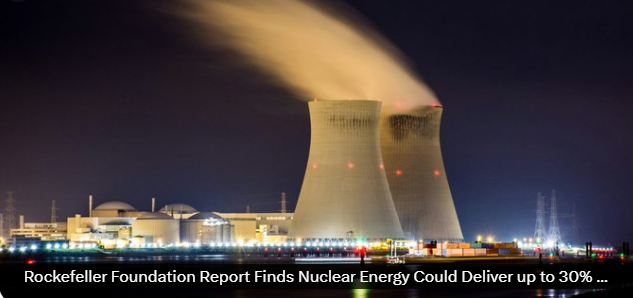
The Rockefeller Foundation has released a report which concludes that nuclear could provide 30% of the electricity in developing countries by 2050, at a cost that is ~31% lower than that of an all-renewable grid. Article link in reply.
🇩🇪 GERMANY’S HYDROGEN “MIRACLE” JUST BLEW UP - $9B A YEAR INTO THE VOID
Berlin’s green dream is eating itself alive.
The Federal Audit Office just torched Germany’s hydrogen strategy, calling it what it is: a black hole swallowing €8 to €9 billion a year - and producing almost nothing.
5 years in, the country’s “clean future fuel” adds up to a grand total of 0.16 gigawatts. That’s the output of a mid-tier wind farm.
This was supposed to be the next industrial revolution. Instead, it’s another central-planning hangover - the kind where taxpayers wake up holding the tab.
The auditors didn’t mince words: supply and demand don’t match, the infrastructure plan is fantasy, and the government has “created a financial risk for the taxpayer.”
Meaning: the money’s gone, and the market’s missing.
Private industry’s verdict? Nein, danke.
Companies like ArcelorMittal and RWE are walking away, even with billion-euro subsidies on the table. When business rejects free money, you know the corpse stinks.
Merz’s government now faces a choice: double down on failure or admit the green utopia is bleeding out.
Prediction? They’ll choose denial - until the bond markets intervene.
Germany wanted to lead the energy future... instead, it just financed its own obituary.
Source: Federal Audit Office, ZeroHedge
Media: DW
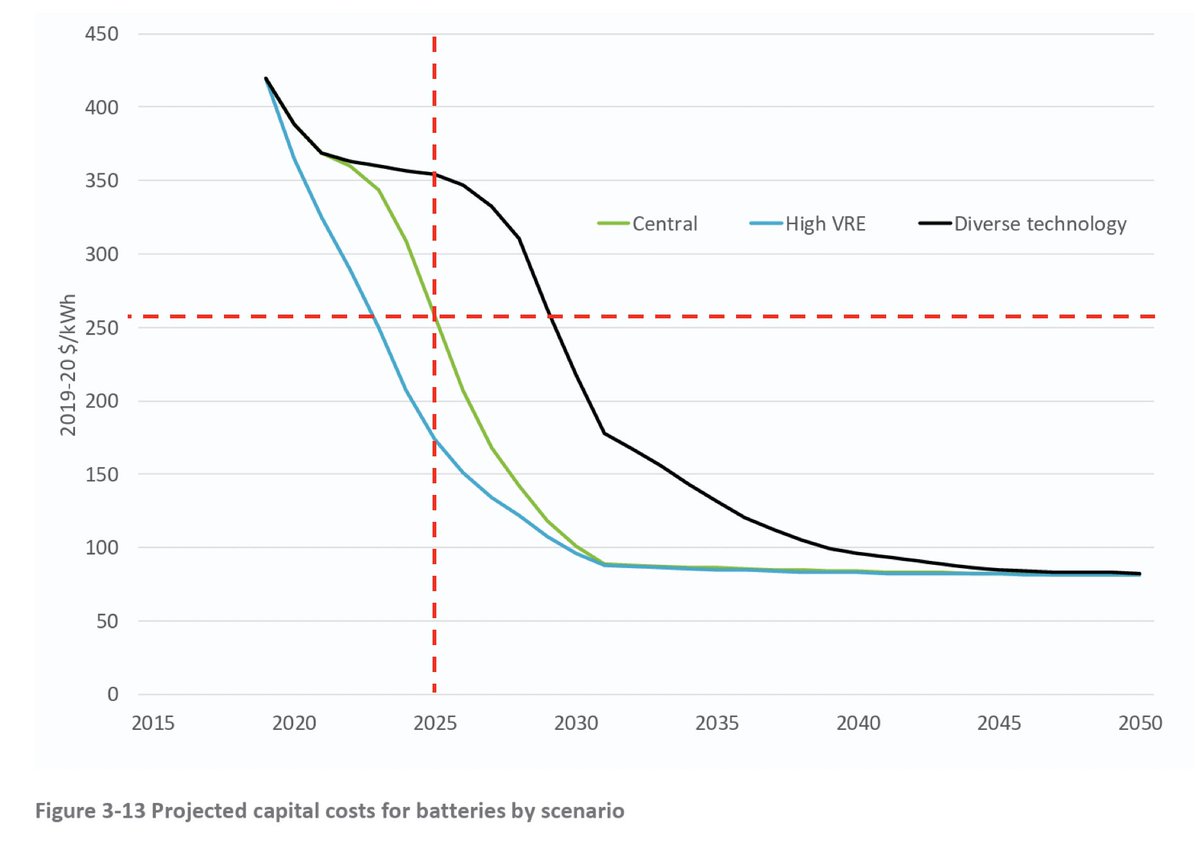
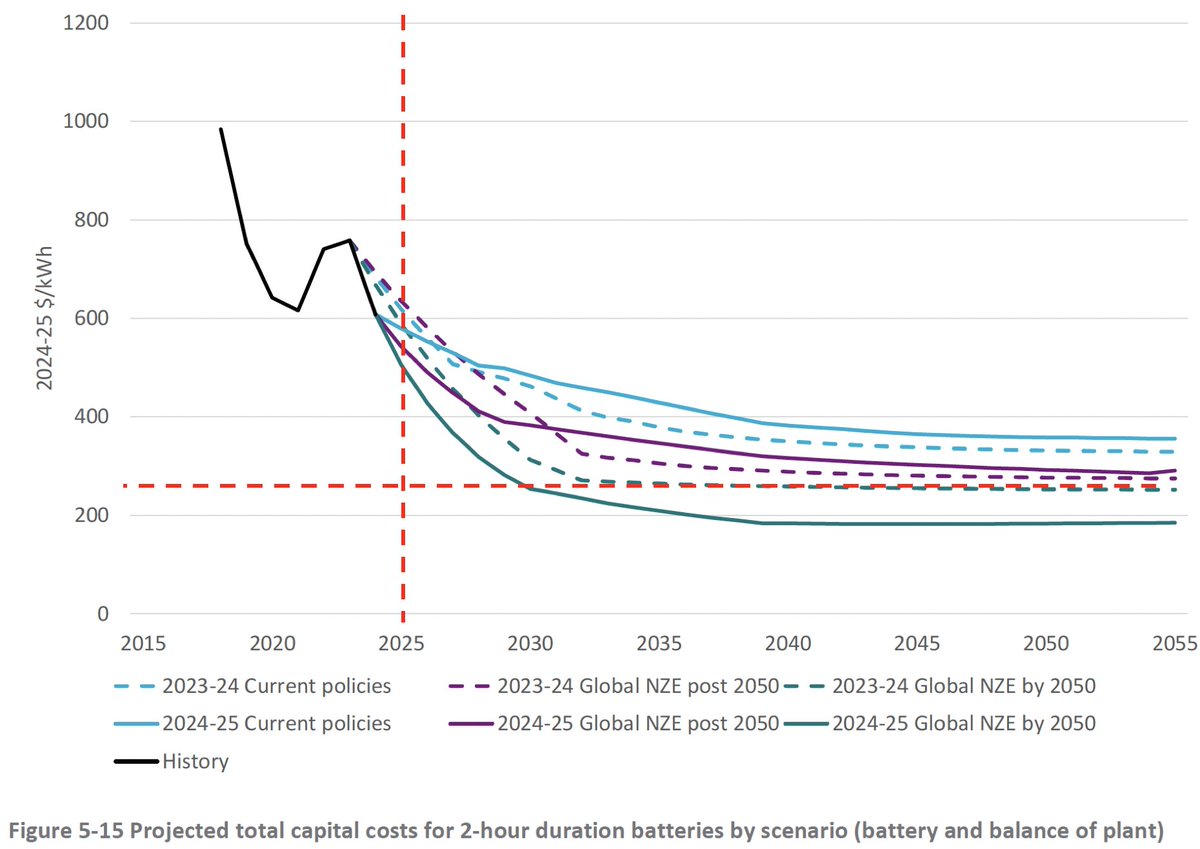
Here's a 5-year reality check for @CSIRO's GenCost on battery cost predictions.
In the 2019-20 version, they thought prices were already under $450/kWh, and would be around $250 by today, and under $100/kWh by 2031.
In the latest GenCost they're still over $600/kWh today. And not predicted to get much below $200/kWh in any scenario, ever.
CSIRO's record on battery cost predictions is terrible.
The UK Minister of Energy and Net Zero @Ed_Miliband now says the UK energy market is broken.
The UK Power Market Reforms and Energy Transition have been an inspiration for mainstream ‘Energy Experts’ in RSA
Everywhere we look , it is the State that leads the National Energy Priorities
In the UK, the State explicitly intervenes in the development of Renewables through a state-funded scheme called Contract for Differences(CfDs). A government owned entity, Low Carbon Contracts Company (LCCC) administers CfDs of 30GW renewable contracts. The cost is recovered through levies that are paid through consumer bills.
JUST IN:The so-called “Russian nuclear deal” story was deliberately weaponized as propaganda to smear Zuma and Molefe.Dr. Kelvin Kemm claimed that the nuclear talk was intended to be a broad, competitive procurement, not a “secret Russia-only” deal.
⚡️After billions of dollars wasted, right now at 1:45 pm on October 2nd, 2025:
ALL the wind turbines in ALL of New England are contributing only 1.4% of the power to our grid.
(For context, refuse is contributing 2.94% of the power to the grid.)
Or in other words - only 137 MW of the current system demand of 8,844 MW.
Once again, it is natural gas at 49% and nuclear at 35% keeping our lights on.
Source: ISO-NE Website
Picture: Saddleback Ridge Wind project
Only in RSA can someone say such engineering gibberish and get away with it. To compare 6000MW of intermittent generation with dispatchable coal generation is inexcusable, for someone who had access to probably the best system engineers in the world.
@jacob_maroga It is interesting that the "nuclear deal" in 2016 was quoted (by the anti nuclear NGOs) as R1tn for 9600MW. So R12tn would have bought 115,000MW, or over three times South Africa's peak demand (or about twice UK's peak demand)
There is no evidence in the world that Power Sector Reforms result in cheap and reliable electricity. The evidence from Europe shows that Reforms has been a scheme of massive wealth transfer from consumers & taxpayers to energy producers through high prices & subsidies
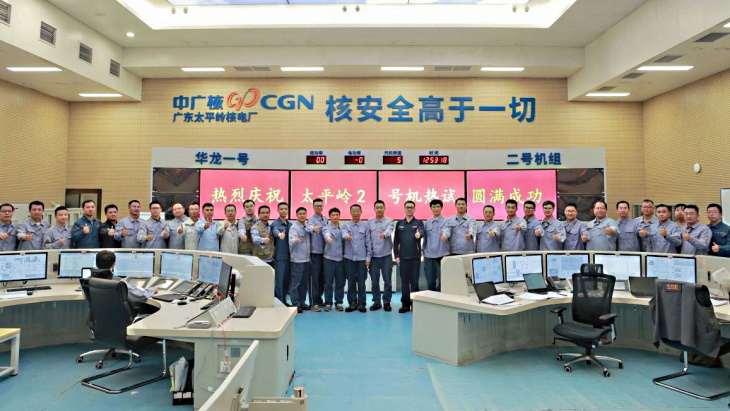
Hot tests have been completed at unit 2 of the Taipingling #nuclear power plant. The unit is the second of six HPR1000 (Hualong One) units planned at the site in China's Guangdong province https://t.co/b1ci8Arn30
Unreliable energy advocates claim solar panels and battery storage are now able to deliver "baseload" power at a lower cost than coal or nuclear.
But we ran the numbers in ERCOT, and solar and storage aren't low cost, they are the most expensive energy out there.
A thread:
UPDATE: Victoria’s wind drought continues into its fifth evening.
There’s still negligible wind across Victoria and Tasmania, with wind power operating at less than 1% of its rated capacity over the past 24 hours in Victoria.
It wouldn’t matter how many wind turbines Victoria built; if they close down their coal-fired power stations, during wind droughts like the one currently being experienced, they’d never have any "excess" generation to recharge their big batteries.
Therefore, to avoid catastrophic blackouts, they are going to need battery backup to get through at least five consecutive winter nights.
That will cost at least $250 billion in batteries.
It would bankrupt the state.
With the catastrophic consequences that would result from lengthy statewide blackouts during wind droughts, closing down baseload coal-fired power stations and believing you can replace them with solar and wind backed by big batteries is not just stupidity—it’s criminally negligent.
And why is there no one from the Labor-lite Liberal Party prosecuting this argument?
Net Zero insanity has us on the way to becoming the next Venezuela.
Did you know Vaalputs is the safest storage facility for Low Level radioactive waste in the world? here’s why!
See image below👇🏽
#Didyouknow#Lowlevelwaste#radioactivewaste
NRC has finished its environmental evaluation of the restart of the Palisades nuclear plant in Michigan. It concluded that the restart would have "no significant envirnomental impacts." In other words, the restart passed the evaluation. Article link in reply.
"No signifcant impact" is the most positive conclusion for environmental impact evaluations. They don't have a "positive environment impacts" option.
A shame, given that that would clearly be the case here. When Palisades restarts, it will replace ~800 MW of fossil power generation. The environmental impacts of fossil generation are orders of magnitude larger than those of nuclear (see graph in 2nd reply).
The reality of almost all countries with high penetration of grid -scale variable renewable resources, is high electricity prices and high volatility of prices. Eg Britain, Germany, Australia & California.
The claim by some RSA “energy experts” that more variable generation will result in “least cost” energy costs has not been observed anywhere on the world.
The claim of ‘least cost’ is usually based on the deliberate conflation of Technology Costs vs System Costs.
Solar generation may be low cost on a stand-alone basis, but to achieve reliable supply, there is an increase in “system costs” to backup and integrate these technologies into the grid.
France's nuclear fleet is needed to firm intermittent and unstable weather-dependent grids like Spain and Portugal.
Could see this coming.
https://t.co/KHnk8C6sYK