Excited to announce the Cook Lab will be opening at the Ottawa Hospital Research Institute Jan 2024. We'll be focusing on intratumoural heterogeneity and therapy resistance in ovarian cancer
Eager to work more with the ovarian cancer research community!
https://t.co/p11SFo7ayP
Thanks to our coauthors and collaborators, and to the teams whose shared datasets that made the work possible.
Please feel free to connect!
Web article: https://t.co/OeGtiHz5nw
Preprint: https://t.co/Lh82EOr3bR
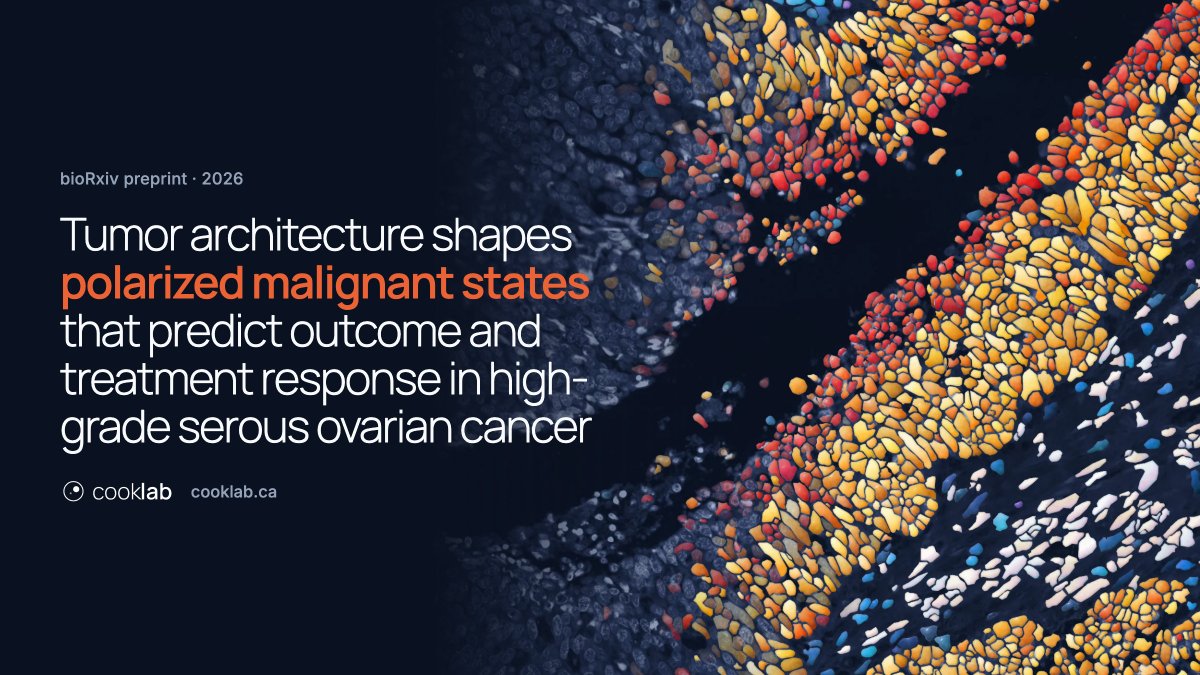
Excited to share the first publication from the lab, led by Sarah Nersesian and John Abou-Hamad!
Tumor architecture shapes polarized malignant states that predict outcome and treatment response in high-grade serous ovarian cancer
https://t.co/OeGtiHzDd4
(Preprint link below)
We hope this work helps provide a shared framework for describing malignant cell heterogeneity in HGSC, provide some mechanistic context to peritoneal metastasis, and potentially help guide bevacizumab treatment for patients with HGSC.
Five major databases of human surface proteins agree on only 188 of them. So we had Claude read the literature instead. Today @deliverome is releasing an open atlas of the accessible human surfaceome, with claims traced directly to quotes from their source 🎯
I released new 0.4 version of mascarade package with a much improved label placement algorithm. It's a pretty neat algorithm, but it took a while to get there. 1/8
Hey Twitter!
~2 yrs ago we dropped a preprint on clonal analysis of mouse development. During revisions the computational side grew so much we split it in two: experimental & computational. Today's thread is about the latter. Let's dig in 🧵 https://t.co/ljZkR9z063
Thanks University of Ottawa for highlighting our work to improve outcomes for women with gynecologic disease. March is Endometriosis Awareness Month and it means a lot to see this focus not just on the science, but the patients who drive it.
🏆 Recipient of the Polanyi Prize in Physiology and Medicine for excellence in early-career research, Professor David Cook is advancing research into gynecologic diseases and paving the way for better healthcare for women.
🔗 https://t.co/XZxgTUXkW9
I just updated the scDiffEq Python API (v1.1.0) to include animated visualizations of simulations.
You can generate GIFs (or still images) showing:
- Temporal gene expression dynamics
- UMAP projections of simulated trajectories
During my PhD, I found animations like these useful in presentations.
Available now in the latest release: https://t.co/Wkl0My7xT8
Excited to share our recent manuscript out at @Nature . @piraner and @majo__duran from @roybal_lab and @Mohamad_Abedi and @AdamChazin in David Baker's lab engineered synthetic receptors that sense natural and designer soluble cues. https://t.co/9Ezof5OFGf
📢Excited to share our work on @biorxivpreprint "Spatiotemporal map of the developing human reproductive tract at single-cell resolution"! Beyond grateful to our amazing team @ceci_icoresi@LuzGarAl@roserventotormo@MarioniLab and collaborators for their contributions. 🧵[1/10]
A protein expression atlas on tissue samples and cell lines from cancer patients provides insights into tumor heterogeneity and dependencies. https://t.co/bD85EUK910