Business Intelligence Architect- University of Iowa... Former Libertarian who joined the #WalkAway movement (before that was a thing). #SayNoToSocialism#MAGA
Let us talk about the bathtubs.
You have seen the graphic. Ten bathtubs of water to make one beef burger. Sometimes fifteen. The number is always vast, always counted in bathtubs, and always delivered with the grave face of someone who has personally caught the cow stealing.
Here is what the graphic leaves out.
About ninety-four percent of that water is rain. The ordinary stuff that falls on a field whether or not an animal is standing in it. For grass-fed beef it is closer to ninety-seven. The water the cow actually drinks, the only bit it genuinely uses, is roughly one percent.
So the honest version reads: ten bathtubs of rain that fell on a Welsh hillside regardless, plus about an eggcup the cow drank. Strangely, that one never makes it onto a poster.
Now meet the almond.
One gallon of water per single almond. California grows eighty percent of the world's almonds, and they swallow roughly a tenth of the entire state's agricultural water, nearly as much as every household in California combined, in a state half-lost to drought. That water is pumped and irrigated, hauled out of aquifers that are not refilling.
So here is the cow, standing in the rain, and here is the almond, draining a drought through a hose. And which one gets the guilt? The cow, every time. The almond gets a wellness blog.
The whole panic is a magic trick. Count the rain that was always going to fall, call it consumption, convert it to bathtubs for drama, and pray nobody asks the one question that ends the act.
Take every cow off that hill tomorrow. Would it rain less?
It would not. The rain has never once checked the agricultural policy before deciding to fall.
"Livestock use 83% of the world's farmland and give back just 18% of our calories."
There it is. The killer stat, lifted off the infographic, courtesy of Poore and Nemecek's enormous 2018 study in Science: nearly 38,700 farms across 119 countries. Damning. Wildly inefficient. Somebody fetch the cow a P45.
One small question before sentencing. Where is that 83% of land?
It's grass. Worldwide, around two-thirds of all farmland isn't cropland at all; it's pasture and rough grazing. Fell, moor, steppe, marsh, scrub.
Marginal land, to use the term of art. Too steep, thin, wet, or cold to grow a single thing a human can chew.
In Britain, about 65% of farmland is good for grass and little else. You are welcome to plant lentils on a Cumbrian hillside. You will then watch them sit there, baffled, and die.
What that land does grow is cellulose, the most abundant biomass on Earth and a substance your gut regards as scaffolding. You cannot eat it. Nor can any pig, chicken, or vegan.
A ruminant can. That is the entire trick. She walks across the inedible two-thirds of the world's farmland and turns it into milk and meat.
So the cow isn't squatting on prime arable while the nation starves; she's working the land that grows precisely one crop, grass, which she eats, which is the whole point of her.
Calling that inefficient is like calling a fishing boat inefficient for its poor performance on the motorway.
Then there's the calorie sleight of hand, which is somehow the dafter half.
Yes, beef is a modest share of calories. So is a glass of cooking oil. You can get calories from a spoon of sugar. Calories are the easy part.
The hard part is everything else the steak is carrying. On DIAAS, the actual measure of protein quality, beef scores about 1.0 to 1.1, with milk and eggs a shade higher.
Wheat limps in around 0.45. Almonds manage 0.40. The FAO won't let a protein scoring under 0.75 make a quality claim at all, which quietly disqualifies most of the plant kingdom.
Then there's B12, of which plants contain essentially none, plus heme iron and zinc in a form your body can actually be bothered to absorb.
Ranking food by raw calories and declaring the steak a failure is like ranking a library by how well the books burn.
By that measure, petrol is the finest meal in Britain.
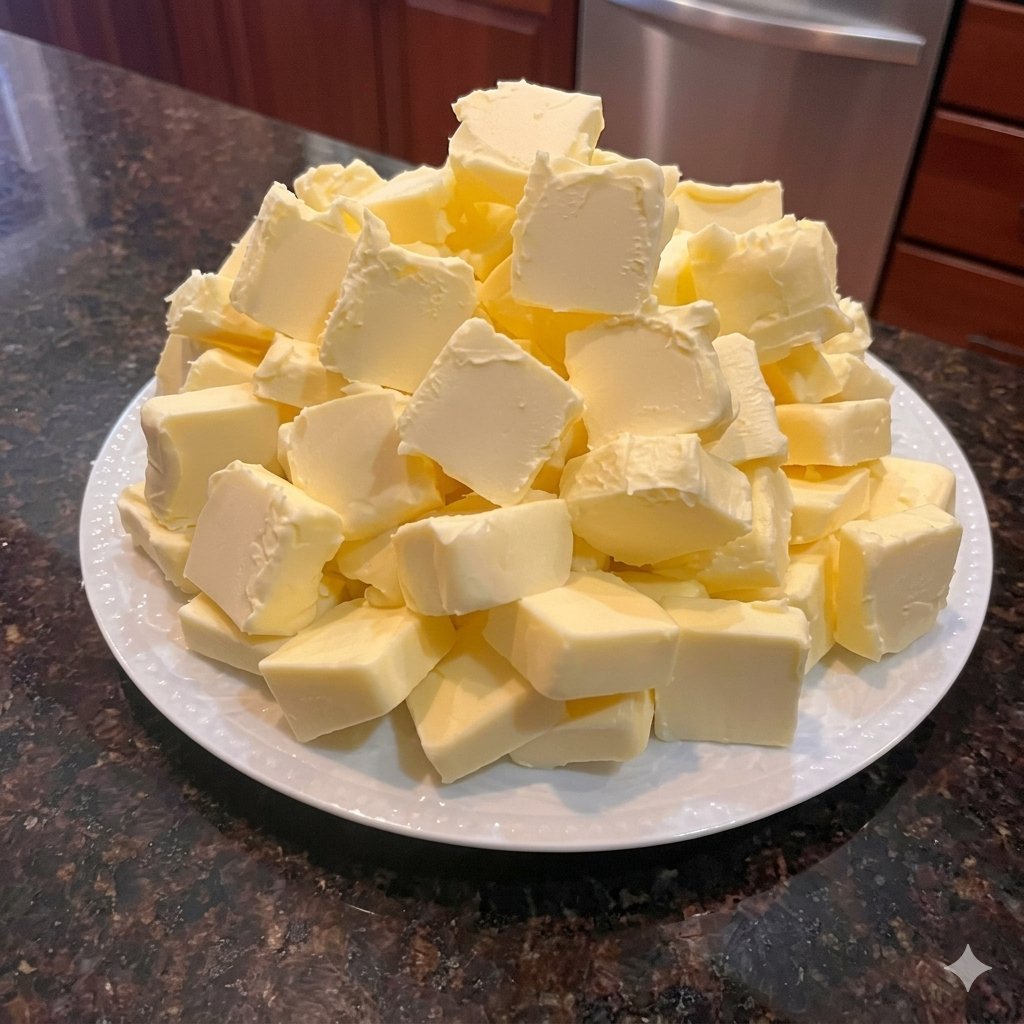
Butter is genuinely incredible.
Cook your steak in it. Cook your eggs in it until it pools around the yolks like a small golden lake. Slather it on liver. Stack a slice on top of mince so thick the pan starts to feel embarrassed.
Stir a knob through the pan juices. Roast a chicken under it. Brown it gently and pour the foaming brown butter over the ribeye, crust crackling, salt optional.
Use it as a condiment. Yes. As a condiment. Have a small dish of butter on the table the way some households have salt.
Eat it off a knife at 11pm when nobody is watching. Eat it off a knife at 11pm when somebody is watching, and look them in the eye.
Pack a small block in your luggage. Customs will have questions. The questions are not really about the butter.
Use it to bribe a magistrate. Anoint a relative on their birthday. Build a small altar in the corner of the kitchen and place the salted block at the centre. Send a stick of butter to your enemy in the post. Receive theirs in return. Stalemate. Both kitchens win.
Trade a wheel of it for safe passage through a checkpoint. Slip a pat under the tongue of a sleeping rival. Smear it on the doorframe to ward off the dietician. Leave a small offering by the back gate for the goat.
The Celts buried it in bogs for two thousand years and dug it up still edible. The French built a cuisine around it. The Tibetans put it in their tea. The Indians clarified it and gave it a holy name.
You were told to be afraid of it by a margarine company in 1977.
Have a think about who benefited from that.
Eat the butter.
No British government ever imagined an American president might finally tell the truth about the “special relationship.”
Until now.
Spare me the pearl-clutching obituary from The Economist, that decaying salon of transatlantic nostalgia where the ghost of Churchill is still being pimped out like a rent-boy for Davos subscriptions.
Your precious bunting of flags in the bin isn’t some tragic metaphor for Trump’s “betrayal.”
It’s the autopsy photo of a one-way parasitic bargain that America has carried on its back like a drunk uncle for eighty goddamn years.
And the drunk finally woke up, looked around, and said: Fuck this.
This isn’t “turning his back.”
This is a sovereign nation refusing to keep subsidizing a continent of strategic eunuchs who have spent decades castrating their own militaries, hollowing out their industrial bases, and importing the very pathologies that make them security liabilities rather than allies.
You want the special relationship?
Earn it. Reciprocate it. Stop treating the United States like an ATM with nuclear weapons.
Geopolitically and militarily, the numbers don’t lie and they never have.
The United States still shoulders roughly sixty percent of total NATO defense spending...$845 billion out of a collective $1.4 trillion last year.
Most of your European “partners” couldn’t hit the 2% GDP target even after Russia parked tanks on Ukraine’s border and started lobbing missiles at civilian infrastructure.
Britain under Starmer talks a big game about “global Britain” while quietly slashing capability, courting CCP-linked cash, and letting its own streets burn under the weight of demographic transformation and speech codes that make the old East German Stasi look libertarian.
You lecture us about values while your own government criminalizes tweets and turns Rotherham into a cautionary tale the media still refuses to fully autopsy.
Historically, the ledger is even more damning. We bled for you in 1917 and 1941 when your empires were on the ropes.
We bankrolled your reconstruction, anchored your defense for the entire Cold War, and let you punch above your weight on the world stage because sentimental Anglosphere nostalgia still meant something.
In return? Suez 1956, where you expected us to back imperial nostalgia while we were trying to contain Soviet expansion.
Vietnam, where you sat it out. Iraq, where you half-assed it and then spent the next twenty years sneering at us in your broadsheets. And every single time an American president dared put America First, your commentariat wailed like Victorian widows about the death of the alliance...as if the alliance was ever meant to be a suicide pact.
You’ve internalized a victimhood narrative so profound it borders on the clinical...projecting your own national decline, your own loss of agency, your own self-inflicted castration onto the one country that still possesses the will to act like a great power.
Trump doesn’t “deprioritize” the relationship; he simply refuses to indulge the delusion any longer.
He sees what you refuse to admit:
the United Kingdom of 2026 is no longer the reliable offshore balancer of 1945.
It’s a mid-tier European power wrestling with internal entropy, elite disconnect, and a demographic trajectory that makes long-term strategic partnership… let’s just say, complicated.
We are sick of it. Sick of the free ride. Sick of the lectures from people whose capitals are turning into no-go zones while their defense ministers beg Washington for more F-35s and more carrier groups to patrol waters they can no longer secure themselves.
Sick of the pomp, the pageantry, the royal visits, and the hand-wringing editorials that treat American self-interest as some kind of moral failing.
The special relationship isn’t dead. It’s being stress-tested by reality.
And reality, Mr. Economist, is a vicious bitch with a ledger in one hand and a mirror in the other.
Look into it.
💀⚖️🗡️
Vegans: "Drinking cow's milk is unnatural!"
Great point.
So instead of pulling on some teats for thirty seconds, we've developed a twelve-step industrial alternative.
Step one: grow almonds in California, a drought-afflicted state currently depleting an aquifer that took twenty thousand years to fill.
Step two: ship them to a processing facility.
Step three: soak them in water. California water, specifically, because almonds need 15 gallons per ounce and California is already rationing.
Step four: pulverise them into a slurry.
Step five: filter the slurry through fine mesh, discarding most of the actual almond in the process. That was the bit with the nutrition in it. Gone now.
Step six: add more water, because the resulting liquid isn't watery enough.
Step seven: add sweeteners, because it tastes of nothing.
Step eight: add emulsifiers, because it separates in six minutes otherwise.
Step nine: add synthetic vitamins, because all the natural ones left in step five.
Step ten: add seed oils, because we apparently learned nothing.
Step eleven: homogenise, degas, pasteurise, and sterilise the mixture until it resembles no food that has ever existed in nature.
Step twelve: put it in a carton with a picture of a field on it.
The cow: stands in a field. Makes milk. Has done this for ten thousand years. No factory. No steps. No aquifer.
Unnatural, though. Very unnatural.
The year is 1950. Your doctor lights a cigarette and tells you smoking is fine. He read it in a study. He is telling the truth about having read it. He does not know, or is not saying, that the study was funded by the tobacco industry.
The year is 1958. Your doctor tells you to eat less fat. The evidence is contested. The contestation is not in the public messaging. The food industry has been helpful in clarifying which findings deserve attention. Some researchers who published contradictory data have been quietly defunded. Ancel Keys is on the cover of Time magazine.
The year is 1962. Your doctor prescribes thalidomide to your pregnant wife for morning sickness. It has been approved. The FDA gave it the green light in Europe. Twelve thousand children will be born with severe limb malformations before anyone in an official capacity acknowledges the problem. The families are told the drug was safe. The drug was approved. Both of these things remain true.
The year is 1972. Your doctor prescribes Valium. Britain is in the grip of a benzodiazepine wave that will last two decades. The dependency risk is known internally. It is not shared. Your doctor is not lying to you. He was not told either.
The year is 1999. Your doctor prescribes Vioxx for your arthritis. It is newer than ibuprofen, well-tolerated, and Merck has a study showing it works. Merck also has internal data suggesting it roughly doubles the risk of heart attack. This data will not reach your doctor for four more years. Fifty thousand people are estimated to have died in the interim. Merck eventually settles for 4.85 billion dollars. No criminal charges are brought.
The year is 2002. Your doctor prescribes OxyContin. Purdue Pharma trained its sales representatives to tell doctors the addiction risk was less than one percent. That figure came from a letter, not a study. The letter was about patients with terminal cancer on short-term doses in hospital settings. Your doctor is a GP with a patient who has a bad back. Nobody draws a distinction. Nobody is required to.
The year is 2008. Your doctor checks your cholesterol. Your LDL is elevated. You are prescribed a statin. Nobody mentions that the number needed to treat for primary prevention is approximately 250. Nobody mentions that the muscle deterioration you'll notice over the next two years is listed as a rare side effect rather than a documented pattern affecting a meaningful percentage of patients. The trial that informed the prescription was funded by the manufacturer.
Now it is today.
Your doctor has new guidelines. New studies. New consensus.
He is confident.
He has always been confident.
The confidence has never been the problem.
The confidence is, in fact, precisely the problem.
Where there’s a will there’s a way
Especially as to policies that American voters overwhelmingly support
As soon as the Senate reconvenes, it’s time to debate the SAVE America Act—as long as it takes to get the bill passed into law
Share if you agree
"Toothless virtue signaling rhetoric like this has already cost two people their lives. The concept of pitting two armed law enforcement agencies against each other is ludicrous, and will not happen. I will not allow SPOG members to be used as political pawns."
- Mike Solan, SPOG President
https://t.co/qh2uvGoPtx
@MayorofSeattle
I think this thread is posted in at least a simulacrum of good faith, so I'll give a substantive response.
It is obviously true that in the moment of crisis, leaders face tremendous pressure to do something dramatic to address the crisis, and often those decisions turn out, in retrospect, to be wrong.
In the case of the covid crisis, the problems were confounded by a determined unwillingness of scientific and public health leaders to respond to data -- in real time -- that showed that core assumptions underlying the lockdown strategy were wrong.
Here is a short list of facts about covid that undermined these leaders' core assumptions:
* covid is airborne,
* covid spreads asymptomatically,
* covid infection fatality rate << case fatality rate,
* covid has a sharp age gradient in its infection mortality risk,
* lockdowns cannot suppress covid spread or protect the vulnerable for long,
* lockdowns crush the lives and well-being of children, the poor, and the working class, and almost everyone other than the laptop class
* lockdowns cause a form of psychological terror that guarantee they could never last just two weeks
The WHO and public health leaders got all of these facts wrong in 2020, which I suppose is understandable.
What is not understandable is that these same leaders conducted "devastating takedowns" of even well-credentialed outside critics who pointed out that the WHO's core assumptions were incorrect, and accepted these assumptions as true even as overwhelming data to the contrary emerged in real time.
What is not understandable is the utter confidence that the WHO and public health leaders expressed in these ideas and lockdown policies to the public as the only way to protect the population, going so far as to call for censorship of contrary voices on social media and elsewhere.
The closest analogue I can think of is the set of "best and brightest" advisors who told Pres. LBJ that victory in the Vietnam War was just around the corner, based on a whole host of faulty information.
Leaders who come out of such situations having embraced such a litany of catastrophically failed ideas and policies have a few choices on how to handle the post-crisis era.
1) They can, in good faith, admit their failures and work to reform systems so the disaster never happens again. This would be best, though I would understand why the public would want a new set of leaders to design and implement the reforms. I personally am very happy to work with and learn from public health leaders who choose this option.
2) They can pretend to have done nothing wrong, clinging to power for as long as they can, hoping against hope that history will vindicate them, crushing public trust in the institutions they lead.
3) They can try to pretend they never recommended or adopted the catastrophically failed policies, hoping that the public has a short memory. This is the current strategy that the @WHO is taking.
4) They can appeal to the difficulty of the job of handling a crisis under considerable uncertainty, not in a spirit of reform, but rather as an excuse to avoid responsibility for their failed crisis management. This is the approach that Koopmans is taking in her thread.
I have very little sympathy for the covid crisis leaders who choose options 2, 3, or 4. Their job was to manage the uncertainty with wisdom and humanity, which they failed to do. They cannot, at this juncture, turn around and expect public sympathy because their job was hard, or expect the public to forget their failure. These leaders have destroyed public trust in public health, and should step aside as a new set of public health leaders works to fix the damage they caused.
Remember Aduhelm? It was Biogen’s $56,000/year Alzheimer’s drug that didn’t even work.
Worse, it caused brain swelling, brain bleeding, and sudden falls in patients—and the FDA approved it anyway.
But the truth is, you don’t need deep pockets to treat Alzheimer’s. You just need to look at what Big Pharma can’t monetize.
This report exposes the real causes behind Alzheimer’s—and the cheap treatment options you should explore instead.
🧵 THREAD
1911: Procter & Gamble invents Crisco - hydrogenated cottonseed oil.
Problem: Nobody wants to cook with cottonseed oil. It's industrial waste used for making soap.
Solution: Marketing campaign to convince Americans that animal fats cause heart disease.
1948: American Heart Association is tiny organization with $1,700 budget.
Also 1948: Procter & Gamble donates $1.7 million to the American Heart Association.
The AHA suddenly becomes influential and well-funded.
1961: The AHA issues their first dietary guidelines: Avoid saturated fat. Use vegetable oils instead.
Recommended oils: Crisco and other vegetable oils.
Who benefits: Procter & Gamble.
Who funded the AHA: Procter & Gamble.
1980s: Trans fats (in Crisco and margarine) are discovered to be catastrophically unhealthy.
2015: Trans fats are finally banned as unsafe.
For 67 years, the American Heart Association recommended a product that:
Was invented as soap ingredient
Was made from industrial waste
Was later proven to cause heart disease
Was produced by their founding mega-donor
And they told you butter would kill you while recommending literal poison.
When trans fats were finally proven deadly, they quietly changed recommendations without acknowledging the millions who followed their advice.
No apologies. No accountability. Guidelines adjusted. Move on.
The organization you're told to trust for heart health was created by a soap company to sell industrial waste as food.
Science.
@ThrillaRilla369 Late 80’s (my early 20’s) I was going to community college full time & working 1 full-time & 3 part-time jobs, none of which paid over $10 / hour.