Today we will be burning ~15.5M LIT, which is the amount of tokens programmatically bought back through the end of Q2 2026.
We will post the Ethereum transaction hash once completed.
WOW, an important release from NVIDIA 🔥
NVIDIA Model Optimizer 0.45.0 is out — big upgrades for everyone, but especially exciting for MoE models with NVFP4 quantization!
Key benefits for MoE quantization:
✨ New “active experts” mode in AutoQuantize — now understands only some experts run at a time, for smarter mixed-precision choices
✨ Better quantization for DeepSeek-style models + easy exact MXFP4 → NVFP4 conversion for routed experts
✨ New W4A16 NVFP4 weight-only mode (no calibration needed) — huge memory savings while keeping good quality
✨ Improved calibration & KV-cache options tailored for MoE models
Should result in higher-quality NVFP4 MoE models, lower memory use, and better throughput on Blackwell with almost no accuracy loss!
This might fix the issues I'm having with Qwen3.6-35b NVFP4 if they are generous enough to update it.
Full notes: https://t.co/1sIIB9y5nx
We're shipping a new feature in Claude Cowork as a research preview that I'm excited about: Dispatch!
One persistent conversation with Claude that runs on your computer. Message it from your phone. Come back to finished work.
To try it out, download Claude Desktop, then pair your phone.
Once @leanethereum is fully deployed, Ethereum will be the only major chain that simultaneously has (i) theoretically optimal security properties under synchrony [requires 51% of online validators honest], and (ii) strong economic finality under asynchrony. Most "semi-centralized fast chains" pick (ii) only, PoW chains pick (i) only, Ethereum gets both.
If you're looking for reasons morale in crypto is low it's because the 2020 era vision of DAOs and Tokens is mostly dead.
Maybe too early, maybe never.
Crypto is currently doubling down on store of value, stablecoins, and DeFi - while getting ready for the AI money explosion.
We should be open to revisiting whole beacon/execution client separation thing.
Running two daemons and getting them to talk to each other is far more difficult than running one daemon.
Our goal is to make the self-sovereign way of using ethereum have good UX. In many cases that means running your own node. The current approach to running your own node adds needless complexity.
Short-term, maybe we want some more standardized basic wrapper that lets you install dockers of any client and make them talk to each other easily? Also good that @ethnimbus unified node https://t.co/BWpU939wIM exists. Longer term, we should be open to revisiting the whole architecture once @leanethereum lean consensus is more mature.
A truth bomb for you.
ETH will never earn fees.
Ok, never is a strong word - let me rephrase - ETH won't earn fees anytime soon or in sustained amounts necessary to justify a centa-billion dollar asset.
The reason is written in the roadmap. Ethereum intends to massively increase blockspace supply in the coming years.
If we get to Justin Drake's gigagas in 5 years, that's a 200x increase in blockspace supply. ETH only generates fees when demand exceeds supply - demand won't outstrip supply during this rapid expansion era, that means low fees.
So if your reason for holding ETH is fee generation, sell now - send it to zero.
Or...re-consider how to value ETH. Consider what the market is already telling you.
What assets don't earn fees but are worth trillions?
Gold. Silver. Oil. Bitcoin.
Together worth $170 trillion in value.
Commodity money and store of value assets aren't priced on their ability to generate fees. They're priced on consumptive usage, and store of value demand relative to their scarcity.
ETH is scarce. Lower annual issuance than gold or bitcoin.
ETH has store of value demand. A censorship resistant digital money, a cyberpunk money, native to AI and the internet, economic bandwidth for DeFi.
You can try to value ETH as a fee generating DCF asset and continue to be confused or you can value it as the market already does.
ETH is an emerging commodity money.
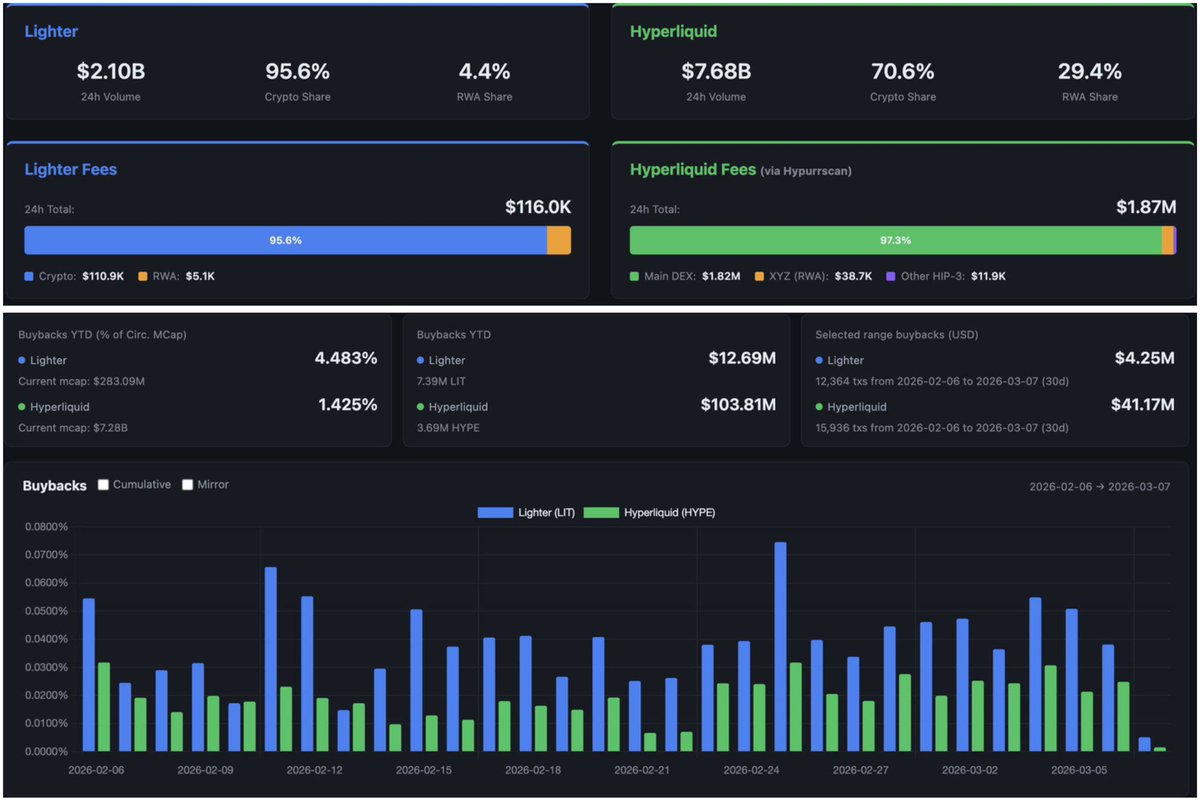
I just added $LIT to my portfolio after comparing it to $HYPE
The current price of $LIT is poor: from the peak has decreased by more than 65%, FDV is only $1.1B (just 3.6% of the FDV of $HYPE).
Compare revenue (annualized in the last 14 days):
> Lighter: $60M
> Hyperliquid: $760M
→ Lighter's revenue is approximately 8% of Hyperliquid's revenue.
P/E ratio:
> Lighter: 18x
> Hyperliquid: 39x
→ $LIT is 2.2x cheaper than $HYPE.
Buyback (past 30 days):
> Lighter: $4.25 million (1.6% market cap)
> Hyperliquid: $41 million (0.6%)
→ Lighter acquired relatively stronger.
Volume & fees 24h:
> Lighter: Volume $2.9B
> Hyperliquid: Volume $7.9B
I see @Lighter_xyz is not far behind @HyperliquidX but in terms of price, $LIT is significantly lower.
This is my personal opinion, not investment advice. Good luck!
Well damn!
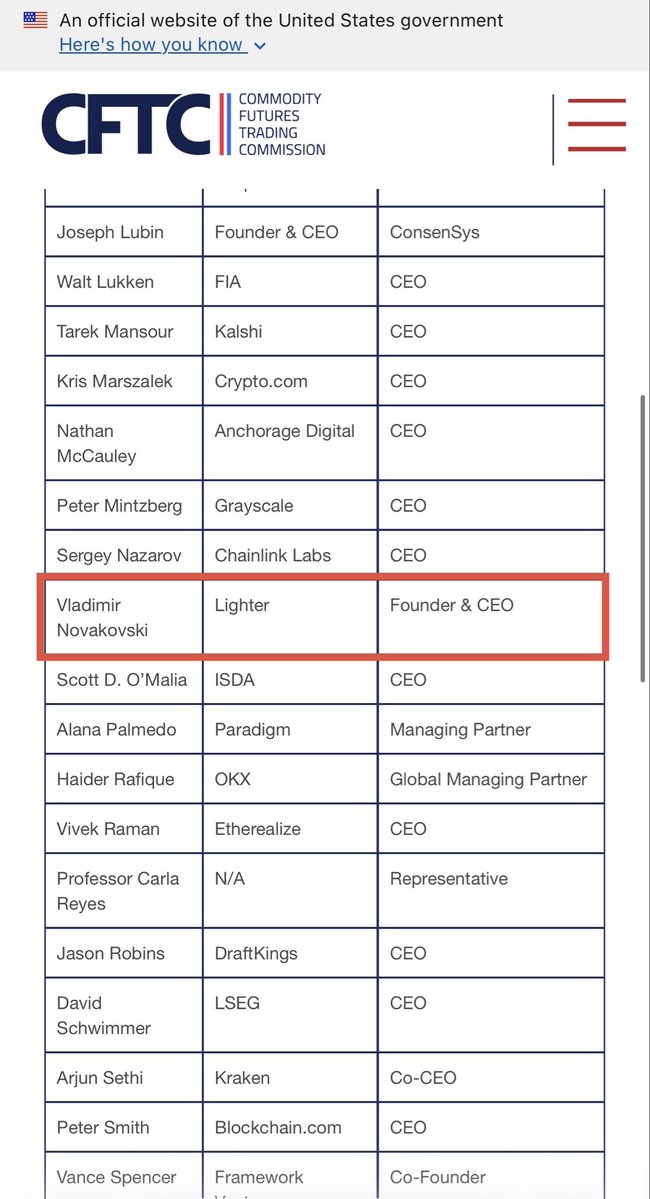
Looks like @vnovakovski got added to the Innovation Advisory Committee.
The list includes names like Brian Armstrong, Vlad Tenev, Shayne Coplan, Adena Friedman and Jeff Sprecher
A seat at the table.
Glighter.
https://t.co/qDlvhk1rHP
Partner Attribution is now live! Integrators that build on Lighter can monetize via configurable fees of up to 10 bps.
We're already working with external teams leveraging this infra, with several partnerships to be announced soon.
More details:
https://t.co/hsqQbOYL6T
Actually lighter is doing good.
They are doing around $200k daily revenue without any incentives ongoing, and they are using 100% of that revenue for $LIT buybacks. Like around $200k+ daily buybacks are happening, and already more than 7.2M $LIT has been bought back. Also, more than 54% of the tokens are already staked in LLP.
And they are consistently doing $2–3B volume, so you can’t say Lighter is dead. I know in your view only the token price is considered growth, but for me other metrics also count as growth.
That’s it
Lighter 🕯️
@HYPERDailyTK A fat finger trade (like this one where a price was entered that was way below market price) on any platform would have had the same result. Many such cases including on Binance and other major platforms. IYKYK. 😂
so someone really tried to jelly Lighter with $ARC huh, $6.4M TWAP long trying to drain the LLP (but maybe it was actually an attack on the $LIT token). didn't work
here's the difference, on Hyperliquid, HLP blindly inherited the toxic position and validators had to manually settle at an arbitrary price
on Lighter, the liquidation engine hits the book first, LLP has a hard insolvency check and won't absorb positions that would make it insolvent, and if worst comes to worst ADL socializes losses automatically, like no emergency committee, no arbitrary prices, no manual override. zk circuits enforce the rules, segmented pools contain the blast radius, position privacy blocks reconnaissance and so on
jelly worked on HL because of single insurance pool + no solvency checks + centralized override. Lighter eliminates all three by design. someone literally stress-tested it today and the system just handled it
Made money on a failed exploit on @Lighter_xyz
Someone tried to pull a @HyperliquidX Jelly Jelly-style attack on Lighter's LLP using $ARC.
Opened a $6.4M TWAP long position (199M+ tokens at ~$0.096) trying to drain the LLP.
His wallet: 0x5F64C8C5C5D0811130c3A314bCF2c791aa6e6452
Unlike Hyperliquid, Lighter's pool architecture handled it. The attack failed and LLP was not affected.
$LIT dropped 10% on panic as people noticed unusual $ARC activity. Once it became clear the exploit didn't work, price fully recovered.
But the real story is the opportunity it created.
$ARC was trading at ~$0.14 on @Lighter_xyz while other venues had it at ~$0.13. Roughly an 8% spread.
That's layer one.
Layer two — funding rates.
Lighter: ~0.4% per hour.
Other platforms: ~0.2% per 4 hours.
Both layers printing at the same time.
Simple math on a $20k position:
Short $ARC on Lighter at $0.14, hedge long on another venue at $0.13. ~$1,600 from the spread alone. Hold for 5 hours and the funding differential adds another ~$350.
That's roughly $1,950 nearly 10% return in half a day.
I used @Lighter_xyz + @variational_io for this. Fully onchain, no CEX needed.
@variational_io pulls prices from CEX which makes it perfect for arbing against onchain venues with dislocated prices. Wide token coverage too.
If you want to try it -> use code OMNIBONUS
These attacks are growing in intensity and sophistication. Addressing them will require rapid, coordinated action among industry players, policymakers, and the broader AI community.
Read more: https://t.co/4SVm8K3qou