I am happy to announce that my book Quantitative Finance with R and #Cryptocurrencies is now published:
https://t.co/LQ2kHStaNc
Book’s companion website(R code,data,updates,slides): https://t.co/bUdndUoyEm
Book R packages
https://t.co/rGm5n1NZNX
https://t.co/LFvXlNMMzl
#crypto
Just went through the latest OIES report on what’s been happening in the oil paper market over the last three months. Here’s the breakdown:
1) In a typical geopolitical scare, you'd expect spec money to pile in and send open interest through the roof. Instead we witnessed a complete anomaly: Brent futures open interest absolutely cratered.
2) On the flip side, daily volumes actually went through the roof. It shows everyone was aggressively passing the hot potato intraday to shift risk, but nobody had the stomach to hold overnight exposure. And now even that day-trading volume is drying up fast.
3) Money managers like hedge funds and CTAs live for trading time, arb, and product spreads based on real oil fundies. But once the war sent vol off the charts, it blew straight through their internal VaR limits. Facing massive margin hikes, they were forced into a structural retrenchment. The capital cost of just holding onto those positions became way too expensive.
4) When the geopolitical conflict flared up, North American shale independents found themselves severely under-hedged. As crude prices ripped higher, they panicked to lock in those attractive margins, offloading massive swap volumes to their bank counterparts. This clearing activity forced a structural expansion in the CFTC data, leading to a concurrent spike in swap dealer shorts and offsetting commercial long exposure across the WTI curve.
5) The Brent-WTI blowout triggered by the Hormuz crisis blew the physical arb wide open for moving North American barrels into Europe and Asia. To nail down those arbitrage margins, mega physical trading houses executed a 'Long WTI / Short Brent' spread trade, which acted as a critical floor for WTI open interest.
6) ICE blunt-force doubled Brent margins, while CME played it smart by using its SPAN system to give massive portfolio-based risk offsets on inter-commodity spreads. On a pure capital-efficiency basis, it was a total no-brainer to park your margin in WTI instead of Brent.
7) As open interest fled the futures complex, everyone piled into options to keep chasing directional plays with a hard stop on risk. Going long premium meant your downside was strictly capped at the premium paid—no brutal daily mark-to-market margin calls, which saved your balance sheet flexibility. Operationally, it was a massive relief because you didn't have to stay awake 24/7 babysitting a position overnight. Shorting options, though, was absolute suicide thanks to that nasty convex risk and punishing margin hikes.
8) Trading in ultra short-dated paper absolutely exploded as players scrambled to chase headline risk in real time. This April weekly WTI options saw average daily volumes skyrocket to around 33,000 contracts, up nearly 50% y/y. 0DTE options squeezed their market share up from 25% to 30% of the entire WTI options complex, while 1-3 DTE contracts also expanded their footprint from 34% to 39%
#oott #iran
1) The SPR release is sending huge volumes of US crude into Europe, which is significantly dragging down the North Sea window diffs.
2) Panic bought cargoes from 1-2 months ago are arriving in Asia this month, giving Asian buyers some breathing room. There is a distinct lack of aggressive buying.
3) China's SPR release.
4) Due to the combination of points 2 and 3, buyers are holding off on bids and staying on the sidelines, hoping the Strait will open. If it doesn't open soon, they'll be forced back into bidding for barrels.
5) I don’t want to blame anyone for this wait and see attitude. Looking at the demand to ship out enriched uranium stocks, I believe the chances of reaching a deal are extremely low.
6) But others might think differently. Plus no buyer wants to risk looking like a fool. Refineries still running have gained a bit of breathing room with May arrivals, and the rest have already implemented run cuts. Opportunistic buying is only natural.
6) There is plenty of incentive for operational refineries to maintain max runs. European diesel spreads are still at insane levels, and the WTI 3-2-1 crack is nearing $54/bbl even while crude is swinging by ~$20/bbl.
7) Unless diplomatic progress creates actual change, I expect buyers will soon be forced to start bidding again.
8) I made massive profits on Brent for Apr, May, and June, but it's true I’m currently seeing a loss on the July contract.
I cut down my rollover volume knowing these headline swings would happen, and I added to my position yesterday.
Unfortunately even those additional entries are starting out in the red. I'm disclosing this bc transparency is important.
I'm open to hearing other perspectives.
#oott #iran
Hormuz is being modeled by consensus as an oil shock. It is not. It is an input layer reset of the global manufacturing economy. The crude price move is the loudest signal but not the most consequential.
The most consequential transmission is the slow repricing of the chemical, metal, and specialty input layer that sits underneath every physical product made on Earth.
Each cascade has its own time signature. Oil moves in days. Fertilizer in weeks. Specialty chemicals in months. Capital goods and consumer durables in quarters. Sovereign wealth flows and reinsurance capital in years.
So the impact rolls through markets in waves rather than a single shock. This is what makes it harder to model than a typical commodity event.
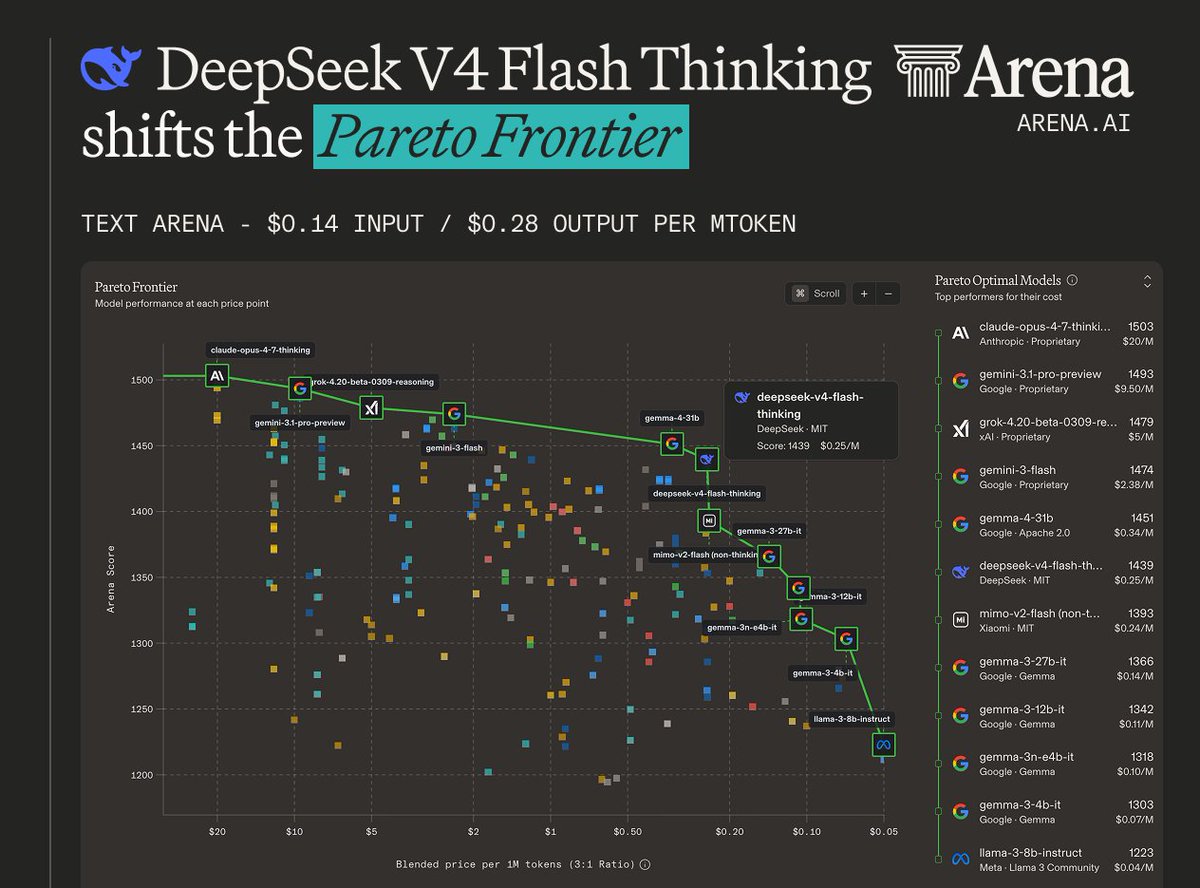
DeepSeek V4 Flash Thinking at 284B parameters (13B activated) shifts the Text Pareto frontier with $0.14 input / $0.28 output per MToken.
Congrats again to @DeepSeek_AI on the open model progress!
🚀 DeepSeek-V4 Preview is officially live & open-sourced! Welcome to the era of cost-effective 1M context length.
🔹 DeepSeek-V4-Pro: 1.6T total / 49B active params. Performance rivaling the world's top closed-source models.
🔹 DeepSeek-V4-Flash: 284B total / 13B active params. Your fast, efficient, and economical choice.
Try it now at https://t.co/GCdiMzk1Dl via Expert Mode / Instant Mode. API is updated & available today!
📄 Tech Report: https://t.co/drlDrxkYtp
🤗 Open Weights: https://t.co/T13Y8i7SDM
1/n
Despite all the noise in the market and the unfolding geopolitical events, the only thing remains unchanged is the fundamental of the uranium market.
It is one of the best spaces where you can simply sit back and let time do the work.
#uranium $nxe $uroy
Oil demand destruction is underway.
1.5-2.5 million b/d
Flow assumption update:
Production shut-in: 12 million b/d
SPR: 2.5 million b/d
Demand loss: 2 million b/d
Net: 7.5 million b/d
⚠️Europe has 'maybe 6 weeks of jet fuel left,' energy agency head tells AP
Europe has “maybe 6 weeks or so (of) jet fuel left,” the head of the International Energy Agency said Thursday in a wide-ranging Associated Press interview, warning of possible flight cancellations “soon” if oil supplies remain blocked by the Iran war.
IEA Executive Director Fatih Birol painted a sobering picture of the global repercussions of what he called “the largest energy crisis we have ever faced,” stemming from the pinch-off of oil, gas and other vital supplies through the Strait of Hormuz.
“In the past there was a group called ‘Dire Straits.’ It’s a dire strait now, and it is going to have major implications for the global economy. And the longer it goes, the worse it will be for the economic growth and inflation around the world," he said.
The impact will be “higher petrol (gasoline) prices, higher gas prices, high electricity prices,” Birol told AP, with some parts of the world “hit worse than the others.” (AP)
JPM:
We estimate that governments, companies, and consumers collectively drew 250 million barrels—or 6.6 mbd—of reserves over March and the first 10 days of April to cushion the shock, with Asia bearing the brunt of the tightening (Figure 1). But that buffer is finite.
At this juncture, even if refiners double the cuts from here, OECD commercial crude inventories could fall toward operational minimums by early May.
At this point, the system is no longer absorbing the shock—it is simply running down its buffers while demand is forcibly rationed. If refinery cuts rise from around 2 mbd currently to 3 mbd in April and then to nearly 8 mbd in May, commercial inventories may last through the end of May.
Conversely, the required throughput reduction could be smaller if China opts to release additional crude inventories into the system beyond the currently assumed 1 mbd.
Physical oil traders lack the firepower to move financial prices to match physical prices.
This is why you are seeing a disconnect between physical and financial oil prices.
It doesn't last.
Oil prices don’t yet reflect the severity of the unprecedented supply crisis caused by the Iran war, but they soon will, the head of the International Energy Agency said.
About 13 million barrels a day of oil supply have been shuttered by the conflict and the near-closure of the Strait of Hormuz, IEA Executive Director Fatih Birol said at an event hosted by the Atlantic Council.
More than 80 energy facilities have been damaged during the hostilities, and a recovery could take as long as two years, he warned. The Paris-based agency has already described the current supply disruption as the biggest in history.
#oott https://t.co/BNAXaQi5Z0