Meta's Chief AI Officer:
"People will have one, maybe two agents they rely on for everything.
More and more of your personal life and work."
In a few years "do you have an agent" will sound like "do you have an email address."
The clearest 20 minutes you'll find on where AI agents are headed.
Watch it, then read the guide on how to create your own AI agent step by step below.
ETH investor Stanley Druckenmiller: “Our whole payment system will be stablecoins in 10-15 years”
BitMine (BMNR), the ETH treasury company chaired by Tom Lee, holds almost $10 billion of ETH. Legendary investor Stanley Druckenmiller is listed among key backers like Founders Fund, ARK's Cathie Wood, and Bill Miller. This aligns with his recent bullish comments on stablecoins and blockchain payments:
“Blockchain and the use of stablecoins — if you want to throw crypto and tokens into that — are incredibly useful in terms of productivity. I assume our whole payment system will be stablecoins in 10-15 years. Efficient. Quicker. Cheaper.”
#silver#uranium $GGD
@RealRickRule on @GoGoldResources
"... I suspect when the history is written at Los Ricos, what you will see is 4 or 5 or 6 production facilities feeding a central mill complex "
https://t.co/sYkLo4JmDx
Andrew Kang turned a few early stage robotics investments into a $500 Million publicly traded empire @RoboStrategy
He is widely considered THE leading investor in robotics
@Rewkang believes the ChatGPT moment for Robotics is happening RIGHT NOW and it will be BIGGER THAN BITCOIN
This interview is a masterclass on Robotics investing in 2026
1:18 – Why robotics today feels like crypto in 2015
4:23 – Is robotics a bigger opportunity than Bitcoin?
10:30 – Robotics 101: players, problems & bottlenecks
16:40 – Who's leading the race: Tesla vs Figure
23:10 – China's 100+ robotics companies & the real investment risk
25:28 – US vs China: who's actually ahead?
33:40 – How many human jobs will be replaced?
38:00 – The "ChatGPT moment" for robotics
43:55 – UBI & the new social contract
46:30 – Why Andrew built Robo Strategy
51:20 – Lessons from Bitmine, MicroStrategy & Saylor
1:07:50 – The Boston Dynamics question
1:12:09 – His most contrarian bet: avoid model-only companies
1:19:55 – Tesla or Figure?
1:23:26 – Figure's valuation in 5 years: bear, base & bull
1:29:20 – Final words of wisdom
Want to see it in action? 👀
Join today’s Fireside Dev Hang with @aaronbassett for a live walkthrough, technical deep dive, and Q&A.
🗓️ Today, June 3 - 5:30pm BST
Tune in live on YouTube or X: https://t.co/zioXjts8sR
@OwenBenjamin@TuckerCarlson Just posted a new show with German economist @DrRichardWerner that explains WAR and China's Belt and Road being a retread of British Colonialism. Worth a watch and a rewatch and taking notes.
https://t.co/mFwURLuLwD
My wife mentioned a nice private school over dinner this week
She said the campus was beautiful
I asked what's the tuition
She said we should look at it as an investment in him not a cost
I made a note
She said don't make a note
I said I always make notes
She said this isn't a deal
I said everything is a deal
She closed her eyes
She said we'd discuss it Saturday
I agreed
Saturday 7:02am
She came downstairs in her Saturday robe
Coffee in hand
I had my cargo shorts on
The dining room had been cleared
The projector was on
The analyst was at the head of the table
Quarter zip on, three iced coffees, a legal pad, and two laptops
He had been there since 6:44am
I texted him at 11:14pm Friday
The text said dining room 6:45am bring the model
He sent a thumbs up
My wife stopped in the doorway
She said what is this
I said you said you wanted to discuss it
She said this is not a discussion
I did not respond
She sat down anyway
The analyst stood
He said good morning ma'am
She did not respond
He sat back down
A printed deck in front of each seat
A fourth copy in case
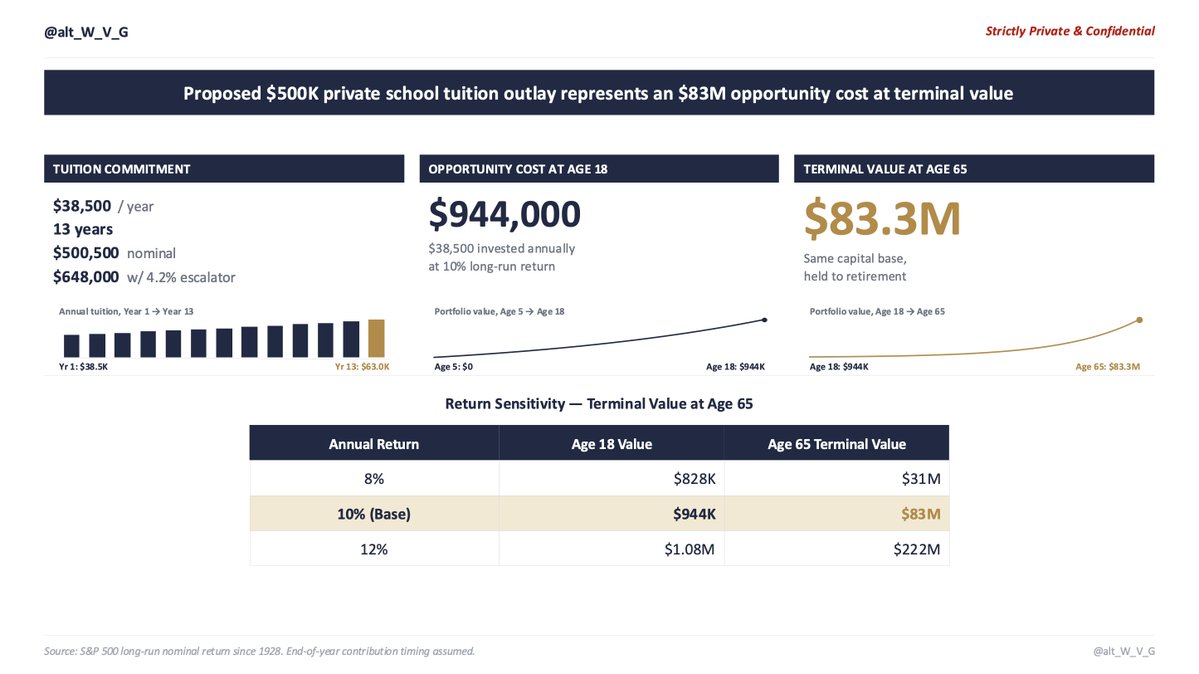
Slide 1 Tuition Schedule
$38,500 per year
Thirteen years
$500,500 nominal
Before escalators
The school has raised tuition 4.2% per year for a decade
With escalators $648,000
My wife said okay
I said I'm not done
Slide 2 Opportunity Cost
Even before escalators
$38,500 invested annually
10% nominal return
S&P long-run average since 1928
By his eighteenth birthday $944,000
My wife said we can afford it
I said I know that's not the slide
Slide 3 Terminal Value at Age 65
$83 million
She was quiet
The analyst slid the sensitivity tables across the table
8% return $31 million
10% return $83 million
12% return $222 million
She did not look
She said this isn't about money
I said it's always about money
She said no it isn't
I said then what is it about
She did not answer
She said you can't put a dollar value on his teachers his classmates his environment
I said I can the analyst already did slide 6
He flipped to slide 6
She did not look
She said the school is the best in the city
I said best is a feeling
She said it produces the best students
I said the students were already the best before they got there
She said our son deserves it
I said our son deserves $83 million
My son walked in
He is five
Dinosaur pajamas
He looked at the projector
He looked at the open deck on the table
He looked at slide 3
He said are we modeling pre-tax or after-tax
The analyst opened a new tab
My wife looked at the ceiling
He said what's the discount rate
The analyst set down his pen
She closed her eyes
He said is this the same return assumption from the 529 conversation
The analyst stopped typing
He looked at me
I did not say anything
She stood up
Sat back down
He said dad can I help
I said yes
He pulled up a chair
The analyst handed him a printout
He started reading
My wife watched him read
She watched him for a long time
She said his name
He looked up
She said do you like school
He said the work is too easy and the kids don't ask questions
She did not respond
She looked at the ceiling
She walked out of the room
The analyst started packing up
He said should I follow up Monday sir
I said no follow up needed
He'll be fine
Sent from my iPhone
Welcome to the most asymmetric trade in modern financial history.
The thread below lays out why. The opportunity exists because capital has chased the AI trade while ignoring the physical assets AI requires to run — assets that have quietly become the best-performing asset class of the decade. Since October 2020 when we first called for the commodity super cycle: QCI Total Return +217%, GSCI Total Return +205%, Gold +140%. NASDAQ trails at +130%. S&P 500 at +85%. The top three are all commodities. Yet oil cannot get out of its own way while copper and the broader atom complex prints fresh highs . That is the dislocation. That is the trade.
Get long. Buckle in. Hang on for the ride.
Forgive the longer posts in this thread — attempting to mimic my old 10-bullet commodity takes. On to it.
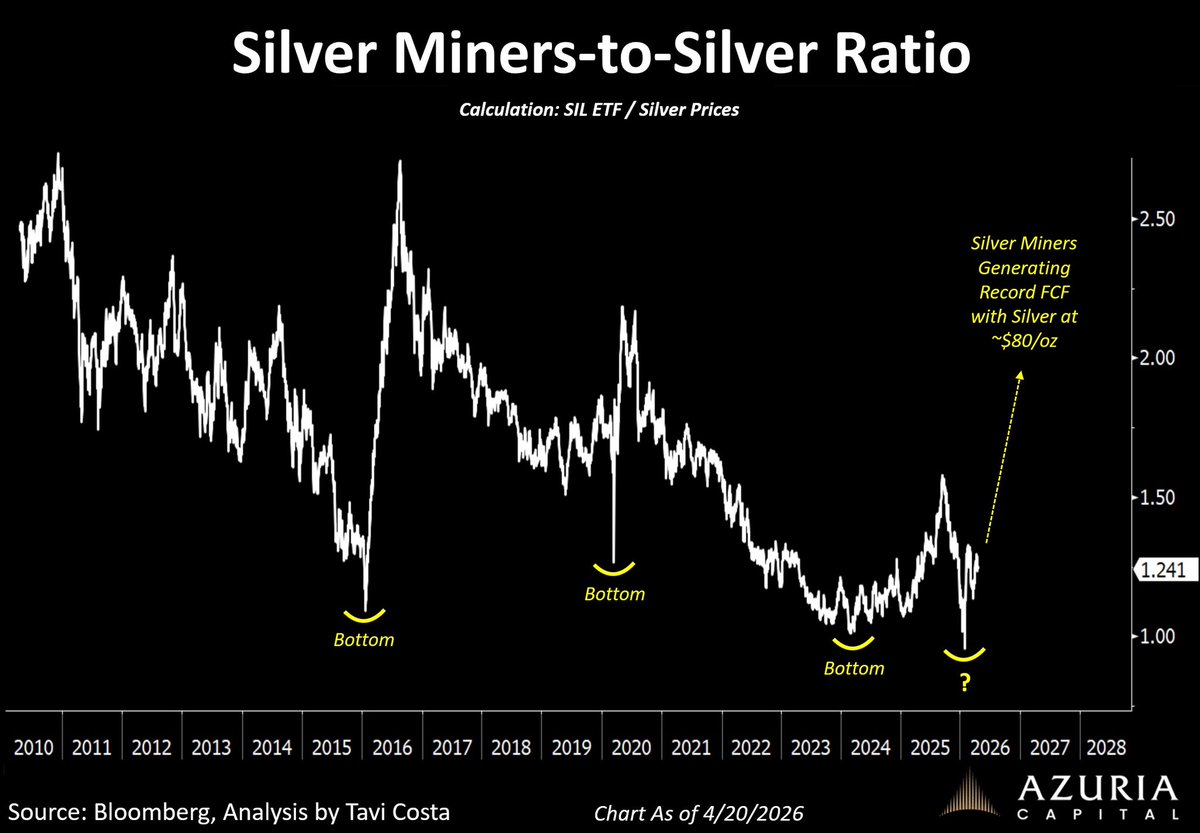
Silver back above $80/oz.
If you like that, you must love a miner producing ounces below $15.
Mining margins today are better than any tech company.
Game on.
https://t.co/FOdI99FmDd
Rule Symposium 2026: Rick Rule interviews Bradley Langille , CEO of GoGo... https://t.co/eUrXUZ7YhK via @YouTube 5-7-2026 An interview in support of the Rule Natural resources Investment Symposium, July 6-10, In boca Raton, or via liveStream, in your own home
do you understand what just happened to your computer..
Google Chrome secretly downloaded a 4GB AI model onto your device. Without asking.. Without telling you..
It's called weights.bin. It lives deep in your system folders. It powers Gemini Nano - Google's on-device AI.
And if you delete it? Chrome re-downloads it automatically. Like nothing happened.
Just Google deciding your hard drive is their storage unit.
At 1 billion Chrome users - that's 4 BILLION gigabytes of data pushed silently across the internet.
The carbon footprint alone equals tens of thousands of cars running for a year.
Check your disk right now:
📁 %LOCALAPPDATA%\Google\Chrome\User Data\OptGuideOnDeviceModel
To stop it: chrome://flags → disable Optimization Guide On Device Model → restart Chrome → delete the folder.
Reshare so people know what's sitting on their computers.
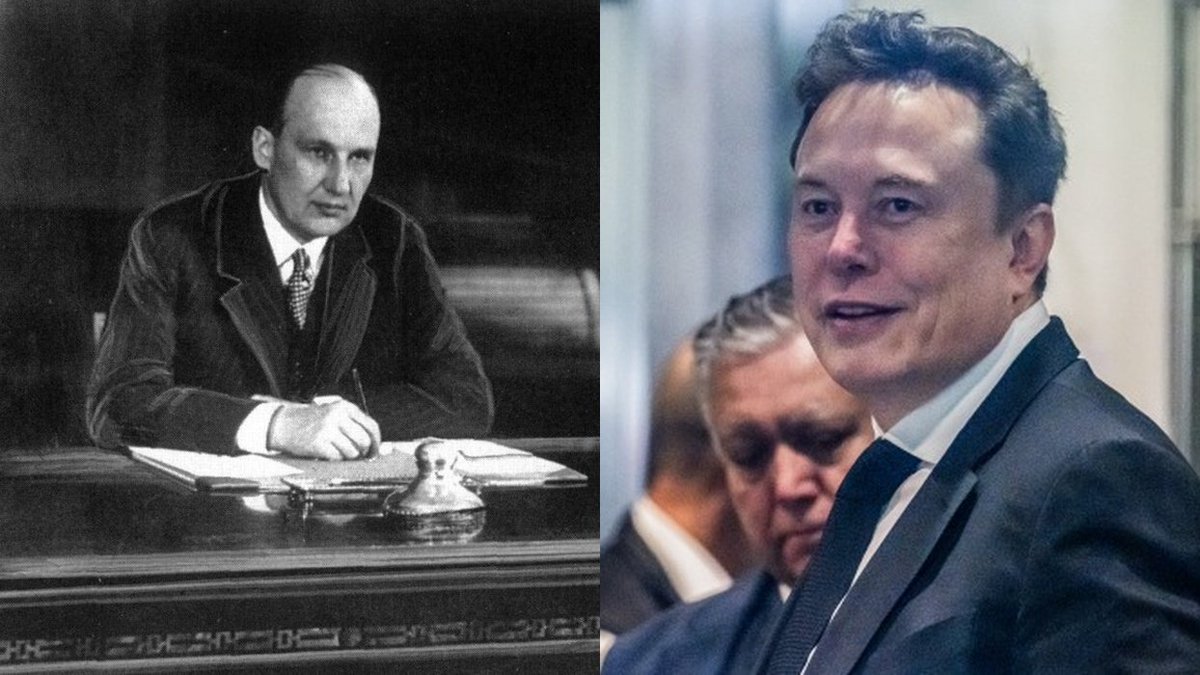
Elon Musk is the Ivar Kreuger of our time, and the OpenAI trial is PROVING it in real time.
If you don't know who Kreuger was, you should:
In the 1920s he was the most admired businessman in the world. The "Match King."
He controlled 90% of global match production, lent money to sovereign governments, and his securities were the most widely held in America.
But after his death in 1932, auditors spent 5 years untangling over 400 subsidiary companies and discovered the whole thing was held together with fictitious assets, forged bonds, and the unquestioning loyalty of people too dazzled to ask questions.
Investors lost $750 million (~$17 billion in today's money). His deficits exceeded Sweden's national debt.
Doesn't this sound familiar?
The Musk playbook is the most DANGEROUS house of cards I've witnessed in my career.
This week in federal court, Musk took the stand to argue that Sam Altman stole a charity. 3 days later he'd contradicted himself under oath so many times that the judge told his lawyers she suspected plenty of people don't want to put the future of humanity in Mr. Musk's hands.
OpenAI's attorney asked if Tesla is pursuing AGI. Musk said no. The attorney then pulled up Musk's OWN post from March 4 where he wrote Tesla will be one of the companies to make AGI.
His own words entered into evidence against him. BY HIM.
Then the attorney asked if xAI used OpenAI's models to train Grok (which violates OpenAI's terms of service).
Musk called it a general practice among AI companies. Pressed for a direct answer, he said "partly."
Think about that: Musk is in court accusing OpenAI of betrayal while admitting under oath that xAI violated the very same company's terms of service to build Grok.
Then came the credibility test:
Musk was asked to name his companies that benefit society. He listed Tesla, SpaceX, Neuralink, and X without hesitation. Every one of them is an uncapped for-profit enterprise.
Then why did xAI start as a benefit corporation and quietly flip to a for-profit C-corp? No clean answer.
This is someone who repeatedly launches entities with noble-sounding charters and converts them into for-profit corporations once the money gets serious.
Then his money manager Jared Birchall took the stand:
OpenAI's lawyer asked about the donor-advised funds at Vanguard and Fidelity that Musk used to send his $38 million. Did Musk have any legal right to direct where the money went once it entered the DAF?
Birchall couldn't answer. Said the legal question was beyond his expertise.
The entire lawsuit hinges on that donation creating enforceable obligations. But the man who managed Musk's money just told a federal jury he can't confirm Musk had any enforceable claim over those funds.
Now step back...
This is a man who promised full autonomy by 2018, a million robotaxis by 2020, and unsupervised FSD by June 2025.
EVERY deadline was missed.
He claimed he invested $100 million in OpenAI. The real number was $38 million. His defense? His "reputation" made up the difference.
Kreuger had 400 subsidiaries and used one entity to prop up another through structures nobody could follow. Musk has Tesla, SpaceX, xAI, Neuralink, the Boring Company, and X.
He shifts AI talent from Tesla to xAI, has xAI building the brains for Tesla's Optimus robot, and uses X as a megaphone while the algorithm amplifies his narrative to 200 million followers.
Kreuger's investors trusted the man, NOT the math.
They loved the confidence. They stopped asking questions because the aura of genius made questioning feel foolish.
The same psychology applies to Musk's empire today.
Kreuger's reckoning took 5 years of forensic auditing after his death. But Musk is providing his in REAL TIME: contradicting his own posts under oath, admitting to the practices he's suing others for, watching his logic collapse under cross-examination.
Different decade.
Different industry.
Same ending.
The truth always catches up.