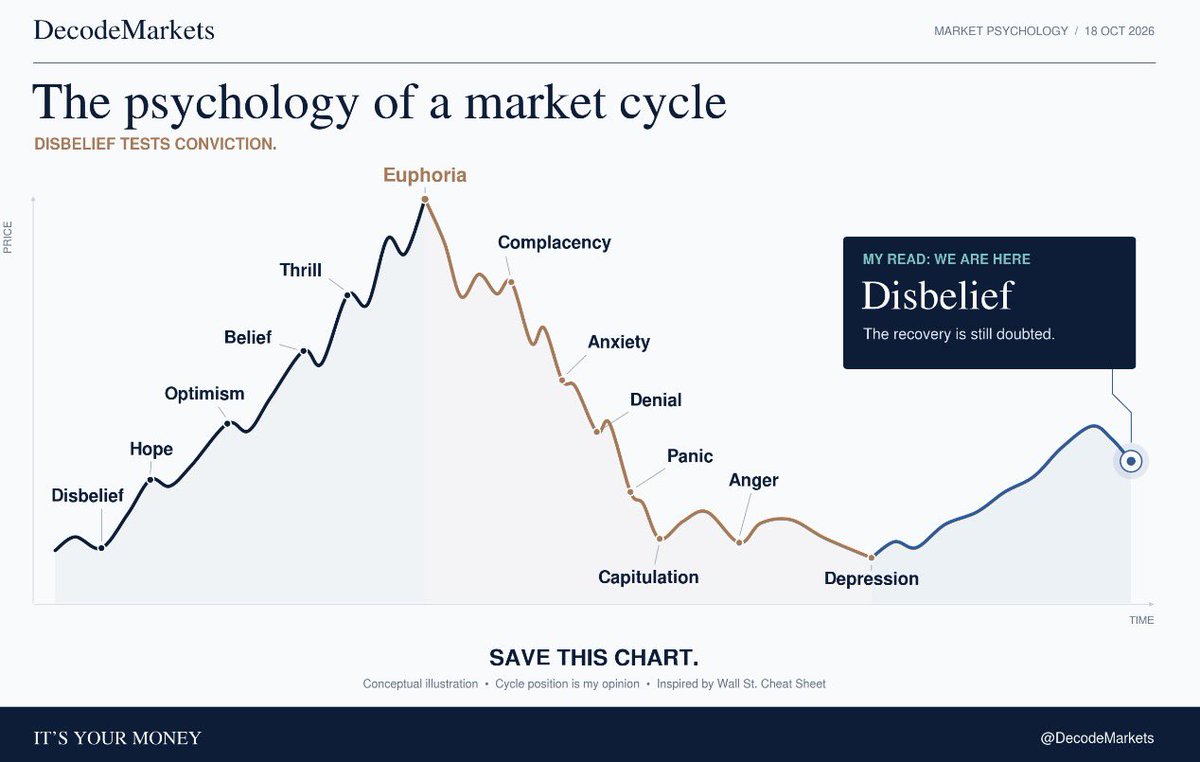
DISBELIEF is one of the worst places to give up. And it is exactly where so many people do. They survive the collapse, watch the recovery begin, then throw in the towel because a pullback convinces them nothing has changed.
$BTC went from roughly $58k to $87k while $ETH from $1,500 to $2,800.
Now they’re around $81k and $2,400 and suddenly the whole recovery is “just another sucker’s rally”. My DM talks and for a while it has been a great indicator.
Apparently a move only counts if it goes straight up and makes everybody comfortable.
I’m convinced this is where we are in the cycle. To me, this looks like weak hands being shaken out of a recovery they still refuse to believe, setting the stage for the next leg higher.
Price has recovered, but their psychology is still trapped in the bear market. And I expect some of the same people giving up here to chase higher once FOMO starts doing their thinking for them.
Meanwhile, BlackRock and JPMorgan already have tokenized funds on Ethereum. The financial system is changing in front of your eyes, and my conviction is that Ethereum will be central to that transformation.
Like it or not.
You can spend your time arguing with every red candle or studying what is actually being built.
Do your own due diligence. Study. Understand WHAT you own, WHY you own it and WHAT would change your mind. Keep checking the thesis. If it still holds, have patience. Sit tight and relax. Nobody can do that part for you.
Five-figure $ETH is my roadmap. Save this chart. Bookmark this post. And don’t come crying when $ETH is trading in five figures saying “nobody could have seen it coming”
Human psychology DOES NOT CHANGE.
Watching people tune out crypto reminds me of the boiling-frog fable. Everyone is numb, beaten down, looking the other way while the temperature keeps rising.
The US Treasury Secretary is comparing the GENIUS Act to Lincoln’s National Currency Act of 1863. The OCC just finalized its stablecoin rule. (Read that again)
People spent years waiting for this kind of regulatory clarity. Now it’s being written into the rules of the financial system, and they’re too exhausted by price to care. What’s happening in plain sight is staggering, yet the chart has convinced them nothing is happening.
Price has beaten people into ignoring the very developments they spent years waiting for. If price catches up, the same people will call it an overnight revolution.
The water keeps getting hotter.
The GENIUS Act marks a watershed moment in American finance, further cementing the United States as the crypto capital of the world. Just as President Abraham Lincoln’s National Currency Act of 1863 established a national framework for bank-issued currency, the GENIUS Act establishes a federal framework for payment stablecoins in the digital age.
The @USOCC's final rule carries that landmark legislation forward, providing a clear, practical foundation for private-sector innovation, competition, and American leadership in digital assets.
🇨🇭 FINMA just approved Switzerland first retail spot $BTC ETF, granting an exemption from diversification rules. More applications already in the pipeline. The financial system is adapting to Bitcoin. Right in front of your eyes.
News: JPM Coin (JPMD), @jpmorgan's USD deposit token, is now live on @ethereum.
JPMD extends from Base to Ethereum L1, giving institutional clients native onchain cash that sits alongside the assets, collateral and counterparties they transact with already.
J.P. Morgan has now added a cash leg to the products it already live on Ethereum mainnet, with tokenized money market funds MONY and JLTXX both already on the network.
Ethereum is the home of onchain finance.
Few, if any, understand where AI is heading better than Sam Altman. He co-founded World years before ChatGPT. I doubt that was a coincidence. The more convincing AI becomes, the more essential proving we’re human gets. $WLD $ORBS
In 2024, an employee at engineering firm Arup transferred $25.6 million after joining a video call where every other participant was a deepfake. Since then, AI has advanced significantly and is making impersonation increasingly convincing, causing challenges for financial institutions in particular. As autonomous agents begin handling more financial activity on behalf of people, establishing an added layer of trust and security behind a transaction or sensitive conversation is becoming an urgent need.
Introducing @world_id for banking and finance, a suite of technologies that helps institutions establish trust through privacy-preserving cryptographic Proofs. World ID for Zoom lets meeting participants confirm they are the same Orb-verified human connected to their account, while World ID for agents allows AI agents to carry Proofs delegated by people. Bain Capital, OpenExchange, Outtake, Pantera Capital, and VanEck Funds are initial design partners, bringing World ID into some of finance's most consequential interactions.
https://t.co/NakSyrdBtq
Bots generated 53% of web traffic in 2025. Cloudflare’s five-year projection implies ~99.9% if current trends hold.
Proof of human is becoming infrastructure.
World ID is now available to Zoom enterprise customers. The dots keep connecting for $WLD and $ORBS. $BMNR owns ORBS. Tom Lee sits on the board. My conviction keeps growing. The short interest still intrigues me. Further buybacks below NAV would send a strong message.
@Badie912@jvisserlabs I’m not married to $ETH or any other asset, not even $BTC. I look for asymmetry. Like him, I expect $ETH to outperform $BTC from here. That’s the trade. But you have to keep reassessing. Alone or with the help of your FA. Always. If the asymmetry changes, so does my positioning.
Connecting the dots…
Sam Altman co-founded World. $ORBS is the largest publicly disclosed institutional holder of $WLD, owns stakes in OpenAI and MrBeast’s Beast Industries, and holds $ETH
$BMNR owns $ORBS, has $180M directly invested in Beast Industries and holds almost 5% of the entire $ETH supply.
World Chain runs on Ethereum.
So what’s the missing piece?
DISTRIBUTION
Imagine MrBeast bringing hundreds of millions of followers into the World ecosystem, potentially onboarding millions onto Ethereum without them even realizing what an L2 is.
And everybody is still wondering where the next wave of $ETH FOMO will come from…
Human psychology NEVER changes.
Connect the dots
Connecting the dots…
Sam Altman co-founded World. $ORBS is the largest publicly disclosed institutional holder of $WLD, owns stakes in OpenAI and MrBeast’s Beast Industries, and holds $ETH
$BMNR owns $ORBS, has $180M directly invested in Beast Industries and holds almost 5% of the entire $ETH supply.
World Chain runs on Ethereum.
So what’s the missing piece?
DISTRIBUTION
Imagine MrBeast bringing hundreds of millions of followers into the World ecosystem, potentially onboarding millions onto Ethereum without them even realizing what an L2 is.
And everybody is still wondering where the next wave of $ETH FOMO will come from…
Human psychology NEVER changes.
Connect the dots
Norway 🇳🇴 today. Who’s next?
$SVIK.ST has spent 79 years building what money cannot buy… nuclear licenses, facilities and know-how across the lifecycle.
Comparable capabilities? Much of it in state-backed hands.
Studsvik? Independent. Listed. Investable.
Mr. Market, sooner or later is about to wake up
♻️ From first concrete to last fuel rod.
Our parent company Studsvik ($SVIK.ST) has signed a long-term agreement to manage Norway's legacy spent #nuclear fuel.
That's the full life cycle.
Full story:
▪️ https://t.co/1nRPdDRNNh
Hi William… it’s ALWAYS my opinion. I bought my first stock at 8. I’m 61 now. One thing 53 years of watching markets taught me… human psychology NEVER changes. First disbelief, then acceptance, then pure FOMO. You’ve laid out the fundamentals. I’m talking about what happens to PRICE when the crowd finally catches up.
Reality and price simply don’t agree. No matter where you look.
Five years of FUD + consolidation have compressed the spring.
History suggests the exit could be EXPLOSIVE, taking $ETH into the low-to-mid five figures once retail piles in on pure FOMO.
Time will tell. That’s my roadmap
Human psychology NEVER changes.
Strategic reality. Ethereum's infrastructure role is working as designed: it is creating more value than it captures, and that value surfaces as apps grow:
- Circle is expanding into 40 countries, with ~65% of USDC on Ethereum, reinforcing ETH as the monetary layer.
- Base, an Ethereum L2, moved $8.8 trillion in stablecoins in 90 days, 52.5% of all volume, $1.6 trillion more than L1.
The Internet value playbook.
Well, well… $WLD up 15% today.
Tom @fundstrat for someone who LOVES to BTD, isn’t THIS the moment to add more $ORBS to $BMNR?
Or are we waiting for Mr. Market to send a formal invitation? 😎
Worldcoin and $ORBS used to trade together.
Then they didn’t
$ORBS owns 283M+ $WLD and is the largest publicly disclosed institutional position.
Since early October, $WLD has held up while $ORBS collapsed.
Same underlying thesis. Very different market verdict.
Mispricing... or warning?
$BMNR still owns ~$85M of $ORBS
Tom @fundstrat if the World thesis hasn’t changed, you are almost done on $ETH for $BMNR .... Isn’t a deep discount exactly when conviction is supposed to matter?
Time to add?
3/3
Look at the first two bars of stablecoin transfers over 90 days.
Base: $8.8T
Ethereum: $7.1T
Add the other Ethereum L2s and the ecosystem carried 77% of the volume tracked.
Base IS an Ethereum L2.
Still very bullish $ETH
The price is testing patience…. this chart helps explain the conviction.
Do your DD. It’s YOUR MONEY
1/3
Mastercard knows “a little” about moving money. And it just launched a platform with BVNK that connects stablecoins, traditional currencies, cards + bank payouts.
For Cos operating across borders, less money tied up in prefunded accounts means more working capital.
$MA sees a business here and is putting the infrastructure in place.
Something to consider while the market debates whether crypto has a use case 👀
2/3
ARK chart now shows more than 300M addresses holding stablecoins.
Ethereum ecosystem share increased from 29% to 37% in two years.
Now think about what happens as banks + payment companies make those dollars available inside the apps their customers already use.
People don’t need to become crypto enthusiasts. They need a useful product 🤷🏻♂️
That’s why announcements like Mastercard matter. They make the next stage of adoption a lot easier.
@BitcoinJesusETH After five years of $ETH denial the awakening will go down in financial history books. And when it happens, it won’t be gradual. It’ll be FAST..
Markets love nuclear PowerPoints
Norway 🇳🇴 just entrusted its legacy spent nuclear fuel to Studsvik 🇸🇪 $SVIK
Potential agreement value: SEK 3–4bn through 2055.
Studsvik’s ENTIRE market cap? ~SEK 1.8bn.
This is the real thing.
Open your eyes 👀
Read the PR. Do your DD
👇
https://t.co/k8T8cIzHyG