Featured daily in @TheTradeXchange.
Six reports per week. Highlighting increasing distortions in markets. Debt & Leverage Supercycle → Commodities Supercycle
Physical oil prices have reached UNPRECEDENTED levels as the global scramble for crude intensifies:
Dated Brent, the price of physical crude for near-term delivery, surged above $154 per barrel on October 5th, the highest level in LSEG data going back to 1991, and remained above $149 last Friday.
In effect, the spread between physical Brent and benchmark Brent futures has widened to a record of more than $50 per barrel, highlighting the growing premium buyers are willing to pay to secure immediate supply.
Normally, longer-dated crude futures trade at higher prices because of storage costs and other factors, but the current supply squeeze has reversed this pattern, making near-term oil more expensive than future deliveries.
The squeeze is intensifying as crude inventories shrink, tanker availability remains low, and shipping through the Strait of Hormuz remains dangerous, with winter approaching and demand for heating fuels rising.
At the same time, Brent futures have risen far less than physical prices, reflecting expectations that oil flows through the Strait will eventually recover.
Meanwhile, intensified Iranian attacks are making these shipments increasingly difficult to secure, while rerouting cargoes and securing tankers add further costs and delays.
The global oil market is facing a historic supply squeeze.
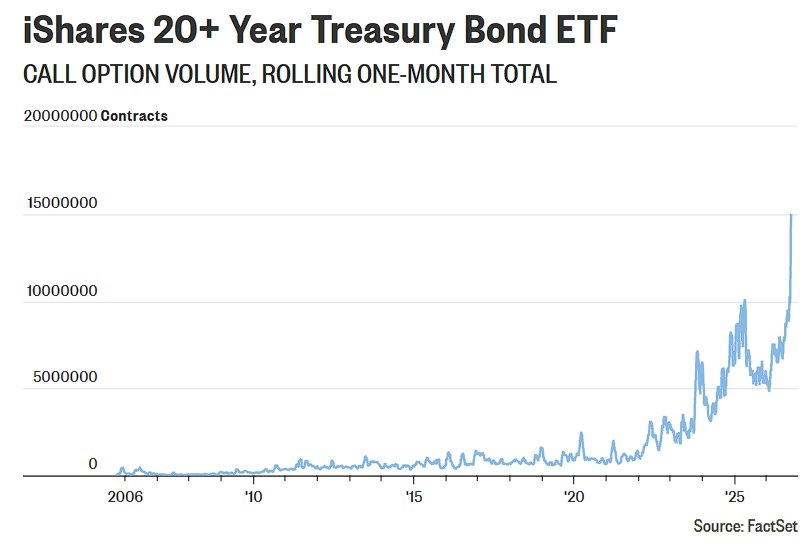
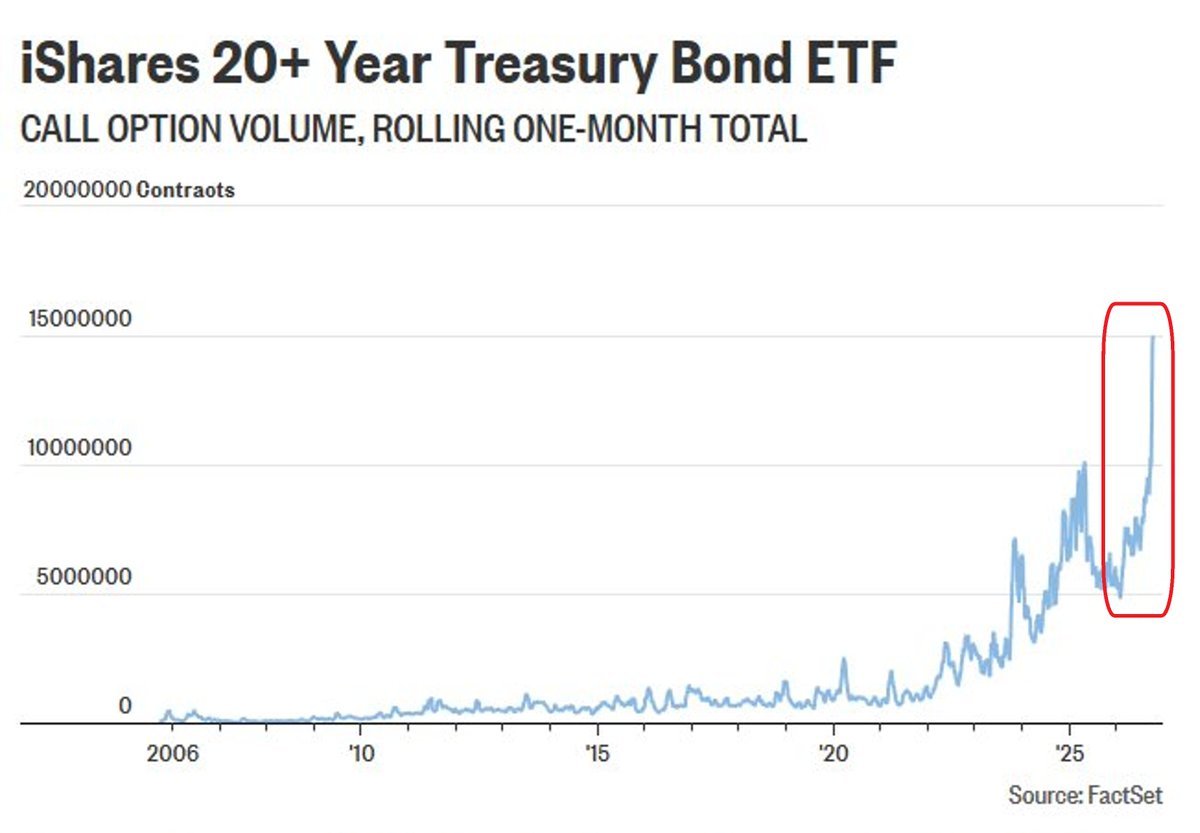
BREAKING: Call options on the 20+ Year Treasury Bond ETF ($TLT) just hit a record high of 14.9M contracts in one month.
Traders are betting that long term bond yields are about to fall and bond prices will rise.
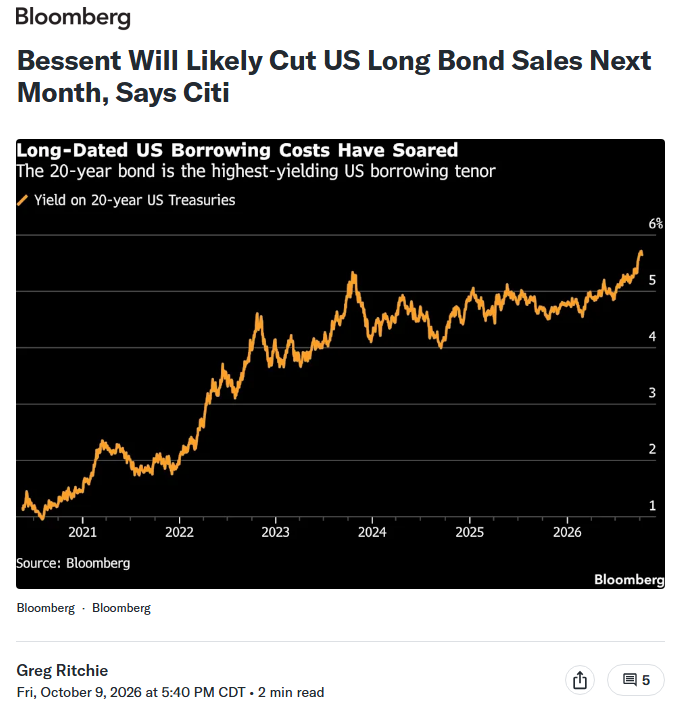
This comes after TLT fell 9% in Q3 and the 30-year yield reached its highest level in 24 years.
Americans are dumping their vacation homes right now.
In September, for every vacation home purchased, 2 were being sold.
This rate of vacation home dumping has held constant since May.
To the Gold reval guys. If Judy Sheldon concludes that China has more AU than the US [They do].
The US would make China stronger than themselves in a revaluation scenario. Therefore it is unlikely to happen, apart from a final act of desperation to extends its fiat/debt system when in death throes for a few more weeks.
I think gold should come down into October, and it looks like a buying opportunity. Gold usually rises in a geopolitical crisis. When people think it’s all over, Iran is defeated, ‘Why do I need gold?’ Then you get the correction.
The fat lady hasn’t sung yet. Gold will go up because you’re looking at war on so many fronts.
Curious to see how yields trade Monday.
You’d think they’d drop. Let me rephrase that:
They better drop.
You can only sell so many t-bills though.
This is big news.
You go to one of our conferences, there’s probably over $10 trillion in the room. I know the biggest funds in the world. They’ve been buying equities, real estate.
This is why the Dow has continued higher.
For the last year and a half, they’ve been swearing it’s going to be the biggest crash in 150 years. It kept going up because big foreign capital buys the Dow.
Treasury has begun to inject liquidity into the financial system.
The Treasury General Account (TGA) balance has dropped about $100 Billion this month.
When TGA falls, liquidity flows into commercial banks, which boosts bank reserves and overall market liquidity.
BREAKING: China’s central bank officially bought +23 tonnes of gold in September, its largest monthly purchase since September 2023.
This follows +20 tonnes purchased in both August and July, and marks its 23rd consecutive monthly gold purchase.
So far in 2026, China has officially acquired +103 tonnes of gold, raising total holdings to a record 2,410 tonnes.
China is now the world’s 5th-largest gold holder, following the US, Germany, Italy, and France.
At this pace, it could surpass Italy and France as early as this year, which hold 2,452 tonnes and 2,437 tonnes, respectively.
China is aggressively buying the dip in gold.
US stock market liquidity is COLLAPSING:
Average daily S&P 500 top-of-book liquidity has fallen -21% since 2023, from $14 million to just $11 million in 2026 YTD.
As a result, top-of-book depth per $1 billion traded has collapsed to just $11K, down -93% from $162K in 2017 and -59% from $27K in 2023.
Meanwhile, daily US equity trading volume has nearly tripled since 2017, from 6.5 billion to 18.7 billion shares.
The problem is that record trading activity does not translate into deeper markets, as more volume flows through ETFs, options and other derivatives rather than resting buy and sell orders.
Furthermore, liquidity also tends to disappear when volatility spikes.
In June, average top-of-book depth fell -33% from May to $8 million, even as daily volume reached a 2026 high of 22.8 billion shares.
The market is trading more than ever, but its ability to absorb heavy selling is shrinking.
This leaves stocks increasingly vulnerable to sharp moves when investors rush for the exits.