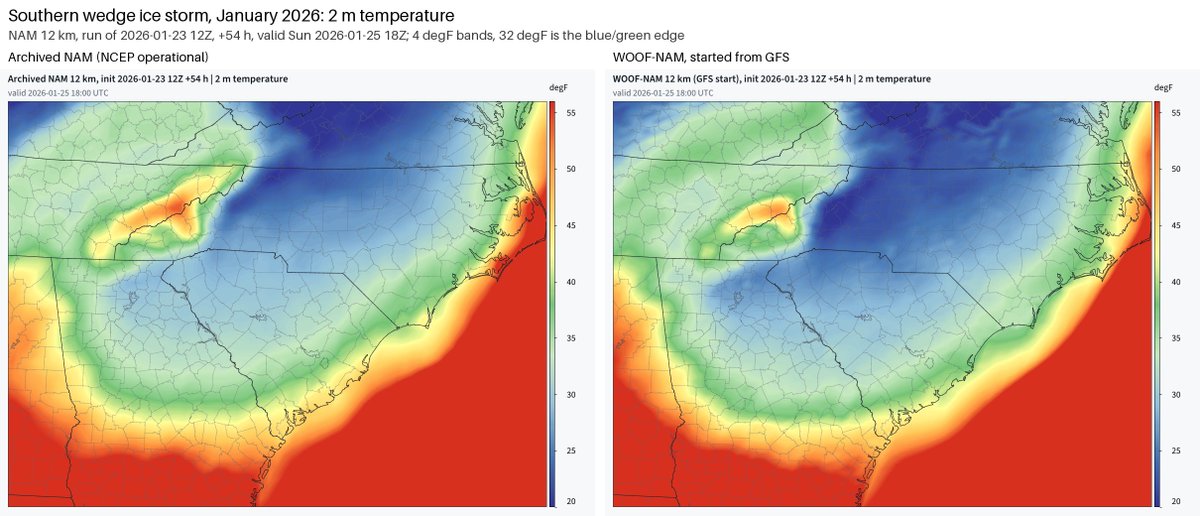
*We* let the dogs out! WOOF-NAM select imagery now available on our model page. Forecast soundings for the model hopefully coming tomorrow. -Gilbert
https://t.co/VQLTuvQ2ot
@WeferWX@amarkowitzWX Yeah no clue why people are making a big deal out of this. If AWS cannot handle 1000 vibe coded weather apps, we have much larger issues
One of the absolute best examples of ML can be applied in weather to solve extremely tough problems (snowfall) from one of the smartest people I know, excited to this and excited for future maps!
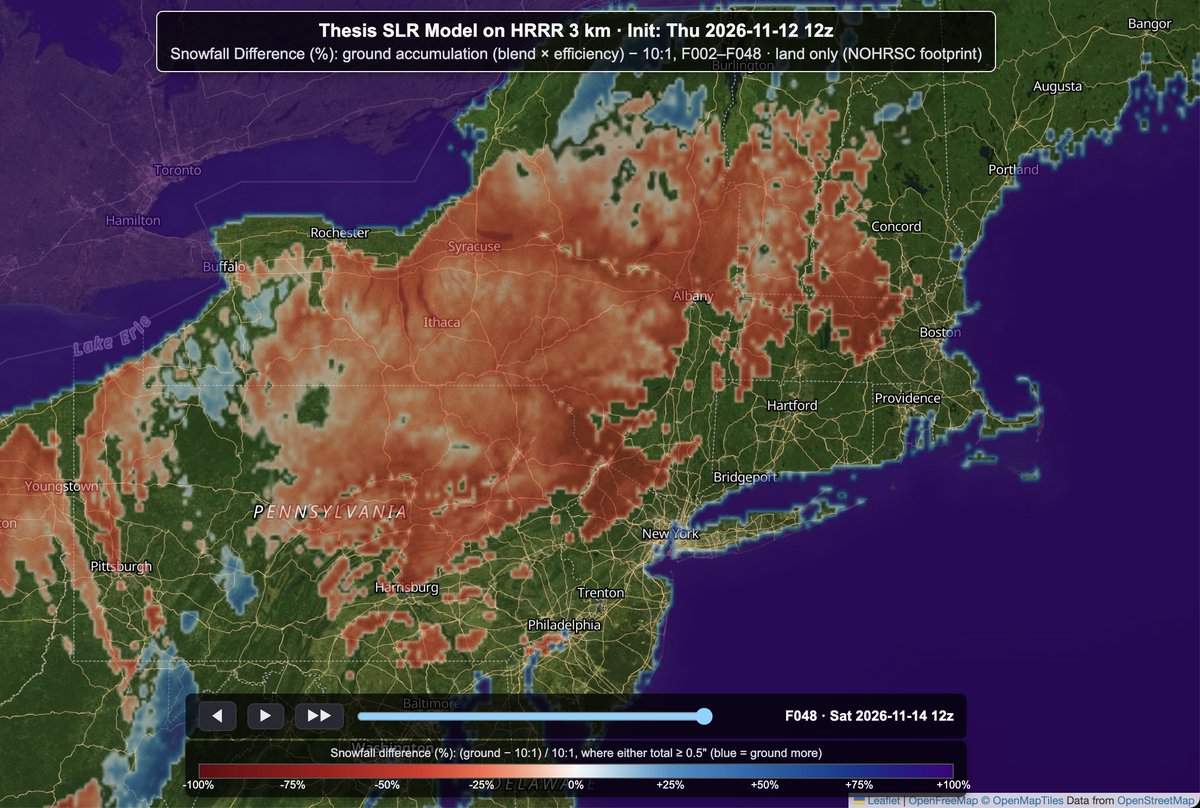
As part of my masters thesis, I'm working on a smarter machine-learning snow-to-liquid ratio. It clearly shows that this inland snow event will be restricted to higher terrain, and even there, ratios will average well below 10:1.
As part of my masters thesis, I'm working on a smarter machine-learning snow-to-liquid ratio. It clearly shows that this inland snow event will be restricted to higher terrain, and even there, ratios will average well below 10:1.
SharpJS v1.8.0 update is live!
- Light mode!
- Over 40 new graphics settings, with a new look!
- Tornado climatology refresh!
Read the full patch notes here: https://t.co/3Y8KZg4gHv
Try it here: https://t.co/NgLVjRGgLh
The fun part of everything being CUDA + Rust is that model physics works one column at a time. Once a scheme is a GPU kernel, it doesn't care which model it's plugged into. So you'll be able to run a WOOF-NAM config with WRF physics for example.
Using Recast WOOF GPU enabled WRF
I took the ECMWF IFS 00z forecast for Day 3-7 and generated output using RAP physics (similar to HRRR) at 9-km. This finished in 40 mins on RTX 5090 w/total cost of 50 cents. Can't say enough about how game-changing this is -- as it opens up mesoscale modeling anywhere on Earth for literally pennies a day. WRF, MPAS, or whatever model can be ported and executed on commodity hardware on-demand. You get the output delivered in whatever format (GRIB2, Zarr) so it can be cloud-ready from the jump even as the model is still running. Thank you to @recast and @DeepGuessr
NOAA retired the NAM this week. We ported it to the GPU and it's back, better than ever: WOOF-NAM, open source.
- 12 km CONUS, all NAM physics, 24 h forecast in ~20 min on a single RTX 5090 (32 GB).
- 8 GPUs: 6 h in 92 s. Multi-card is bitwise to single card.
- 4 km CONUS, 24 h in under 9 min on 8 GPUs. 3 km nests anywhere on Earth (Europe, Japan, CONUS): 48 h in ~7 min on one card.
SStarts from the NAM analysis or GFS today, IFS open data in the next release. Beside the operational NAM from the same cycle it's hard to tell them apart (pics).
Today it needs one 32 GB card for the full 12 km CONUS; ~15 GB is the target, coming soon.
https://t.co/Kd932pFxLx
@cho_tokisen It was just one case, but if you download the local version you can start from GFS, Euro, or ERA5 and place a domain over Japan, can probably cover most of Japan on a 12gb vram Nvidia gpu if I remember correctly.
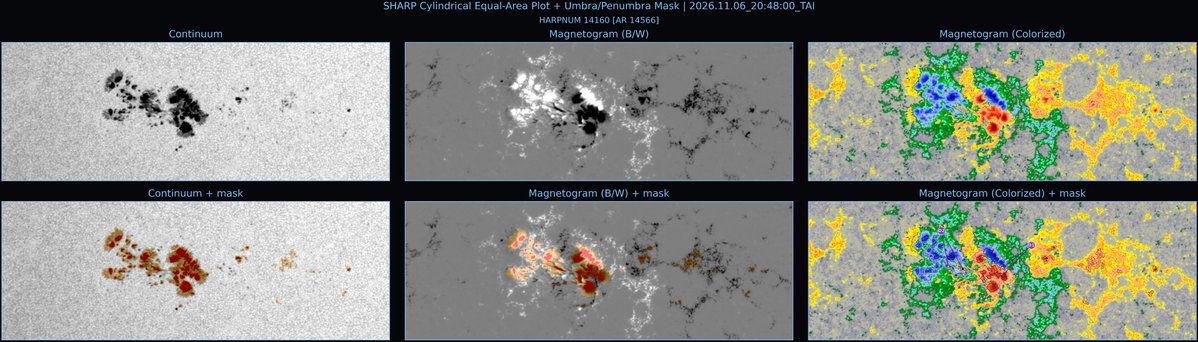
Latest look at AR14566! Still an impressive looking region that should by all means be capable of interesting flares and eruptions. It's been a bit tempered thus far but that could change, especially if it sees more growth!
I've run 12 hindcasts so far and it seems the two side by side are fairly close. Some issues i've seen so far is a cold air damming wedge that erodes a few hours early, some convective lines come in thinner before the model has spun up its own moisture, but nothing too crazy. Gribs will be on the file site later today for anyone to compare the hindcasts. I personally dont feel i have enough experience to determine whether its "close enough" to the real nam, but im interested in hearing everyone's thoughts!
👩🔬It's our people that make our science exceptional! Meet NSSL Research Scientist Miranda Silcott, recent @NOAA Team Member of the Month honoree. 🏐🏔️🥾🏕️
FULL STORY 🔗: https://t.co/77MAtXsxGe