Co-Founder & CEO @SkildAI, Faculty @CarnegieMellon.
PhD @UCBerkeley; BTech @IITKanpur
I study topics in AI (robotics, machine learning & computer vision).
@mrthemgoodstuff@GoingBallistic5@Rewkang@SkildAI It is recurring run rate. I am not sure where your screenshot is from, but this is the official article, along with details on how much has been recognized etc:
There’s robotics talk.
And then there’s robotics walk.
This here, is the walk 🙂 - incredible milestone for Team @SkildAI - $100m ARR, 10 months after 1st commercial deployment.
🇺🇸 Skild AI says it has crossed $100M ARR, around 10 months after its first commercial deployment, with more than 60 paying customers.
Notably they are one of the most heavily funded robot-intelligence startups, Skild raised $1.4B at a valuation above $14B earlier this year.
The company says it is now deploying its robot intelligence across factories, warehouses, data centers and other environments.
This includes work with NVIDIA and Foxconn on dual-arm robots assembling NVIDIA Blackwell systems.
The robotics companies that win won’t just have the best demos. They’ll have the strongest deployment loop.
Skild AI: first commercial deployment → 60+ paying customers → $100M ARR in 10 months.
Every deployment creates new problems to solve and new knowledge to feed back into the system.
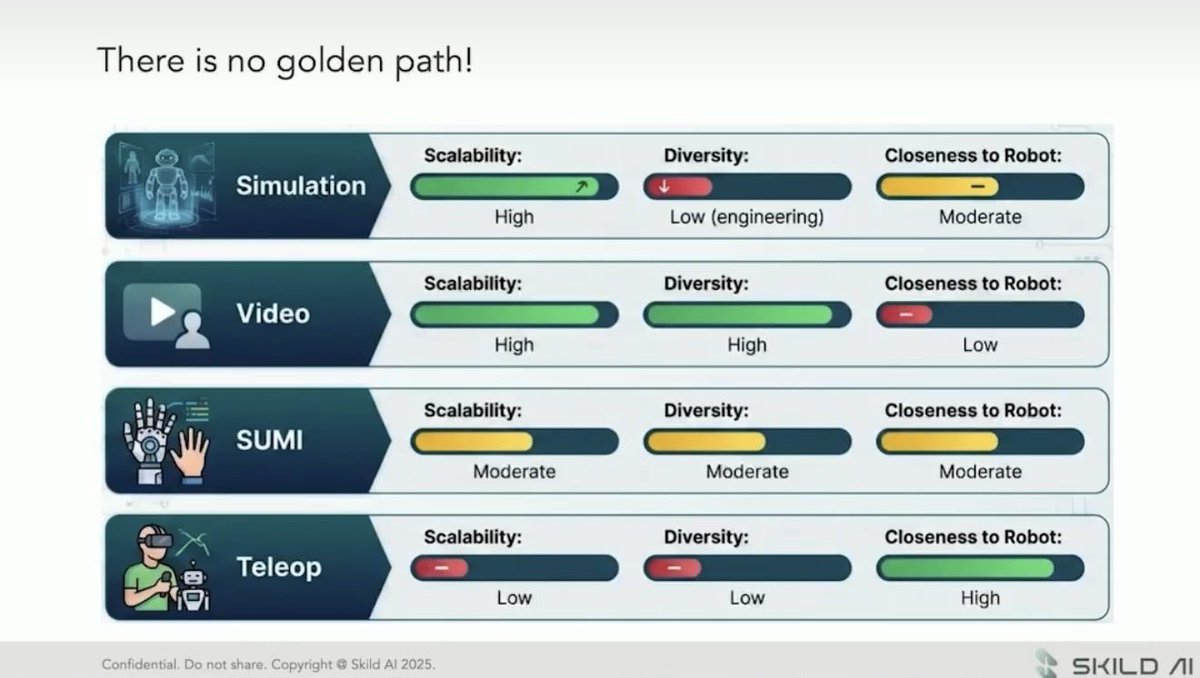
Have seen a few people (myself included) try to present data needs for physical AI as a pyramid, but this framework from @deepakpathak does a much better job at showing the pros and cons of each
Paraphrasing Deepak: “You cannot rely on one data source to scale contribution… A combination is what will solve the data robotics problem”
Congrats on the $100M ARR announcement @SkildAI !
For real world robotics deployments, learning the initial procedure is only part of the challenge. Most startups' robot foundation models are already able to do that.
To deploy in to the real world, robot also needs to adapt when that procedure changes. In-context learning offers a way to communicate those changes through another demonstration, rather than automatically starting a new data-collection and training project. That reduces the engineering required to keep complex deployments useful as the customer’s operation evolves.
Skild had a unique focus on in-context learning, and it is reaping the rewards in the scale of their deployments within the first year.
Great article from the Co- Founder of @SkildAI
"In robotics, you cannot leave deployment until the end.
How will the supply chain work? Who installs it? Who owns the integration? Who fixes it when it breaks? Who updates it when the process changes? You don’t fully understand these questions until you’re there.
Deployment is the hidden pillar of robotics research because it’s where robotics happens. There is no substitute."
I think its interesting to see Skild is using similar logic and deployment method as $CCXI / @agilityrobotics.
To a certain degree, it feels like Agility "forced" Digit into deployment, focusing on commercial traction rather than perfecting all of the technological components.
With that said, they have the highest level of deployment, the value of which we may not fully understand until humanoid manufacturing scales.
The "Data Flywheel" that Agility hypes is something I've touched on in my piece here:
https://t.co/A7eCwMqIhr
How did a $100m ARR robotics company solve scale?
"Unlike language models, speech or video, in robotics there are three axis to evaluate data quality. One is how scalable you are, how diverse it is, and how close it is to robot."
Robotics has four ways to collect training data. Each one comes with its own fault.
Robots collecting their own data produces the best-targeted data and scales slowest, because the physical world will not run faster than real time. Teleoperation is the industry default and produces almost no diversity. Simulation runs far faster than real time, but every new task needs an environment built by hand. Human video is the most abundant and the furthest from a robot, since a person has a different body and you cannot see the forces they apply.
There is not one "Golden path" as @deepakpathak put it on stage at AUTONOMOUS earlier this year.
@SkildAI
A banger memoir by @deepakpathak. @SkildAI had successfully been able to build something that was once a distant dream for robotics engineers.
The important part is they got it right after doing lot of things wrong! That’s how it must be.
Deployments deployments deployments! In the heated robotics battle, @SkildAI sure seems to be the front-runner in getting robots live. Exciting new development every week...
“If every change requires collecting a new dataset and running another round of post-training, you’re signing up to repeat that work for as long as the robot is deployed. This is not scalable.”
Adaptation Cost has always been the right metric for generalization. You must minimize it through diversity.
https://t.co/WQdTXjTcOo