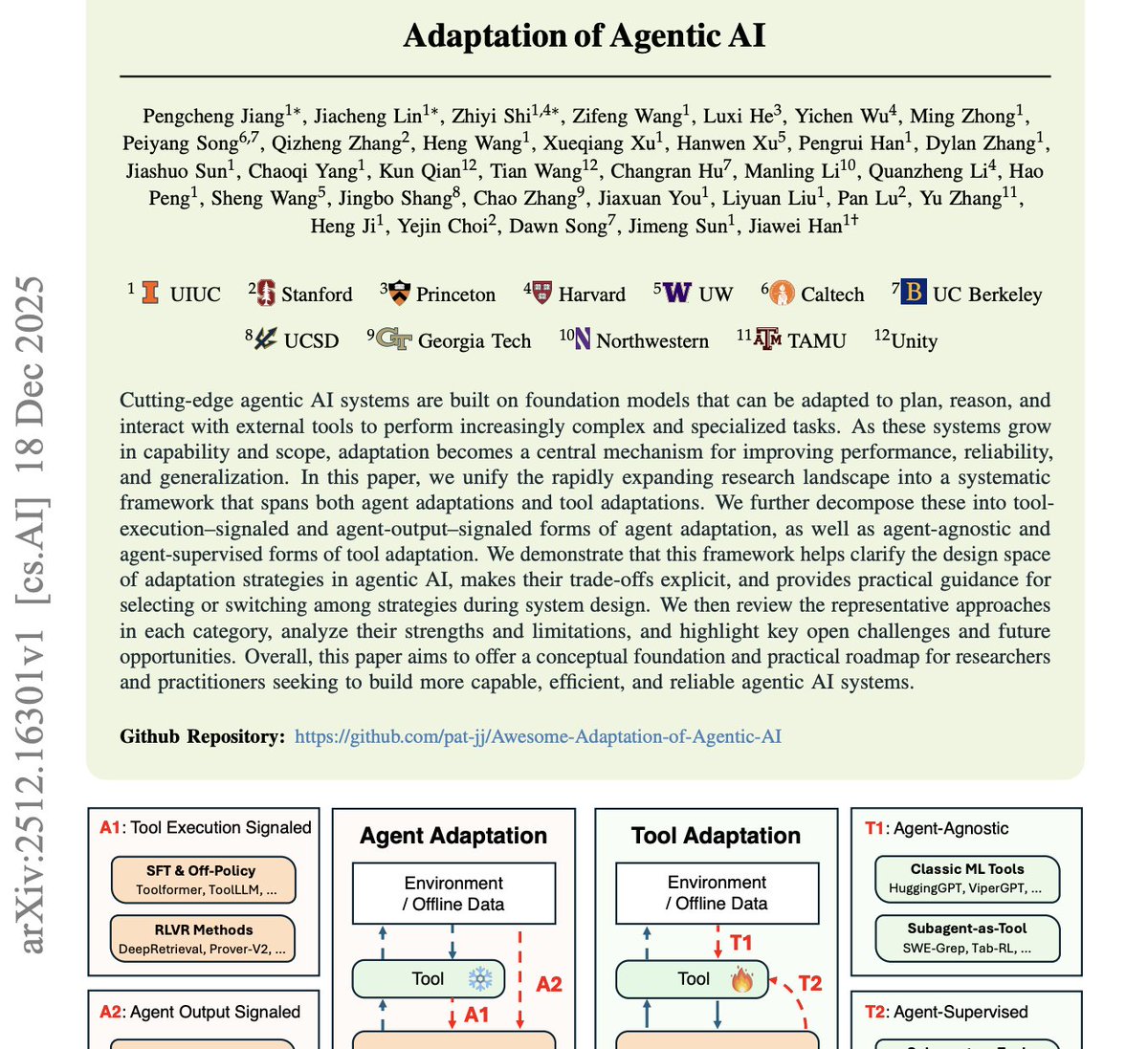
This paper from Stanford and Harvard explains why most “agentic AI” systems feel impressive in demos and then completely fall apart in real use.
The core argument is simple and uncomfortable: agents don’t fail because they lack intelligence. They fail because they don’t adapt.
The research shows that most agents are built to execute plans, not revise them. They assume the world stays stable. Tools work as expected. Goals remain valid. Once any of that changes, the agent keeps going anyway, confidently making the wrong move over and over.
The authors draw a clear line between execution and adaptation.
Execution is following a plan.
Adaptation is noticing the plan is wrong and changing behavior mid-flight.
Most agents today only do the first.
A few key insights stood out.
Adaptation is not fine-tuning. These agents are not retrained. They adapt by monitoring outcomes, recognizing failure patterns, and updating strategies while the task is still running.
Rigid tool use is a hidden failure mode. Agents that treat tools as fixed options get stuck. Agents that can re-rank, abandon, or switch tools based on feedback perform far better.
Memory beats raw reasoning. Agents that store short, structured lessons from past successes and failures outperform agents that rely on longer chains of reasoning. Remembering what worked matters more than thinking harder.
The takeaway is blunt.
Scaling agentic AI is not about larger models or more complex prompts. It’s about systems that can detect when reality diverges from their assumptions and respond intelligently instead of pushing forward blindly.
Most “autonomous agents” today don’t adapt.
They execute.
And execution without adaptation is just automation with better marketing.
If Sonam Wangchuk is a terrorist in Modi’s India, then every citizen who dreams of a better future is next in line
If you still support this government, you are not innocent. You are an enabler of this injustice
#SonamWangchuk#isupportsonamwangchuk
@east_bengaluru@DKShivakumar The chandapura signal in Sarjapur and the stretch before decathlon flyover are deplorable. It’s been like this for years and then the Dommasandra flyover construction has stopped. It’s horrible to commute in this road and there is absolutely no sign of any action!!!
@ChaseMc67@yacineMTB Thanks for sharing @ChaseMc67. That is a great example of moving forward with technology instead of back. (I saw some suggestions of whiteboard and flight tickets on this thread).
Would love to feature this example in the AI series. Will connect.
We shouldn't listen to people because we agree with what they think. We should listen when we're impressed by how they think.
Intellectual loyalty is defending strong convictions. Intellectual integrity is being convinced by strong arguments.
A key to growth is being willing to change our minds. @waitbutwhy https://t.co/nSGKHuX0oN
Are you thinking of #NewYear#resolution?? This #research gives you useful pointers.
1) Set goals you move towards (achieve something) rather than move away from (will not do x)
2) Be specific
New Year's around the corner! Are you planning to set some resolutions? Check out some research backed tips to help those new year's resolutions stick!
Here's to making 2023 awesome!
This topic of #assumptions and #learning was fun to explore. Got a lovely #quote from @VivekUvaach after this one
"Assumptions are the termites of relationships" - Henry Winkler.
How do assumptions impact us? They prevent us from seeing things as they are.
Explore this facet through a story, research and quote!
https://t.co/Ui92EJQRz1
This was an interesting panel discussion to have been a part of on the current mass #layoffs plaguing many #industries globally.
https://t.co/tyA4Cwm9l9
"A big office may no longer be more prestigious than a resilient, productive workforce that works where it wants to. A loud factory crammed with workers might not be the sign of power and influence that it used to be.
Norms seem normal. Until they’re not"@ThisIsSethsBlog
#Expertise
"In a competition between someone who knows the most and someone who is willing to #Learn the most, the edge usually goes to the #curious and empathic #professional, not the one who is simply protecting what’s already known"-via @ThisIsSethsBlog
Ideas are everywhere if we look for them. But should you go and implement the idea right away? A useful way of working that we bring to CxO teams across industries is data driven decision making. Here is a story of a company which did just that. Watch this story from @Starbucks
"Some things are a job, others are a craft. The primary difference is not the task, but the enthusiasm and curiosity put into the task. The more engaged and interested you are, the more it becomes a craft." Via @JamesClear#work#job#craft#curiosity