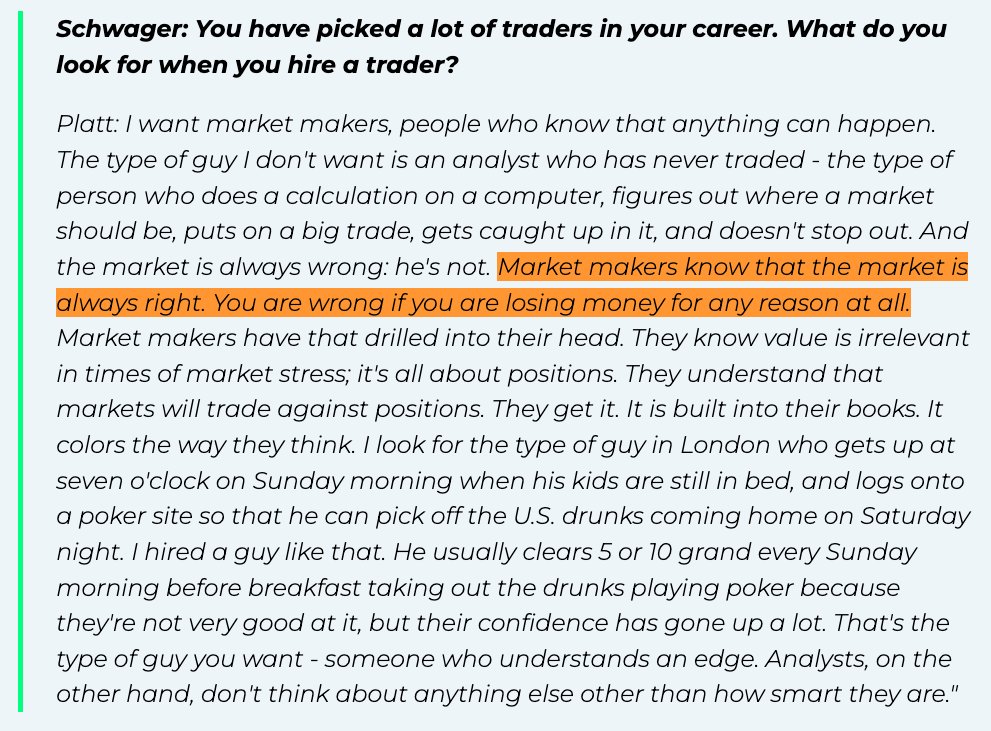
If you cannot patiently wait for good setups to come in, you will eventually need to patiently wait for funds to come in because you have lost so much to worse setups
The World is Changing: AI For Creativity
By Jeffrey Katzenberg
A few months ago, I sat in my office in Silicon Valley and watched as a tech founder showed me something extraordinary. On the screen was a fully realized, beautifully lit, well-composed animated scene. It was stunning and it made me feel exactly what I felt in 1986 watching Luxo Jr. That was the first time I watched a computer-animated 3D character take a breath and seem, against all reason, to have life. It left me in awe.
Later that day, I received a text from an artist I've known for thirty years, 350 miles to the south, in the city where I spent most of my career. After seeing a similar video, she texted: "Is this the end of us?" My answer was, "Certainly not.”
I have spent the better part of the last decade in Silicon Valley, but the heart of my career has been in Hollywood. Being deeply connected to both worlds means I have deep loyalties to each and a responsibility to speak honestly to both.
In 2023, I said that these new AI tools would cut the time and cost of producing world-class animation by as much as ninety percent within three years. Some colleagues were alarmed, many were furious.
There is growing fear and resistance surrounding AI within the creative community. I deeply understand it, because I've spent countless hours walking through animation studios watching gifted artists bent over their desks, rebuilding a single second of film for the tenth time because the ninth version wasn't quite right. I've sat in screening rooms where four years of people's labor played out in minutes, and I knew the name of every person that had spent countless hours bringing those images to life. The creative process is a calling, there's really no other way to describe it. From the outside some see resistance. From the inside, it is love.
People do not fight this hard for things they don't care about. The pushback coming out of Hollywood represents the collective effort of people who are deeply passionate about their craft.
Is History Repeating Itself?
The history here is more complicated than either side may realize. In 1906, the most famous composer in America, John Philip Sousa, published an essay titled “The Menace of Mechanical Music." He warned that the phonograph would become "a substitute for human skill, intelligence and soul."
Sousa's fight was not really about the machine, it was about money. The machines were playing his compositions, and the men who built them weren't paying him a cent. His campaign helped create the Copyright Act of 1909. He did not stop the technology. He changed the terms under which it could use his work.
A hundred years ago, sound came to the movies. We remember it now as a miracle, and it was. What we forget is who paid for it. Before sound, tens of thousands of musicians made their living in the orchestra pits of movie houses, scoring every film live, every night, in towns all over the world. When the soundtrack arrived, the work of one composer and one orchestra was recorded for a film that went into thousands of theaters. The union fought back with everything it had, taking out newspaper ads across the country warning against the menace of "canned music," one of them showing a mechanical man tearing the strings out of a harp while an angel wept.
They were not fools, and they were not Luddites. They were right. Those pit jobs did not come back. And yet (this is the part we have to be brave enough to admit), sound gave us the movie musical, the modern score, sfx, sound design, audio engineering, and an art form vastly larger than the one it disrupted. And it helped keep Hollywood in the forefront of world entertainment for the rest of the century and into the next. The loss was real. And yet the art form expanded.
This is a story that has been told over and over again. To resist technology is to risk irrelevance. Just look at Kodak or Blockbuster. To embrace technology is to open doors of new possibility. Just consider Apple and Netflix.
What I Learned From Walt Disney
In the mid-1980s, I was tapped to lead Disney's animation division at a moment when the studio was at an inflection point. Animation wasn't just another business unit. It was the soul of the company, a medium revered because of Walt's genius and his passion. But the production system was cumbersome and unforgiving. A single movie was 125,000 individual hand-drawn and painted cels, photographed one frame at a time. Every revision carried a cost measured in months. These degrees of difficulty shaped the kinds of stories we could tell.
We found our way forward in an unexpected place: Walt himself. The Disney archives held astonishing recordings of Walt explaining his creative process. His own writings. His notes and storyboards. Work product captured at every stage of his process. This was truly a gift. Listening, reading, sitting with the work itself, we heard him talk about character, about emotion, about how an audience feels when a character truly comes alive. He talked about making bold choices and refining a scene until it genuinely moved people. We didn't hear a word about pencils or paintbrushes. In fact, Walt was famous for being a technologist, forever hunting for state-of-the-art tools, often inventing them himself to achieve the images he saw in his head. But he never defined animation by the tools. He defined it by whether the audience believed the character. His principles were timeless. The tools were not.
That realization changed everything. We co-developed the Computer Animation Production System (CAPS) with a young Northern California company called Pixar, replacing hand-painted cels with CGI. In The Little Mermaid, the final scene shimmered with a dimensionality and light that the old process simply couldn't achieve. In Beauty and the Beast, the ballroom sequence moved with a cinematic sweep that placed the audience inside the emotion of the moment. In Aladdin, the Cave of Wonders felt vast and alive, and the Magic Carpet became an intricate, compelling character all its own. In The Lion King, the stampede carried a scale and intensity that raised the emotional stakes beyond anything we'd done before. Technology didn't diminish the craft, it expanded the canvas. It gave artists more room to create.
A decade later, the canvas expanded again. When Disney released Pixar's Toy Story, it wasn't simply a technical milestone. It was proof that a fully computer-animated film could carry real emotional weight, that it could make audiences laugh, cry, and believe. At DreamWorks, we made the difficult decision to sunset hand-drawn animation and become a fully computer-animated studio. It was the right thing to do, but it was not without pain. It cost talented people their place in an industry where they had worked their whole lives. Some made the leap to the new tools and did the finest work of their careers. Some never did.
Tools are never the point. The instruments change with every generation. What endures is taste and imagination. The magical ability to make an audience feel. One of the greatest storytellers of our generation, George Lucas, succinctly captured the eternal essence of this issue: “It’s not the how, it’s the why.”
A Distinction With a Difference
I asked one of the leading AI models a question that has been challenging me for months. What is the difference between reasoning and creating? Its answer changed how I think about almost everything happening in this industry. It said . . .
Reasoning and creating are two distinct cognitive modes, though they also work together. Reasoning is fundamentally evaluative and analytical. It operates on what already exists: facts, premises, evidence. It moves toward a conclusion that was in a sense already implied by the input. Reasoning is constrained by logic and truth. Its goal is to arrive somewhere correct, not to invent somewhere new.
Creating is fundamentally generative. It produces something that didn't exist before. And crucially, there's no single right answer waiting to be found. A blank page has infinite valid responses. Creation involves choices that can't be fully justified by logic alone. Taste, intuition and vision fill the gap where deduction runs out.
Reasoning is what Silicon Valley has been perfecting. Creating is what Hollywood has been practicing for more than a century. AI today operates almost entirely on the reasoning side of the line. It can deduce, evaluate, optimize, and pattern-match brilliantly. And while it can create, there is a real distinction to being creative. What it doesn’t yet have is those things that make us human: empathy, devotion, serendipity, the kind of creativity that comes from a person trying to say something only they could say. When the bot generates a piece of art, it is not trying to communicate anything. It is statistics, not soul; it is emulating things that have been done. By contrast, human creativity isn’t about repeating patterns of zeros and ones; it is about doing something new.
One day, AI may close this gap. Three years ago, the leaders building AI would have called what they are achieving today, improbable, if not impossible. Impossible is no longer improbable.
Today, the line between reasoning and creating is real. Even the leading technologists acknowledge we are not there yet. There is no scientific path to crossing this divide that anyone in the field can articulate today. Understanding that gap is where we will find common ground.
A Path Forward
In 2016, I closed one chapter in Hollywood with the sale of DreamWorks and opened another in Northern California, co-founding WndrCo. We’ve backed more than 50 founders building the next generation of technology and watched how breakthroughs in Silicon Valley emerge, first as experiments, then as platforms, and finally as infrastructure that reshapes entire industries. It's worth remembering that the last great revolution in animation also came from the north. Pixar was a Northern California company, forged not in the conventions of the Hollywood studio system, but in the technological breakthroughs of Silicon Valley. I've spent years on both sides of this bridge. For sure, I don’t have all the answers (take Quibi, for one!). But, from my past and present vantage points of my long career, here is what I see . . .
Brilliant people in Northern California building this technology have made something extraordinary. They have earned the right for the rest of us to be, if not believers, at least optimistic that what comes next will be remarkable. But they have not made an artist. The tools are powerful, but they are not what makes a story matter. That knowledge lives 350 miles to the south, inside people whose life's work has informed the very models you are building. The right path forward includes them by design, with credit, with consent, and with compensation. Build this with the storytellers. Not on top of them. Taste is not something that can be synthesized, it is uniquely human.
At the same time, Hollywood needs to accept that AI is not going away. The energy they are spending trying to make it disappear is energy they are not spending deciding the terms on which it will exist. And the terms are everything. The north needs something from it that they cannot build and cannot buy: creativity. The kind that takes a blank page and conjures a single right answer where there was none and has held audiences for a century. Without it, the most powerful reasoning engine ever invented will still be missing the only thing that makes a story worth telling.
The artists who learn to wield these new instruments will do things the engineers never dreamed of. They always have. Edison invented the motion picture but made terrible movies. It took Chaplin, Lloyd, Keaton and so many others to make movies emotional. Now, the canvas is about to expand yet again. We should decide now that we intend to paint on it.
There are so many valuable lessons in history. This has happened many times before, and it was never settled by the technology. It was settled by the terms. Sousa did not stop the phonograph; he helped write the law that made sure composers got paid. And two years ago, when the writers and the actors walked out, they were fighting for the very things Sousa was fighting for in 1906. Consent, compensation, the basic recognition that human creative work has a price that must be paid. The terms of that fight are still being negotiated, but the principle is older than any of us.
The tools-versus-no-tools argument is a trap. First, we must all agree that there should be terms. Then we can have the crucial debate about what fairness requires.
What I Learned From Steve Jobs
Years ago, Steve Jobs said, "It's in Apple's DNA that technology alone is not enough. It's technology married with the liberal arts, married with the humanities, that yields us the result that makes our hearts sing." He was describing a device. But he could just as easily have been describing this tale of two cities.
What I See Coming Soon
As the barriers and the costs come down, more films will get made, not fewer. Studios will get to take more risks. There will be more seats at the table, and very soon entirely new forms of storytelling. In the 1980s, animation was dismissed as a niche corner of the business. Today it is one of the most beloved and profitable forms of storytelling in the world. In live action, filmmakers like Steven Spielberg, James Cameron and Peter Jackson embraced new visual tools not as shortcuts, but as instruments, and expanded cinema in the process. Every time storytelling has met a genuine technological shift, from synchronized sound to color to computer animation, it has redefined the boundaries of the medium and grown larger in the process.
Assuredly, I don’t have all the answers, but I am confident that the creative opportunities will expand yet again. How we come through this is a choice. The north has the new tools. The south has the creative soul. The best future will draw on the best of both worlds.
yeah so basically trump got cocky after succeeding with venezuela and had a hot hand and decided to double down and strike iran in february thinking they could take over the country in a couple of weeks despite everyone telling him it was a bad idea and would drag on
nothing really happened and then Iran learned that they can actually close the strait of hormuz and were unsure if it would even work but now its become obvious they can do it and feel empowered. the iranians have a longer history as a culture and are slow walking trump as much as possible as they know that higher oil prices are going to ruin his odds in the midterms and weaken him
not only that but now higher energy prices are putting upward pressure on inflation and bond yields which has made the job of his new fed chair warsh who came in under a premise of potential rate cute but because of the iran war were entering a rate hiking cycle
the only person in the room who was trying to juggle all of this was scott bessent but after trying to juggle everything for so long he decided he was going to try and fight the bond vigilantes to lower bond yields and declared himself as the house. but he showed up to the bond fight with hardly any ammunition and now the bond market is calling his bluff and now the bond auctions are going terrible and he looks like a fool now
so now bond yields are surging export bans on diesel are being put in place as an act of desparation midterms are a total write off and the trump admin is about to spend the next two years probably fighting impeachment hearings while things continue to detoriorate and the funny thing about all of this is he won the presidency off the idea of no more foreign wars but its his own foreign war with iran that started this whole mess and now the free market is testing them all
We’re in the “phone phreaking” era right now for AI agents. AI agents are selling you on convenience; how they will actually work at scale is very different: a cautionary tale
Back in the 60s and 70s, some kids figured out you could use toy whistles and the like to control AT&T’s phone network. AT&T actually published the relevant frequencies in open literature; you could just look them up. AT&T did this for the benefit of telephone engineers; it never considered that the system could be hacked.
The system worked so long as no one took advantage of it. It was convenient. But once knowledge spread of *how* it worked, and how easy it was to reverse engineer, it broke down. AT&T shifted over to a different system, and phreaking came to an end
AI agents are doing the exact same thing. They’re taking advantage of a system that works on human trust, and also on the friction - the time cost - that having to call or chat to a customer service agent imposes. Everyone has made the calculation about whether or not it was “worth it” to make a complaint or request or to raise an issue. Often, it isn’t. So you just don’t say anything.
AI agents reduce the cost of complaints/requests to ~ zero. Anything free is consumed at much higher rates, so we should expect the total volume of this category to explode.
Further, today companies and their employees typically assume that the complaints or requests they receive have an actual person behind them. Once AI agents become a mainstream thing, this will no longer be true. Now the assumption will be reversed: that any given customer interaction is actually coming from a bot.
Just as early car ownership was liberating, but mass ownership represents a constraint on your freedom, the same will be true with AI agents.
People using these agents today are getting good responses from companies because they are benefiting from the (now unwarranted) assumption that these requests are coming from a person. They’ll
no longer think this in the near future. The ways they train their customer service people to deal with customer requests will change, too. You don’t have to be nice to an agent. And they won’t be. The return to AI agents will decline as companies build entirely new workflows to deal with the huge volume of automated requests they’ll be getting from bots in the near future
The system today works on trust: that there’s a real person behind each customer interaction, and that if somebody has reached out to you, they’re concerned or mad or scared or whatever enough to do so. The contact is a signal that some minimal threshold of importance has been met. The business model is built on this belief about customer behavior.
But that trust is broken by ubiquitous AI agents. None of the current assumptions will hold true in the future. Once the customer population is mostly bots, the nature of customer service (at least online) is fundamentally changed
Agents will make the online environment even worse. I’m very bearish on the category. All the tech guys seem excited by this new frictionless world of automated convenience where the agents are getting you automatic refunds and canceling your old subscriptions and getting you that free upgrade on your next flight
Please.
You’ve got to think non-linearly. All these new frictions will need to be introduced to keep the system working smoothly. Agents rely on deception; that there’s a person behind them. But that’s not a safe assumption anywhere. So the system will adjust, just as it did with the phreakers: from default open and trusting, to adversarial: prove you’re human
It still amazes me how long it often takes the markets to react to something like Muse
META released Muse on September 8th, right around 2 weeks ago (Instinct was even earlier, at the end of August and had similar implications)
You had over a full week where nothing really happened besides $META slowly moving higher. That is until Monday, where META shot up 11% and all the Muse winners (especially CPUs) and the agentic losers really started reacting. Has Muse gotten any better since it’s launch? Nope
Just goes to show how much price drives the narrative
DeepSeek engineer just published an essay explaining, in detail, why he's personally accelerating the AI that will make his own life's work obsolete.
His name is Shengyu Liu. His code sits inside DeepSeek V4.1's main attention kernel. A year ago AI could help him look up docs and hunt bugs. Now it reads CUDA, PTX and SASS on its own, analyzes stalls per instruction with professional tools, and iterates. His estimate: six to twelve months until it matches or surpasses him.
The part that got to him isn't unemployment. He thinks he'll stay in the industry. But the work shifts from writing kernels to piloting an agent that writes kernels. He used to sit at his computer for an afternoon meticulously tuning performance like a speedrunner chasing his own record. Those afternoons are ending. His phrasing: leave his talent behind in yesterday and become a pilot for an agent.
Then the essay pivots. Liu argues society ends up in one of two places, communism or Cyberpunk 2077. Either frontier AI becomes cheap infrastructure everyone can access, or a handful of companies own it and lock everyone else out. He describes the lock-out as a dead loop. You need the strongest AI to gain resources, but you need resources first to access the strongest AI. He says outright he doesn't believe Anthropic or OpenAI will voluntarily open their frontier. That's why he's staying at DeepSeek. To open-source enough to pull the world a step away from the second scenario.
MY THOUGHTS
This is the most honest essay I've read this this recently (sorry little angel).
Everyone warns about AI taking jobs. Liu is a practitioner at the frontier, personally speeding up his own obsolescence, who has done the math and is doing it anyway on ideological grounds. That's a different essay than the ones coming out of American labs.
The dead loop is the sharpest framing of AI inequality I've seen from inside the industry. You need top-tier AI to earn the resources that pay for top-tier AI, or you don't get in. That's not a warning about the future. That's a description of how enterprise AI pricing already works. Microsoft canceling its Claude Code licenses last week was the same story. Copilot users burning through credits in two hours was the same story. The people with the most money buy the best models, which earn them more money, which buys the next tier. Everyone else runs on the weakened version.
Anthropic and OpenAI dance around the concentration question in every safety essay they publish. Liu names it. His answer, that open weights are the only thing standing between us and a permanent AI class system, is what's actually motivating a lot of Chinese AI labor right now. Not nationalism. A bet on who owns intelligence in ten years.
He is a person building the thing that eliminates him, doing it on purpose because he thinks the alternative is worse. That's not a career anxiety post. That's a worldview. And the person writing it works on the kernel.
Jensen is clearly running out of patience with the lab CEOs. He anchors their rounds / IPOs, supplies the compute, then gets another doomerism sermon.
Eventually he says, fine. No more GPUs for you. I’ll build the lab myself.
Let them eat ASICs
Ever wonder why the Big Short legends like Michael Burry and Steve Eisman are now selling subscriptions?
Why so many legendary investors became star guests on CNBC: Bill Gross, Jeremy Grantham, Jim Chanos, Carl Icahn, Bill Miller, Mohamed El-Erian.
Why Paul Tudor Jones, who reportedly once tried to keep old footage of himself trading out of circulation, is now a regular market commentator.
It would also be fascinating to follow every investor who appeared in Market Wizards and see where they are today.
I suspect the full stories would look much less magical.
MAYBE a couple would prove to be genuinely exceptional. But most probably found one great wave, rode it brilliantly for one cycle, then spent years underperforming the index until they quietly disappeared.
Markets are very good at turning luck into genius during the right cycle.
There is no such thing as a permanent edge.
What worked for five, ten, or even twenty years can stop working.
The real test is not whether you had an edge once. It is whether you can keep adapting after it disappears.
Warren Buffett's greatest returns didn't come from Coca-Cola or Apple.
They came when he was a microcap investor. And his favorite stock had a $1.25M market cap.
In 1953, Buffett sells his ENTIRE GEICO stake for $15,259 and puts half his net worth into a stock no broker would ever pitch him: Western Insurance Securities of Fort Scott, Kansas.
The company was earning $16 a share while the stock traded between $12 and $20. One times earnings. With only 50,000 shares outstanding, the whole company was valued around $1.25 million, while sitting on a $22M bond portfolio and a book value of $86 a share. Buffett was paying roughly 37 cents on the dollar of book.
He found it flipping through Moody's manuals page by page. It was so illiquid he ran ads in the local newspaper to buy shares off farmers and townspeople.
By 1955 the stock hit $95. Roughly a 6x from his cost.
Buffett said his 50%+ annual years in the 1950s came from exactly this kind of hunting: "You have to find the companies that are off the map, way off the map."
But the story doesn't end there.
In 1976, when GEICO nearly went bankrupt with a $126M loss, the stock down from $61 to $2, and regulators circling, he came back. He saw the one thing that hadn't broken: GEICO was still the low-cost producer in auto insurance. No agents. Direct to customer. A moat that a few bad years couldn't kill.
He met new CEO Jack Byrne, started buying at ~$3, and backed the rescue financing when Wall Street wouldn't. GEICO's buybacks quietly grew Berkshire's stake to half the company. In 1996, he bought the rest for $2.3 billion.
The kid who knocked on GEICO's door in 1951 ended up owning the whole building.
He wasn't born a blue-chip investor. He was a microcap hunter first.
this is how i trade. what i do is scalping attention. that is my job. believing in smth is not my job. mapping out possibilities of exchange listings, crime team twaps or industry leaders liking tweets is not my job.
my work is gauging if smth is capable of achieving a certain attention threshold. if the verdict is yes and said attention threshold is not reached yet, i am buying. when the attention threshold is reached i am selling. that does not involve speculating if peak attention is reached.
example is my $AI trade today. i bought when there was not much talk about it yesterday and i sold when half the timeline talked about it today. the attention threshold is reached. my work is done. my edge is exhausted. can it go much higher from here? absolutely. one Vlad twitter interaction will send it flying, but i have no edge in mapping out possibilities of such an event occurring. that is not my job.
i am not in the business of dreaming and i am not in the business of gauging ceilings. i am in the business of scalping attention. and by doing this it is only natural that from time to time i will sell an asset that does many multiples after my exit. and that is totally fine. i do not feel pain about it anymore(i did in the past, and it is a hard habit to get rid off).
i acknowledge that selling some runners too early is part of my job. it is part of the contract i signed and it is necessary and crucial for the environment where i can do my job to exist in the first place. if dreamers would not be rewarded from time to time there would be nothing to scalp for me. its a symbiotic relationship. dreamers must stomach frequent roundtrips and getting their lunch eaten by scalpers in order to catch a huge multiple from time to time, and scalpers must accept selling a giga runner too early from time to time in exchange for no roundtrips. these are the contracts we signed.
The irony of Nike’s share repurchase program is brutal.
Under its current authorization, Nike has spent approximately $12.1 billion repurchasing 124.4 million shares at an average price of $97.57.
Nike stock now trades around $40.
At today’s price, those repurchased shares would be worth only about $5 billion, roughly $7 billion less than Nike paid for them.
Even worse, that same $12.1 billion could repurchase approximately 302 million shares at $40, more than twice as many as Nike actually retired.
But here is the ironic part:
Nike aggressively repurchased stock when shares traded above $90. Then, as the stock collapsed below $50, the company almost completely stopped buying.
During fiscal 2026, Nike spent only $122 million on repurchases before pausing the program entirely.
This is a perfect example of why buybacks are not automatically good for shareholders.
Repurchases only create value when management buys stock below its intrinsic value without weakening the balance sheet or starving the business of necessary investment.
Nike bought aggressively when its business and valuation looked strongest, and stopped when its stock appeared cheapest.
Capital allocation matters.
"Stock prices are a function of simply 2 things - 1) expectations and 2) positioning. Not fundamentals. When positioning is full and expectations can no longer expand through positive surprises that's when you see stocks sell-off despite best earnings (see Memory, AMD, etc."
re @jukan05 recent short term bearishness on Memory stocks
Stock prices are a function of simply 2 things - 1) expectations and 2) positioning. Not fundamentals. When positioning is full and expectations can no longer expand through positive surprises that's when you see stocks sell-off despite best earnings (see Memory, AMD, etc.). Fundamental analysts at this point will find all sorts of reasons to explain why it sold off (e.g. LTAs at lower prices, SPCX chose NVDA instead of AMDA, prices topping out in 2Qs, etc), but frankly it's just positioning x expectations.
Memory stocks imo are at 1) low not 0 positioning and 2) in a discovery phase on expectations.
re Positioning: Forced selling and deleveraging has probably cleaned out much of the weak hands but fundamental ownership still exist. These are most fundamental LO or HFs that are still taking bearings on their view and haven't sold. In addition to the fact that there are still fast money dip buyers that expect these to quick flip to ATH. This residual positioning is probably what leaves room for slightly more downside from here (its also where I'll bid).
re Expectations: What I've mentioned above re Positioning is also what puts Expectations in a discovery mode. Dip buyers will soon realize that these wont revisit ATH in the next 6-12 months. That memory prices have indeed peaked. At the same time, its not all doom and gloom. There is indeed a possible chance that market could reprice these as non-cyclicals given HBMs/LTAs/capital return plans etc (ie positive expectations that are not yet in the price).
TLDR:
- I agree with @zeroxkyle that these won't hit ATHs anytime soon.
- I can definitely see them trading to a new low as some residual positioning gets cleaned out from the expectations of these holders being adjusted - namely fundamental holders and quick flip buyers in the past month.
- It will be difficult for memory names to stage a more aggressive rally until those positioning gets cleared or they become diamond handed for some reason (e.g. a narrative that memory is truly no longer cyclical because of LTA and are not super high FCF companies that return CF to shareholders).
- I am long Hynix (its a ~15% position for me) and I will buy more if it hits KRW 1.1mn. I am probably a more long term holder than most. I am long simply because I like memory as core ingredient in many industrial parts post AI and robotics and this is probably one of the best times to buy Hynix. Re-rating because its potentially not a cyclical anymore is a bonus bull case for me. Also given where the Kospi is at and how that has longer term ramifications to wealth effect and the economy, I do think something will eventually be done to help the stocks of Hynix and Samsung.
So much of the advice from investing legends is in direct opposition to what they actually do.
I wonder how much of it is because they know they are just significantly better than their audience else and if others tried to do what they did, they’d get wrecked.
Or do they actually believe what they say, but they 1) don’t realize how frequently they do the opposite or 2) break the rules when the opportunity presents itself
Prediction: SALP will be bigger than Citadel by the end of the decade.
Leopold has predicted the last two years better than anyone else - now that he can combine that with very expensive lessons in risk he will be unstoppable.
He has my full confidence.
Products are short term objectives but organizations are long term objectives because they are the ones pushing the direction with product outcomes. You can also say that organization is the foundation of the product.
Over the past few months, China's largest banks have quietly moved to end paper gold trading for individual customers across the country. The Industrial and Commercial Bank of China makes it final on July 24.
The official line is that this protects ordinary people from a volatile market. I don't buy it.
I think we're watching the moment China stops accepting the West's paper price for gold and starts letting real metal set its own.
New episode: The Truth About Gold ▶️