@HolySmokas It’s funny seeing the small percentage of people that just can’t contain their jealousy. They can’t just say nothing. They HAVE to comment something negative. Some are more creative than others but they all say the same thing: “I’m full of jealousy and envy”.
I will grace you with an in-depth response, but only because you think what you provided in that video actually provided “value”. It doesn’t and is dangerous for the uneducated.
I think there are fair criticisms of SoFi, but a lot of what you’re saying here is either apples-to-oranges or just not how banking works.
You start with the idea that unsecured lending is inherently bad because there’s no collateral. That’s not really how you should look at it. What matters is what you’re getting paid for the risk. A 12% unsecured loan to a high-income borrower with a 750 FICO can easily have better economics than a 6% mortgage. The question is whether the yield covers credit losses, funding costs and the capital required to make the loan.
The mortgage/Treasury comparison is probably the biggest problem. You ask why SoFi would make a mortgage yielding around 5% when it can get roughly the same thing from the government risk-free. You’re comparing completely different assets and ignoring how banks actually make money. SoFi is funding these assets largely with deposits. What matters is the spread they’re earning over their funding cost and the return they’re generating on the capital required to support the asset. You’re also ignoring origination fees, servicing and the ability to sell mortgages.
I also don’t understand the student loan comparison. You’re talking about students with no income history who are still looking for jobs. That’s not representative of a huge part of SoFi’s student loan business. SoFi built its student loan business largely around refinancing loans for graduates who already have jobs, high incomes and good credit.
Then you bring up the millions of people in default on student loans nationally. Most of that is federal student loan debt. That’s a completely different borrower pool from SoFi’s. If you want to argue SoFi has a student loan credit problem, show me deterioration in SoFi’s borrowers, not the entire US student loan market.
Same problem with the personal loan charge-off comparison. You’re comparing SoFi’s unsecured personal loans with a broad commercial bank consumer loan charge-off rate. That’s not an appropriate benchmark. Compare SoFi with similar prime unsecured personal loans and then look at FICO, income, DTI and vintage performance.
I actually agree with you that the charge-off number excluding delinquent loan sales is the one investors should watch closely. But you make selling delinquent loans sound like some trick SoFi is using to make bad loans disappear. They disclose the number both ways. And selling a delinquent loan doesn’t eliminate the loss. Someone is buying that loan at a distressed price.
You also say a loan is worth nothing once someone stops paying. That’s just not true. Banks recover money on charged-off loans all the time through collections, settlements and debt sales.
Then there’s the idea that SoFi can juice revenue whenever it wants by lowering its underwriting standards. Obviously it could. So could JPMorgan, Capital One or basically any lender. The relevant question is whether SoFi is actually doing it. If FICOs are falling, DTI is getting worse, borrower incomes are falling and newer vintages are performing worse, then you have a real argument. Saying they could lower standards isn’t evidence that they are.
The AI/student loan argument feels like a huge reach too. Maybe AI eventually causes problems for entry-level employment. But you need to show that SoFi’s borrowers are particularly exposed to that and that it’s showing up in their credit performance. Otherwise it’s just speculation.
The marketing argument is missing half the equation too. Saying they spend $1 billion on marketing doesn’t tell me whether that’s good or bad. What’s the customer acquisition cost? What’s the lifetime value? How many additional products do those customers buy? What’s retention? What does the contribution margin look like as those customers mature?
@FadingTheNoise@DataDInvesting@nanalyzetweets Nana is always the smartest person in the room according to Nana. Their videos and comments are laden with condescension and snark. It’s tough to watch which is a bummer because sometimes they do have good insight.
$NBIS to $880 by 2029? My Nebius full valuation model.
I think I'm far more conservative than most here but I like to be surpirsed to the upside.
Check it out!
https://t.co/HhsFqwpWAo
@KrisPatel99 I have wanted to buy back into this all year, I just never had the cash. I always wanted to spend it on something else more. Great company. I wish I was able to get back in by now.
@KrisPatel99@michaeljburry I think most everyone knows this isn’t lasting forever. But there are so many obvious signs that it won’t be over in the near term. That’s why people are dunking on burry
Heavy industrial and off-highway environments break sensors. Constant vibration, hard impacts, temperature swings, and washdowns are the norm. The Rev8 OS1 Max is built for exactly those conditions: 256 channels of vertical resolution, up to 500m max range, and up to 10.4 million points per second. It withstands 100 g of shock, 10 G-rms of vibration, and a -40°C to +85°C operating range, with IP68 and IP69K ratings for dust and high-pressure washdown.
The Rev8 OS family is designed for functional safety and the most rugged conditions in autonomy and industrial automation.
See the full OS1 Max spec sheet here:
https://t.co/uxblKtYqnL
@FunOfInvesting Honestly would be fine either way. Happy to hold if it rips but I could still add more if we see $140. My position could be bigger so I would be happy
@AtlasShrug1 It’s weird how it seems to be deviating a bit ever since 2023 and refuses to snap back to the bottom. It’s almost like something huge changed at that time. I wonder what it was.
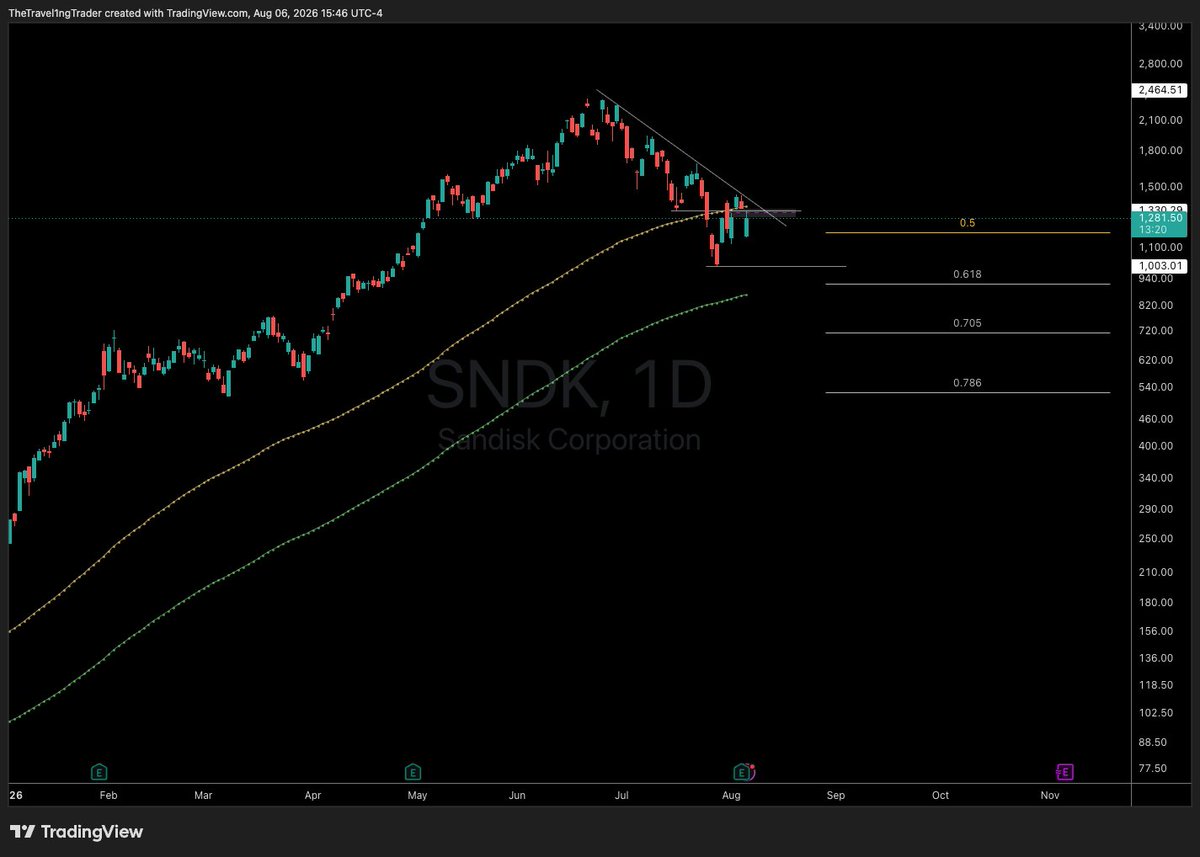
Still not convinced of $SNDK here.
Lower highs and lower lows into the volume imbalance and 100MA. Still respecting down trend. Market structure remains bearish for now.