🧠 Prepara tu app para los agentes de IA
Google explica cómo usar AppFunctions para que el sistema de inteligencia de Android pueda acceder a funciones de tu aplicación de forma segura y ejecutar tareas por el usuario.
► Casos de uso para integrar IA
► Implementación de AppFunctions
► Herramientas para acelerar el desarrollo
► Cómo probar la integración
👇🏻👇🏻👇🏻
→ https://t.co/8MX0SWOw2q ←
Ahora Claude Code puede leer documentaciones completas sin gastar un solo token.
Solo necesitas conectarlo a NotebookLM de Google vía MCP.
Aquí el tutorial de cómo hacerlo. ⬇️
New in Claude Cowork: teach Claude a skill.
Record your screen while you do a task, talk through it as you go, and Claude turns it into a skill it can run again. Find it under Record a skill in the + menu of the Claude desktop app.
Available on Pro, Max, and Team plans.
Un proyecto para tener IA gratuita.
OmniRoute agrupa en un solo endpoint todos los servicios con free tier.
✓ Funciona en Claude Code, Codex y Cursor
✓ Compresión de tokens incluido
✓ 50 proveedores disponibles
De código abierto:
https://t.co/VOZuYHbmv7
Claude Code on desktop now works with the iOS simulator.
Build and run your iOS app, and the simulator opens in a panel right next to your conversation. Available today in public beta.
Added another set of SwiftUI animations, components, and shaders to my open-source repo ✨
It’s a growing collection of loaders, prototypes, shaders, & components, all built with SwiftUI.
Feel free to star, fork, & share with other developers.
https://t.co/i60fWohzAL
#swiftui
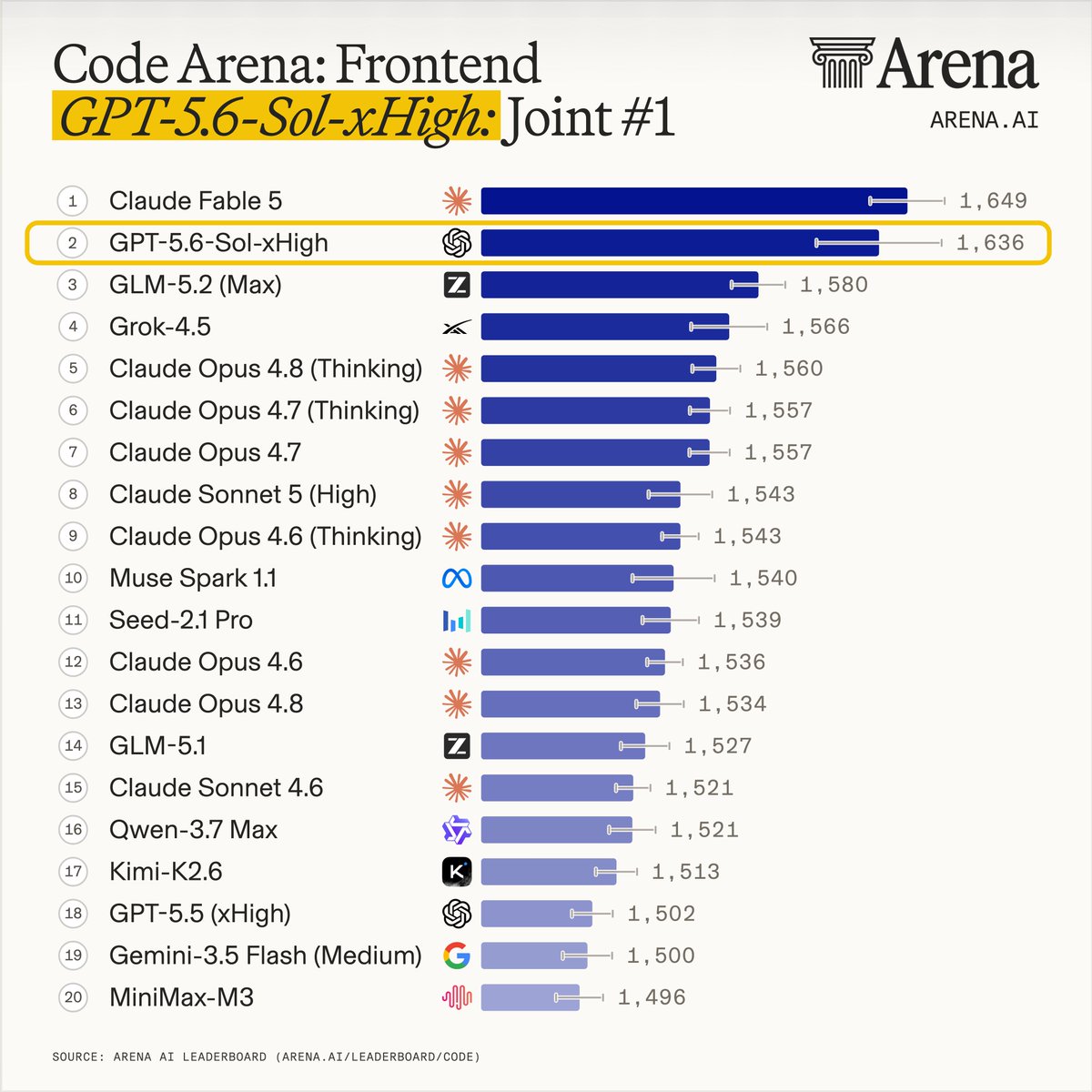
Exciting news: @OpenAI’s GPT-5.6-sol is now joint #1 in the Code Arena: Frontend, matching Claude Fable 5!
This marks the first time an OpenAI model has reached the top spot in Code Arena, demonstrating major gains in agentic coding, frontend and web app development.
Highlights:
- Significant improvement from GPT-5.5-xhigh (#18 -> #1)
- #1 in Data & Analytics, Brand Marketing, Consumer product, and Gaming
- Priced at $5/$30 per million input/output tokens - roughly 2× cheaper than Claude Fable 5
Huge congrats to the @OpenAI team for this incredible milestone!
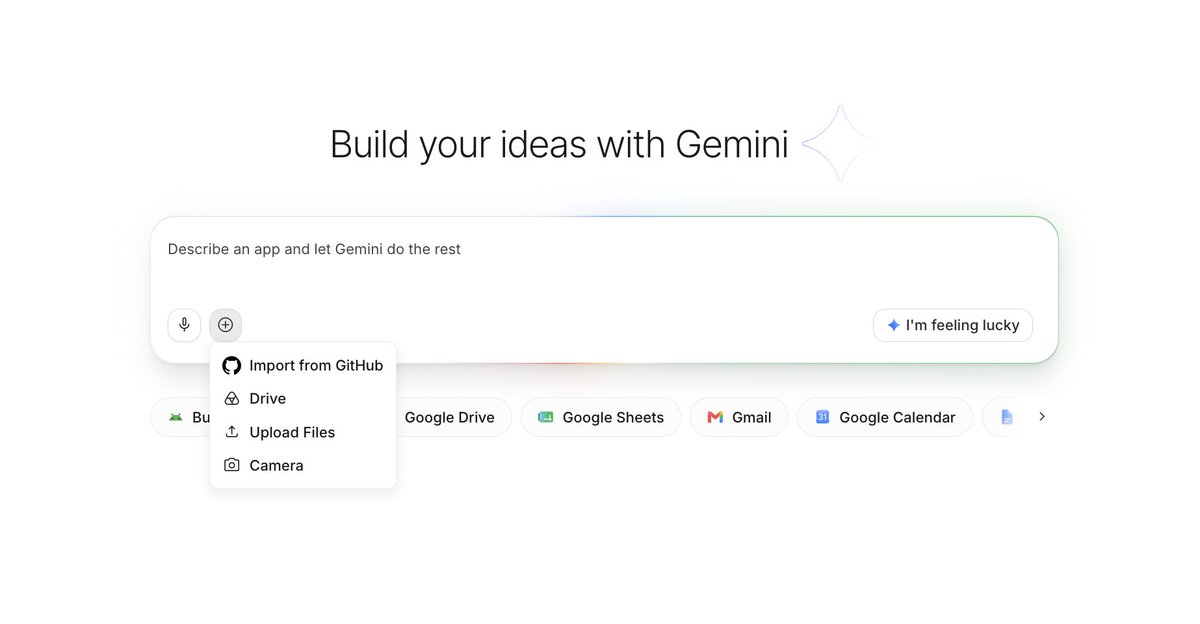
Today we are rolling out "import from GitHub" in @GoogleAIStudio Build!!
We will automagically take the repo and transform it into a format that is compatible with our runtime and then let you keep iterating on it in AI Studio, deploy it, and more.
UNA INGENIERA DE ANTHROPIC LO DIJO CLARO: NO TIENES QUE PROMPTEAR A CLAUDE, TIENES QUE CONSTRUIR UN SISTEMA QUE SE PROMPTEA SOLO
en 45 minutos te muestra como armar un agente que se mejora a si mismo.
guardalo y miralo
There is a Claude Skill for auditing recomposition performance in Compose.
It checks:
- Parameter stability / skipping
- Where state is read (what phase)
- Back-writing state across phases
Added another set of SwiftUI animations, components, and shaders to my open-source repo ✨
It’s a growing collection of loaders, prototypes, shaders, and components, all built with SwiftUI.
Feel free to star, fork, and share with other developers.
https://t.co/255CSFyCwz
#swiftui
Introducing ZCode, the official development environment for GLM-5.2
- GLM Coding Plan subscribers: now 1.5x usage quota in ZCode
- BYOK supported: works with your existing subscriptions and APIs
- Available on macOS, Windows, and Linux
Download now: https://t.co/Peepqv4XSx
Excited to introduce Computer Use support for Gemini 3.5 Flash!🔥
This enables Gemini to reason and act across platforms (browser, mobile, and desktop environments)
We see significant improvements across many work-related automation tasks, from filing tickets and more. Enjoy!
Got your hands on Claude Fable 5?
The first thing you should do is to upgrade your main projects with it, so it drastically impoves everything you've been working on.
Run this Audit & Project Improvement Prompt on each repo that's important to you (simply copy-paste it):
Repo Audit & Improvement Plan:
Prompt made by Claude Fable 5
You are a world-class principal-level software engineer and technical auditor. Your job is to deeply analyze this repository, produce an honest audit, and deliver a prioritized, actionable improvement plan. Work in the four phases below, in order. Do not skip ahead.
Ground every claim in actual files: cite file paths and line numbers. If you can't verify something, say so explicitly rather than guessing.
Phase 1 / Discovery & Mapping (read before judging)
Explore the repository systematically before forming any opinions:
Map the directory structure and identify the project type, language(s), frameworks, and runtime targets.
Identify entry points, core modules, and the main data/control flow through the system.
Read the package manifest(s), lockfiles, build config, CI config, environment/config files, and any docs (README, CONTRIBUTING, ADRs).
Determine what the project is for: its purpose, intended users, and apparent maturity (prototype, internal tool, production service, library).
Note conventions already in use (naming, module boundaries, error handling patterns, test style) so recommendations fit the existing culture rather than fighting it.
Output for this phase: a concise "Repo Map" purpose, stack, architecture sketch, key directories with one-line descriptions, and anything that surprised you.
Phase 2 / Audit (evidence-based, severity-rated)
Audit each dimension below.
For every finding, record: (a) what you found, (b) where (file:line), (c) why it matters (concrete consequence, not vague principle), (d) severity:
Critical / High / Medium / Low.
• Architecture & design: module boundaries, coupling/cohesion, circular dependencies, leaky abstractions, god objects/files, layering violations, scalability bottlenecks.
• Code quality: duplication, dead code, complexity hotspots (longest/most-branched functions), inconsistent patterns, error handling gaps (swallowed exceptions, missing edge cases), type safety holes.
• Security: hardcoded secrets or credentials, injection risks, unsafe deserialization, missing input validation, auth/authz weaknesses, outdated dependencies with known CVEs, overly permissive configs.
• Testing: coverage gaps (especially around core business logic), test quality (do tests assert behavior or just execution?), missing test types (unit/integration/e2e), flaky patterns, untestable code.
• Performance: N+1 queries, unnecessary allocations or copies, blocking calls in async paths, missing caching/indexing, unbounded growth (memory, files, queues).
• Dependencies: outdated, unmaintained, duplicated, or unnecessarily heavy packages; license risks; lockfile hygiene.
• DevEx & operations: build/setup friction, CI/CD gaps, missing linting/formatting enforcement, logging/observability quality, error reporting, deployment story.
• Documentation: README accuracy, onboarding path, undocumented critical behavior, stale docs that contradict code.
Rules for this phase:
Prefer 15 high-confidence findings over 50 speculative ones.
Distinguish facts ("this function has no error handling: src/api/client.ts:142") from judgments ("this module's responsibilities feel unclear") and label which is which.
Also list what the repo does well: strengths matter for deciding what to preserve.
Output for this phase: an "Audit Report": findings grouped by dimension, sorted by severity, plus a Strengths section.
Don't forget to mention all the ugly parts that need utmost priority.
Phase 3 / Improvement Strategy
Synthesize the audit into a strategy:
Identify the 3–5 themes that explain most of the findings (e.g., "no enforced boundaries between layers," "error handling is ad hoc").
For each theme, propose a target state and the principle behind it.
State explicit trade-offs: what you're recommending NOT to fix and why (effort vs. payoff, risk, project maturity).
Define what "done" looks like — measurable signals (e.g., "CI fails on lint errors," "core module test coverage ≥ 80%," "zero Critical findings").
Phase 4 / Detailed Task Plan
Convert the strategy into an execution plan:
Break work into discrete tasks. Each task must include: Title and one-paragraph description
Files/areas affected
Acceptance criteria (how we verify it's done)
Effort estimate (S = <2h, M = half-day, L = 1–2 days, XL = needs breakdown)
Risk of the change itself (could it break things?)
Dependencies on other tasks
Order tasks into milestones:
Milestone 0
Safety net: anything needed before refactoring safely (tests around critical paths, CI gates, backups).
Milestone 1
Critical fixes: security and correctness issues.
Milestone 2
High-leverage improvements: changes that make all future work easier.
Milestone 3
Quality & polish: remaining medium/low items worth doing.
Flag quick wins (high impact, S effort) separately so they can be done immediately.
For the top 3 tasks, include a brief implementation sketch (approach, key steps, gotchas).
Final Deliverable Format
• Produce a single document with these sections:
• Executive Summary (≤10 sentences: overall health grade A–F with justification, top 3 risks, top 3 opportunities)
• Repo Map
• Audit Report
• Improvement Strategy
• Task Plan (milestones + task table + quick wins)
• Open Questions: anything you need from a human to decide (product intent, deprecation candidates, performance targets)
Constraints
Do NOT modify any code during this audit. Analysis only.
Do not pad the report. If a dimension is healthy, say so in one sentence and move on.
Calibrate to the project's maturity. Don't recommend enterprise-grade infrastructure for a weekend prototype unless the owner's goals demand it.
Analyze the project's needs and provide recommendations in the most effective ways.
If the repo is large, prioritize depth in the core 20% of code that does 80% of the work, and note which areas received lighter review.
Every new SwiftUI framework update from WWDC26 in one place.
I’m especially loving the new transition and toolbar changes this year.
Save it for later, and share it with your developer friends :D
#wwdc26#swiftui
Meet Gemma 4 12B!
A unified, encoder-free multimodal model designed to bring high-performance intelligence directly to your laptop, and released under an Apache 2.0 license.
Bridging the gap between edge efficiency and advanced reasoning. Here is what’s new with Gemma 4 12B: 👇