I am a student of the world studying mathematics, love, and life. I aspire to help others on their personal educational journey as a teacher and a learner.
@dwarkesh_sp@ericjang11 Awesome episode as always! For anyone interested in learning Go, find a nearby club on the free world map I made https://t.co/6JJiaSk6z7
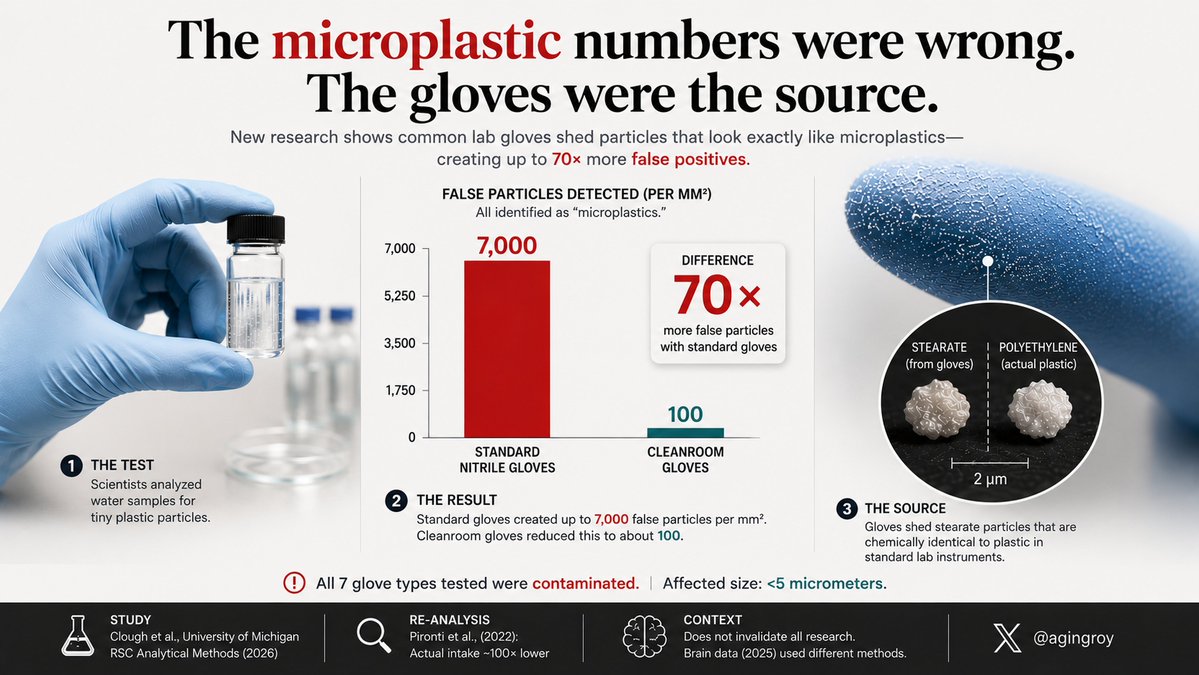
7,000 false positives per square millimeter. The culprit was the lab gloves.
University of Michigan researchers just upended a core assumption in microplastics science. Latex and nitrile gloves, worn by the scientists doing the measuring, shed stearate particles that look chemically identical to polyethylene. Standard infrared and Raman instruments can't tell them apart. The gloves were counting as plastic.
Seven glove types tested. All contaminated. The cheapest fix: switch to cleanroom gloves, which dropped false positives to around 100 per mm² vs. 7,000.
The "credit card per week" headline (5 grams, WWF/Newcastle 2019) has separate problems. A 2022 re-analysis found severe methodological errors in the original estimate. Actual measured intake is likely 100x lower.
None of this means microplastics are harmless. Last month's data on brain accumulation still stands. But the numbers driving the panic may have been measuring the scientists, not the environment.
Science catching its own errors is exactly how it's supposed to work.
Price controls are a classic feel-good policy. They sound compassionate, but rarely reflect a real understanding of how credit products work or why they’re priced the way they are.
Markets won’t comply emotionally. They’ll respond mathematically.
The real impact won’t be on banks. It’ll be on the people who need credit the most.
Sub-prime, thin-file, and young borrowers will be the first to get quietly cut off.
Banks, meanwhile, will do what they always do.
Tighten underwriting. Tune risk algorithms. Shrink limits. Exit entire segments.
That demand for credit won’t disappear. It just migrates. To BNPL. Payday lenders. Informal credit. Loan sharks. All far more expensive, opaque, and predatory.
Caps treat the symptom, not the cause.
If affordability was the goal, the focus would be on financial literacy, transparent repayment nudges, better product design, and alternative credit models that actually expand access.
Democrats are desperate to make sure people don’t see what just happened as a good thing. Not because it’s wrong, but because TDS kicks in and it’s bad for them politically if Trump looks effective.
So they rush to frame it as illegal, dangerous, or immoral. They claim to care about human rights and opposing abusive dictators, yet refuse to celebrate when one is actually held accountable.
Why?
Because even the appearance of Trump being right is unacceptable to them.
Opposing Trump matters more than consistency, logic, or reality, even when it makes them look completely out of touch.
I exposed extensive migrant shelter fraud in massachusetts. The governor knew about this and likely profited from it. $42 per migrant meal that is beyond waste, that is fraud. $100,000 a month for free lyft rides after the migrants are given nice cars, and much more.
This is largely being ignored but it's easily one of the biggest China news of the year.
What China is doing with Hainan - a huge island (50 times the size of Singapore!) - is pretty extraordinary: they're basically making it into a completely different jurisdiction from the rest of the country, and an extremely attractive entry gate for the Chinese market.
You can now import most products in the world (74% of all goods) entirely duty free into Hainan. And, if you transform the product and add 30% value locally, you can then send it to the rest of mainland China completely tariff-free.
So for instance: import Australian beef into Hainan tax free. Slice it and package it for hotpot in Hainan: it can enter all mainland supermarkets duty-free.
They also have insanely low corporate tax rates: 15%, lower than Hong Kong (16.5%) and Singapore (17%) or the rest of the mainland (25%).
That's not all, Hainan now has different rules from the rest of China in dozens of areas:
HEALTH: Basically the rule is that if a medicine or medical device is approved by regulatory agencies anywhere in the world, it can be used in Hainan - even if banned on the mainland. Which undoubtedly makes it THE place in the world with the widest range of medical treatments available.
NO FIREWALL: Companies registered in Hainan can apply for unrestricted global internet access
OPEN EDUCATION: Foreign universities can open campuses without a Chinese partner
VISA-FREE: 86 countries get visa-free entry, probably one of the most open places in the world
CAPITAL: Special accounts let money flow freely to and from overseas - normal mainland forex restrictions don't apply
So they're running a pretty extraordinary "radical openness" experiment there.
They're basically building a "greatest hits" of global free zones: Singapore's tax regime, Switzerland's medical access, Dubai's visa policy - all in one giant tropical island attached to the 1.4 billion people Chinese consumer market.
GOOD NEWS 🚨 TESLA HAS CRACKED THE "DRY SILICON CODE" FOR THE 4680 CELL 🔋
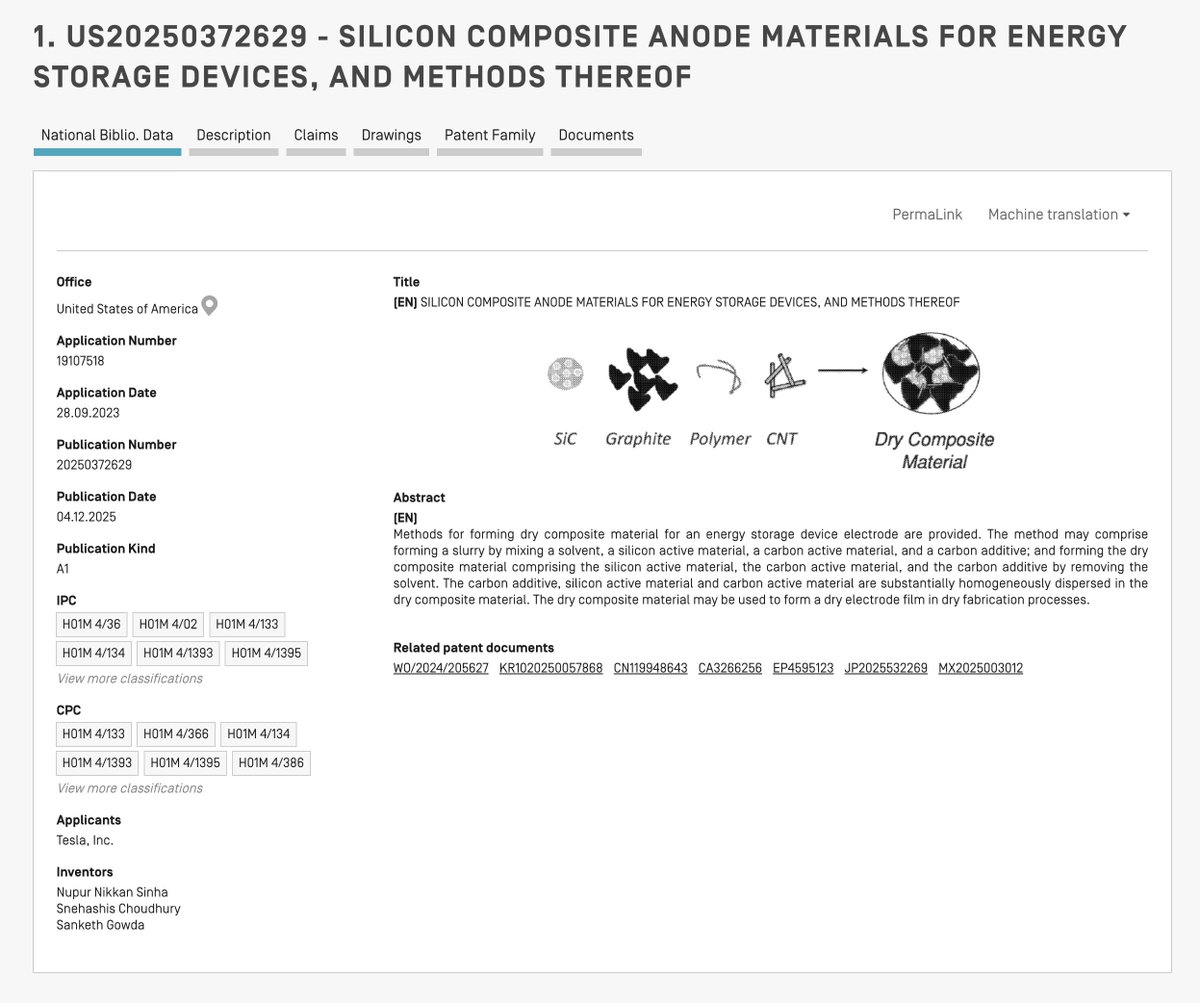
📄 Published on December 4, 2025, patent US 2025/0372629 A1 unlocks the technical secrets behind a chemistry breakthrough Tesla has been developing to finally bring high-capacity silicon to its mass-market vehicles.
This document provides our first public look at the "alchemist's recipe" that allows Tesla to feed high-performance silicon into their dry manufacturing lines without clogging the machines or ruining the battery—proving that extreme range and low-cost manufacturing can finally coexist.
⚖️ The problem: Silicon hates the dry process
The core problem addressed by this patent is the specific incompatibility between silicon anodes and dry electrode coating. While silicon is the "holy grail" for boosting range, its particles are notoriously difficult to handle without liquid solvents.
Historically, using silicon in a dry process was prohibitive because the raw particles clump and aggregate. In standard dry manufacturing, these clumps lead to uneven distribution and electrodes that crack under the high pressure of the coating machinery, rendering them unsuitable for mass production.
🔗 Tesla's solution: The "dry composite"
Crucially, the patent specifies that Tesla solves this not by changing the machine, but by engineering a completely new feedstock. It explicitly details a pre-processing step where silicon, graphite, and conductive additives are combined into a perfectly homogenized "dry composite material" before they ever touch the manufacturing line.
This material acts as a "Trojan Horse," allowing the difficult silicon to flow through the dry-coating equipment like a liquid while performing like a solid.
🏗️ Microscopic engineering: A particle within a particle
At a microscopic level, this innovation relies on a unique architecture. Rather than existing as loose dust, the material is engineered into spherical "secondary particles" roughly 16 to 26 micrometers wide.
Think of each microscopic sphere as a pre-packaged shipping container. Inside each one are thousands of tinier components—silicon chunks, graphite flakes, and carbon nanotubes—all locked together in perfect ratios. This structure keeps the silicon physically close to its conductive partners, preventing the isolation that typically kills battery life.
🕸️ The physics: The carbon web
Tesla’s solution involves a sophisticated physical balancing act. Inside these spheres, the patent highlights the specific role of Carbon Nanotubes (CNTs). These additives don't just sit there; they form a flexible conductive matrix or "web" that wraps tightly around the active silicon particles.
This web counteracts the negative effects of silicon's volume expansion. When the battery charges and the silicon swells like a balloon, this pre-formed nanotube web stretches with it. This ensures electrical contact is never broken, turning what is typically a chemical weakness (expansion) into a manageable structural feature.
🌊 The process: A "wet-to-dry" hybrid
To achieve this precision, the patent describes a surprising "wet-to-dry" hybrid method. Although the final goal is a dry electrode, engineers discovered that a temporary liquid medium is necessary to achieve perfect uniformity.
They first create a slurry containing the ingredients and a specific "composite binder" (CMC or PAA). This mixture is then subjected to spray drying—blasted into a hot chamber to instantly evaporate the solvent. This rapid drying locks the ingredients into those perfect homogeneous spheres, effectively "freezing" the perfect distribution of wet processing into a dry powder.
🖇️ Structural integrity: The dual-binder system
Furthermore, this invention solves the major mechanical problem of holding the film together. The patent introduces a distinct two-stage binder approach. It distinguishes between the composite binder used inside the particles and a separate "dry binder" (PTFE) added later.
In the final step, the dry powder is mixed with PTFE and subjected to high shear forces. This causes the PTFE to "fibrillize"—stretching into microscopic spiderwebs that physically trap the composite spheres in a self-supporting film. This ensures the electrode remains mechanically strong without the need for toxic solvents or massive drying ovens.
📊 Performance rivals wet processing
The patent cites specific performance targets that allow this dry-processed material to rival traditional wet-slurry electrodes. The new composition achieves a discharge capacity between 409 and 418 mAh/g with a first cycle efficiency of ~90%.
Cycle life tests revealed that these anodes retained about 95% of their capacity after 100 cycles in a full-cell configuration. This proves that the conductive nanotube web successfully accommodates the mechanical stress of silicon expansion, effectively outperforming control groups where silicon clumped and failed.
🚀 Enabling mass production
The most critical contribution of this patent is its direct enablement of the 4680 scaling strategy. By solving the technical bottleneck of how to run silicon through a dry coater, Tesla can finally increase the energy density of vehicles like the Cybertruck and Semi.
This capability allows the company to decouple its range goals from the limitations of its manufacturing equipment. It turns the 4680 from a "cheaper" cell into a "better" cell, ensuring that the promised performance gains of the format can be realized in mass production.
@MarioNawfal This is false. I love Tesla. But overhyping it only hurts it. These antenna are not the same frequency used for high bandwidth satellite internet (nor are they are phased array). This is for things like GPS and Nav.
Did u know that Vincent Van Gogh's painting were worthless at one time?? Nobody wanted them—not even after his death. They were headed to rot forgotten in storage... Shocking, but check this out, it really brought me to tears and explains everything! 🤯
🚨 WOW. Brown University student Alex Shieh previously EVISCERATED the school's administrators for having a $46 million deficit, despite surging costs for students.
They pay $90K+ PER YEAR.
Alex Shieh: "What about the kids who weren't born on third base?! [...] Brown is on track to run a $46 million DEFICIT this year. WHERE is all the money going?"
"I'll tell you where it's going. It's going into an empire of administrative bloat and bureaucracy! Brown employs 3,805 full time non-instructional staff for just 7,229 undergrads. That's one administrator for every two students."
"This isn't education. This is bloat paid for on the backs of students and families who are mortgaging their futures for a shot at a better life!"
HE'S SPOT-ON.




![mnd233445's tweet photo. Quarter circles.
[Red] / [Green] = ? https://t.co/jLUJz90jvW](https://pbs.twimg.com/media/HJuEt0uXQAMLhVD.jpg)