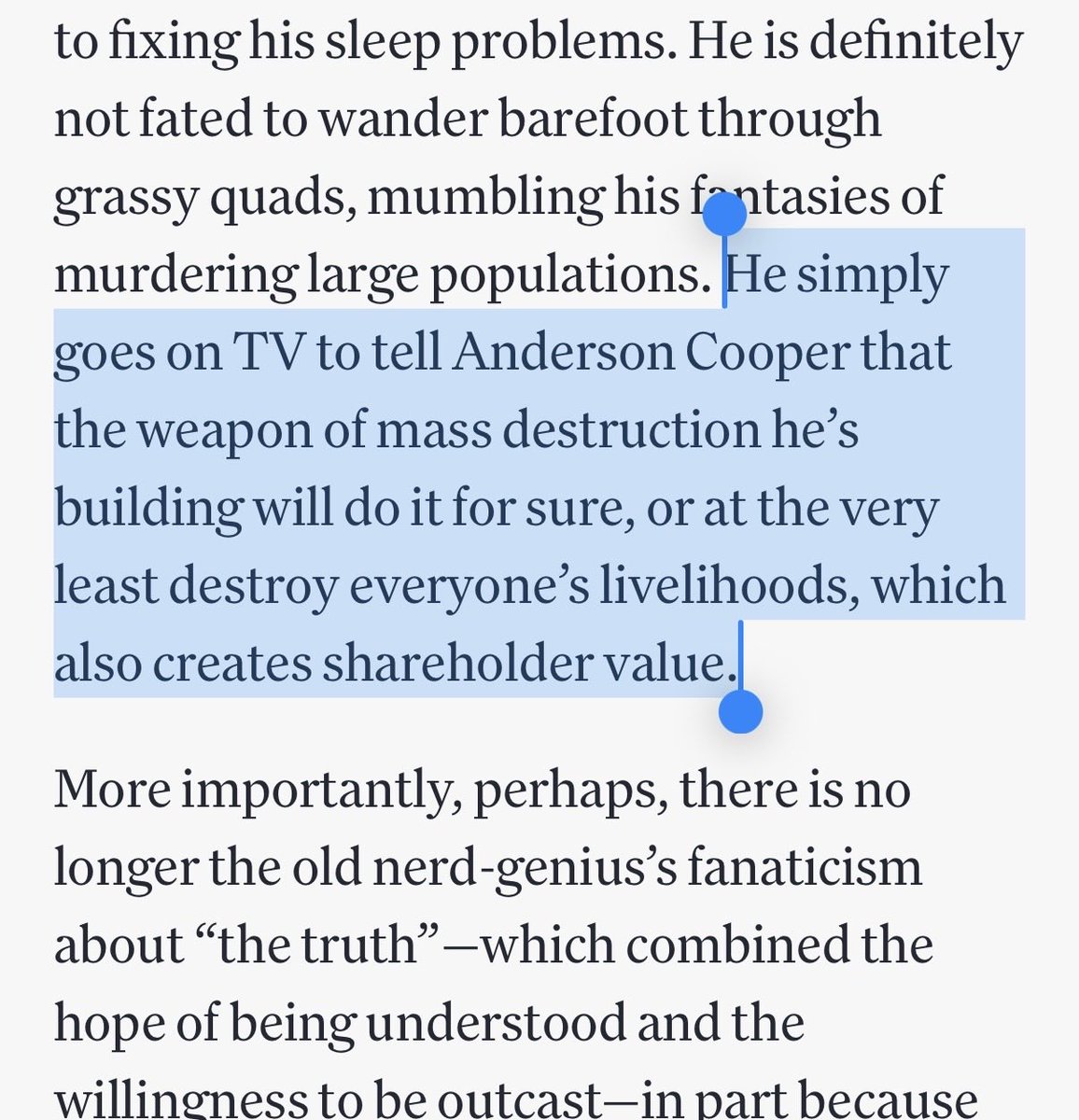
Among the many reasons I enjoy @JeremySternLA profiles is he knows how to skewer and celebrate tech in equal measure. Most mainstream media only knows how to do the former, and they lack the redeeming quality of being funny
Turns out googling and chatbots did not devalue knowledge.
Knowledge is what enables thinking.
Most skills are EXPRESSIONS of knowledge.
In the words of a wise colleague:
"When you're trying to read about butterflies and you don't know what a butterfly is, you're f*****!
You cannot teach critical thinking. You can teach domain specific expertise, which enables you to think critically about that domain. Brilliant chess players do not make great military commanders.
More problematically, people who think they have great critical thinking skills are often the ones who get hoodwinked by any fashionable idea, because they lack the domain expertise to interrogate nonsense.
Watch me slide into 1000 DMs in the next 24h 📳
Playcademy will turn Epic game designers and developers into epic Education Engineers.
Join the revolution!
In the coming days, employers will see a stream of resumes of once-in-a-lifetime quality folks. An important thing to understand is that Epic never lowered our hiring standards as we grew, and the layoff wasn't a performance-based "rightsizing" as companies call it nowadays. It's a sound bet that anyone with Epic Games on their resume is in the top few percent of their discipline.
Watch me slide into 1000 DMs in the next 24h 📳
Playcademy will turn Epic game designers and developers into epic Education Engineers.
Join the revolution!
Decomposing standards is step 1 of curriculum architecture.
As you correctly point out, step two is filling this scaffolding with content.
In fact, one of our most important views is that knowledge of content and facts is vastly underrated.
We curate, generate, and hand-craft the content on Timeback. It's probably what we spend 90% of our time on. Good content is really important.
Schools buy teacher materials from 5 different publishers. Hundreds of teachers then apply their individual training and experience to classroom delivery.
When a student fails a standardized test, how can anyone tell what went wrong?
The solution is vertical integration!
@teachthemx3 We just started tagging all test items at Alpha with the standards they test. Based on this, we can assign more targeted hole filling when a student fails a test.
"Real world skills" are just knowledge in disguise.
By making K-12 (general knowledge) 10x more efficient, we unlock time for the development of specific knowledge, which is orders of magnitude more valuable.
This is how Alpha High students outpace experienced professionals.
I've been teaching 100,000 fake students for 2 weeks.
and used them to build the best AP prep system in the world.
I took Qwen 3 8B models and gave them simulated human memory.
Now every night thousands of simulated students start with zero knowledge of the social sciences. Their only training is our adaptive curriculum. They work through it, then take a full AP (advanced placement) practice exam.
The first batch averaged a 3 on their exam. (~45th percentile)
Then the agents looked at where they failed, and improved the algorithm. Again, and again, and again.
Two weeks later, the average is 4.43 (~80th percentile)
This is such an insane number because the curriculum they worked through is ONLY basic knowledge and comprehension.
They were never taught how to build an argument, contextualize evidence, or even shown the exam rubric.
...And yet they're averaging 80th percentile on an exam that requires all of it.
Basically built a machine learning feedback loop for edtech.
Spoke about this at @clawcon & @sxsw last week. This is just the beginning.