🚨 Weekly AI Fail Check #3 is here!
What wild mistakes did you see an AI agent make this week? Auto-ordering the wrong thing, deleting the wrong file, sending test data to a real customer, or confidently talking nonsense in a group chat?
A fail itself isn't scary. What's scary is when nobody knows, nobody is accountable, and there's no way to trace it back. Most agent failures don't happen because the agent is "not smart enough" — they happen because there's no gate before it acts: no pre-frozen rules, no entry verification, no signed behavioral record. It fails, and you can't even investigate it properly.
So the same question as always this week: drop your AI fail screenshot or story in the replies, tag @Actum_AI, and tell us whether an entry "Circuit Breaker" could have stopped it.
The 3 best answers win 10 USDT each. 🏆
That's exactly what Actum's PoHA is for: a pre-frozen codebook before the action, six-dimensional verification at the gate, and signed attestation after — so every agent action has someone accountable for it.
Traditional Logs vs. Actum PoHA Ledger — why the difference matters more than it looks.
Traditional logs record what happened. That sounds enough, until something goes wrong. Then the questions start: who edited this entry? When did it actually happen — when the event occurred, or when it reached the log? And the investigation usually ends the same way: "system error." No one accountable, nothing to prove otherwise.
❌ Editable by admins — whoever holds the keys can rewrite history.
❌ Single timestamp — occurrence and ingestion collapse into one number, so you can never prove when something really happened.
❌ Blames "system error" — the log describes the machine, not the human behind it.
Actum's PoHA ledger is built the other way around:
✅ Signed at generation — every event is signed the moment it's created. Tamper-evident: any change after the fact is detectable.
✅ Bi-temporal truth — Occurrence Time and Ingestion Time are recorded separately, so the timeline is provable, not asserted.
✅ Anchors every AI and machine action to an accountable human — Humans, Machines, and AI Agents all write to the same ledger, under the same standard, and every entry traces back to a specific authorized person.
A log tells you what the system says happened. A PoHA ledger proves what happened, when, and who is responsible for it.
That's the difference between "we looked into it" and "here is the evidence."
Traditional logs tell you what the system says happened.
A PoHA ledger proves what happened, when it happened, and who is accountable for it.
That’s the gap Actum is closing. Curious how others here think about the difference between logs and verifiable records 🤔
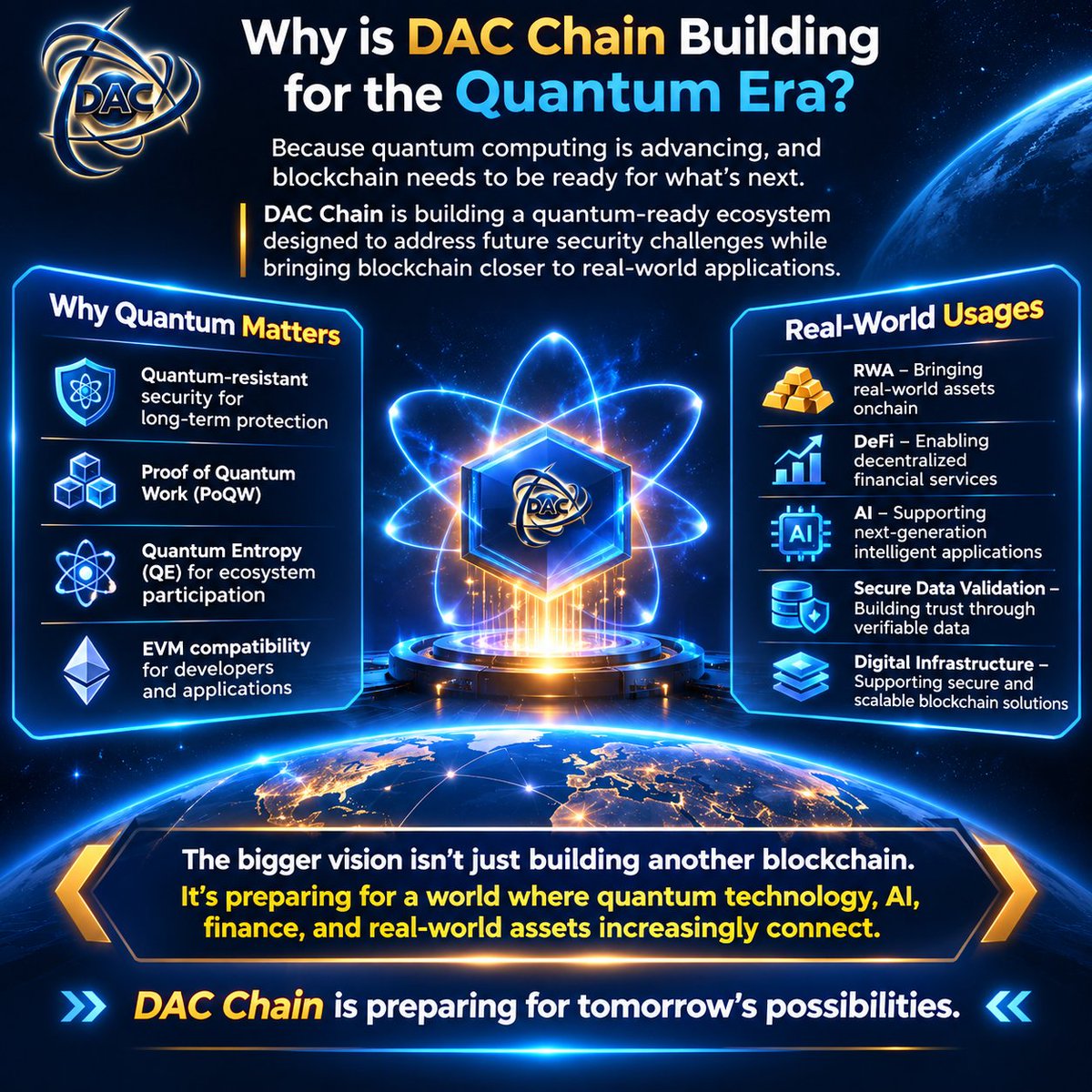
🌌 Why Is @dac_chain Building for the Quantum Era?
Quantum computing is advancing, and blockchain must be ready for what comes next.
DAC Chain is building a quantum-ready ecosystem designed to address future security challenges while bringing blockchain technology closer to
@dac_chain Supporting secure and scalable blockchain solutions.
The bigger vision isn't just building another blockchain. It's preparing infrastructure for a world where quantum technology, AI, finance, and real-world assets increasingly connect.
Tribe — just joined @tribe3tech Early Access! 🕊️
A new way to engage, monetize & earn on Solana.
Join the movement: https://t.co/gy6J6aupxT https://t.co/SiEs52QXk9
The real-world use case that surprised me most is nurse shift scheduling!
Imagine using optimization to balance staff availability, coverage, & labor limits while reducing understaffing and unnecessary overtime.
QMS turns useful computation into real-world solutions.
#QMS1102