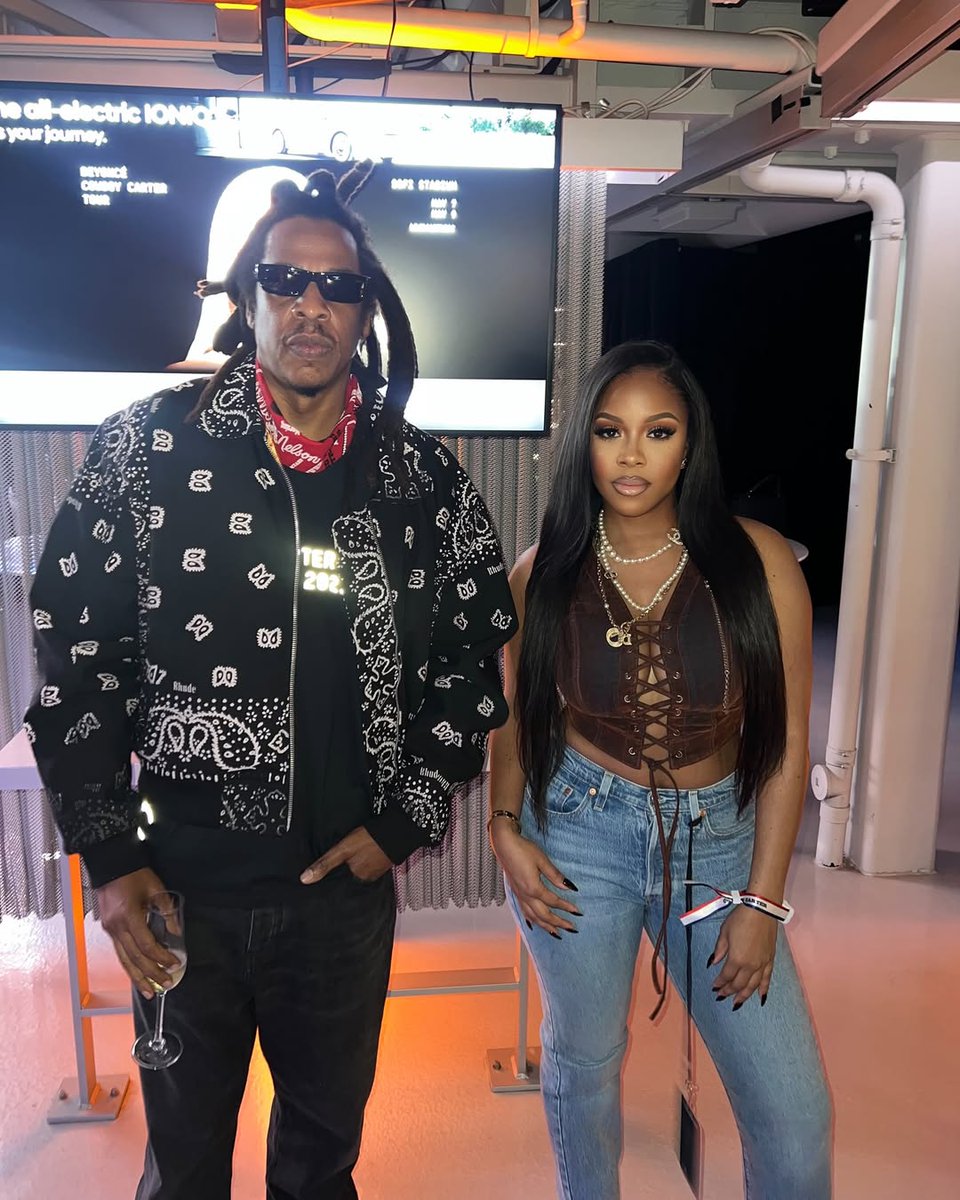
@holahovitaaa Omg you better pray the beyhive don’t find this. You know they would rather crawl through hot lava before they ever admit those kids look like their father
Live reporting from #Diddytrial: It is very apparent that both Sean Combs and Cassie Ventura were both drug addicts. There relationship was dysfunctional to put it mildly. I've been in the main courtroom listening to testimony from his accuser and I believe the government might have overreached in prosecuting this case. Those text messages are damning to the government's case.
I’ve said this since before the Diddy trial started.
This is a domestic violence case that the Feds turned into a RICO and sex trafficking trial.
Diddy is definitely guilty of the domestic violence part. But Cassie was a willing participant in a lot of the other things they’re charging him with and giving her immunity over.
@SirOmaree WTH is this pathetic loser doing at this concert?? After saying disgusting lies about Jay Z, and trying to blackmail Beyonce with lies??? I hope security kept an eye on this clown and made sure he didn't try to sneak in to backstage.
@KeithTapps@TheRocSupremacy Not to mention a background dancer for digital underground. lol. Jay Z, a former drug dealer from Brooklyn. Jay Z was repulsed by rappers like Tupac who were nerds pretending to be thugs. Which is probably why he often refered to them as FAKE RAPPERS in his lyrics
My theory/Opinion: Why Judge Epstein is struggling to rule on the Jay-Z Extortion count in the California case (long post: you can skip to the last 4 paragraphs).
As a background, California & many other states have a public policy of encouraging out-of-court settlement of cases rather than flooding the courts with lawsuits. The judicial system is so aligned. Settlement discussions often begin with a demand, specifically a demand letter. Demand letters are used in a wide variety of cases such as auto accidents, slip-and-fall cases, etc. Because settlements are favored, CA courts are very protective of a lawyer’s ability to send demand letters in an attempt to reach a settlement. In a garden variety civil matter, a lawyer’s demand letter is almost presumptively deemed proper and not extortionate in California.
With this background, when Judge Epstein reviewed Jay-Z’s extortion case against Buzbee based on Buzbee’s demand letter, the judge’s inclination was to dismiss the case if and when Buzbee files for demurrer (equivalent to a Rule 12(b)(6) motion to dismiss in a fed case). Along the way, something else happened. Jay-Z amended the case to add the defamation count, premised on Buzbee’s social media activities and media statements. Also, Jane Doe, who was one of the subjects of the demand letter, dismissed her SDNY case.
When Buzbee filed for demurrer, the judge easily concluded that the defamation count (which is unconnected to the demand letter) should not be dismissed at this stage. The judge was still inclined to dismiss the extortion count, in keeping with the policy of encouraging settlements. Because of the uniqueness of the extortion allegation against Buzbee, the judge knew that if he dismissed the extortion count outrightly, he could be reversed on appeal. The judge wanted to get more justification for dismissal. Thus, the judge gave Jay-Z what he imagined were impossible tasks, in the hopes that if Jay-Z couldn’t perform those tasks, the nonperformance would add more justification for the dismissal of the extortion count. The judge tasked Jay-Z to prove that the demand letter was sent by Buzbee without his client’s permission/consent and to prove that the demand letter was sent without an intention to imminently sue.
Make no mistake: In a normal case, these are truly impossible tasks. Jay-Z’s lawyers could not contact Buzbee’s client (Doe) to find out whether she gave Buzbee permission to send the demand letter. Also, Jay-Z’s lawyers couldn’t contact John Doe about whether he had an imminent intention of suing at the time the demand letter was sent. As such, if Jay-Z failed in these tasks, the judge would’ve felt justified to dismiss the extortion count.
To the judge’s apparent surprise, investigators were able to help Jay-Z fulfill these tasks. They showed that Doe had never spoken to Buzbee before the complaint was filed on 10/20/2024, and/or before the demand letter was sent on November 5, 2024. Equally surprising is that Buzbee did not definitively assert that he got Doe’s permission before sending the Nov 5 demand letter. Instead, he stated that he got Doe’s permission on or about Nov 5 – a wishy-washy formulation that could mean Nov 5 to Nov 9. Also, even if he got Doe’s permission on Nov 5, it doesn’t necessarily mean he got the permission BEFORE sending the letter. Here’s why: Let’s say he sent the demand letter at 10 a.m. On Nov 5 to Jay-Z’s lawyers, and at 6 p.m. the same day he got Doe’s permission to send the letter, it still means that he sent the letter without Doe’s permission. In short, the investigators helped Jay-Z fulfil the 1st impossible task.
On the 2nd task, I am not clear whether it related to John Doe. If it was in reference to John Doe, the fact that since Nov 5, 2024 to the present day he still hasn’t filed suit helps to show that he had no intention to imminently sue at the time the demand letter was sent. If the 2nd task related to Jane Doe, the suit had already been filed. If it related to naming Jay-Z, the facts show that Jay-Z was specifically named in the SDNY case on Dec 8, 2024. Jay-Z’s lawyers contend that Buzbee didn’t meet or speak with Jane Doe until Dec 11 or 12, that is, prior to Doe’s NBC interview.
In my opinion, the fact that Jay-Z completed these seemingly impossible tasks (prove that the demand letter was sent w/o Doe’s permission, and that it was sent w/o intention to imminently sue) completely flummoxed the judge – who was poised to dismiss the extortion count. Given this state of affairs, the judge is now seeking another justification for dismissal: the judge now wants to listen to the audio of the investigators’ interaction with Jane Doe to determine whether there were any hints of threats, harassment, or promises, or confusion that caused her to make the statements to the investigators.
The judge is not wrong for seeking to listen to the audio. However, my opinion is that it seems like a very unnecessary attempt to find justification for a possible dismissal. It doesn’t mean he will dismiss the extortion count but there is no need to bend over backwards and do extensive factfinding and credibility determinations at the demurrer stage of the lawsuit.
My criticism of the judge is that, in my opinion, he was treating this case as a garden variety extortion lawsuit based on a lawyer’s demand letter. Such lawsuits are routinely dismissed at the earliest possible stage because of the need to encourage settlements and protect lawyers’ ability to send demand letters. The Jay-Z case is different. The demand letter contained threats, lies and deception. There is no public policy reason to protect or encourage a deceitful demand letter. None. As the investigators’ work has shown, the demand letter was sent before Doe even met or spoke to Buzbee. There is no public policy reason to protect a lawyer sending a demand letter without client’s permission or before even speaking to client.
Significantly, Buzbee (as the moving party in the demurrer) had a golden opportunity to get the case dismissed. Buzbee could have sworn a declaration that he spoke to Doe on a specific day before Nov. 5, 2024, and got her permission to send the demand letter. That would’ve ended the extortion count, but Buzbee didn’t make such a declaration. The judge should’ve placed the burden on Buzbee (the party seeking dismissal) to prove that he got permission before sending the demand letter. He can prove this by sworn declaration, by phone records, texts, email, etc that could show the dates of his communication with Doe that predated the Nov 5 demand letter (those pieces of evidence can be submitted to the judge under seal, or privileged portions can be redacted). Either way, Buzbee’s failure to prove that he got Doe’s permission, coupled with Jay-Z’s evidence that Buzbee never met or spoke to Doe before sending the demand letter should’ve led to the denial of Buzbee’s demurrer and the case should move forward.
you need to fix your 'consume-to-think' ratio. most people are constantly stimulated. an endless cycle of scrolling, music, podcasts, youtube. don't fall for it. stop the noise. spend time with your own thoughts instead. only then can you start to process what actually matters.
One of the most beneficial things to spend your time on is transcending the fear response that you're programmed to have. You aren't fighting a bear. You're sitting down to type at a computer. You're not in danger and it isn't a threat to try something new with your life.
The most effective health & longevity protocol= the levers that make 90% of the difference: sleep, cardio & weight training, light in am/day, dim/dark at night, stress control, eating unprocessed quality foods & real connection should be done 90%* of your remaining days.
Jay-Z has named Antigone Curis in his first amended complaint in Carter v. Buzbee.
This is the Alabama case.
Read the full complaint here: https://t.co/vhdoL5sKod