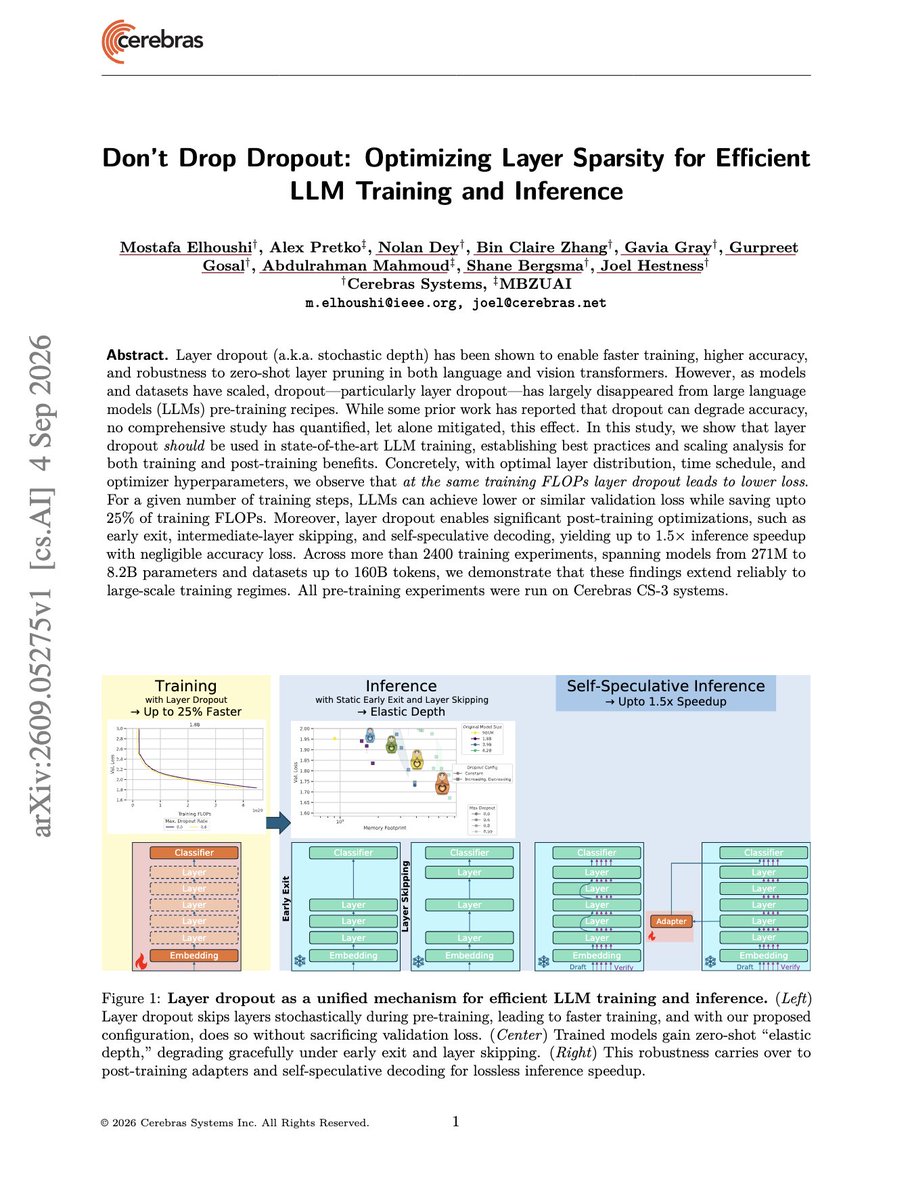
“Don't Drop Dropout: Optimizing Layer Sparsity for Efficient LLM Training and Inference”
Layer dropout mostly disappeared from modern LLM pretraining because it was thought to hurt accuracy at scale.
But this Cerebras paper shows the opposite when configured correctly.
They apply layer dropout at the whole Transformer-block level, sampled per sequence, use an increasing dropout distribution across depth, and a decreasing dropout schedule over training that decays to zero.
Across 2,400 runs up to 8.2B parameters, this saves up to 25% of training FLOPs while preserving accuracy, and makes models depth-elastic enough for early exit, layer skipping, and up to 1.55x faster self-speculative decoding.
https://t.co/TwjAJYdk7z
NeurIPS 2026 workshop alert!!!
BeNTo: Beyond Next-Token Prediction
Diffusion & Flow Models for Next-Generation Decoding
https://t.co/euzUEgDri1
Submission deadline: Aug 29, 2026
If you are working in this area, consider submitting!
Sponsored by @cerebras and @OutputBio
"You could imagine yourself actually being 10x more productive."
@DeyNolan from the Cerebras Core ML team speaks with @alyciazcary on why speed contributes to intelligence.
In agentic workloads like Claude Code, queries can run for hours. Faster inference means more test time compute in the same budget.
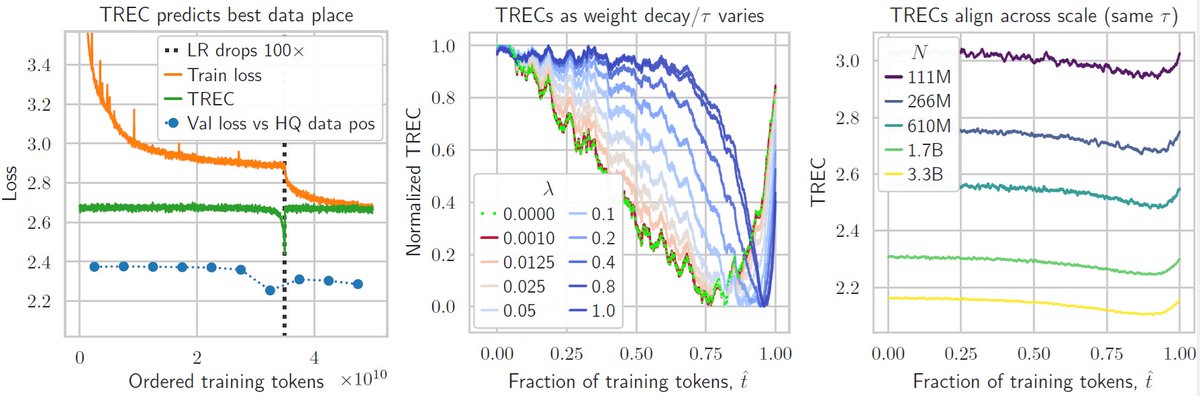
Another new preprint from @cerebras 🚨📄- this time on training *re-evaluation* curves (TRECs) for data curriculums in LLMs.
Everyone sticks high-quality data at the end of training… we show the sweet spot is often earlier — and we can predict it.
https://t.co/C8X1C3hUWL
(1/4)
@cerebras Hot off the presses 🔥📄https://t.co/ahPvKCFN9g
If you're spending $1B to train an LLM, you need to know it’s on track—every step of the way.
With optimal AdamW τ + fixed TPP, loss curves collapse to a universal path → an early-warning signal for training.
Power Lines paper now out: https://t.co/AwAgxyM735
TL;DR - we identify how AdamW's weight decay should scale with batch size, dataset size, and model size in LLM pre-training. We also investigate the scaling of both "optimal" and "critical" batch size.
@roydanroy@TheGregYang Thanks for the kind words @roydanroy! My first exposure to all this stuff began with the collaboration with you and @mufan_li back in 2020. Cool to see it all come full circle :)
(7/7) If you are looking to conduct research into deep models, contact us to collaborate! We are also hiring research scientists (https://t.co/QG7zTeH5Uc) and research engineers (https://t.co/Y0RKb6KpK6)!
(1/7) @cerebras Paper drop: https://t.co/dCATF7nMCp
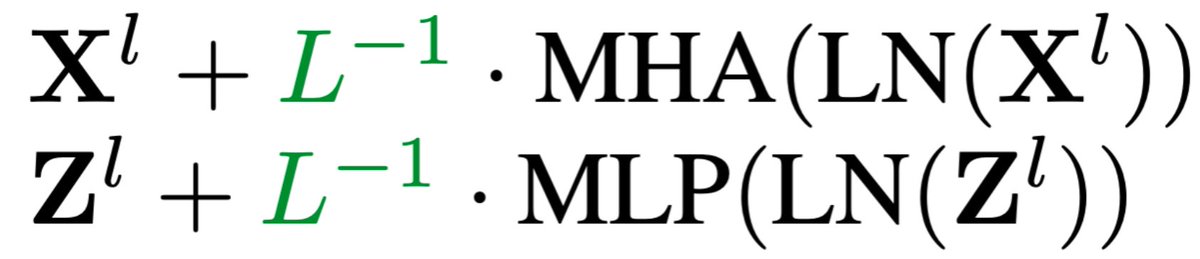
TLDR: We introduce CompleteP, which offers depth-wise hyperparameter (HP) transfer (Left), FLOP savings when training deep models (Middle), and a larger range of compute-efficient width/depth ratios (Right). 🧵 👇
Published "Neuron-based explanations of neural networks sacrifice completeness and interpretability" in TMLR 2025!
TL;DR: The most important principal components provide more complete and interpretable explanations than the most important neurons.
https://t.co/T4Gokt5aAk
🎉We're excited to announce our joint work with @Cerebras on a new guide to Maximal Update Parameterization (μP) and μTransfer!🎉
This practitioner's guide (and implementation) aims to make μP more accessible and easier to implement for the broader training community. 🧵
(1/n) Paper drop: https://t.co/fcr3Jr2ckD
TLDR: We introduce the sparse maximal update parameterization (SμPar), which ensures optimal HPs remain the same for any width or sparsity level. This dramatically reduces HP tuning costs, allowing SμPar to achieve superior losses. 🧵 👇