Nifty 50 SIP Returns (2005–2024): 6.7% CAGR
SIP Sales Pitch: Returns @ 12-15% CAGR. The Reality: Returns @ 6.7% CAGR in Nifty 50 SIP over the last 20 years. 9.65 crore active SIP contributing Indians should know the facts.
SIPs: Myth vs. Reality
a. Last week's JP Morgan report said SIPs are now the MF industry’s demand anchor, contributing 77% of equity MF & hybrid MF net inflows. Monthly SIP inflows in May 2026 were up 48% YoY.
b. Brokers sell SIPs showing a past track record of 12-15% CAGR annualized returns. In reality, the actual 20-year Nifty 50 SIP CAGR, pre-tax, pre-fees was only 6.68%. (Source: Peer-reviewed Arxiv study, 2005–2024, available online).
c. When a Mutual Fund reports "10-yr return of 15%", that 15% applies only to the investor who invested a lump sum 10 years ago and never touched it.
But the average SIP investor tops up during rallies and stops during declines. So, actual return (XIRR) is much lower in the real world.
d. In other words, the 15% return only works for the SIP investor who entered in a bear market, never panicked, never switched from one fund to another, invested through every crash, and held until the exact date the broker did his calculations for 15% CAGR.
Why Real-World Returns are Low?
a. A 2026 FundsIndia study published in the mainstream financial media analyzed Nifty 50 TRI (total return index) returns from 1999 to 2026.
b. If you invested a lump sump in Nifty 50 TRI in 1999 and remained invested till 2026 (YTD), you would earn 13.3% CAGR over 27 years.
c. But if you missed just 15 best trading days in the last 27 years, your portfolio lost 2/3rd of its value. (You only earned 8.8% CAGR).
If you missed 30 best days, your portfolio lost 85% of its value. (You earned 5.7% CAGR – lower than FD returns and not even beating inflation).
If you missed 50 best days, your portfolio lost 94% of its value. (You earned 2.3% CAGR over 27 years.)
d. 7 of the 10 best days occurred within two weeks of the 10 worst days. This means investors who panic during crashes usually miss the strongest rebounds.
For example, if you panicked and stopped SIP during Covid, you would have missed some of the “best trading days” in Nifty history that followed when market rebounded.
e. SIPs Destroy SIPs: SIPs are designed to gain from market corrections. At market lows, an SIP buys more units for the same amount (rupee-cost averaging).
But when there is a flood of SIP liquidity, market volatility is removed systematically. SIPs lose their natural advantage.
That’s why Charlie Munger says passive investing works best when relatively few people are doing it.
Where are Rich SIP Investors?
a. Anurag Singh @anuragsingh_as who has extensively written on the SIP “illusion” asked in a 2024 article in ET: “Why isn’t the previous generation rich if SIPs delivered such fantastic returns?”
b. When old SIPs keep closing and new SIPs keep opening, only the broker makes money. Even if investors switch from one fund to another, it still kills the compounding as soon as you stop one fund.
c. In 2024, Anurag said: “Small-cap SIPs jumped nearly 4X after FY21, and are currently 50% more than large-cap SIPs. (Large-cap money was switched to small-caps.) What kind of SIP education brokers are giving to investors?”
d. SIP Stoppage Ratio is a metric that tells how many SIPs are stopped or switched every month (and thereby lose the compounding effect). It is the ratio of SIPs discontinued to new SIPs started in a given month.
SIP Stoppage Ratio in early to mid 2024 ranged from 50% to 60%. Market was rising, and more SIP accounts were being opened at peak prices. Stoppages increased in 2025 as prices declined.
SIP Stoppage Ratio in 2026:
Jan: 74.8%
Feb: 75.6%
Mar: 101.06%
Apr: 101.1%
May: 95.5%
Stoppage ratio trend shows SIP investors follow this cycle:
Market Rises: Start SIPs
Market Falls: Stop SIPs
Market Recovers: Those who stopped miss the rebound.
Market Peaks: Those who stopped return to make new SIPs.
When there is deep pessimism in the markets, it is the worst time to stop SIPs. But human mind is not wired to handle extreme pain of loss. Most investors simply give up, cut their losses, and move on with their life.
Endquote
“If investing weren’t hard, everyone would be rich.” – Charlie Munger
@arabicatrader
🚨Did you know that the Magsaysay award is specially given to CIA Assets !!
🚨Some Indians who Received Ramon Magsaysay Award -
1. Mother Theresa 1962 !
2. Arvind Kejriwal 2006 !
3. Sonam Wangchuk 2018 !
4. Ravish Kumar 2019 !
🚨In 2005, Wangchuk was appointed as a Member in the National Governing Council for Elementary Education in the Ministry of HRD in Manmohan Singh Govt !
🚨From 2007 to 2010, Wangchuk worked as an education advisor for Mellemfolkeligt Samvirk, a Danish NGO working to support the Ministry of Education for education Reforms !
So many patronages from Sonia Gandhi govt
🚨In 2008 Congress signs secret MoU with China
🚨Sonam is associated with an NGO LEAD India which is funded by Ford Foundation
🚨 The only agenda behind Sonam Wangchuk's protest is to stop all infrastructure projects in Ladakh and give advantage to China in that Region !
भगवंत मान पहले सर झुका के बैठा था आज आप पंजाब का पूरा मंत्रिपरिषद अकाल तख्त के सामने सरेंडर करके बैठी है!
कहा गए सेक्युलरिज्म के ठेकेदार 🤔
बीजेपी के नेता मंदिर जाए तो सबके पेट में दर्द हो जाता है ! बीजेपी को सबक सेक्युलरिज्म का पाठ पढ़ाने लगते हैं 🙄
These manuscripts survived centuries so they could reach us.
Carried across generations, protected through immense change, and preserved by countless hands, they hold stories, wisdom, and knowledge that form part of India's civilizational memory.
Today, that legacy is being carefully preserved through digitization, one manuscript at a time.
We are deeply grateful to every donor who made this work possible. Because of your support, thousands of fragile palm leaf manuscripts are being protected for future generations.
Hindu Fund is honoured to support this important initiative of the @midf_org through grants and partner with those working tirelessly to ensure India's knowledge heritage endures.
Together, we are not just preserving manuscripts.
We are preserving memory.
#SaveIndianKnowledge #PalmLeafManuscripts #DigitalHeritage
I was fourteen, walking home from school in Paris with my French-American friend. Summer was around the corner and the heat was relentless.
‘You must be used to this heat,’ she said.
‘Not really,’ I replied. ‘We lived in the hills in India before we came to Paris.’
‘Hills? I didn’t know India had hills.’
‘We have the Himalayas,” I had replied. ‘The highest mountains in the world.’
She stopped dead.
‘You’ve got to be kidding! The highest mountains are in America.’
That expression of absolute certainty is etched into my memory even today.
Twenty years later, when I met her again in New York, I reminded her of that conversation. We couldn’t stop ourselves from laughing.
So anyway that afternoon we went home, and I opened my Philips Atlas and showed her the Himalayas.
‘You know,’ she said thoughtfully, ‘ I’d always wondered about that weird name. I just assumed it was some Native American name.’
A few weeks later, in geography class, while studying the Alps, our teacher announced they were the highest mountains in the world.
My newly enlightened friend proudly corrected her.
‘Actually, the Himalayas are.’
The teacher shot me a look that instantly identified the culprit behind this inconvenient fact.
Then, without missing a beat, she recovered.
‘Yes… but the Himalayas are the newest highest mountains. The Alps were the oldest highest mountains.’
Case closed.
At fourteen, I learnt one of life’s great lessons: The West doesn’t just write history, geography, science. It often decides it.
If something is ancient, extraordinary or foundational, somehow it must have originated in Europe or at the very least be explained through a European lens.
The Rig Veda became “Aryan.” A Middle Eastern Jew named Jesus acquired blond hair and blue eyes.
Even Panini, at one point, seemed to belong to everyone except India.
Now, apparently, Panini is Pakistani.
Progress, I suppose.
From ‘ that’s impossible’ to ‘it was ours all along.’
The script changes. The narrator doesn’t.
#SundayMusings
On Bakrid, Marwaris, Jains and Baniyas used to have a religious tradition.
They used to buy the animals that were about to be slaughtered for Bakrid. They used to keep those animals until the completion of the day and then set them free. In 17th century, they bought so many animals in Ahmedabad that not one was available on Bakrid. Aurangzeb had banned this tradition but they continued it, covertly or overtly, until 21st century.
This is real animal activism. Not fake PETA drama.
Why not have a rule that if any MP’s attendance is less than 50% in a year, they should return the money and resign, subject to health and other acceptable reasons?
Why should celebrities be appointed if they can't add any value?
Shared from WhatsApp
@PMOIndia@HMOIndia
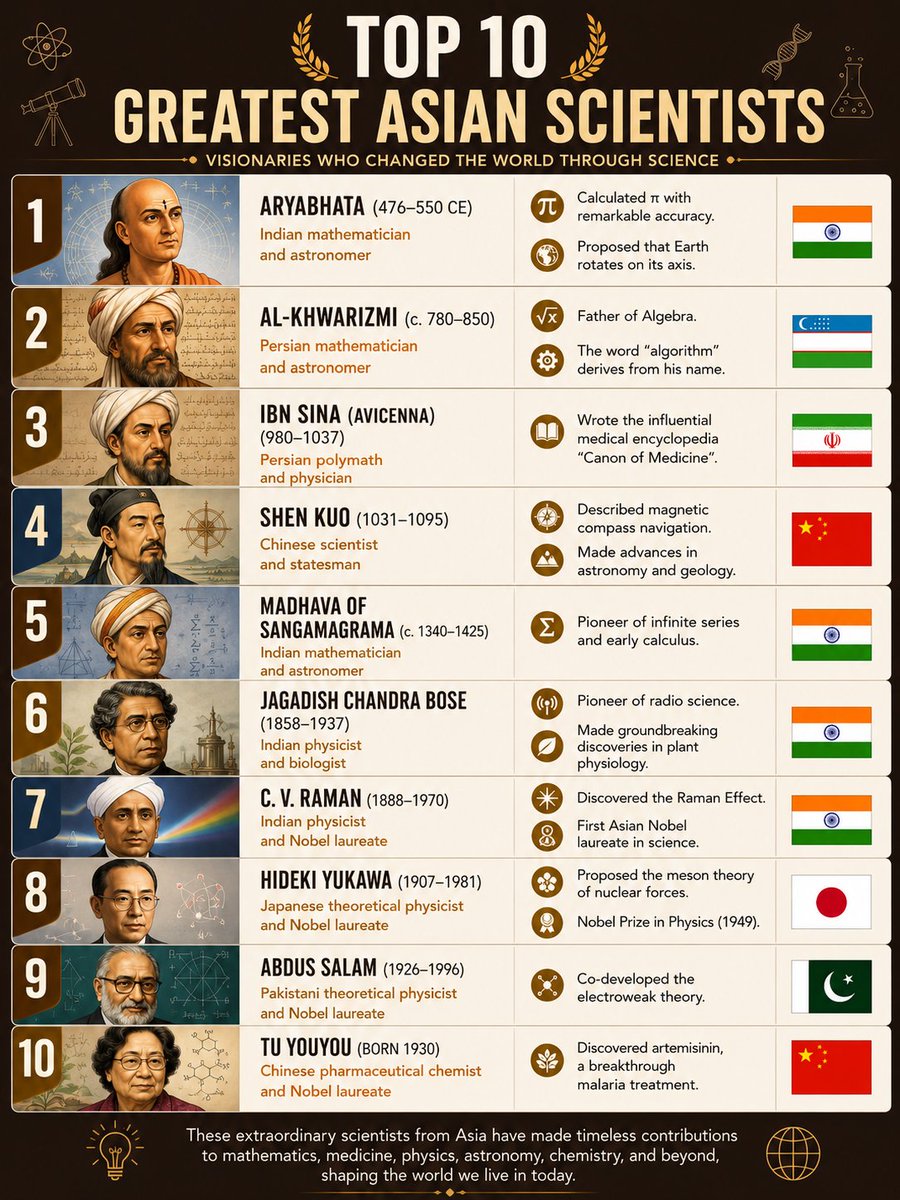
Top 10 Greatest Asian Scientists
1. 🇮🇳 Aryabhata (476–550 CE)
- Indian mathematician & astronomer
- Calculated π with remarkable accuracy
- Proposed that Earth rotates on its axis
2. 🇺🇿 Al-Khwarizmi (c. 780–850)
- Persian mathematician & astronomer
- Father of Algebra
- The word "algorithm" derives from his name
3. 🇮🇷 Ibn Sina (Avicenna) (980–1037)
- Persian polymath & physician
- Wrote the influential medical encyclopedia "Canon of Medicine"
4. 🇨🇳 Shen Kuo (1031–1095)
- Chinese scientist & statesman
- Described magnetic compass navigation
- Advanced astronomy and geology
5. 🇮🇳 Madhava of Sangamagrama (c. 1340–1425)
- Indian mathematician & astronomer
- Pioneer of infinite series and early calculus
6. 🇮🇳 Jagadish Chandra Bose (1858–1937)
- Indian physicist & biologist
- Pioneer of radio science
- Made groundbreaking discoveries in plant physiology
7. 🇮🇳 C. V. Raman (1888–1970)
- Indian physicist & Nobel laureate
- Discovered the Raman Effect
- First Asian Nobel laureate in science
8. 🇯🇵 Hideki Yukawa (1907–1981)
- Japanese theoretical physicist & Nobel laureate
- Proposed the meson theory of nuclear forces
- Nobel Prize in Physics (1949)
9. 🇵🇰 Abdus Salam (1926–1996)
- Pakistani theoretical physicist & Nobel laureate
- Co-developed the electroweak theory
10. 🇨🇳 Tu Youyou (Born 1930)
- Chinese pharmaceutical chemist & Nobel laureate
- Discovered artemisinin for malaria treatment
Located in Hisar (Haryana), Rakhigarhi is the largest known archaeological site of the Indus-Saraswati Civilisation, spanning approximately 550 hectares, significantly larger than both Harappa and Mohenjo-daro.
Major excavations at the site have revealed advanced urban planning, sophisticated craftsmanship, a large lapidary workshop, drainage systems, wells, and a substantial cemetery.
Many scholars believe it may have served as a major provincial capital or an important regional center of the Indus-Saraswati Civilisation.
These discoveries firmly establish that the heart and largest expanse of the Indus-Saraswati Civilisation thrived across a vast area of Bharat.
Ongoing research and preservation efforts at Rakhigarhi continue to provide deeper insights into this ancient civilisation and its profound roots in Indian history.
#Rakhigarhi #IndusSaraswatiCivilisation #LargestIndusSite #AncientIndianHeritage #CivilisationalContinuity
@ASIGoI