1. Start with FII and DII activity.
https://t.co/0bVrbuT9Wx
This is the daily net buying and selling of foreign and domestic institutions. It will not tell you what to buy. It tells you which way the biggest money is leaning, and that sets the odds for everything else you do.
Typical features of Operator driven stocks in connivance with Promoters
By the time positive news or results come stock has already moved up. Retail gets trapped in buying as operators sell
By the time negative news comes in stock has already fallen. Operators buy as Retail exits
Be careful of such companies
If u intend to make generational wealth look
- defence technology
- aerospace
-Bio tech
-space tech
- chip makers
Support first generation entrepreneurs with expertise in deep tech and precision engineering.. India is just starting here !
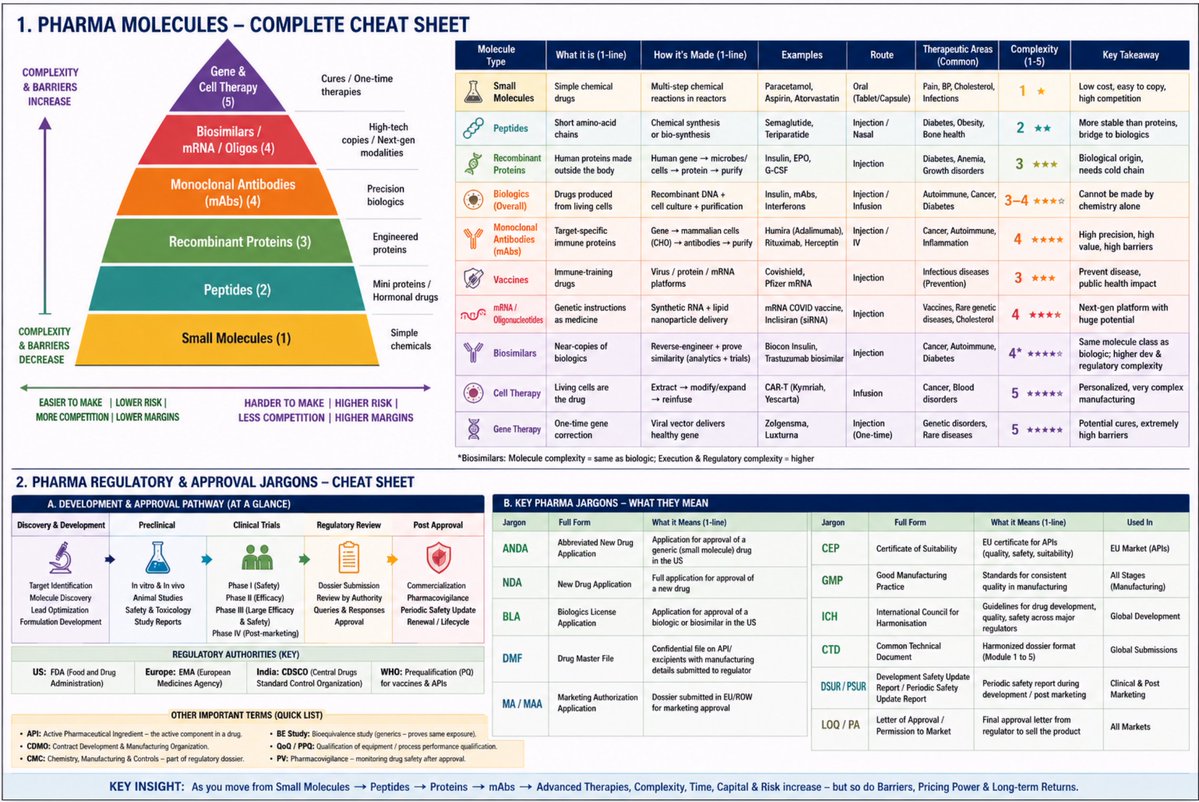
Pharma Cheat Sheet
As you all know, I am heavily invested in Pharma - it is by far my highest allocation, around 35-40%
For someone like me, with no background of pharma, it is extremely difficult to understand the basics and all the jargons related to different types of molecules, regulatory approvals etc.
So, I created this sheet sheet working with GPT, keeping an investor perspective in mind.
Hope it helps.. you can keep it as a reference.
I don't claim any accuracy, as I am not an expert.
Let's keep learning and sharing 🙂🙂
Sanjeev Prasad of @KotakMF on #CNBCTV18
India loves a narrative — until it forgets it. Railway stocks are down 50% from 2 years ago and nobody's talking about it anymore.
ABB went from 35x to 60x forward earnings — that's when we walked away
Cognizant at 7x, Accenture at 9x forward earnings — Kotak's Sanjeev Prasad says that's the US market pricing in a profit decline for IT services. His call: don't catch a falling knife.
Private banks could deliver ~30% returns over 2 years
Preferred themes: domestic services: financials, healthcare services, hospitality (travel, tourism, transportation), retailing and telecom, backed by a long domestic growth runway, large unorganized-to-organized market share shifts in three of the five sectors, and limited global competition in India
Full interview on @CNBCTV18Live
https://t.co/cIRJhDYzTb
One Pager on Three Stocks i found worth Tracking:
Azad Engineering: Turbine blades for gas turbines. Scaling aerospace segment, supplies APUs, landing gear actuators. LTAs with rolls-royce, safran for engine components.
Kirloskar Oil Engines: manufactures diesel gensets, industrial engines, and energy transition products for power generation, defense, and infrastructure. Growth driven by 2100cr capex, nuclear genset order, and HHP sales.
Bhagyanagar India: copper recycling and value added products company targeting 25% CAGR growth through capacity expansion, margin improvement, demergers. Key segments include copper processing, plastic recycling, and AI data center bus bars.
Genus Power Targets Major Share of ₹60,000 Crore Smart Meter Opportunity
Genus Power & Infrastructures is aiming to secure a significant portion of the ₹60,000 crore worth of active smart metering tenders currently available in India
Backed by Singapore's sovereign wealth fund GIC, the company is among the leading beneficiaries of India's smart meter rollout under the power sector reforms
Genus currently holds around 30% market share in the smart meter segment
The company expects strong growth momentum driven by the Revamped Distribution Sector Scheme (RDSS) and accelerating smart meter deployments across states
Management plans to install approximately 24 million smart meters over the next 2–3 years
Genus has already crossed 10 million meter installations across the country
In addition, around 15 million smart meters have been deployed through various Advanced Metering Infrastructure Service Providers (AMISPs) and utility partners
India has around 310 million non-agricultural electricity connections, all of which are expected to gradually transition to smart meters
Tenders covering 150 million smart meters have already been floated and corresponding orders have been placed
The company sees a large long-term opportunity as utilities accelerate digitization and modernization of electricity distribution networks
The smart metering push is expected to improve billing efficiency, reduce power losses and strengthen the financial health of power distribution companies
The article highlights the enormous scale of India's smart meter rollout, positioning Genus Power as one of the key players in this multi-year infrastructure opportunity
NSE is a cash generation and distribution machine. In FY26 alone, NSE earned a profit of over ₹10,300 crore and paid out roughly ₹8,660 crore in dividends— a payout ratio of 84%. This will likely continue even after listing because NSE can't do much with the excess profits. SEBI doesn't allow exchanges to invest in other businesses, listed or private.
So why aren't there more businesses like this?
It comes down to a tax arbitrage. Assume a business earns ₹100. It pays ~25% corporate tax, leaving ₹75. If that ₹75 is distributed as dividends, the shareholder pays tax again at their marginal rate. Can be another ~36% for someone in the highest bracket. The investor ends up with ₹48 out of the original ₹100.
Now contrast that with a company that reinvests the entire ₹100 into growth. If that growth reflects in the stock price, the investor pays capital gains tax only when they sell and at a much lower rate of 14.5% (the highest rate). Adding to this, there is no tax on this ₹100 because nothing is booked as profit.
A differential of 14.5 % vs 51% creates a strong incentive for profitable companies to reinvest aggressively rather than distribute. Which is why you don't see many new-age businesses choosing to be profitable in the first place.
I hope something changes here. Reinvestment is good for the economy in the short run, but businesses that aren't profitable are also far more vulnerable. One bad cycle can kneecap them severely. In the long run, that isn't smart.
This is part of a much larger global debate: the double taxation of corporate profits. Many countries have tried to address it. The US taxes dividends from most listed companies at lower rates than regular income through "qualified dividends." Australia gives investors credit for tax already paid by the company on its profits.
I have a conflict of interest on this topic. At Zerodha, almost all the cash we generate is retained and reinvested in startups through @Rainmatterin, the social sector through our @RainmatterOrg, or listed companies/Gold/Bonds. Even otherwise, it doesn't make sense to pay another tax and take out dividends, one of the few negatives of not being listed.
I think there should not be such a big differential in taxes, on dividend income as compared to capital gain. 😀
What if the biggest investment risk today isn't AI itself—but the price investors are willing to pay for it?
From tech IPO mania to unlisted share euphoria, markets have a habit of turning great stories into expensive trades. The latest chapter? The global AI frenzy.
We explore this topic in the latest edition of our letter to investor: https://t.co/9Lov96M5Kp
#Investors #AI #Valuations #StrategicInvestments #IPO #FOMO #ViksitBharat2047
Never sell because you're bored': PPFAS CIO Rajeev Thakkar's 6-point guide on when to exit an investment
#ETAlphaWealthSummit | @RajeevThakkar | @PPFAS
Read the full story here
https://t.co/USA8c9sIJ3
How a made-in-India antibiotic opens new front against superbugs
Wockhardt's Zaynich received FDA approval after 14 years of R&D. A made-in-India antibiotic hitting drug-resistant infections that kill nearly 3 lakh Indians every year (more than cancer, diabetes & kidney disease combined).
With a 97% success rate in clinical trials against the hardest-to-treat hospital infections, this is the breakthrough doctors have been waiting for.
At $10,000–$12,000 per treatment course in the US, Zaynich's India pricing is still unannounced
Hyderabad overtakes Bengaluru in chip design hiring. 𓇲
Cities competing hard = win-win for India’s talent & innovation.
As per latest statistics, Hyderabad has taken the lead over Bengaluru with 3,549 new GCC jobs and 21% share of India’s semiconductor talent hiring.
Hyderabad currently has 9,300+ design engineers (growing 4% YoY), strong VLSI talent pool, and is positioning itself for 100+ advanced design IPs by 2025.
Leveraging strategic initiatives:
• Leverage NITI Aayog’s Future of Semiconductors roadmap.
• $10B national incentive scheme.
• Focus on advanced packaging, ATMP, and full ecosystem building.
Hyderabad is now positioning itself as a global hub for the next decade of semiconductor ambitions.
Top leaders (including from Intel, former VLSI architects, and industry veterans) are bullish, terming Hyderabad as a "knowledge city" that can deliver real growth in end to end value chain.
Implications:
- Diversifies India’s tech geography.
- Creates healthy competition between cities → better salaries, infrastructure & innovation.
- Positions India stronger in global chip supply chain.
India’s semiconductor journey just got more exciting.
#Hyderabad #Semiconductors
@SemiconIndia