@DavidJonesBrain Anatomically consistent w one of the rATL syndromic variants (which sometimes can include bvFTD-like behavioral symptoms or both semantic-behavioral symptoms), usually caused by FTLD-TDP43
@DavidJonesBrain I agree w you Dave—sounds like this is syndromically a case of progressive semantic memory impairment for people, not simply prosopagnosia like in this early paper but multi-modal person-specific knowledge:
https://t.co/nEC195Piup
In our recent work, we elucidate the underlying mechanism of language abnormalities in Alzheimer's disease, such as overusing pronouns and verbs. The insights were gained from a comparison between English and Persian. https://t.co/yrwA94JhDo
Excited that this paper is published by PNAS today where we show how speakers maintain a balance between the complexity of words and syntax; and how this property may assist aphasia patients to better communicate
Big thanks to @DickersonLabMGH@LanguageMIT@kmahowald@raryskin
Fantastic neuropsychiatrist in our @FTDunitBoston@NeguineR Neguine Rezaii’s new paper with @LanguageMIT “A syntax–lexicon trade-off in language production” in PPA & healthy people is out today in @PNASNews: https://t.co/vmCxKdmMn2
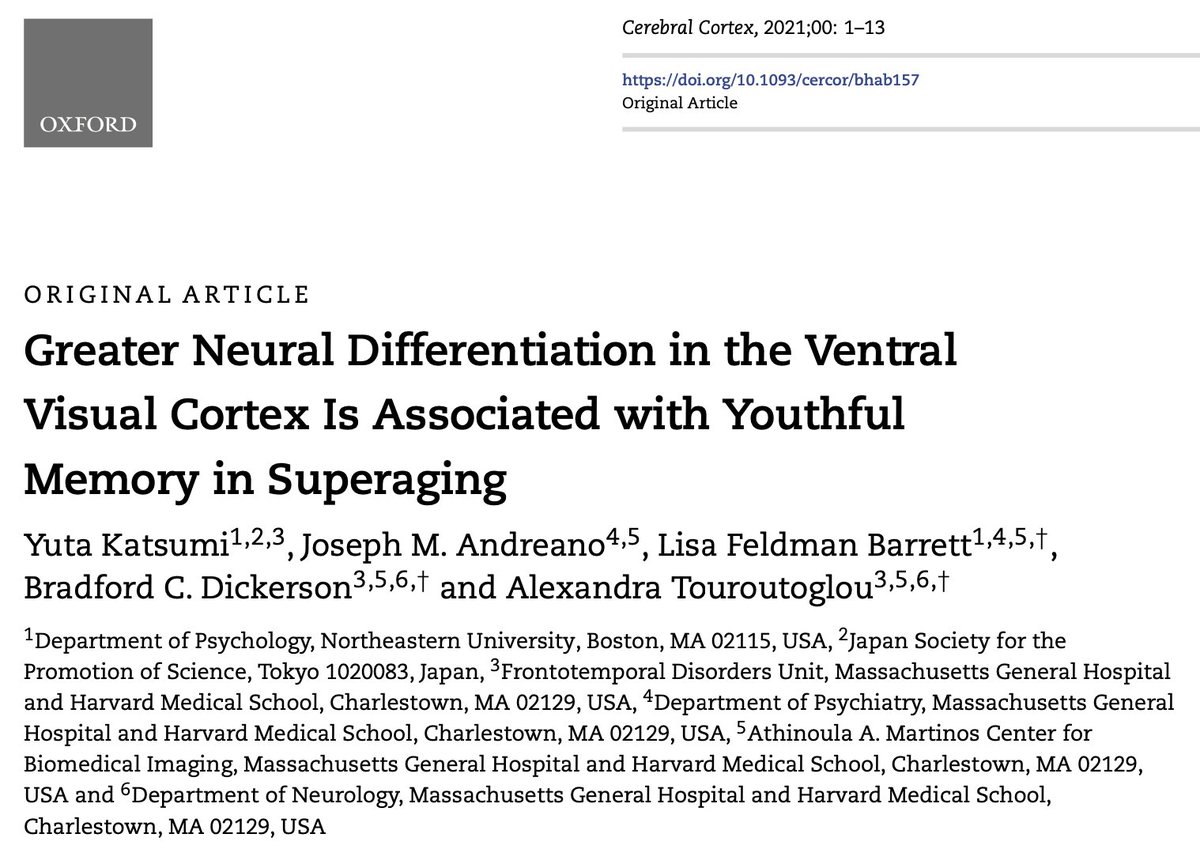
Our new #superaging paper out now in Cerebral Cortex! https://t.co/bNNo33Kc1k
We show that superagers (older adults with youthful memory) retain their selective and efficient ability to process visual stimuli, allowing them to form distinct memories.
2 days down, 2 days to go! Great faculty, perfect co-directors (Drs. Brad @DickersonLabMGH & Lili Shaughnessy) & fantastic fun learning with everyone @ #Harvard#Dementia Course. United we will one day win the war against #Alzheimers & Related Dementias. Hope, ❤️ & perseverance!
Our annual Harvard Dementia Course is off to a great start with nearly 500 attendees! You can still register for this livestream CME course, with videos available for 30 days after the course. https://t.co/zD6LrsBPiL
Register for the upcoming annual Harvard Dementia Course, streaming for clinicians who want a comprehensive update on the field (with CME/CEUs). https://t.co/5CKZq7ahuX
Today was surReality @ MGH... this afternoon was my first FTD clinic since March 9. Valuable safety protocols in place, but strangely quiet except for a few patients (after a very busy morning of virtual clinic)
Dear colleagues, please distribute broadly. This is a White House petition to allow F-1 students to stay in the US through the fall semester if instruction is online due to the pandemi https://t.co/y4DFRnnofQ
Our behavioral neurology/neuro psychiatry field has lost a (too young) giant. We will miss you Dan, and our hearts go out to your family, friends, and patients
Behavioral neurology and neuropsychiatry lost an important member of the field today, and I lost a mentor and friend. Ave atque vale. @UNCneurology #Neurology#neuropsychiatry#BNNP
In a recent webinar hosted by @homeinstead, AFTD's Matthew Sharp & Deena Chisholm discuss caring for persons living with #FTD, ways in which FTD differs from #Alzheimers, and the many resources and services AFTD can provide to those facing this disease: https://t.co/jpOPvF1CAu