this is just the most ridiculous AI application i've ever seen lol
a Peter Thiel-backed startup that makes AI collars for cows is now worth $2 billion
and the more I read about it the cooler it gets. here's how it works:
every cow wears a solar-powered collar that talks to a network of radio towers and an app on the farmer's phone
instead of building physical fences, the farmer draws the fence on a map in the app, and the collar keeps each cow inside that invisible line using GPS
when a cow drifts toward the edge, the collar plays a sound to steer her, and a gentle vibration tells her which way to go.
it's like how a car beeps as you back up toward a wall
the cows learn the cues in a few days
so now a rancher can move an entire herd to fresh grass by sliding the fence on a map, without driving out to open a single gate
and that same collar is reading each cow's body the whole time.
it takes five readings per second on every animal, so the AI can catch a cow that's sick, injured, ready to breed, or about to give birth before a person would ever notice walking the field
so it's basically like WHOOP for cows too lol
and they gave the AI behind it the perfect name: the Cowgorithm
it's been trained on more than 7 billion hours of real cow behavior, which is why Halter calls the data its real asset and moat.
they know what a normal cow looks like better than anyone, so they can flag the odd one out instantly
it's already on more than 1M cattle across New Zealand, Australia, and a bunch of US states.
California even used it on public land to graze cattle in patterns that clear dry brush and slow down wildfires
costs about $5 to $8 per cow per month
a job that used to mean barbed wire, gates, and driving the fields all day is now mostly 1 person on their phone
I once flew 30+ hours from Melbourne to London to pitch during the peak of the SoftBank Vision Fund era.
I had a 39°C fever.
The investor was 90 minutes late.
When he finally walked into the room, he was barefoot.
No shoes. No socks. Just completely barefoot.
I started pitching.
About 30 seconds later he opened a bag of peanuts.
Crunch.
Crunch.
Crunch.
Then he interrupted:
“How much are you raising?”
“$100-150M.”
“I’ll give you $300M. We can king-make your company.”
Meeting over.
20 minutes total.
I spent longer getting from Heathrow to the office than the actual pitch.
Fundraising is one of the strangest games in business.
You can spend months doing DD work with them and preparing for a meeting. And sometimes the person deciding the future of your company is barefoot and eating peanuts while you have a 39-degree fever.
In 2023, I paused my PhD to join @OpenAI to build the world’s first reasoning machine — OpenAI o1.
Earlier this year, I defended my PhD thesis “Building a Reasoning Machine” advised by @Yoshua_Bengio at @Mila_Quebec 🎓 🎉
Much has changed since Yoshua and I first discussed reasoning in 2022, but the main themes aged well:
- Adding structures to computation unlocks strong reasoning capabilities;
- Data & sample efficiency will become the bottleneck to useful intelligence;
- Retaining Bayesian uncertainty is key to reliable and safe AI systems.
You can read the introduction of my thesis here: https://t.co/JBQ8C73Jm5
My next professional chapter (TBA) will be on bridging frontier intelligence with real economic impact, a theme dear to my heart after working closely with @drwconvexity and @suna_said in the last year 🚀
Judging by my tl there is a growing gap in understanding of AI capability.
The first issue I think is around recency and tier of use. I think a lot of people tried the free tier of ChatGPT somewhere last year and allowed it to inform their views on AI a little too much. This is a group of reactions laughing at various quirks of the models, hallucinations, etc. Yes I also saw the viral videos of OpenAI's Advanced Voice mode fumbling simple queries like "should I drive or walk to the carwash". The thing is that these free and old/deprecated models don't reflect the capability in the latest round of state of the art agentic models of this year, especially OpenAI Codex and Claude Code.
But that brings me to the second issue. Even if people paid $200/month to use the state of the art models, a lot of the capabilities are relatively "peaky" in highly technical areas. Typical queries around search, writing, advice, etc. are *not* the domain that has made the most noticeable and dramatic strides in capability. Partly, this is due to the technical details of reinforcement learning and its use of verifiable rewards. But partly, it's also because these use cases are not sufficiently prioritized by the companies in their hillclimbing because they don't lead to as much $$$ value. The goldmines are elsewhere, and the focus comes along.
So that brings me to the second group of people, who *both* 1) pay for and use the state of the art frontier agentic models (OpenAI Codex / Claude Code) and 2) do so professionally in technical domains like programming, math and research. This group of people is subject to the highest amount of "AI Psychosis" because the recent improvements in these domains as of this year have been nothing short of staggering. When you hand a computer terminal to one of these models, you can now watch them melt programming problems that you'd normally expect to take days/weeks of work. It's this second group of people that assigns a much greater gravity to the capabilities, their slope, and various cyber-related repercussions.
TLDR the people in these two groups are speaking past each other. It really is simultaneously the case that OpenAI's free and I think slightly orphaned (?) "Advanced Voice Mode" will fumble the dumbest questions in your Instagram's reels and *at the same time*, OpenAI's highest-tier and paid Codex model will go off for 1 hour to coherently restructure an entire code base, or find and exploit vulnerabilities in computer systems. This part really works and has made dramatic strides because 2 properties: 1) these domains offer explicit reward functions that are verifiable meaning they are easily amenable to reinforcement learning training (e.g. unit tests passed yes or no, in contrast to writing, which is much harder to explicitly judge), but also 2) they are a lot more valuable in b2b settings, meaning that the biggest fraction of the team is focused on improving them. So here we are.
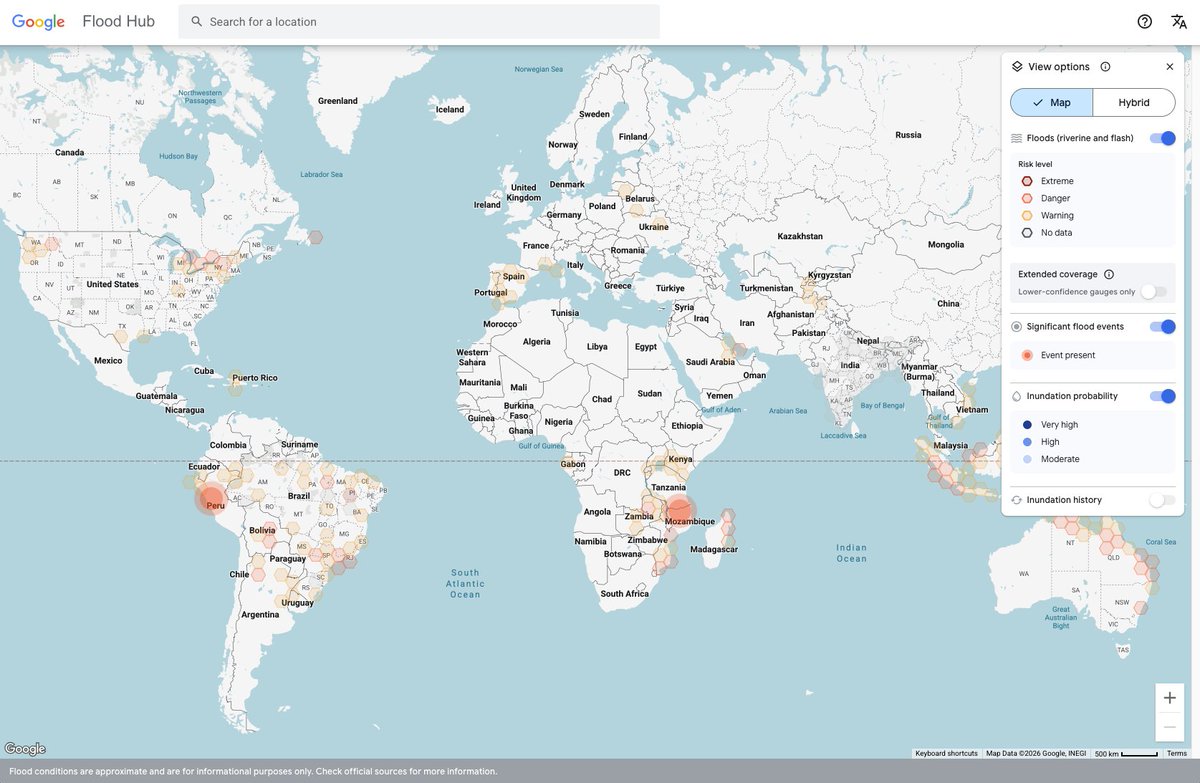
We trained a new flood forecasting model designed to predict flash floods in urban areas up to 24 hours in advance.
To help address a flash floods data gap, we created Groundsource: a new AI methodology using Gemini to identify 2.6M+ historical events across 150+ countries.
We’re open-sourcing this dataset to advance global research, and urban flash flood forecasts are live now in Flood Hub to help communities stay safe.
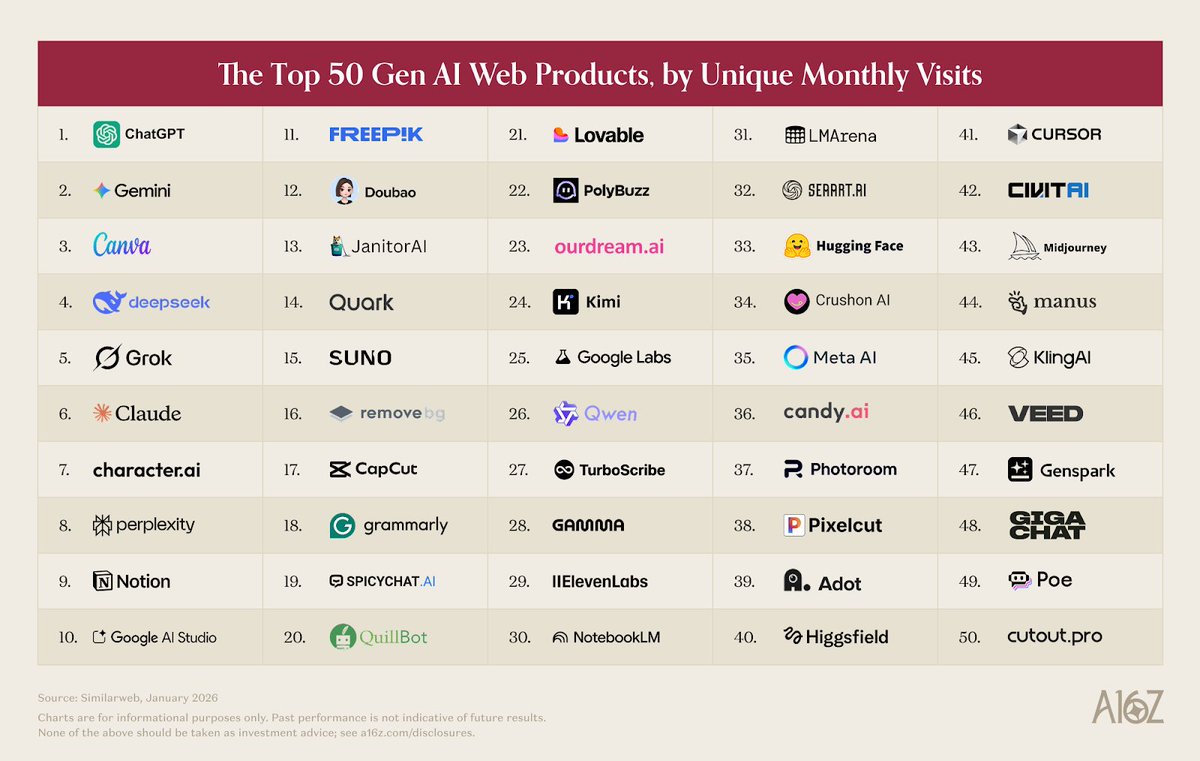
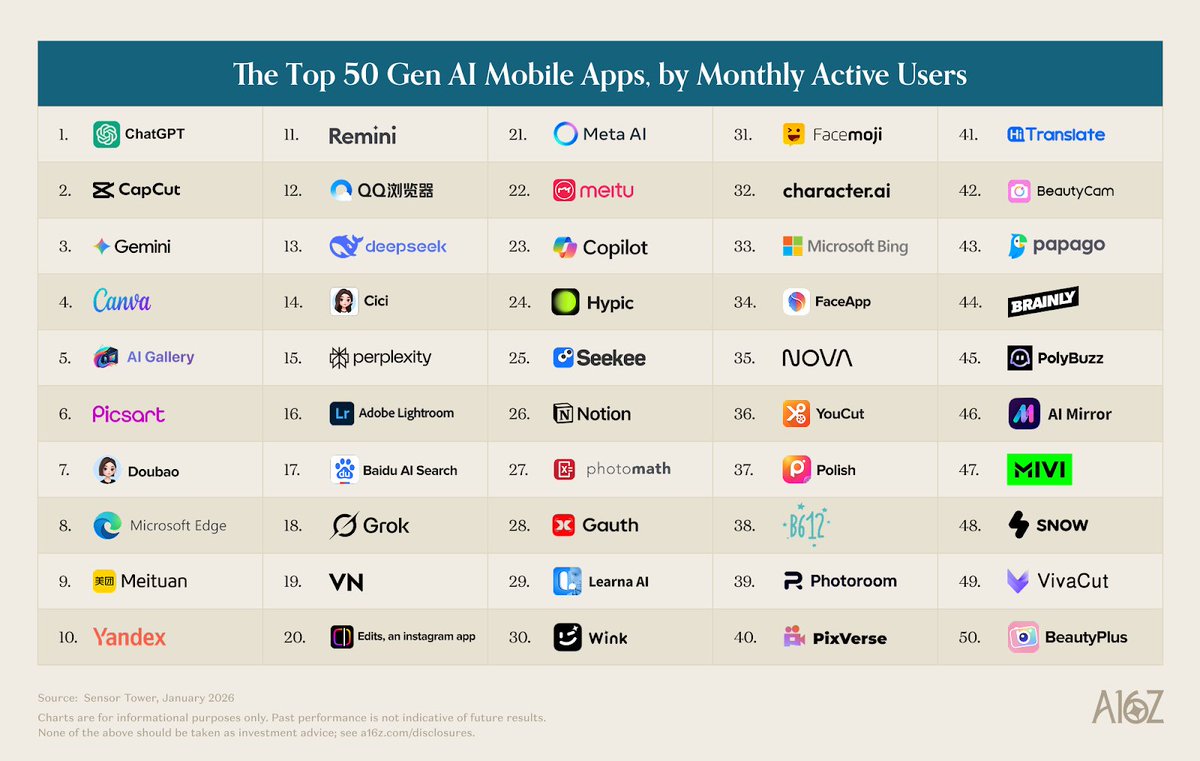
🚨 The @a16z consumer AI Top 100 is back!
For the sixth time, we ranked consumer AI websites and mobile apps by usage (monthly unique visits and MAUs).
This edition, we changed the rules. Here's why - and what the new list says about where consumer AI is heading 👇
Want to host Claude meetups in your city? We'll cover the funding, send swag, and give you monthly API credits for your demos.
You also get access to pre-release features and a private slack with the team! Go apply 💛
we're making @blocks smaller today. here's my note to the company.
####
today we're making one of the hardest decisions in the history of our company: we're reducing our organization by nearly half, from over 10,000 people to just under 6,000. that means over 4,000 of you are being asked to leave or entering into consultation. i'll be straight about what's happening, why, and what it means for everyone.
first off, if you're one of the people affected, you'll receive your salary for 20 weeks + 1 week per year of tenure, equity vested through the end of may, 6 months of health care, your corporate devices, and $5,000 to put toward whatever you need to help you in this transition (if you’re outside the U.S. you’ll receive similar support but exact details are going to vary based on local requirements). i want you to know that before anything else. everyone will be notified today, whether you're being asked to leave, entering consultation, or asked to stay.
we're not making this decision because we're in trouble. our business is strong. gross profit continues to grow, we continue to serve more and more customers, and profitability is improving. but something has changed. we're already seeing that the intelligence tools we’re creating and using, paired with smaller and flatter teams, are enabling a new way of working which fundamentally changes what it means to build and run a company. and that's accelerating rapidly.
i had two options: cut gradually over months or years as this shift plays out, or be honest about where we are and act on it now. i chose the latter. repeated rounds of cuts are destructive to morale, to focus, and to the trust that customers and shareholders place in our ability to lead. i'd rather take a hard, clear action now and build from a position we believe in than manage a slow reduction of people toward the same outcome. a smaller company also gives us the space to grow our business the right way, on our own terms, instead of constantly reacting to market pressures.
a decision at this scale carries risk. but so does standing still. we've done a full review to determine the roles and people we require to reliably grow the business from here, and we've pressure-tested those decisions from multiple angles. i accept that we may have gotten some of them wrong, and we've built in flexibility to account for that, and do the right thing for our customers.
we're not going to just disappear people from slack and email and pretend they were never here. communication channels will stay open through thursday evening (pacific) so everyone can say goodbye properly, and share whatever you wish. i'll also be hosting a live video session to thank everyone at 3:35pm pacific. i know doing it this way might feel awkward. i'd rather it feel awkward and human than efficient and cold.
to those of you leaving…i’m grateful for you, and i’m sorry to put you through this. you built what this company is today. that's a fact that i'll honor forever. this decision is not a reflection of what you contributed. you will be a great contributor to any organization going forward.
to those staying…i made this decision, and i'll own it. what i'm asking of you is to build with me. we're going to build this company with intelligence at the core of everything we do. how we work, how we create, how we serve our customers. our customers will feel this shift too, and we're going to help them navigate it: towards a future where they can build their own features directly, composed of our capabilities and served through our interfaces. that's what i'm focused on now. expect a note from me tomorrow.
jack
The New York Times made news the loss leader for a $2 billion digital revenue machine, and this chart is the receipt.
News-only subscribers dropped 65% since June 2022. Bundle subscribers grew 227%. That looks like a news collapse. But the NYT deliberately killed its standalone news product. They stopped marketing it. They made it nearly impossible to buy a news-only subscription on their website. They priced the full bundle (News + Games + Cooking + Athletic + Wirecutter) at $2/month introductory, cheaper than a standalone Games subscription.
News-only ARPU is $13.33. Bundle ARPU is $12.92. Single non-news product ARPU is $3.36. Those 4.3 million single-product subscribers paying $3.36/month? They’re not the business. They’re the funnel. The NYT CEO said it explicitly on the earnings call: single products are “funnels to get people to subscribe” to the bundle.
Games now accounts for over 50% of time spent inside the NYT app. Wordle, Connections, and the Mini pull 10+ million weekly players who never intended to read a news article. But half of all NYT subscribers now pay for the bundle, and bundle subscribers retain longer, engage more, and accept price increases. The bundle just went from $25 to $30/month.
The result: digital revenue crossed $2 billion for the first time in 2025. Free cash flow hit $550 million. Adjusted operating margins reached 24% in Q4. Berkshire Hathaway just took a billion-dollar position. While the Washington Post cut 300 journalists last week, the Times added 1.4 million subscribers.
This chart shows a news company that built an attention ecosystem where Wordle gets you in the door, Cooking keeps you at breakfast, The Athletic owns your commute, and by the time you think about canceling, you’d lose four products instead of one.
The NYT figured out that the way to fund journalism in 2026 is to make sure you can’t quit the crossword.
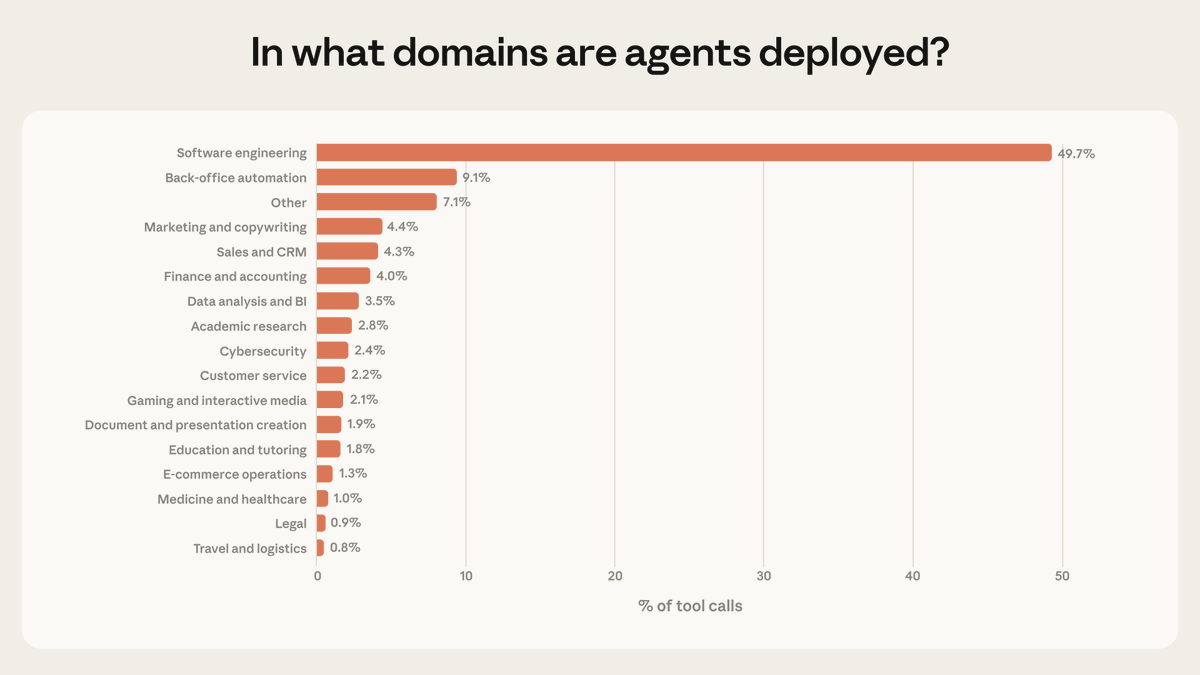
Software engineering makes up ~50% of agentic tool calls on our API, but we see emerging use in other industries.
As the frontier of risk and autonomy expands, post-deployment monitoring becomes essential. We encourage other model developers to extend this research.
Everyone’s reading this as “tech company does Africa partnership.”
The real story is why Rwanda specifically.
Rwanda is trying to eliminate cervical cancer by 2027, three years ahead of WHO’s global target. They already have 90% HPV vaccination coverage for girls, 81% treatment coverage, and 15,000 community health workers going door to door across 30 districts screening women aged 30-49. Their screening rate is at 31% against a 70% target, which means they need to more than double throughput in under two years.
That screening bottleneck is exactly where AI compounds. Pattern recognition on HPV DNA tests, triage prioritization across 1.3 million eligible women, resource allocation across rural health centers. Rwanda already built the physical infrastructure. They already have the human network. What they lack is processing speed at the edge of their health system.
This is what makes Rwanda a better AI deployment partner than countries 10x its GDP. They’ve been running national-scale public health programs with measurable outcomes since 2011. They have a community health insurance system covering 91% of the population at roughly $2 per person. They have a government that sets aggressive targets and actually reports against them.
Compare that to most AI health pilots: disconnected from national health systems, no community distribution layer, no insurance infrastructure to absorb follow-up treatment costs. The tech works in the demo. It fails at scale because there’s nobody to act on the AI’s output.
Anthropic picked the country where AI has the shortest path from prediction to treatment. Rwanda built that path over 15 years of health system investment. The 2,000 Claude Pro licenses for educators and the developer API credits are nice, but the cervical cancer screening acceleration is where you’d actually measure whether frontier AI changes population-level health outcomes.
If screening coverage moves from 31% to 70% by 2027, that’s the first real proof point for AI in public health anywhere in the world.
We've signed an MOU with the Government of Rwanda—the first partnership of its kind in Africa—to bring AI to health, education, and other public sectors.
Read more: https://t.co/txgEScvKtP
Yann LeCun just said something that every AI-in-healthcare researcher should sit with.
He basically said:
If language were enough to understand the world, you could learn medicine by reading books.
But you can’t.
You need residency. You need to see thousands of normal cases before you recognize the abnormal one.
He also points out something wild — all the public text on the internet is on the order of 10¹⁴ bytes.
A 4-year-old processes about that much through vision alone.
The world is just… higher bandwidth than text.
I think this shift — from language models to world models — is going to matter a lot in healthcare. 🫀
Here's my conversation with Peter Steinberger (@steipete), creator of OpenClaw, an open-source AI agent that has taken the Internet by storm, with now over 180,000 stars on GitHub.
This was a truly mind-blowing, inspiring, and fun conversation!
It's here on X in full and is up everywhere else (see comment).
Timestamps:
0:00 - Episode highlight
1:30 - Introduction
5:36 - OpenClaw origin story
8:55 - Mind-blowing moment
18:22 - Why OpenClaw went viral
22:19 - Self-modifying AI agent
27:04 - Name-change drama
44:15 - Moltbook saga
52:34 - OpenClaw security concerns
1:01:14 - How to code with AI agents
1:32:09 - Programming setup
1:38:52 - GPT Codex 5.3 vs Claude Opus 4.6
1:47:59 - Best AI agent for programming
2:09:59 - Life story and career advice
2:13:56 - Money and happiness
2:17:49 - Acquisition offers from OpenAI and Meta
2:34:58 - How OpenClaw works
2:46:17 - AI slop
2:52:20 - AI agents will replace 80% of apps
3:00:57 - Will AI replace programmers?
3:12:57 - Future of OpenClaw community