For Apple silicon:
Fast training, fast fine tuning, fast generation with no compromises on flexibility, all open source under MIT.
pip install <zero perplexity prediction>
As part of our goal to make MLX a great research tool, we're expanding support to new languages like Swift and C, making experimentation on Apple silicon easier for ML researchers.
Video generating text with Mistral 7B and MLX Swift 👇
MLX is an array framework for machine learning research on Apple silicon. MLX is intended for research and not for production deployment of models in apps.
Latest MLX has a compile transformation to make stuff go fast.
Some functions are up to 10x faster.
Docs: https://t.co/aN4O3w9hFA
We (@angeloskath, @DiganiJagrit) built this in the past three weeks.
A 🧵 on what it can do:
@danveloper We wanted to make developing metal kernels for MLX easier - so we're trying to organise reusable components into a Subroutine Templates and Effcient Elements Library (steel)! This newest update is just the first step in that direction
I solved the 2D Heat Conduction equation in a plate with 2 Dirichlet & 2 Neumann BCs on the Apple M2 Ultra GPU using PyTorch & the new MLX framework. MLX is roughly twice as fast and interestingly I can Matplotlib plot directly, no need to transfer to CPU. @awnihannun@Apple
I am really excited about our latest work!
A simple efficient framework to experiment with modern neural networks even on your laptop!
12 lines to write a transformer LM 🥳
I find it interesting that the perception of the ML community is that @Apple "does not publish" or that it "does not contribute frameworks". Anyways, I'm going to start actively sharing my colleagues works to gently push back on that perception :)
The video is a Llama v1 7B model implemented in MLX and running on an M2 Ultra.
More here: https://t.co/gXIjEZiJws
* Train a Transformer LM or fine-tune with LoRA
* Text generation with Mistral
* Image generation with Stable Diffusion
* Speech recognition with Whisper
Just in time for the holidays, we are releasing some new software today from Apple machine learning research.
MLX is an efficient machine learning framework specifically designed for Apple silicon (i.e. your laptop!)
Code: https://t.co/Kbis7IrP80
Docs: https://t.co/CUQb80HGut
We find that algorithms that can use a mix of heuristic and stronger search mechanisms like NOMAD are reliable at finding the (known) global minimum on limited search spaces and efficient in finding the best devices on much larger and computationally intractable search spaces
Excited with my first manuscript together with @davoyan_artur ! Here we suggest an optimal way of applying optimization algorithms for inverse design of the materials and geometries for photonic devices: https://t.co/Wc9QPt5d6i
Our framework evaluates the blackbox optimization algorithms in a variety of scenarios and search spaces. We consider multiple objective functions derived from different inverse design problems such that some are chaotic while others are structured.
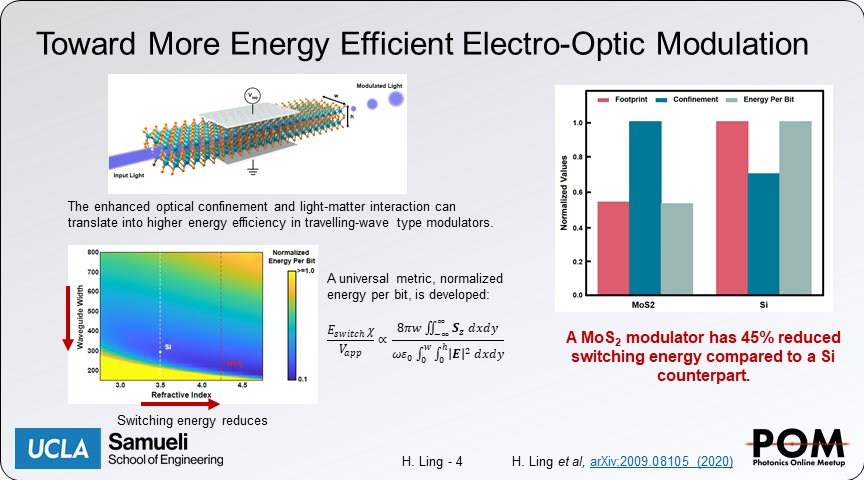
We theoretically examine the use of bulk TMDCs in creating integrated nanophotonic devices. Our study indicates that all-TMDC components may have performance comparable or exceeding that of conventional devices in use today.
@davoyan_artur@PhotonicsMeetup#POM21ja#POM21other