Grateful that @elizabethjdias of @nytimes wrote this piece on how Anthropic thinks about their model, software consciousness, & the model's role vis-a-vis religion. If you are doing business with this company (customer/partner), evaluating it (press), or regulating it (government), it is important to know how "they" think about their models and what they are doing. It's very different from any software company that ever existed.
Judge for yourself what you think about this approach, but be aware and informed.
https://t.co/L1oP6lGxEF
Tough jobs report today:
Payrolls rose only 29,000.
Unemployment is up from 4.1% to 4.2%.
July/August payrolls were revised down by a combined 60,000. Average hourly earnings barely moved (0.1%).
Professional services, information, financial activities, and temporary help all shrank.
On the other hand, the lack of growth in aggregate hours implies that productivity growth will likely come in stronger than expected.
Honest Argon take: it's not perfect (Opus 5.5 thinking traces are prettier), but it's the first big model we've released that's been this battle tested.
Far from being benchmaxxed, the 200k+ Googlers who rely on it everyday ensured that real utility was prioritized.
After 9 years. 16K+ family homes. 500M sqft inside real homes covered, we know home robots are being built in wrong order.
So we built Matic the way nature grows a child.
Finally, sharing our vision:
1. Why robots get stuck at the demo
2. Why labs can't ship robots
3. Why we started with eyes, not hands
4. The 99.999% rule in robotics
5. Where Matic is going next
1. Why most robots get stuck at demos
Robot demos look brilliant in a room arranged around its limitations: familiar lighting, predictable furniture, nothing troublesome on the floor.
A family’s home makes no such accommodations. There are cables, toys, shifting rugs and, occasionally, dog poop. Yes, humanoids will need to avoid that too.
Repeating a task under familiar conditions of uncluttered floors is not the same as handling an unfamiliar home with all its chaos.
2. Why labs can't ship robots
SLAM (Simultaneous Localization and Mapping) is how a robot maps its surroundings and locates itself within them. Ask most academics and they'll tell you it's a solved problem.
But real homes are the most chaotic spaces that exist.
There are glass doors that look like open doorways, mirrors, stairs, rugs, charging cables, and Legos placed all around.
So ask yourself: if indoor mapping and navigation is "solved," where are the robots? Why aren't airports, hotels and grocery stores full of them?
Calling it “solved” misses the question families actually care about: can I leave this thing alone and trust it?
3. Why we started with eyes, not hands
Nature doesn't give birth to a fully working human. We took our cue from how nature develops humans: capabilities built on one another.
Children learn to see before they learn to grab, and to grab before they learn to plan and handle the unexpected.
Perception comes first. Manipulation follows. More complex responsibilities come after that. At every stage, the robot must earn the next job by doing its current one well enough.
Before asking a robot to pick up a sock, we wanted it to understand where it was, where the sock was, and how to reach it.
Most of the industry started at the top, with humanoids. We started at the bottom, with a robot whose job is to see and move through a home precisely with 1cm accuracy in any lighting condition.
Floor cleaning gave that foundation an immediately useful job. It forced us to confront navigation, clutter, privacy and everyday reliability before reaching for more complex chores.
The floor cleaner isn’t a detour from our larger ambition. It is how we’re building toward it.
4. The 99.999% rule in robotics
At 90%, one in ten decisions is wrong, and a robot makes thousands in a single clean. That's the robot that bumps, gets lost, and falls down the stairs.
Every extra nine is a new mountain. The failures get rarer, harder to find, and exponentially harder to fix. They barely even happen until they happen in your home.
Matic's visual SLAM runs at 99.999% in 16K+ homes. We’re the ONLY unsupervised home robot at scale with pure vision-only full autonomy. If you ask us, the gap between 80% and 99.999% is where our 9 years of engineering went.
We close that gap inside real homes. When Matic handles something imperfectly, it saves a short clip and keeps it on the device. It only leaves if the family chooses to share it. If they do, it gets labeled, fed back into the model, and every Matic gets smarter, including theirs.
Families control what leaves their homes. We do the work of making the product better.
Better robots earn trust > trust brings more homes > and more homes teach the robot more.
5. Where Matic is going next
Phase one was perception and it's nearly done. Matic has covered 500 million square feet, 400K miles in thousands of real lived-in homes.
Now phase two is going to be about manipulation. And our idea is to build a robot that doesn't just move through your home, but acts in it to eliminate even more chores.
Each step must be useful today, not justified by something we promise tomorrow. The evolution of Matic is the revolution.
The goal isn’t to put the most impressive humanoid in your living room.
It’s giving your family time and energy back through robots that earn your trust, protect your privacy, and help without becoming another responsibility.
More time for each other. Less work getting in the way.
That’s Matic.
Get yours today at https://t.co/tEo81BKSmA
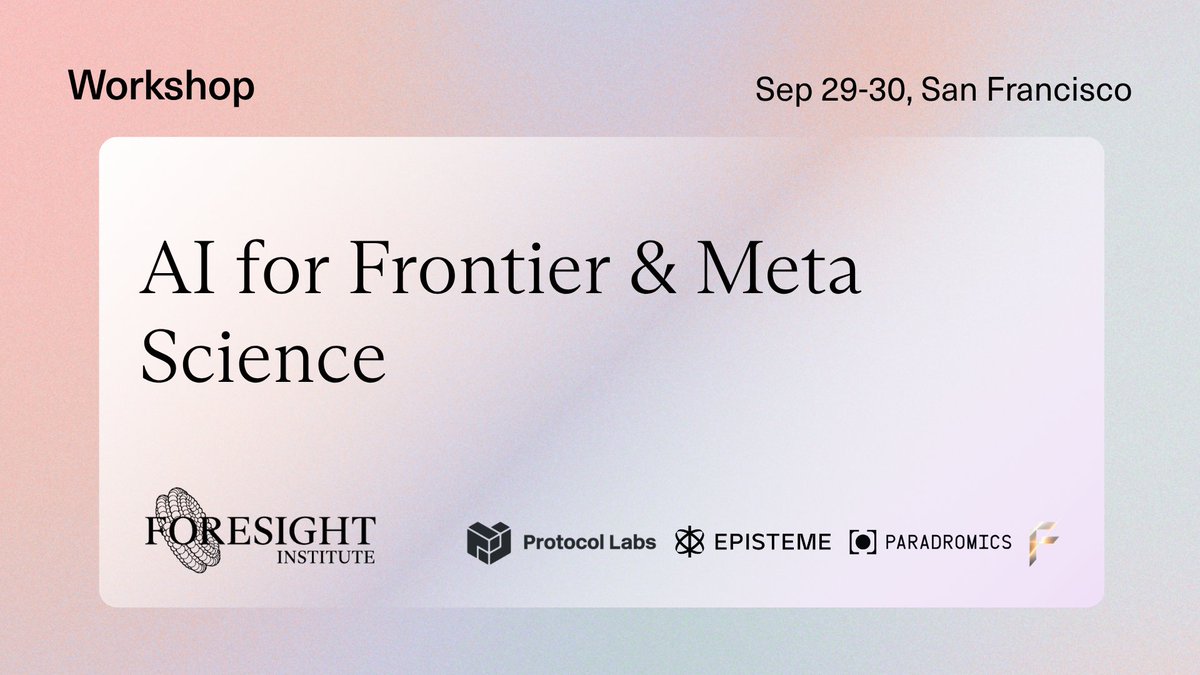
I'll be talking @foresightinst workshop tomorrow on how current AI capabilities accelerate our quest to reverse-engineer the algorithms of the brain, & why @AsteraInstitute is the best place to do this because we have AI team working along with @doristsao's Neuro team.
Could AI compress decades of scientific discovery into years and can progress be open, verifiable, and widely shared?
Some of the best minds in AI-first science are joining us this week in SF to unhobble our engines of discovery, translation and progress.
Speakers:
• Thomas Oxley @tomoxl (Synchron)
• Alex Pentland @alex_pentland (MIT Media Lab)
• Martin Borch Jensen @MartinBJensen (Gordian)
• Vivek Natarajan @vivnat (DeepMind)
• Eli Dourado @elidourado (Astera Institute)
• Dan Turner-Evans @DanTurnerEvans (Institute for Progress)
• Andreas Stuhlmüller @stuhlmueller (Elicit)
• Emilia Javorsky @Emilia_Javorsky (Future of Life Institute)
• Chelsea Fries (Institute for Protein Design)
• Sonia Arrison @soniaarrison (100 Plus Capital)
• Sean Escola @SeanEscola (Protocol Labs)
• Alex Teng @Alexteng (50 Years)
• Niko McCarty @NikoMcCarty (Asimov Press)
• Dileep George @dileeplearning (Astera Institute)
• Nabiha Saklayen @nabihasaklayen (Cellino)
• Mo Niknafs @moniknafs (Deep Science Ventures)
• Michael Previte @MichaelPrevite (Element Biosciences)
• Mikhail Shapiro @mikhailshapiro (Caltech)
• Angelica Parente (Civilization Ventures)
• Becca J. Carlson @beccajcarlson (Deliverome Bio)
• Madelyn Heart @madelynheart_ (Pillar VC)
• Michaela Hinks @MichaelaThinks (Edison Scientific)
Powered by @protocollabs, @episteme, @paradromics, and Future Forge Ventures.
@johnennis@stanislavfort Thats today. But if we do at some point understand how brains work then it’s hard to imagine that it won’t have implications for AI. (Sure some may say brains work exactly like how current AIs work, but even that needs to be proven out)