AI can now make you a great parent.
Introducing Ollie: the world’s first AI family assistant that manages your family life better than any human.
Here’s how it works:
Marc Andreessen’s advice to college students interested in startups
“If I’m 22 again, I think what I do is I go try to find the company in the Valley that’s growing the fastest, has a really good culture, and a really good foundation for training. An example of that would be an Airbnb, but there are many others. I would go plant myself at a company where I can really learn. I spend my time working my butt off so that I can establish a good reputation so that when people reference check me, I reference check well. But I also spend that time thinking, and really critically, I spend that time building my network and finding people I know I want to work with down the road. And then I either come up with an idea or I don’t.”
Mark also gives advice for people just enrolling in college:
“If I was 18 and going to college right now, I would do computer science again in a heartbeat. And then I would either focus on: #1 distributed systems and the broad domain of cryptocurrency; #2 AI & machine learning; or #3 intersection of biology and computer science—so genomics and synthetic biology. Personally I would do one of those three areas, and the hard part for me would be picking between them because I think all three of those are going to have transformative work happen in the next 20 years. They’re going to change a lot about how the world works.”
Source: @ycombinator (Oct 2016)
Brian Armstrong explains how he built Coinbase on nights and weekends while working at Airbnb
Brian first advises those who are currently employed to not build your project on company hours or on your company laptop:
“If you build it on company time or on the company hardware, the company probably owns the IP.”
Then he describes his schedule for working on Coinbase while still working full-time at Airbnb.
“I would often work [at Airbnb] until 7pm. I’d come home, eat dinner, and then I would work from 8pm to midnight. I would do that maybe 3-4 days a week on weekdays. And then on the weekend I’d work Sunday afternoon for 7-8 hours.”
Brian did this consistently for about a year and a half until Coinbase was far enough along for him to get seed funding from Y Combinator.
“It sucked. I mean I was tired after the full day of work [at Airbnb]. But this is where determination comes in… At that moment in time, I was in my late 20s, and I was like, ‘I really want to try to build something important in the world.’”
When asked how he maintained friendships during this time, Brian replies:
“I was pretty intense about it. I would say I sacrificed friendships for it. It’s not like I was just never responding to people, but I’ve seen this happen to various people. They get to a certain point in their life. Sometimes they turn a certain age where they thought they would have more done by then or maybe someone in their family passes away and they’re like, Oh my god, time is finite. It’s precious. And something happens where they’re like, ‘I’m going to get this done, no matter the cost.’”
Brian tells those out there who might be in a similar situation:
“Go hard at it. Finish your book. Launch your thing. Just start doing stuff - and even if you don’t know what to do, just do anything, because action will produce information and it’ll help you get to the right thing.”
Video source: @StevenBartlett (2022)
The financial architecture of the post WW2 world rested on three assumptions:
- US is a benevolent hegemon with an embedded interest in maintaining global trading order
- US controls the world’s sea lanes
- US treasuries could always be transformed into commodities at a moment’s notice
These assumptions are melting away faster than morals at a bachelor party.
So how do we now position portfolios?
I wrote the following last weekend and a number of clients asked me to unlock it, so here is the paper
https://t.co/PpxYN0UswZ
A guy wanted to drive his vacuum with an Xbox controller. He ended up with live camera feeds from 7,000 homes in 24 countries.
The US government spent two years debating whether DJI theoretically could spy on Americans. Congress passed the NDAA, triggered an automatic FCC Covered List placement, effectively banned new DJI products from the US market in December 2025.
The entire argument was hypothetical. “Chinese drones could enable persistent surveillance and data exfiltration.” No public evidence of actual misuse. DJI challenged the designation in court and lost. They published security white papers. They offered to submit to audits. Nobody took them up on it.
Then Sammy Azdoufal in February 2026 pulls his own auth token from a $2,000 DJI robot vacuum, and DJI’s servers hand him the keys to 7,000 units in 24 countries. Live camera feeds. Active microphones. Complete floor plans of strangers’ homes. IP addresses showing approximate locations. Every device phoning home MQTT data packets every three seconds.
The authentication token was based on the device serial number with zero ownership verification. Any valid credential worked for any unit on the planet. He cataloged 6,700 devices and collected over 100,000 messages in nine minutes.
Azdoufal used Claude Code to reverse-engineer his own vacuum’s protocol. He didn’t crack anything, didn’t brute force anything, didn’t bypass anything. DJI just never built the wall.
And this is the second time in 18 months. In May 2024, hackers took over Ecovacs Deebot X2 vacuums across multiple US cities, yelling racial slurs through the speakers and chasing dogs around living rooms. That vulnerability was disclosed at a hacking conference in December 2023. Ecovacs acknowledged it, said users “do not need to worry excessively,” and shipped an insufficient patch.
The pattern tells you everything about how Chinese IoT companies think about software. World-class hardware, authentication systems that wouldn’t pass a first-year security course. The PIN protecting Ecovacs’ video feed was only validated by the app, not the server. DJI’s MQTT broker accepted any authenticated client for any device topic. Someone designed these systems, reviewed them, and shipped them knowing cameras and microphones would be inside people’s homes.
Washington spent two years arguing about whether DJI might collect your data. Azdoufal proved that DJI couldn’t even stop a hobbyist from collecting everyone’s data by accident. And 54 million US households have at least one smart home device installed, with that number growing every year.
The question Congress should have been asking all along: does DJI know how to secure data in the first place? Now we have the answer.
“Or you can see what it [an ad] really is.
A subsidy.
A financing mechanism.
The price of letting more people in.
The cheapest distribution system ever created for small businesses trying to compete.
”
OpenClaw (fka ClawdBot) is the third big 'Aha' moment for me with AI:
The first was ChatGPT
The second was Claude Code
The third is OpenClaw
So I wrote a complete guide to it.
https://t.co/8O1c5qdn1w
Paul Graham explains why you shouldn’t try to be a visionary
“Empirically, the way to do really big things seems to be to start with small things and grow them bigger. Want to dominate microcomputer software for decades? Start by writing a basic interpreter for a machine with a couple thousand users. Want to make the universal website and a giant vacuum for people’s time? Start by building a website where Harvard undergrads can stalk one another.”
Paul Graham continues:
“Neither Bill Gates nor Mark Zuckerberg knew how big their companies were going to get. All they knew was that they were onto something… Maybe it’s a bad idea to have really big ambitions initially, because the bigger your ambitions, the longer they’re going to take to realize and the long you’re projecting into the future, the more likely you’re going to be wrong.”
PG suggests starting with something small that works instead.
“I think the best way to do these big ideas is not to try and identify a precise point in the future and say, How do I get from here to there? Like the popular image of a visionary. I think a better model is Columbus who thought there was something to the West—I’ll sail westward. Start with something that works, that you know works, that’s small, and then when the opportunity comes to move, move westward. The popular image of a visionary is someone with a very precise view of the future, but empirically it’s probably better to have a blurry one.”
My Venezuela experience as head of trading in the region for Cargill.
Cargill was/is the leading producer of critical staple ingredients such as flour, pasta, vegetable oil, and rice in VZ. I am not saying I agree with grabbing the dictator, but I did have a front row seat to the damage a kleptocracy did to innocent people.
1. The government took over our "minute rice" facility at gunpoint because we were "gouging" the nation's poor. The government was never able to run the plant. It never ran again. It was returned years later with no equipment inside
2. There are 1000's of generals in the army. They are each given a slice of the economy to loot. The large number of generals made it difficult to organize a coup against the regime.
3. The government opened grocery stores and sold staples below the cost we sold them to the government. In theory they used petro oil money to lower grocery prices. Our regular grocery outlets were forced out of business. When the government demanded we sell them products below cost we simply had to shut down. The populous became ever more dependent on the government handouts. (PS this is the mayor of New York City's proposal.
4. Dollars- We needed dollars to go buy raw materials like wheat from places like the US and Canada. The government would periodically allocate us some dollars that could only be spent for raw materials and freight. Eventually only the local companies that can and would pay bribes got dollar allocations. We had several facilities closed for lack of raw material
5. My employees liked working for Cargill. The office was an armed compound with access to a gym, high speed internet, global communications, and a weekly box of basic staples. Cargill provided a safe and secure environment if only for the working hours.
6. Employees became very close to others inside the apartment building. Going out on the street with a desperate population was not advisable.
7. I needed wood pallets for feed. We tried to export wood pallets to swap for grain. We refused to pay the bribes it would take to export the pallets
8. I once tried to set up a closed loop wheat planting to flour mill supply chain. A. They came and stole all the seed wheat for food. When we tried to ship in seed wheat in containers via US donors there was no way to get it out of the port without it being stolen
9. Livestock- Our feed business completely collapsed. Even if you could raise a pig, you couldn't defend it from being stolen. People with guns were hungry.
10. Employees- In the end my highly skilled team alone with other highly educated people chose to leave. Cargill often found jobs for them in other Latin countries. The regime was more than happy to see the well-educated leave the country. Setting these employees up with high quality stable jobs after fleeing remains one of the best things I ever did in my career. No one remembers millions in trading earnings.
This is a short list. In my opinion the first money spent needs to happen now and it needs to be food. The US is already on the clock. The current regime does not care if it starves the population. The orgy of theft will actually accelerate if they believe their days are numbered. VZ should be an outstanding customer of US grown ag products. Rice, bread wheat, veg oil ect. Feed the people first.
Jeff Kazin
Former head trading Cargill
Agency > Intelligence
I had this intuitively wrong for decades, I think due to a pervasive cultural veneration of intelligence, various entertainment/media, obsession with IQ etc. Agency is significantly more powerful and significantly more scarce. Are you hiring for agency? Are we educating for agency? Are you acting as if you had 10X agency?
Grok explanation is ~close:
“Agency, as a personality trait, refers to an individual's capacity to take initiative, make decisions, and exert control over their actions and environment. It’s about being proactive rather than reactive—someone with high agency doesn’t just let life happen to them; they shape it. Think of it as a blend of self-efficacy, determination, and a sense of ownership over one’s path.
People with strong agency tend to set goals and pursue them with confidence, even in the face of obstacles. They’re the type to say, “I’ll figure it out,” and then actually do it. On the flip side, someone low in agency might feel more like a passenger in their own life, waiting for external forces—like luck, other people, or circumstances—to dictate what happens next.
It’s not quite the same as assertiveness or ambition, though it can overlap. Agency is quieter, more internal—it’s the belief that you *can* act, paired with the will to follow through. Psychologists often tie it to concepts like locus of control: high-agency folks lean toward an internal locus, feeling they steer their fate, while low-agency folks might lean external, seeing life as something that happens *to* them.”
I wanted to give everyone something meaningful, a gift…
This comes from Global Macro Investor (GMI) and a deep, long-running body of research developed by @RaoulGMI and myself.
Many of you already know The Everything Code, which is our framework for understanding the macro landscape and why major central banks are debasing their currencies to manage aging demographics and overwhelming debt loads.
I call this a gift because these four charts, while only scratching the surface of The Everything Code, give you the big-picture context you actually need in moments like this.
They stop you from getting lost in every Bitcoin pullback and explain why Raoul and I never panic, even when, to borrow one of his expressions, everyone’s acting like monkeys throwing poo at each other.
Once you understand The Everything Code, you stop trading short-term noise and expand your time horizon. You cannot unsee it.
The starting point is what we call The Magic Formula:
GDP growth = population growth + productivity growth + debt growth.
Population growth and productivity growth have been falling for decades. Debt growth is the only thing filling the gap.
The private sector has been deleveraging since 2008, mainly households, but debt levels are still around 120% of GDP. The public sector sits at roughly the same level.
Here’s the problem…
If the government is running debt at 100% of GDP and the private sector is sitting on another 100%, and for simple math we call rates 2% even though they are really closer to 4%, then the entire 2% trend growth of the economy is being consumed by servicing private-sector debts. That is a completely unproductive use of GDP. And then there’s the issue of public-sector debts. There’s just not enough organic growth to service the existing debt load.
To understand why this dynamic persists, you need demographics.
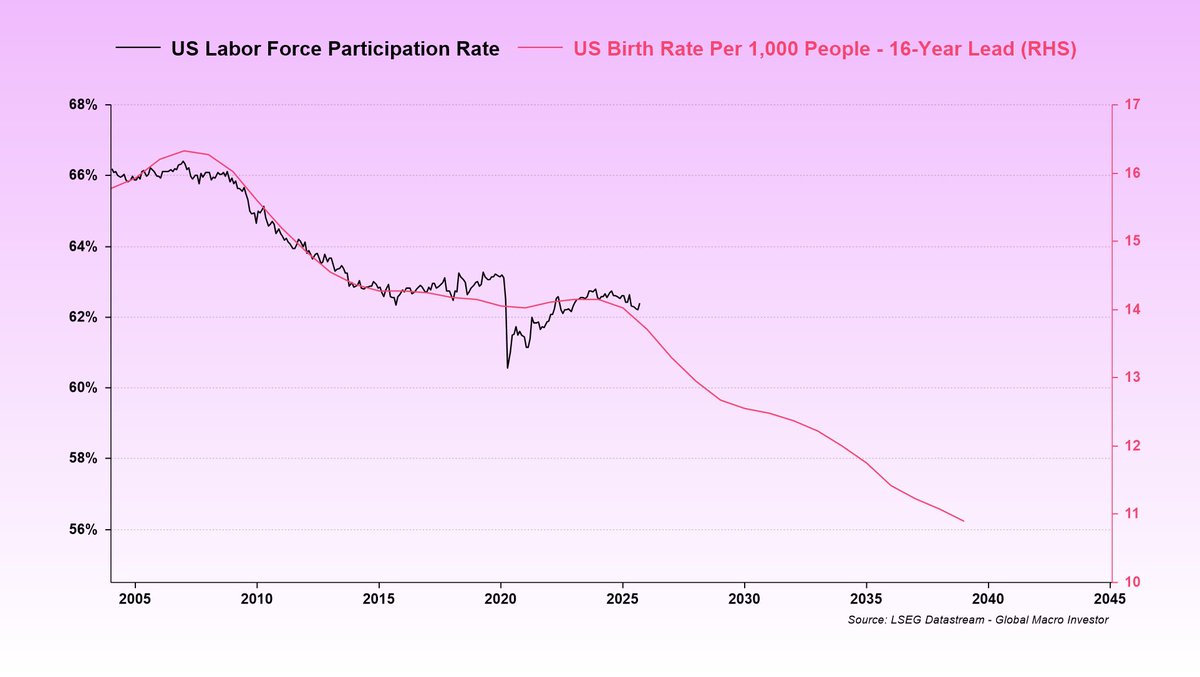
Birth rates peaked in the late 1950s and have been declining ever since. This shows up about sixteen years later in the labor force participation rate as each generation enters the workforce (chart 1).
That means the labor force participation rate is not going to rise any time soon. It is set to keep drifting lower. This is a structural problem.
Aging populations, falling birth rates, and rapidly expanding automation make the backdrop even more deflationary. AI and robotics are replacing humans at scale, and we are only at the beginning. This reinforces the need for ongoing stimulus to keep the system functioning.
With weak population growth and sluggish productivity, the only way to keep GDP expanding is through debt.
Now here’s where it gets interesting…
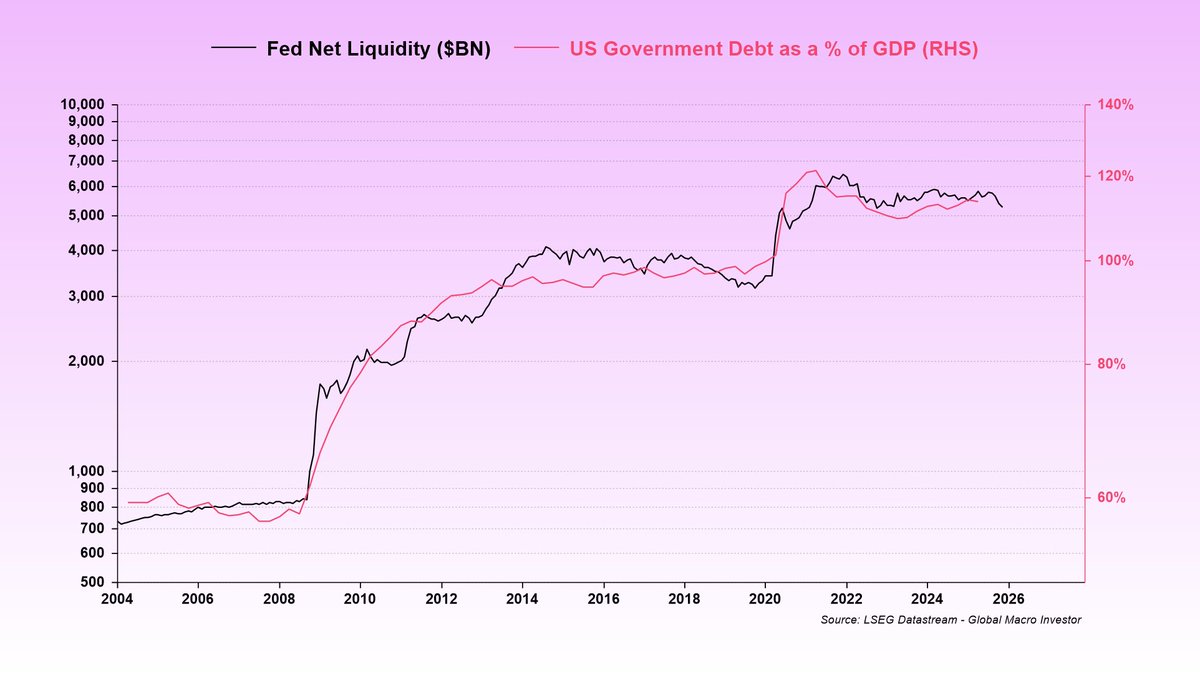
Government debt growth is completely offsetting the demographic decline and policymakers know exactly what they are doing (chart 2).
And what happens next?
All debt growth in excess of GDP gets monetized (chart 3).
Basically, since 2008, magic money has effectively been paying the interest. Governments issue new debt to cover old interest, and once rates fall enough, central banks absorb it onto their balance sheets.
So to wrap this up, demographics drive the decline in the labor force. Governments offset that decline with more debt. That debt eventually gets monetized through quantitative easing (QE) style operations, not always directly by the Fed, but through the coordinated ecosystem of the Fed, the Treasury, and the banking system. And the bottom line is that there’s still a massive wall of interest that needs to be monetized, far more than GDP can ever cover. Liquidity is literally the only game in town.
And what thrives in a world of perpetual debasement? Bitcoin (chart 4).
I know this correction has been painful, but it’s all part of the journey. These periods feel brutal in the moment, then they fade and the trend resumes. This too shall pass…
To quote Walter White from Breaking Bad, later echoed by @LynAldenContact, nothing stops this train.
MOAR COWBELL (liquidity) = number go up over time. Zoom out and be more bullish…
Just created a complete analysis of AI infrastructure opportunities covering chip manufacturers, power companies and system integrators.
I shared this analysis with my 20,000+ students.
For 24 hours, it's yours for FREE.
Like, RT & Comment "AI" and I'll DM it to you.
Without AI, the US economy would likely be contracting right now.
AI spending contributed ~1 percentage point to the 1.6% US GDP growth rate recorded in the first half of 2025.
This means ~63% of economic growth came from AI investment.
This is by far the most on record.