“Let Buenos Aires become for AI what Amsterdam was for the age of sail — the place where the legal imagination caught up with the technological moment, and the world was changed” - Javier Milei (!) https://t.co/RgC58gp5jJ
One extra euro of GDP in education and health has three to four times less material footprint and energy consumption than one extra euro of GDP in the manufacturing sector. So that’s why the sectoral shifts are hugely important https://t.co/bguJWLwa0O
Can we create humane AI without humane working conditions? Learn why fair labor practices are critical to building trustworthy, inclusive AI systems.
Watch it in action (from our Cambridge Meetup) https://t.co/4tH2fjVa5w
#PracticalAI#FutureOfWork#ResponsibleAI
"The observation is simple, and I think it has real implications for how startups should think about their edge: AI is making the cost of building software collapse. And when building gets cheap, the questions that were always important but easy to defer suddenly become the only ones that matter."
Bill Spyropoulos of @epignosishq shares his insights on the @StarttechVC blog!
https://t.co/FgNoOsVUZt
#entrepreneurship #LeanStartup #AI #StarttechVentures #TalentLMS #StarttechWrites #ScaleupGreece
"Together for Europe: Α call - Join us on Thursday June 4th, 17:15 CET". Check it out and subscribe to get everything I'm making.
https://t.co/eQs3EyYfeq via @kit
We at Together for Europe believe that a federal Europe, a Europe that finds a way to invent and organise around a federalism appropriate for its histories, is the only Europe that can remain a relevant player in world events and assert both its peoples’ interests and its basic principles. We also believe that the vibrant debate and discussion that this process will entail can jolt Europe's citizens and peoples into a politically creative renaissance. We are not talking about EU reform here. We are talking about the creation of a new European Federal state.
https://t.co/LVYHwl4aWX
#Europe #EuropeanFederalUnion #TogetherForEurope
EU looks more attractive in Donald Trump’s ‘crazy world’ - be it in Iceland or Norway.
I bet for new EU members by the end of 2027, but for this we need EU reforms - the ultimate taboo https://t.co/BCJ01hh0B1
Together for Europe: A Call
We are living in tumultuous times. And Europe is completely unprepared for them.
The past two decades have seen crisis after crisis sweep the world, destabilising all that we had considered normal. And throughout all this, Europe at best barely ploughed through, and at worst lost ground and influence.
Together for Europe is a movement - and a grassroots organisation - that emerged in the midst of such a crisis. We were born out of the frustration that a group of interconnected Europeans felt about the indecisive, inefficient and problematic way that the European Union faced a global emergency: the Covid-19 pandemic. It was the lack of a unified response that pushed us to act — seeing that the retreat to the national brought weakness, not strength.
There are major global issues emerging for which there is no simple solution, especially no simple solution that can be effectively handled at a national level, and for which the intergovernmentalism that has been the modus operandi of the European Union so far seems to be failing.
In the face of fierce superpower pressures, Europe is on its way to be squeezed, shoved into a dependent periphery of world affairs and practically vassalised. The near total surrender of its elites to this fate is a symptom not mainly of the leadership’s personal failures, but the outgrowth of a diffuse malaise that is making Europe less assertive, more phobic and angrier.
We at Together for Europe believe that a federal Europe, a Europe that finds a way to invent and organise around a federalism appropriate for its histories, is the only Europe that can remain a relevant player in world events and assert both its peoples’ interests and its basic principles. We also believe that the vibrant debate and discussion that this process will entail can jolt Europe's citizens and peoples into a politically creative renaissance. We are not talking about EU reform here. We are talking about the creation of a new European Federal state.
We do not imagine that this will be easy, nor do we believe that the political character of this new federal entity that we want to be built will be predetermined. A constitutional assembly will be needed to establish and legitimise the new constitutional order. The ensuing debate is bound to produce a synthesis that we cannot foretell. Since federalism is a project that is primarily institutional and constitutional, but open to many forms of politics, we are certain that federalists will be all over the political map after the creation of a federal Europe. What we strive for is the creation of a unified European political space. And we feel that this is no longer merely a vision, a preferred political path, but a necessity if our continent is not to slip into irrelevance.
Let's start from the bottom up
But this is our view. Let's discuss it.
We suggest that we should start multiple conversations on critical issues that have to do with Europe as a whole. Identify the problems. We believe that debating the problems we are facing will confirm that the federalist transformation of Europe is a necessary (though admittedly, probably not sufficient by itself) way for Europe to retain its sovereignty.
We want, then, to talk about many different issues on a different basis. These are some of the conversations we are calling you to join:
A European social contract
The promise of Europe has always included, however imperfectly, a vision of social solidarity, of societies that do not abandon their most vulnerable members to the blind mechanics of the market. Yet as Europe has expanded and integrated economically, the social dimension has lagged dramatically behind. If Europe must build a common floor of social guarantees, a European welfare framework that gives meaning to the idea that all European citizens share not just a market, but a community of fate, then it seems to us that federalism is the only principle under which this could be legitimately organised. Without social solidarity, the European project will continue to breed the resentments that feed nationalism and disintegration.
Technological sovereignty
Europe's dependency on non-European platforms, semiconductors, cloud infrastructure and digital standards is a political vulnerability. We believe that a federal Europe would offer the scale and the institutional coherence to build and sustain genuine technological sovereignty: to invest in European champions, to spark startup and scale-up entrepreneurship in a number of different tech sectors, to set standards that reflect European values, and to ensure that the digital infrastructure of our societies remains under democratic control. Is there any other way?
European defence
Sovereignty without the capacity for self-defence is dependence with a polite name. For decades, Europe has outsourced its security to an alliance whose continued commitment can no longer be taken for granted. Events in the US and in Ukraine have made this starkly plain. Europe must develop a genuine common defence capability — not as an act of aggression or militarism, but as the elementary precondition for being able to make free choices in world affairs. And It can also achieve this without the inefficiency of maintaining 27 separate national militaries. and mindlessly replicating 27 different infrastructures. Defence issues concern political will and democratic legitimacy – we think that this legitimacy can only be effectively conferred through a federal structure.
Energy sovereignty and a common climate plan
Europe's exposure to energy blackmail — as brutally demonstrated by its dependency on Russian gas and now American LNG — is inseparable from the broader question of sovereignty. At the same time, the climate emergency is the defining long-term challenge of this century, and it is one that no European nation can meaningfully address alone — indeed, Europe must act as an anchor for global action. Europe, then, needs a unified energy policy. Energy and climate are not separate issues — they are two faces of the same existential challenge. Our view is that it is only through federation that the EU can achieve these goals.
What does it mean to be sovereign and democratic today?
Underneath all of the above lies a more fundamental question, philosophical as much as political: what does sovereignty actually mean in the world as it is now? The classical notion of the sovereign nation-state is being hollowed out by economic globalisation, by the platform power of technology giants, by climate change that recognises no border, by the military reality that small and medium powers cannot project credible deterrence alone. To insist on national sovereignty in this environment is often, paradoxically, to guarantee dependency and irrelevance. We want to have an honest conversation about this — including with those who disagree. What forms of democratic self-governance are actually viable in this geopolitical contingency? What does it mean to be free, collectively, in the world of 2026 and beyond?
These are the conversations we want to start. And we do not want to start them only among those who already agree with us.
Together for Europe is holding an open online meeting on 4 June, and we want you to be part of it. The purpose of this meeting is not to deliver conclusions from on high, but to collectively set the priorities and define the tasks that our movement should take on. We want to hear from people across Europe — from different countries, different political traditions, different generations.
If you are a convinced federalist, come and help us build. If you are a Eurosceptic who believes that the problems we have described are real but that a European federation is not the answer, come and tell us why. Bring your counterarguments. Sharpen our thinking. The quality of the debate matters more to us than the comfort of an echo chamber.
Europe's future will not be decided by the indifferent. Join us.
Find our more on https://t.co/4UNLjUK2yb and @EurFederalUnion
From Doing the Work to Designing and Supervising the Work
Please try to reflect on the days you work.
How much of your time actually goes into real problem solving? How often do you have the luxury to think of your work as a “machine” which you have to improve and optimize?
If you are like most of us, the answer to the questions above probably isn’t really satisfactory. Of course, you find time to do creative stuff. But most likely you spend most of your time in what we call, rather poetically, “doing everything necessary to get the job done”.
Understanding this reality, and its inherent inefficiency, makes obvious how exciting the era of AI really is.
Human beings, workers of any type and level, will be much less in the business and much more on the business.
In this new era, the employee — the worker of any kind — will have to be more of a problem solver and an architect than ever before in mankind’s history.
And, of course, this will be reflected in compensation. But not only there.
AI brings an unprecedented revolution in entrepreneurship and in the workplace. Not tomorrow, though. It is already happening today.
For us, this is not something entirely new.
We were born by embracing the web transition, with Virtual Trip. We got our first significant success by embracing the mobile transition, with AbZorba Games.
We reached the scale-up level by embracing the cloud transition, with TalentLMS and Yodeck.
In this entrepreneurial ecosystem, we have proven several times that change is the only constant. We thrive in change. We thrive in transitions. This is our comfort and our confidence zone.
This is why we are now enthusiastically embracing the AI transition, by all means. And we will take our organization to a whole new level.
The good news is that the amount of brainpower that will be devoted to problem-solving is beyond any imagination. During the next few years, it is certain that humanity will make several leaps forward at an unprecedented pace.
The amazing news is that this tectonic shift in capability, and the universal access to powerful means of production, will result in an unbelievable democratization of entrepreneurship.
Which, in turn, will take us one step closer to the actual liberation of humans from work: ending work as an “obligation” and making it some kind of “privilege” or “choice”; freely accessible to all.
And later, of course, we will embrace blockchain, or quantum, or whatever other transition life will bring.
We will keep changing and evolving. We will keep thriving and creating a better, brighter future for us, our loved ones, and society at large.
Change is the only constant.
And we were born to thrive in change.
#AI #ScaleupGreece #Entrepreneurship #FutureOfWork
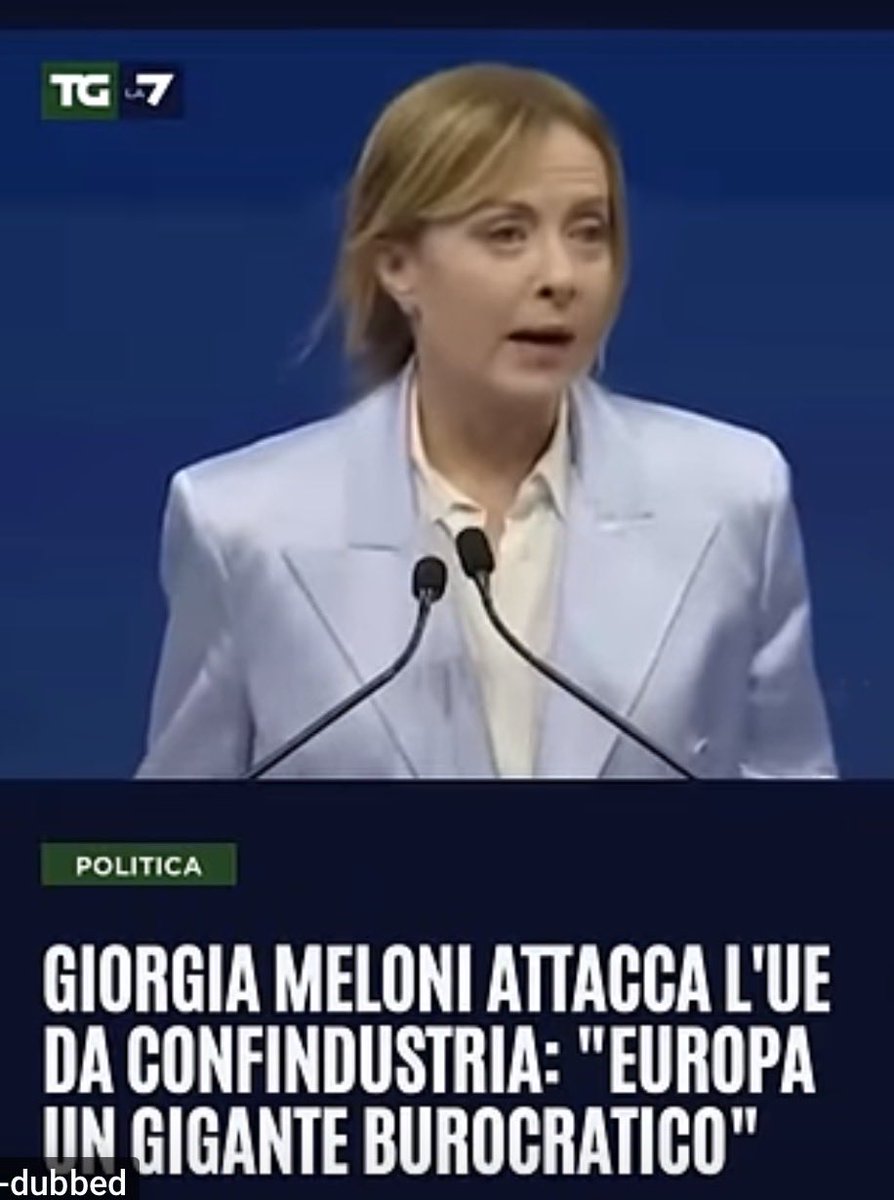
Giorgia Meloni’s attacks on the EU are deeply unfair:
Brussels didn’t create Italy’s public debt, decades of stagnant productivity, weak GDP growth, or low wages. Nor is the EU responsible for Italy’s chronic difficulty in implementing reforms and investment projects.
Italy has struggled to absorb a large share of the COVID recovery funds it received from the EU, funds Meloni herself opposed in 2020.
At a time when Europe faces unprecedented security and economic challenges, this anti-EU rhetoric - echoed by leaders such as Merz - risks weakening the very cooperation Europe needs most.
Οι πρεσβείες κάνουν κουμάντο, αυτή είναι η πικρή αλήθεια για την Ελλάδα του 2026.
Αν δεν αλλάξει αυτή η θεμελιώδης πραγματικότητα, λίγα μπορει να ελπίζει κανείς για την Ελλάδα. 82 χρόνια μετά την απελευθέρωση του 1944, σχεδόν 200 χρόνια μετά τη δημιουργία του νεοελληνικού κράτους, η εθνική κυριαρχία και ανεξαρτησία παραμένουν ζητούμενα.
https://t.co/33d7kFLf1r