Cause they’ve never worked? Maybe you could greenlight thousands of new homes in the borough in which you lead rather than grievance politics on twitter? Would be much better than rent controls!
The mere suggestion of rent controls by @AyoCaesar causes audible gasps and nervous laughter on the #bbcqt panel.
100% guaranteed that not a single one of the panelists is a renter and has experienced the insecurity and extraction that renters do at the hands of private landlords
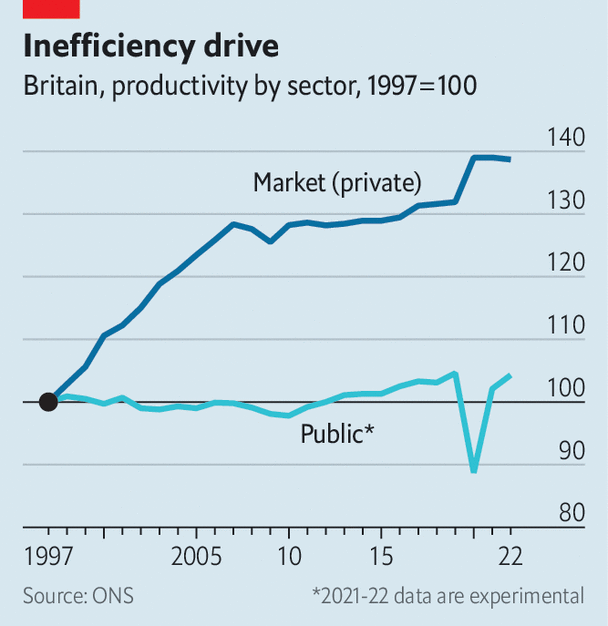
@empirepub1@warksdave@that_stocks_guy That’s your takeaway? the one year that it improves is more important (figures to 2022, not the last four) compared to a 25 year trend of stagnating public sector efficiency at a time when *the internet* was widely adopted…
More tinkering like this shows why we need proper tax reform:
- merge NI + income tax
- broad VAT but lower rate
-equalise CGT with a investment allowance
- scrap 100k trap
- phase in LVT replacing council tax and stamp duty
- Get @DanNeidle to run the review too
EXC: Officials have worked up plans for a new 1.8% income tax to fund Andy Burnham’s social care reforms.
The Health Department is looking at proposals by Re:State, a Burnham-linked think tank, which suggests a new “social insurance” model.
Civil servants commissioned expert advice on the idea after access talks with Burnham’s team.
The plan would involve mandatory contributions on income over £6,240 for workers over the age of 34.
The money would be invested and used to pay for the care of each cohort when they reach old age, and would be topped up by contributions from wealthier pensioners.
No10 says Burnham won’t decide how to fund his plans until after an accelerated Casey review is published, but this idea is in the mix — alongside the “death tax” estate levy reported last week.
Mostly, yes. Hyundai Rotem uses AI extensively in train production in South Korea. Last September, Hitachi opened a $100m railcar factory in Maryland US that uses AI to design the train, organize its production, spot defects, & control those creepy-looking Boston Dynamics robot 'dogs' to carry out inspections.
@Conno99@KirstieMAllsopp So we all pay the same amount for NHS, Welfare and Defence do we when it comes to general taxation? We do have a fairly standard principle that those who earn / have more should contribute more…
@KirstieMAllsopp Not saying there wouldn’t be issues which would need to be ironed out / phased in but the vast majority would be better off and you’d do away with a tax that gums up the property market and effectively tax wealth in a decently fair way
This is why @lb_southwark’s decision to block 900 homes matters. Without building more homes of *any* type, we will not make it easier for people get on the housing ladder. But at least they saved a dilapidated shopping centre…
About one-fifth of potential home buyers would need to save for at least a decade to have enough for a deposit.
Read 'Credit where credit's due' here ⤵️ https://t.co/tWx4NOai5M
@lfg_uk I say this as a fan of your work, but disagree with you here. This is a sensible reform (it differs from Stevenson’s nonsense as there would be an investment / inflation allowance) and could pay for a cut in NI and additional defence/infra spending - which would boost growth
Housebuilding has collapsed in London.
And Southwark Council are celebrating having blocked 850+ homes.
You can’t afford to live in London because of thousands of decisions like this over decades.
I got my Claude to do a UK version.
…
Fun prompt. Below is my honest swing at it for the UK. Caveat upfront: "fix everything switch" overstates things — these are policies where I think the case is unusually strong and the standard objections look weak relative to the upside, not magic wands. Confidence ratings are about "this would meaningfully improve UK welfare/growth if well-implemented," not "this is politically easy."
1. Radical planning liberalisation (housing + infrastructure)
Confidence: Very high.
Reasoning: The UK's discretionary planning system is the single biggest unforced error in British policy. It drives the housing crisis, suppresses productivity (workers can't move to high-wage cities), worsens regional inequality, slows clean energy buildout, kneecaps infrastructure, and arguably depresses fertility. Most rich-country peers build more housing per capita. Moving to a zoning/rules-based system with by-right approval, looser greenbelt around stations, street votes, and curtailed judicial review on planning would be transformative.
Why not done: Homeowners are an enormous, high-turnout voting bloc whose paper wealth depends on scarcity. Greenbelt is politically sacred. The losses are visible and concentrated (a new block next door); the gains are diffuse and slow. Both main parties have flirted with reform and flinched.
2. Council tax revaluation and property tax reform
Confidence: Very high it's needed; high it would be beneficial.
Reasoning: Council tax bands are still based on 1991 property values. A flat in Hartlepool can pay more council tax than a mansion in Westminster. This is regressive, distorts the housing market, and starves councils. Revaluing — or better, replacing council tax and stamp duty with a proportional property tax or land value tax — is one of the most-endorsed-by-economists reforms going.
Why not done: Revaluation creates visible losers (London/South East homeowners) and quieter winners. Treasury also fears the transition. The Mirrlees Review laid this out in 2011 and basically nothing has happened since.
3. Abolish stamp duty on primary residences
Confidence: High.
Reasoning: Stamp duty has among the worst deadweight losses of any UK tax — it taxes transactions, so it discourages downsizing, labour mobility, and matching people to suitable homes. The empirical literature on this is unusually unified.
Why not done: It raises ~£12bn and is invisible to most voters most of the time. Replacing it (ideally with #2 above) needs political capital nobody wants to spend.
4. Build clean energy and grid infrastructure fast
Confidence: High.
Reasoning: UK industrial electricity prices are among the highest in the OECD, which is quietly hollowing out manufacturing. Cheap, abundant electricity is the most undervalued input to almost every modern industry. Streamlining onshore wind, solar, nuclear (SMRs and large), and especially grid connections and transmission would compound for decades. Connection queues currently stretch into the 2030s.
Why not done: Planning (see #1), Ofgem incentives that historically rewarded keeping grid investment low, judicial review, NIMBYism around pylons, and a regulatory culture that treats new build as risky and the status quo as safe.
5. Devolve real fiscal and policy power to cities and regions
Confidence: High.
Reasoning: The UK is one of the most fiscally centralised democracies in the OECD. Manchester, Birmingham, Leeds, Glasgow are dramatically underpowered relative to peers like Munich or Lyon. Mayors with proper tax-raising power, transport authority, and skills budgets would let cities tailor solutions and compete. Most evidence on agglomeration economics suggests this matters a lot.
Why not done: The Treasury genuinely hates losing control of money; this is a deep institutional preference that survives changes of government. Westminster MPs don't like rival power centres either.
6. A genuinely competitive high-skilled immigration regime
Confidence: Medium-high.
Reasoning: Top-talent immigration is close to a free lunch for receiving countries — fiscally positive, innovation-boosting, and concentrated in tradeable sectors. The UK has the language and the universities; it's leaving money on the table with slow visas, high fees (the NHS surcharge plus visa costs for a family is brutal), and a Global Talent visa that's narrower than it looks.
Why not done: Immigration politics is toxic and the public doesn't reliably distinguish high- from low-skilled flows. Total numbers have been high recently, which makes it hard to argue for more of any category even when the composition matters more than the total.
7. Childcare cost reform
Confidence: Medium-high.
Reasoning: The UK has among the highest childcare costs in the OECD as a share of household income. This depresses female labour force participation, suppresses fertility, and acts as a giant marginal tax on the second earner. The recent expansion of "free hours" helps but the supply-side problem (provider economics, ratios, planning for nurseries) isn't fixed.
Why not done: It's expensive, the sector is politically diffuse, and ratios/quality regulations have genuine trade-offs that aren't easy to legislate around.
8. NHS productivity reform plus sustained capital investment
Confidence: Medium.
Reasoning: NHS productivity has fallen meaningfully since 2019 even as funding rose. The UK has unusually few CT/MRI scanners per capita, old buildings, and weak digital infrastructure. Capital investment with productivity-linked reform (better IT, more diagnostic capacity, GP/secondary care interface) is probably higher-ROI than another marginal headcount increase.
Why not done: The NHS is genuinely a political third rail; structural reform gets framed as privatisation regardless of content. Capital is the easiest budget to cut in any given year, so it gets cut repeatedly.
9. Curtail judicial review of major infrastructure
Confidence: Medium.
Reasoning: HS2, Heathrow, nuclear, transmission lines — UK infrastructure costs are 2–4x peer countries partly because of endless legal challenges and the consultations that anticipate them. A narrower "did the decision-maker follow the process" standard, with tight time limits, would lower costs without sacrificing core rule-of-law protections.
Why not done: Constitutionally fraught, lawyers and the legal establishment push back hard, and any government doing this is accused of authoritarianism — sometimes fairly.
10. Reform the pensions triple lock and the wider intergenerational settlement
Confidence: Medium-high on the need; medium on whether reform alone "fixes" much.
Reasoning: The triple lock ratchets state pension spending up faster than wages or prices and is a major driver of long-run fiscal pressure. Combined with NI exemption for pensioners and protected pensioner benefits, the UK has built a fiscal regime that systematically transfers from young workers to older asset-holders. Untangling this would free fiscal space for investment in #4, #7, #8.
Why not done: Pensioners vote at roughly 75% turnout; under-30s at roughly 50%. The maths is unforgiving.
A few honourable mentions I cut: tax simplification (genuinely good but rarely "fix everything"), proportional representation (large effects but unclear sign), drug policy reform (good evidence base, narrower scope), regulator growth duties / a serious bonfire of Quangos rationalisation, and reforming the apprenticeship levy.
The pattern. Almost every item above is blocked by the same underlying thing: a system that makes losses visible and concentrated while gains are diffuse and slow, in a country where homeowners and pensioners vote heavily. The "switch" in the meme exists; it's just wired to a circuit that the median voter has a strong short-run reason to leave alone. That's not a reason not to flip it — it's a reason the case has to be made repeatedly and honestly.
Standard disclaimer: reasonable people disagree on all of this, especially #6, #9, and #10, and "well-implemented" is doing a lot of work in every line above.
Sorry, Kevin, this is nonsense. Housing costs as a % of income have risen from 10% in 1957 to 30% or more. We are 6.5m homes behind European average. And the evidence from the many other countries with similar interest rates but higher housebuilding is pretty bloody clear.