Heavy-duty electric trucks are rapidly destroying oil demand in China, and they're now coming to Europe
>Octopus Energy and CATL JV to build 30 mega-hubs by 2035 to support more than 300,000 e-trucks: Fresh batteries in under 5 minutes, faster than filling up a dirty diesel tank
>That's billions of liters of diesel wiped out in Europe each year
>In May 2026, sales of e-trucks in China surged 104% y-on-y to 30,800 units in 1 month
>In 2025, China registered 231,000 electrified heavy trucks, up 182% y-on-y
>Clean trucks are now at a 40.88% market share of all new heavy trucks sold in China - and cut annual operating expenses by $22,000 to $37,000 per vehicle
>China also just announced a Heavy-Duty Truck Master Plan: Target of 1.6m new e-trucks by 2030, powered by 30,000 kilometers of zero-carbon highway freight corridors across key national expressways, backed by 3,000 dedicated truck charging and battery-swap stations. Talk about an Electro-Shield
>As an added bonus, every truck can be turned into a virtual power plan, charging electricity when it's cheapest and discharging it, if idle, when it's expensive
Road freight has been one of the single largest cash cows for the oil industry globally. Those days are soon over.
Wires chewing pipelines
https://t.co/bvMHJJRPgt
In 2008, skeptics claimed more than 20% variable renewables on a large grid was not possible.
In 2017, they backtracked to 80%.
And then to 90%. Then 95%.
Once it became obvious that 100% renewables is possible, now they say, "not everywhere is like California" and "what about nighttime?"
The fact is, there is no limit. 100% WindWaterSolar renewables is possible every hour of every day everywhere.
https://t.co/w4nO2LlL2F
151 of 176 days (86%) in 2026 with WWS meeting >100% of demand for an average of 5.2 h/day.
Gas down 61%, batteries up 337%, solar up 56% in '26 v '23.
Duitsland tendert succesvol 2500 MW extra wind op land tegen een prijs die 10% lager ligt dan in de vorige ronde.
Opnieuw vooral in Niedersachsen, wat de Noord-Zuid congestie aldaar (en deels ook in NL/BE) verergert.
We overestimate how hard the energy transition is because we diagnose it wrong.
Electrifying doesn't just swap the fuel, it cuts how much energy you need beause combustion wastes so much as heat. I call it 'Electrofficiency'.
More @AuroraER_Oxford pod.
https://t.co/L5e3BP97yd
For a while "only gas and nuclear can provide needed firm power" was the "serious" position in the US.
It's why people like @mzjacobson were attacked as if they were "heretics". Turns out the heretics were right.
Australia, where household energy bills are to fall 10% from 1 July 2026, is executing an industrial slaughter of legacy gas peakers
>In 1st quarter of 2026, battery systems tripled their daytime-to-evening energy shifting compared to last year. Batteries surged 1,115 MW of clean power into the evening peak, hitting a record discharge of 3,556 MW
>Batteries became the grid's primary price-setting mechanism, dictating terms in 32% of all trading intervals
>Gas-powered generation collapsed to its lowest quarterly average since 1999 (dropping to an average of just 712 MW). It's in terminal structural decline
>Average wholesale electricity spot prices plummeted by 12% y-on-y to AU$73/MWh
>In Victoria, wholesale prices crashed by 28% to an average of just AU$43/MWh
>Four million households and businesses are now generating free power, acting as the biggest power plant in the country
>One in every 25 homes has a battery today, with 415,000 active residential storage systems
>Because of this unstoppable wave of clean energy and storage, residents in Queensland, New South Wales, and South Australia will receive 100% free electricity from 11:00am to 2:00pm starting next month
>Australia’s battery capacity additions surged by nearly 8 GW in a single year, a nine-fold increase. Utility-scale systems skyrocketed to 4.2 GW, while behind-the-meter household storage hit 3.4 GW
>Battery storage now commands a massive 18% of all installed dispatchable capacity in Australia (China is at 7%, the US at 5%, and Europe at 4%
Storing free solar during the day and dumping it into the evening peak has permanently flattened the daily price curve, bringing down forward electricity contract prices and passing the savings directly to consumers
Every solar + battery is a national security shield
Gas spent 20 years owning the evening peak. Batteries took a year to crash the party.
That's disruption. Not gradual, but a rapid shift in who supplies grid's most valuable hours.
The battle was never about total generation. It was about the peak & batteries are winning it.
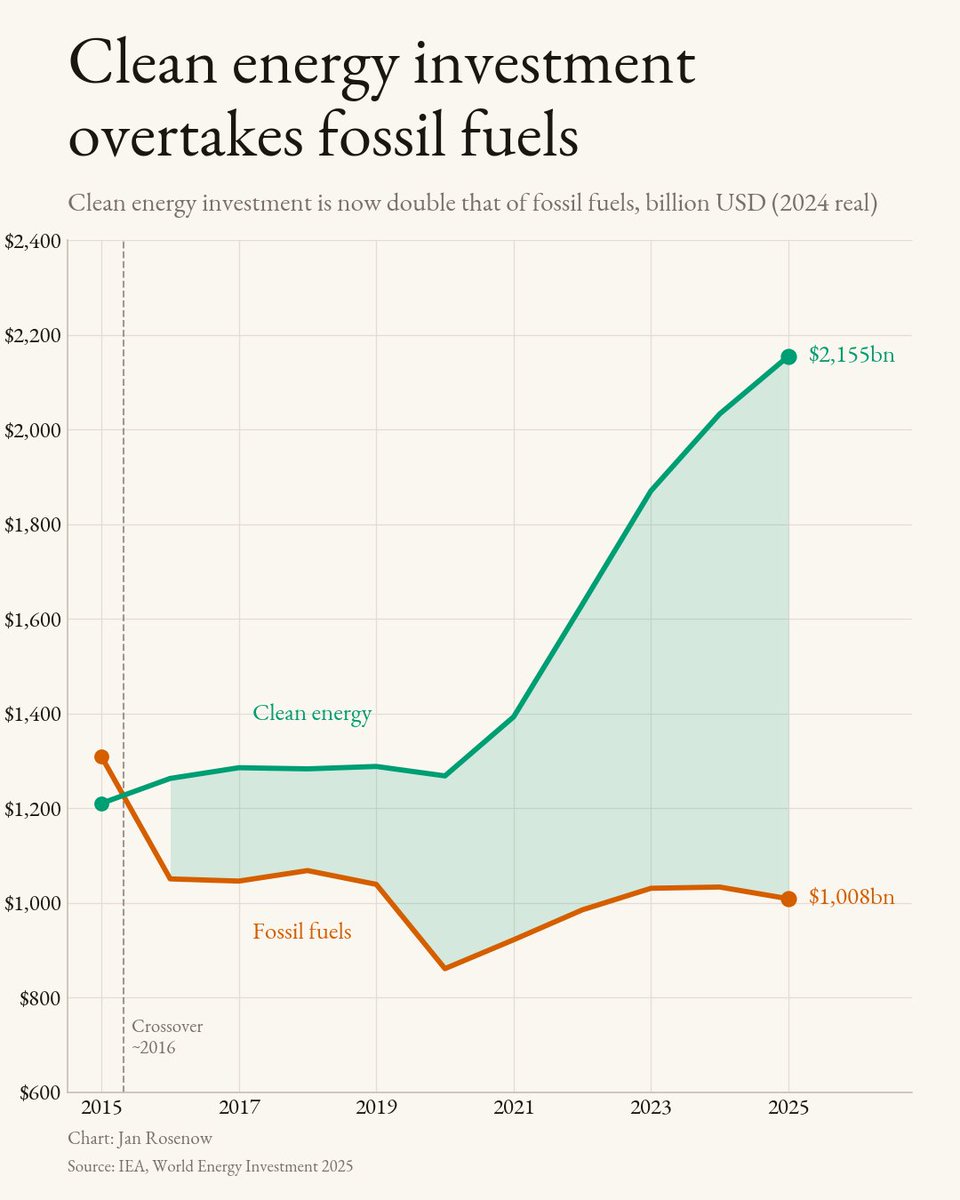
NEW @IEA data: clean energy investment is now more than double fossil fuels.
$2,155bn vs $1,008bn in 2025.
The crossover happened around 2016. Since then the gap has only widened. What was a narrow lead a decade ago is now a >2-to-1 split.
Mega heat pumps can replace fossil fuels in industry.
Huge innovation already:
In 2018 the frontier sat at ~165°C & a few MW.
By 2024: 280°C & up to 100 MW. +115°C & a 50x capacity jump in six years.
More soon, sign up here https://t.co/In5lBaF2ox
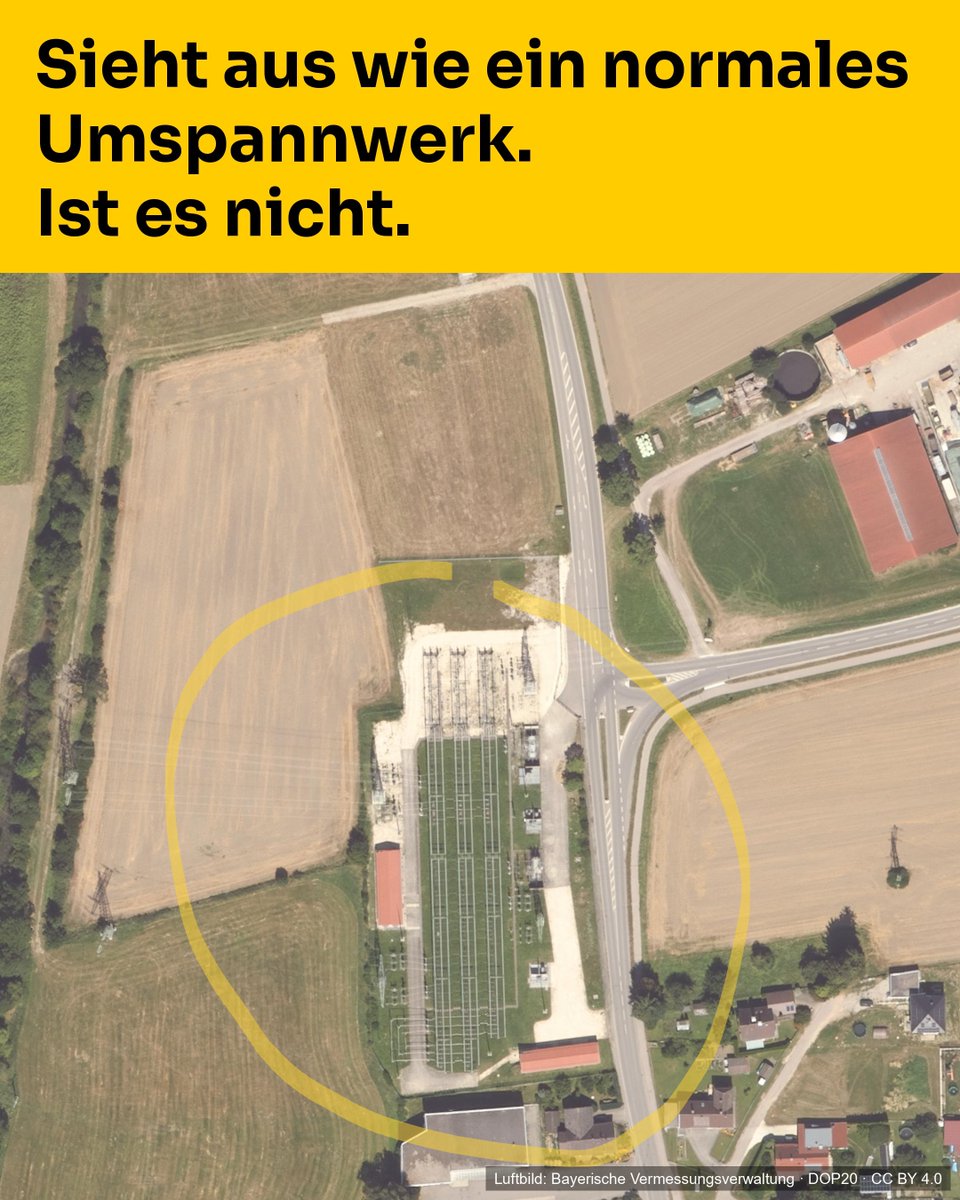
Rund 70 Gigawatt Solar- und Windprojekte warten in Deutschland auf einen Netzanschluss. Diese Anlage zeigt, dass es schneller geht.
Halblegal.
Es verknüpft sieben Projekte an einem einzigen Anschluss und kann innerhalb von zehn Tagen zu- oder absagen. Aber bisher fehlt das Gesetz dafür.
In Balzhausen, Landkreis Günzburg, hängen seit Herbst 2025 drei Solarparks, drei Batteriespeicher und ein Windpark am selben Transformator.
80 Megavoltampere kann der Trafo verarbeiten, das ist seine Anschlussleistung. Dran hängen werden aber 126 Megawatt Leistung.
Schau genau hin, dann merkst du es: Am Trafo hängt mehr, als er „eigentlich“ leisten könnte.
Das Konzept heißt „Einspeisesteckdose“ und ist im Branchendiskurs noch eine Fußnote. Sollte es aber nicht sein.
Denn wer heute einen Solar- oder Windpark anschließen will, wartet Monate. Die gesetzliche Acht-Wochen-Frist streckt sich in der Praxis auf acht Monate. Branchen-Experten schätzen den Anschluss-Stau allein für Deutschland auf rund 70 Gigawatt.
Trick #1: alles andersherum.
Im Pilot des LEW Verteilnetz dreht Projektleiterin Barbara Plura die Reihenfolge um. Normal: erst kommt der Projektierer, dann plant der Netzbetreiber zwei Jahre einen Trafo. Hier: der Netzbetreiber sucht selbst die Stelle im Netz, wo noch Kapazität frei ist, baut den Anschluss vor und schreibt ihn aus.
Plura wurde überrannt. Sie bekam 20 Bewerbungen über 445 Megawatt in vier Wochen. Beim Schwesterpilot des Bayernwerks in Niederviehbach gingen am ersten Tag 90 Prozent der Kapazität weg.
Trick #2: kontrollierte Überbauung.
Weil Solar mittags läuft, Wind nachts und der Speicher beides puffert, blockieren sich die sieben Anlagen nicht. Sie teilen sich die Anschlussleistung. Die Netzintegration kostet so laut Betreiber nur die Hälfte.
Damit wird die Einspeisesteckdose mehr als ein kleiner Pilot. Sie könnte den 70-Gigawatt-Stau etwas auflösen. Bisher duldet die Bundesnetzagentur das Modell nur. (Geduldet heißt im Behördendeutsch: nicht verboten, aber auch nicht geregelt.)
Das Bundeswirtschaftsministerium arbeitet aber am Rechtsrahmen, im Entwurf des Netzpakets stehen Einspeisesteckdosen explizit drin.
Die interessantesten Klimalösungen sehen aus wie Verwaltungs-Kleinkram – bis sie überall ausgerollt werden.
🍏 Vielen Dank fürs Lesen! Jeden Dienstag zeige ich dir in meinem Newsletter, mit welcher Technologie wir die Klimakrise lösen. Hier abonnieren: https://t.co/4rcIzAnSET
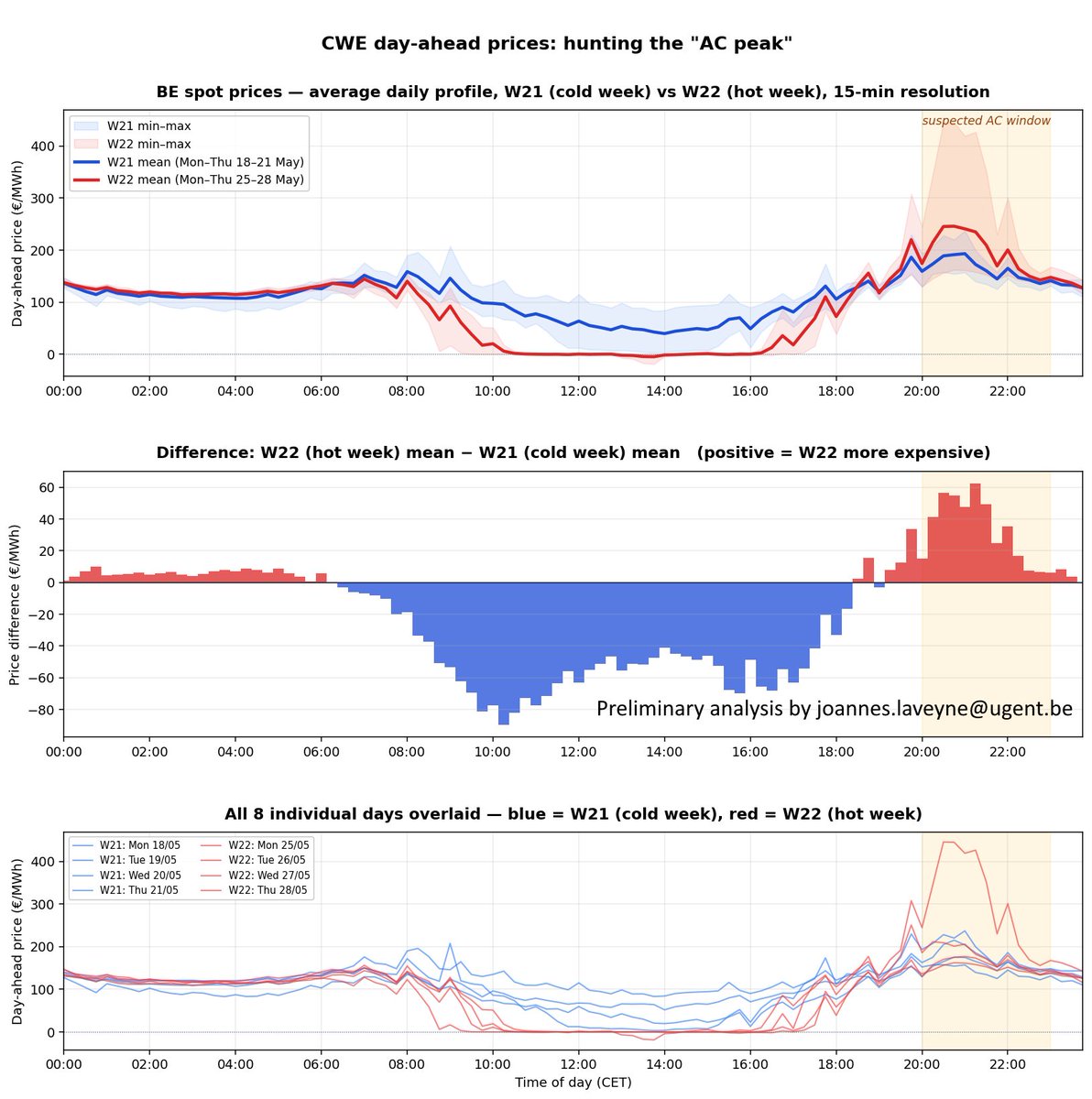
Is de beruchte "aircopiek" er terug? Analyse van de elektriciteitsprijs van vorige vs deze week duidt op 'ja'. De zonnige temperaturen drukken de elektriciteitsprijs overdag, maar er is een uitgesproken prijspriek als de zon ondergaat en airco's nog draaien. 🧵
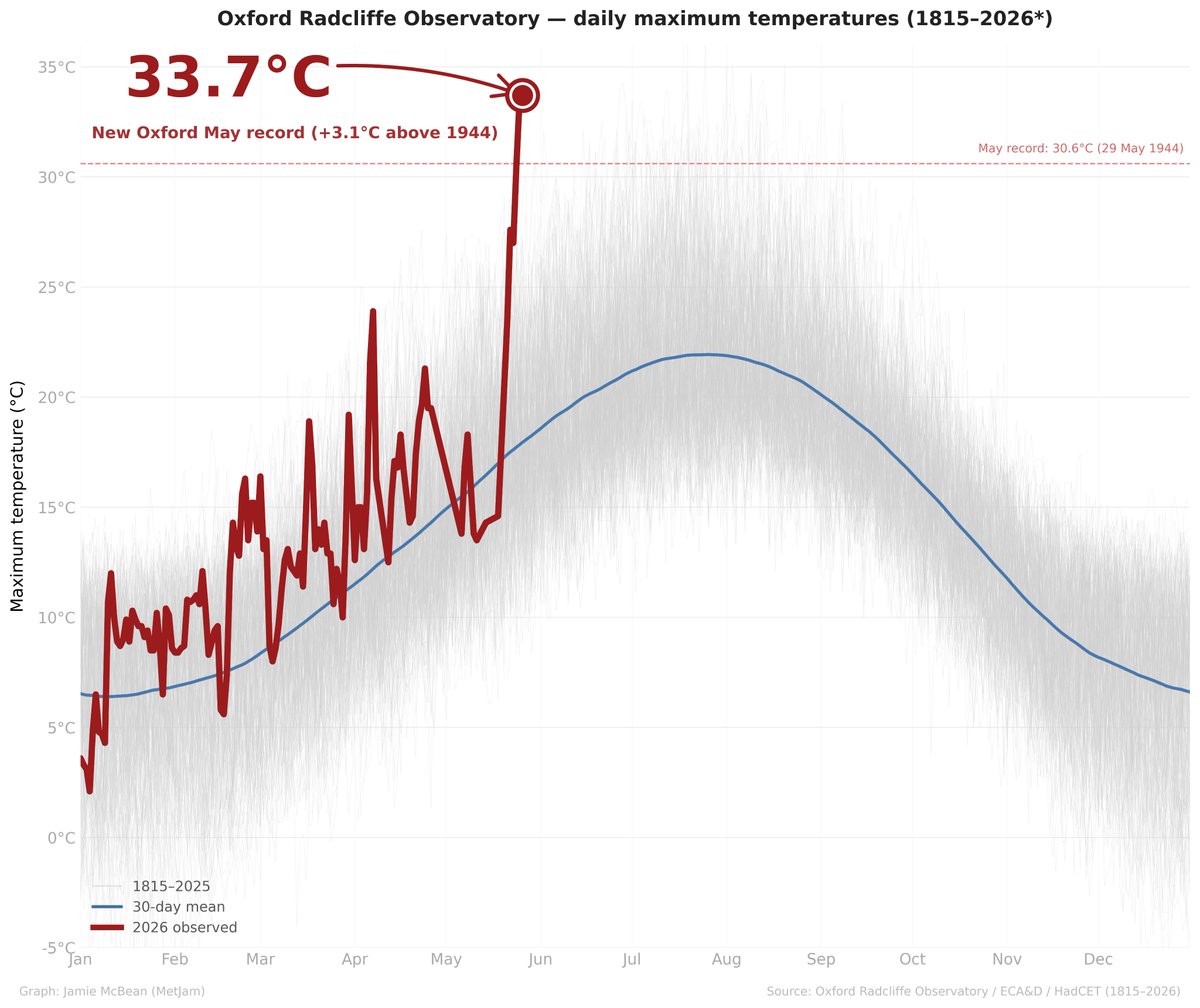
Oxford, the longest running continuous weather station in UK history, with temperature observations stretching back to 1815, has preliminarily broken its maximum temperature record for May yesterday by OVER 3ºC with a temperature of 33.7ºC. Unprecedented in its 211-year history.
Good morning with good news: EV truck sales in China doubled in 2025 & were 25% of truck sales!
Global sales of EV heavy trucks tripled.
EV medium truck sales rose 65%.
Europe's EV truck sales rose 40%.
EV trucks were 9% of global market.
https://t.co/7mI1iEcMTJ
Global sales of combustion engine cars peaked in 2017—
To decarbonize road transport, the world must move away from petrol and diesel cars towards electric vehicles and other forms of low-carbon transport.
This transition has already started. In fact, global sales of combustion engine cars are well past their peak and are now falling.
As you can see in the chart, global sales peaked in 2017. This is calculated based on data from the International Energy Agency. Bloomberg New Energy Finance also estimated this peak occurred around that time.
Sales of electric cars, on the other hand, are growing quickly. They more than doubled in the three years from 2022 to 2025.
(This Data Insight was written by @_HannahRitchie.)
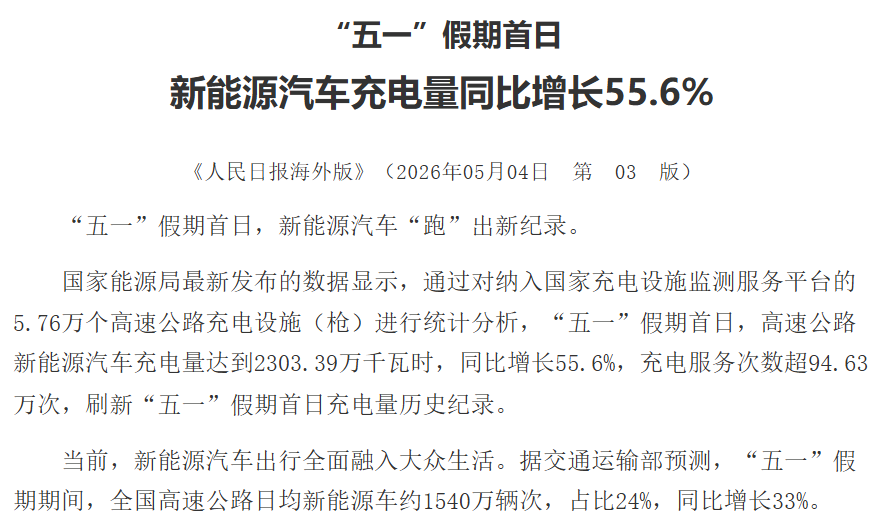
24% of trips on China's highways during the May 1 holiday were in EVs, while the share of EVs in all vehicles is 15%, highlighting how EVs are making a bigger dent in oil consumption than their share in the fleet. EV charging volumes along the highways were up 56% year on year.
Germany's electricity mix, 2000 vs 2025:
Renewables: 6% → 62%
Fossil fuels: 62% → 36%
Nuclear: 30% → 0%
Nuclear's exit was filled by renewables, not coal or gas.
Want more of this content + more detail and links to sources? Subscribe to my Substack: https://t.co/nBMZPS4HTp
@olofvdgaag Wat is de gemiddelde dagelijks afgelegde afstand? Hier in België is dat 50 km. Met 300 of meer km hebben rijders dan voldoende capaciteit voor 6 dagen en daarmee ook voldoende mogelijkheid om een geschikt laad-moment te vinden.