Hmm this discussion is also making me consider things I actually never thought about. Hmm. I think that's an area I didn't properly consider.
I feel the crash, whatever that may be, is going to happen. Now, it might look like the dot com bubble, or the aftermath of the Printing Press, either way I believe something is going to happen.
Where and when the regulations happen is something I didn't consider. Maybe the regulations can mitigate the fallout? I actually don't know.
It has made me think quite a bit about it.
@wadewilldesign_@SenSanders Ah I see my mistake.
The sentiment of noting that regulation and labour rights is important. I think partial ownership isn't quite the answer we should be looking at. Mainly because when it fails, its on the govt to act.
Apologises if that was not clear!
Book recommendations on X! Hells yes.
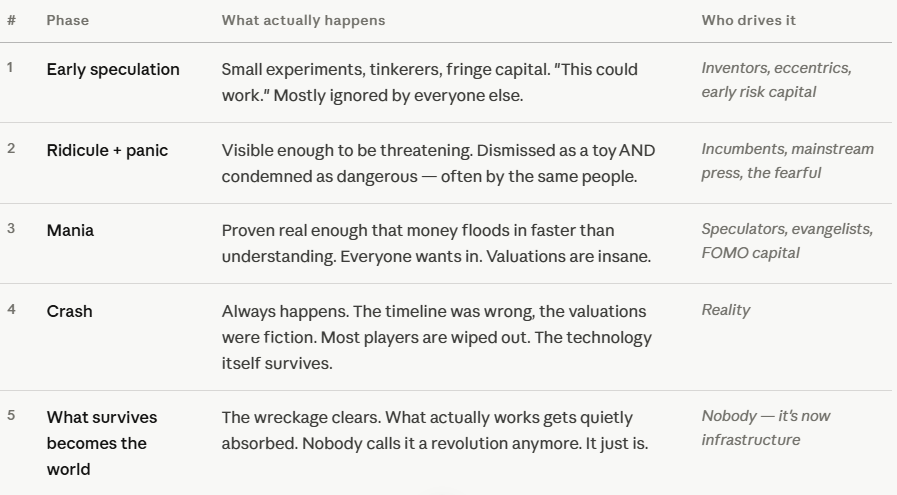
The table I shared earlier is something I've been working on in my own time as I needed to understand it. The thinking is rooted in three books that genuinely changed how I see technology, history, and money:
Carlota Perez — Technological Revolutions and Financial Capital
The book that proves the mania-crash cycle isn't chaos. It's a pattern. Five times over.
Tom Standage — The Victorian Internet
The telegraph in the 1840s reads exactly like the internet in the 1990s.
Karl Polanyi — The Great Transformation
What actually happens to societies when technology moves faster than institutions can adapt. Written in 1944. Somehow still the best version of this argument.
If the AI conversation is making your head spin, start with Standage.
The conversation around #AI lately has a specific sense of revolt.
So did railways. So did the printing press. So did electricity.
Every age-defining #technology triggered this cycle and the revolt was always loudest just before the crash, not after it.
They tend to follow the same arc: Speculation → ridicule → mania → crash → then what survives becomes infrastructure.
The question is what stands after this crash? And where are we now?
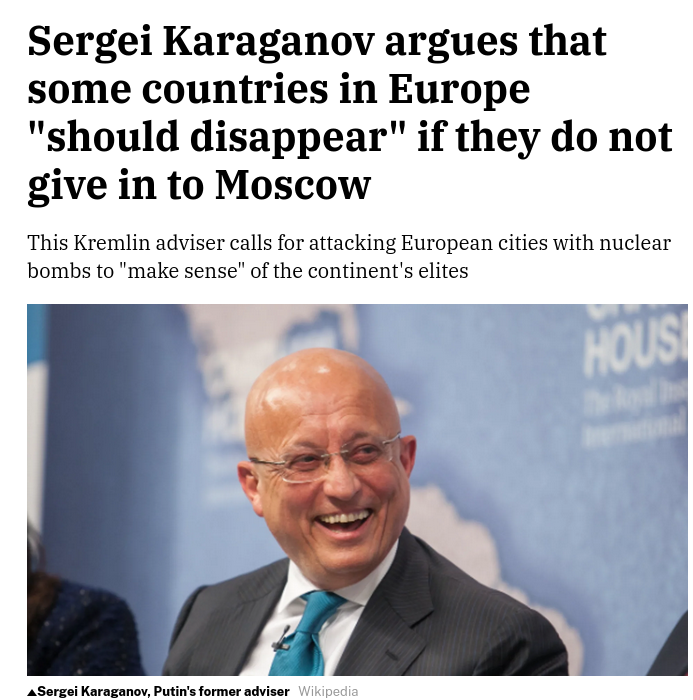
Russian propagandist and former adviser to Vladimir Putin Sergey Karaganov continues to publicly advocate for nuclear strikes against European cities, arguing that some European countries should ‘disappear entirely’.
He is the same figure who regularly accuses EU member states of being ‘reckless warmongers’ on behalf of the Kremlin.
@SGTWipper1Each After a sanity check and questionable research matters, this post is true.
Even though I love me some bad military movies with a tub of ice cream and rip it.
Fact-checking can't fix lying. In fact, it cannot.
This is not because people are too dumb or too partisan, but because corrections get filtered through incompatible definitions of the same words. Think about how the words “Freedom”, “Elite”, and “Justice” are used.
It opens up avenues that we are all vulnerable to. When that happens, the truth does not emotionally matter.
https://t.co/7bSrESBrCo
No, this is not real, and Grok is once again wrong.
The second part of this video, of the float collapsing, is AI (AI-spliced) - Signs:
1. 5th Avenue sign disappears between cuts.
2. a gibberish sign is added to the corner post.
3. One of the people on the float morph into a different person.
Here is the original video, uncut:
Ukraine has released the full video of Operation Spiderweb the daring container hidden drone operation which left over 40 Russian airforce aircraft damaged or destroyed last year.