Linear Algebra — the way I’m trying to understand it:
A scalar is a single number.
It has magnitude, but no direction.
A vector is an arrow in space.
It has both length and direction.
Vector coordinates depend on the basis.
Same vector, different basis → different numbers.
A basis is the set of directions we use to describe vectors.
In 2D, the usual basis is [1,0] and [0,1].
A matrix is a transformation machine.
It takes vectors as input and moves them to new positions.
A matrix transforms the whole space, not just one vector.
Matrix multiplication is the calculation.
Linear transformation is the meaning.
The columns of a matrix tell where the basis vectors land.
That’s why matrix columns define how the whole grid changes.
A matrix can stretch, shrink, rotate, reflect, shear, or collapse space.
A determinant tells how much area/volume changes after transformation.
Determinant > 0 means orientation is preserved.
Determinant < 0 means orientation flips.
Determinant = 0 means space collapses and information is lost.
A matrix has an inverse only if the transformation can be undone perfectly.
Eigenvectors are special directions that do not rotate away after transformation.
Eigenvalues tell how much those special directions stretch, shrink, or flip.
The eigenvector equation is:
Av = λv
Meaning: matrix transformation acts like simple scaling on that vector.
Diagonalization rewrites a matrix using its eigenvectors and eigenvalues:
A = PDP⁻¹
Diagonalization means:
change to eigenvector basis → scale simply → change back.
SVD says any matrix can be understood as:
input rotation/change → stretch/compress → output rotation/change.
SVD works even when diagonalization does not.
PCA uses eigenvectors/singular vectors to find the strongest directions in data.
My memory line:
A vector describes something.
A matrix transforms it.
Eigenvectors reveal natural directions.
Eigenvalues reveal strength.
SVD and diagonalization make the transformation easier to understand.
A matrix changes space, eigenvectors reveal its natural directions, eigenvalues reveal the strength along those directions, and diagonalization/SVD make the transformation easier to understand.
We spent the last 2 years teaching AI how to answer questions.
Now researchers are teaching it how to work together.
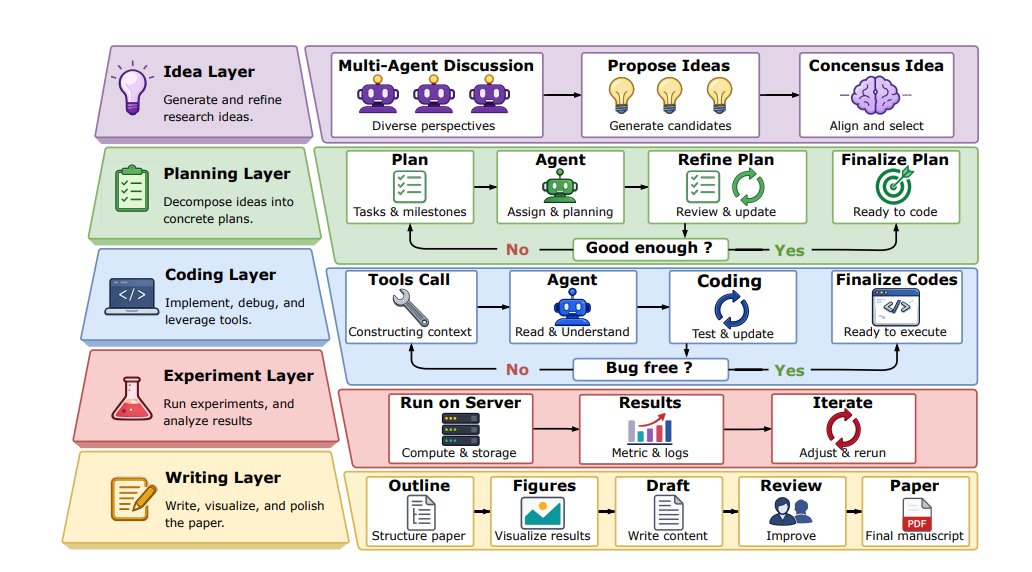
Just read a paper called “Claw AI Lab,” and it genuinely feels like a glimpse into where AI systems are heading next.
Instead of one model doing everything, they built an entire AI research team:
one agent generates ideas
another writes code
another runs experiments
another reviews results
another documents findings
Almost like a real engineering lab.
What stood out to me wasn’t “wow AI can code.”
We already know that.
It was the coordination layer behind it:
retries when experiments fail
verification loops
artifact tracking
specialized responsibilities between agents
That’s a much bigger shift.
Because most AI systems today don’t fail from lack of intelligence.
They fail from lack of structure.
Feels like the future of AI may not be one massive super-model…
…but systems of smaller specialized agents collaborating together.
Less “chatbot.”
More “autonomous team.”
And honestly, that’s both exciting and slightly terrifying.
The dirty secret of 2026 AI: most benchmarks are compromised. Models are scoring high because they’ve seen the test. “Humanity’s Last Exam” exists precisely because nobody trusts the old evals anymore. Every time a model “beats” a benchmark, the first question should be: was the test already in the training data?
SkillRL is out and it’s quietly wild. Instead of training agents on fixed tasks, it lets them discover and reuse their own skills recursively. Agents that teach themselves to be better agents. We’re one abstraction layer away from something that genuinely scares me in the best way.
Anthropic just locked down 300 megawatts of power for AI compute. TSMC is buying wind farms to keep up with chip demand. The bottleneck for AI in 2026 isn’t talent or ideas it’s electricity. The real AI arms race is happening at your local power utility.
OpenAI dropped voice models that translate 70 languages in real time without losing pace with the speaker. People are connecting the dots, language barriers in business, travel, and diplomacy are about to collapse.
OpenAI: $25B/yr. Anthropic: $19B/yr. Both of them basically didn’t exist as revenue-generating companies 3 years ago. We’re watching the fastest wealth creation event in tech history in real time and most people are still arguing about whether AI is “just autocomplete.”
@Thebiglade I have to remind myself, but I’m trying to do it everyday
The more you understand yourself, the better decisions you can take and clear you brain fog I say
Sometimes life feels unfair,
But plan and get your shit done, that’s the only way
Show up, start exploring, work your ass off, assess yourself daily
Consistency is the only key.