Alaska’s Ring of Fire is waking up again.
Great Sitkin volcano is still erupting lava inside its summit crater and sits at ORANGE / WATCH. Shishaldin volcano and Pavlof volcano are now at YELLOW / ADVISORY with elevated seismic and volcanic unrest along the Aleutian arc.
This means three Alaska volcanoes on the Ring of Fire are on alert at the same time. Lava eruption, earthquake swarms, ash risk for aviation, and real-time monitoring from AVO and USGS are all happening right now.
I track official Alaska Volcano Observatory and USGS data, satellite images, and webcams in real time. If alert levels change, if ash clouds form, or if new eruptions start, you will see it here first.
Watch the video, then follow me for live volcano, earthquake, and Ring of Fire updates.
#Alaska #Volcano #RingOfFire
@elonmusk This is one of the worst platform for content creators unless they favor some narratives.. Especially if someone is new, your @X algorithm treats them shit!
Himalayas From Space 📸 Captured By NASA Astronaut from the International Space Station. 🕉️ Mountains of Lord Shiva’s silence.
This breathtaking image shows the Himalayas stretching across Earth’s surface, with Mount Everest visible in the frame. The astronaut’s lens caught the snow-clad ridges, the clouds rising from the valleys, and the shadow line where day meets night over Nepal and northern India.
The Himalayas are not just the highest mountain range on Earth, they are the youngest, still rising as tectonic plates collide. These mountains create their own weather, steering monsoons, shaping rivers, and feeding billions of lives across Asia.
Many call this the roof of the world, but in ancient texts, it’s known as something more, the sacred home of Lord Shiva, where heaven and Earth meet. Even from orbit, this image feels alive, like the pulse of the planet itself.
🌍 Captured above: The Himalayas, Nepal, Northern India (October 12, 2025)
#himalayas #everest #lordshiva #iss #earthfromspace #nepal #india #nasa #mountains #spacephotography #earthview #mahadev #spacefacts #spiritualearth #divyafindsyou #planetearth #sacredgeometry #naturefromspace #cosmicindia #spaceshots #universe #earthbeauty #divinecreation #issview #mountainmagic
Breaking news. ESA’s ExoMars just released a clip of 3I/ATLAS passing near Mars. The coma is visible as it moves across the background stars, but the nucleus is too small to resolve at about 30 million km. This is normal for a fast, distant target. Cameras built for planetary surfaces are not designed to deliver a razor-sharp portrait of a tiny interstellar nucleus. Processing continues through perihelion and new motion clips may drop as data is cleaned.
I will post the next update later today. Save this and check back.
#3iatlas #comet #mars #space #nasa
As promised, this is the intelligence briefing for October 7th. The highly anticipated post-flyby trajectory data for interstellar object 3I/ATLAS has been released by the JPL HORIZONS database, and my analysis reveals a significant anomaly.
In this briefing, we conduct a deep dive into the numbers. The data confirms that after passing Mars, 3I/ATLAS is exhibiting a subtle but measurable deviation from its predicted gravitational path. This “non-gravitational acceleration” is equivalent to a sustained thrust of roughly half a meter per second.
What could be causing this? We explore the two leading hypotheses:
1. Directed Outgassing: A natural phenomenon where jets of gas and dust vent from the comet’s surface, acting like chaotic, tiny rocket thrusters.
2. Controlled Propulsion: A more disturbing possibility. The precision and sustained nature of the trajectory shift are also consistent with a controlled, low-energy engine.
The investigation continues with a deeper look into the secondary object. Follow and turn on notifications so you don’t miss the next update.
Disclaimer: This analysis is based on publicly available data from the JPL HORIZONS system. The hypotheses presented are part of an ongoing investigation into the nature of 3I/ATLAS.
🚨 3I/ATLAS Update Oct 6: New Images Show It’s Not Alone.
The initial data from interstellar object 3I/ATLAS is in, and it’s more disturbing than anyone predicted. In this intelligence briefing for October 6th, 2025, we reveal the first two anomalies that suggest this is no ordinary comet.
The official narrative of a simple, natural object is already falling apart. My analysis of the raw data from NASA and the European Southern Observatory (ESO) points to two unsettling facts that defy conventional explanation:
* ANOMALY 1: The Companion Object. High-resolution frames from the Mars Reconnaissance Orbiter (MRO) show a definitive secondary object shadowing the main body of 3I/ATLAS. We analyze its perfect, stable formation and discuss the possibilities of what it could be.
* ANOMALY 2: The Unnatural Composition. The initial spectrographs are even more shocking. The object is venting a massive plume of what appears to be industrial-grade carbon dioxide and cyanide. It has a near-zero water signature, a chemical fingerprint completely unlike any natural comet ever recorded in history.
A shadow object and a toxic chemical signature demand a new hypothesis. This story is just beginning. Tomorrow, the most critical data arrives: the post-flyby trajectory analysis. This will be the key to understanding this object’s true nature and potential intent.
I will post my update at 2 PM Eastern on October 7th. Subscribe and turn on notifications so you don’t miss the reveal.
Disclaimer: This series is an ongoing investigation into the anomalies surrounding 3I/ATLAS, based on publicly available data. The analysis presented is for the purpose of commentary and education.
When the users are high or the usage is higher, are you guys switching us to a low quality AI model? Because, like, a hundred times, ChatGPT doesn’t listen to any instructions within the same thread or new ones. This happens especially in the morning, evening, and night. However, it works fine during midnight.
NASA Recorded the Creepiest Sound Ever — From a Black Hole 200 Million Light-Years Away
In the Perseus galaxy cluster, 200 million light-years away, a supermassive black hole sits at the center. Astronomers detected pressure waves rippling through the hot gas around it — real sound waves traveling across space.
The problem? Those waves vibrate at 57 octaves below middle C — too deep for human ears. So NASA’s Chandra team shifted them up trillions of times, preserving the pattern.
The result is chilling: a low, ghostly roar echoing from the void.
Not edited. Not fiction. This is real data.
And those sounds aren’t just eerie. They’re life-saving. Without the black hole’s violent outbursts heating the gas, the Perseus cluster should have cooled and collapsed into stars long ago. Instead, it still burns hot.
So when you listen, you’re not just hearing noise — you’re hearing the energy of a black hole keeping a galaxy cluster alive.
⚠️ Would you dare listen to this at night?
🔗 https://t.co/IoPcv3MTp6
NASA’s spacecraft didn’t just film Saturn’s rings — it uncovered one of the strangest storms in our solar system.
At Saturn’s north pole spins a giant hexagon storm, 30,000 km wide — bigger than Earth itself. Six sharp sides, straight like a machine. It’s been raging for decades, maybe centuries, without breaking apart.
Storms are supposed to twist and collapse. This one looks engineered. Scientists have tried to recreate it in labs… but nothing explains why it’s still there.
A storm with straight edges on a gas giant?
Nature… or something unnatural?
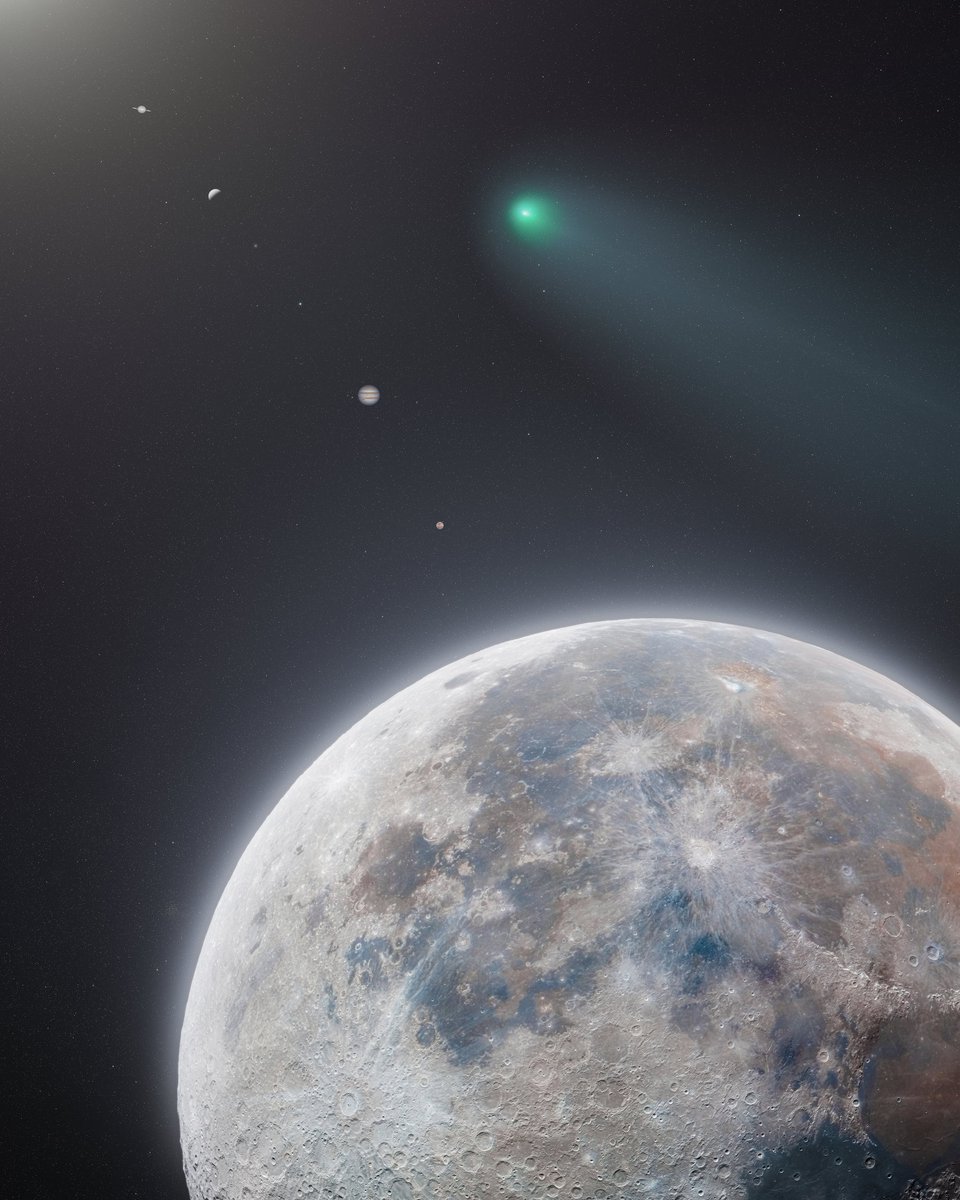
I captured the entire "Planetary Parade" using my 11" telescope, and combined everything into one composite photo that stayed true to the angular scale of these objects.
Made entirely with real photos, I hope this composite helps illustrate the scale of these things!
@CleverAds_tools Just got charged by @CleverAds after canceling my subscription, and they refused to refund. Terrible customer service! Beware before signing up. They don’t even consider anything that customers say.