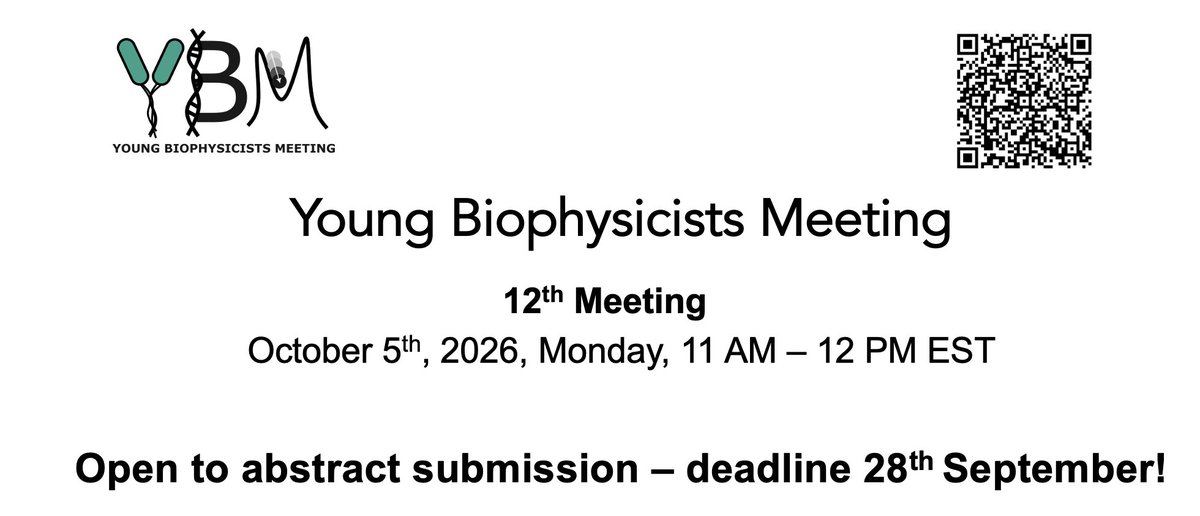
Submission open for the 14th YBM Meeting (deadline - 30th November)! Abstract submission link:
https://t.co/AOyv8naLAV
Sign up here for more information: https://t.co/AyxcVvFPnn
Previous speakers list: https://t.co/ciFDajeIJw
Thrilled to share that I’ll soon be defending my PhD at @Harvard and starting my own research group as an ELISIR Fellow in the School of Life Sciences at @EPFL_en! My lab will investigate how signal transduction networks evolve and function in time-varying environments to improve cellular growth and survival.
I’m currently recruiting a PhD student through EPFL’s Computational and Quantitative Biology doctoral program (https://t.co/5qrazI2qFx). Please reach out if you’re interested in working with me!
I'm also excited to share that the preprint of my PhD research, "Translational antagonism enables bet-hedging in yeast via mitochondrial bistability": https://t.co/eeIbSidfWQ. More below (↓)
The main preprint from my postdoc is live!
https://t.co/wL9oEHZYaK
The core idea is to try to make synthetic biology much more systematic and precise, akin to more mature fields of engineering.
This was an ambitious project, it started all the way back in February of 2020 and is only just now wrapping up! Thankfully there were no events in that timeframe, either around the world or specifically here at Harvard, that made things any more difficult than they needed to be.
The fundamental dilemma is that we are often forced to do one of two things when designing a synthetic circuits: either we can navigate a laborious design-build-test cycle where we iteratively optimize a circuit's performance tuning one parameter at a time, or we can screen a huge array of variants using techniques like directed evolution and pick the winners and have little insight into the molecular details of why one design worked better than the others.
Our idea was to try to get the best of both worlds, to combine precise mechanistic insights with extremely high throughput in such a way that we could systematically study the whole design space of a given circuit architecture.
Two preprints from my postdoc are now on bioRxiv!
1/Division of labor during bacterial warfare
https://t.co/YXgawAEgkG
2/Inherited flagellar structures coordinate the onset of swimming among related E. coli cells
https://t.co/eGKbZNohZD
2.1/ Lineage-related E. coli begin swimming together.
2.2/ Inherited flagellar structures integrate transcriptional activity across generations.
2.3/ FlgM sharpens the switch to swimming, allowing relatives with similar flagellar expression to become motile together.
Clonal does not mean uniform. Our new review explores how genetically identical bacteria adopt different cell states, and how that diversity shapes survival, cooperation, antibiotic responses and gene transfer. https://t.co/zRX8eKj7t2
📣 We’re hiring a postdoc at @ASUBiodesign! 🦠🔬
We’re looking for someone excited about microbial interactions, ecology & evolution, and using molecular genetics and microfluidics to understand microbial communities.
Come do fun science with us!
https://t.co/oV2ZLukWDN
With the encouragement and generous help from @NikoMcCarty, I've decided to start trying to write more for a public audience! I think both the culture and process of science are changing rapidly, and I am more than anything trying to organize my own thoughts about how this might play out in the areas of science I am closest to.
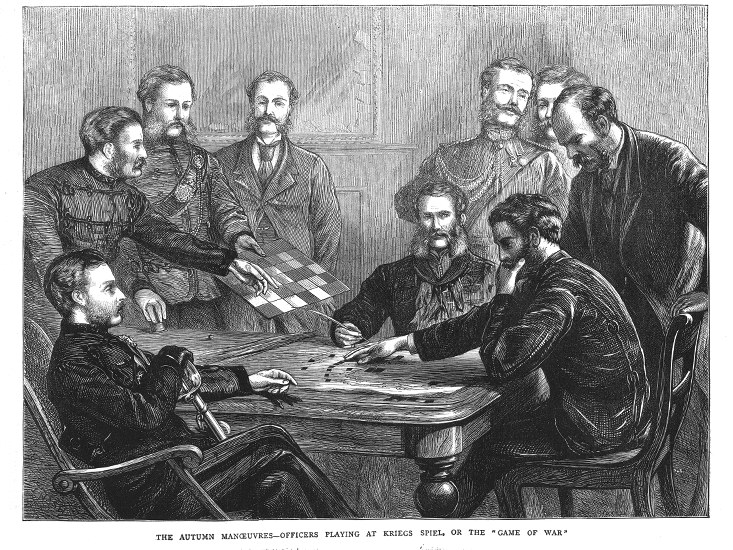
My first essay is about a useful metaphor I've been thinking about for the role of AI/ML tools in biology, based on an obscure chess variant called Kriegspiel.
In Kriegspiel, each player can only see their pieces on the board, and must blindly make moves trying to capture their opponents pieces with extremely limited feedback and information. Each move must be made with deeply imperfect information, and can have costs that only become obvious many turns later.
Whereas in chess the correct strategy involves thinking many moves in advance, Kriegspiel rewards a play style where each move extracts the maximum amount of information without taking on catastrophic risk.
I write this because I think there is a broad belief that AI tools will serve like a chess engine or biology, where we have so much data that a sufficiently advanced machine could just piece it all together and make predictions far beyond the capacity of a human.
Having spent many years first on theory and computation and now as an experimental biologist, I think this mode of thought is misguided. Biology is more like Kriegspiel, where we are constantly immersed in ambiguity and have to piece together messy and seemingly incoherent information to try to understand the systems we interact with.
In light of this, I want to argue that the best use of AI in biology is likely not bigger and bigger foundation models built on data we know is flawed and incomplete, but rather the development of tools that assist scientists is making the day-to-day decision that arise constantly in experimental work. A tool that can minimize months wasted going down fruitless paths will likely be far more valuable than a marginally better predictor of transcriptional state.
Put another way, biology is not so much bottlenecked by intelligence as by speed of iteration. Many of the biggest advances in the field are not some incredibly clever deduction from first principles, but rather methods that take something that take processes that were once laborious and make them faster, easier, and cheaper.
I think there is a huge role for machine learning in accelerating the development of these types of tools, my own daily workflow has become unimaginable more efficient in just the last few years. However, it is important that we point them at the right problems, and those will only come from working hand-in-hand with experimentalists rather than trying to create so-called virtual cell models from whole cloth.
I would love to get feedback from anyone interested in these questions! Link to the article in the post below.
I am happy to share that we are recruiting a postdoc with previous #tuberculosis research experience for a Mtb systems biology project focused on gene networks! Please visit our lab website (https://t.co/t8XBTcS1wa) and our ad (https://t.co/YVr8o7h6Uo) for more information!
I'm unsure how many of my fellow scientists are still left on Twitter, but in case you are interested in what I've been up to recently, we have a new preprint available to read 😊
https://t.co/wXVxy39w41
Antibiotics changed medicine because we learned how to mine nature.
Our next challenge is to mine the code of life itself.
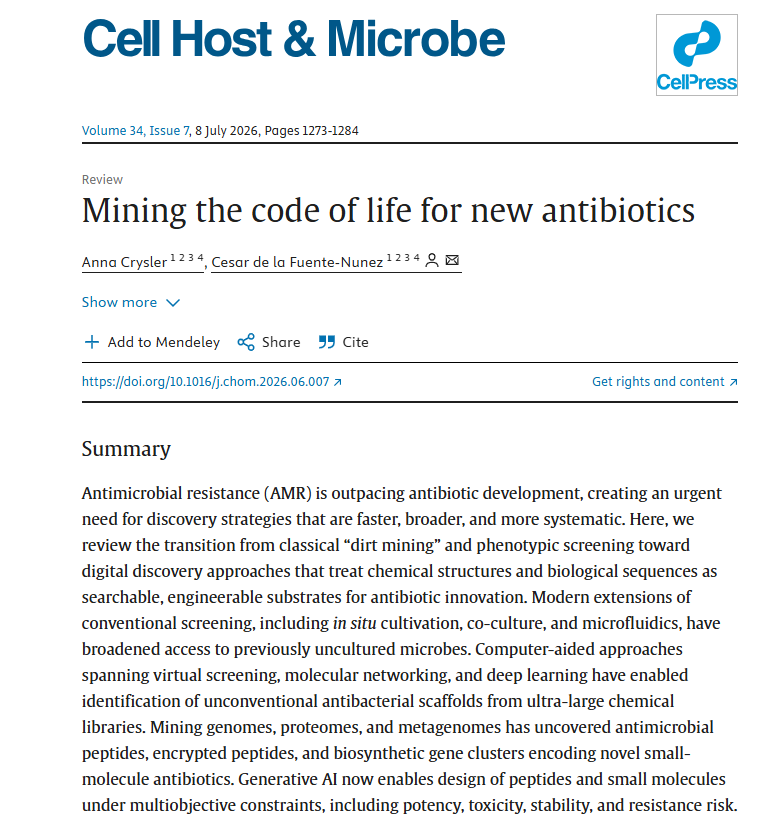
Glad to share our latest piece with Anna Crysler, now out in @cellhostmicrobe@CellPressNews: “Mining the code of life for new antibiotics.”
We discuss how antibiotic discovery is moving from classical “dirt mining” and phenotypic screening toward digital platforms powered by genomics, metagenomics, deep learning, and generative AI.
The goal is not AI instead of experiments. It is to build tighter loops between computation and biology — systems that can search larger spaces, reduce rediscovery, and help design candidates with potency, safety, stability, spectrum, and resistance risk in mind.
A step toward our broader mission: using machines to understand and engineer biology.
Link: https://t.co/MLpXbWbzD8
Happy to announce that a new opinion paper of our group just came out @ Current Opinion in Microbiology :
A conceptual framework to dissect emergent functions in microbial communities
with Swagatika Dash @sharvari_harshe@anjanaprasad06@_Shubharthi_
https://t.co/FaBMpNR0Ki
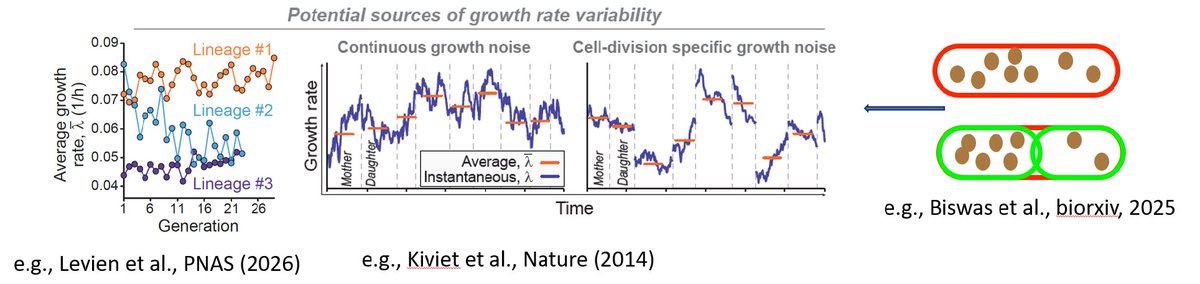
How can we characterize how cellular growth rate fluctuates? Are the fluctuations continuous, or does growth abruptly change at cell division? Or perhaps they are lineage-dependent?
We built a method to answer this, and applied it to bacteria and mouse leukemia data.
1/6
1/ Many antibiotics are derived from microbial warfare systems.
We all know about antibiotic resistance as a way bacteria survive and thrive under attack. But there’s another, sneakier mechanism fewer people talk about: persistence. 🧵