Captured the mysterious (269) Justitia tonight!
Sitting right in the main asteroid belt, this ~14.2 mag object hides a massive mystery: its spectral profile shows an intense, deep-red tint—a signature rarely seen in the belt, matching objects from the distant Kuiper Belt beyond Neptune.
Scientists suspect Justitia didn't form here, but migrated inward across billions of miles.
That raises the question: why is this the sole target where the UAE’s upcoming MBR Explorer mission will actually deploy a surface lander? What really did we detect from Earth that made us want to touch it?
#Astronomy #Asteroids #Astrometry #CitizenScience #SpaceExploration #DobsonianPower
#space
Have you seen our new episode of Planetary Defenders yet?
"This Is Not an Exercise," our latest documentary on the scientists who find asteroids before they find us, is now free to watch on our YouTube channel: https://t.co/qHxwCBOoMr
Just tracked and captured near-Earth asteroid 2026 TG9 from my observatory (MPC Station R39).
You can see it crossing from right to left very fast.
This asteroid is approximately 14 meters across and is traveling at 11.6 km/s. It is making a close approach today, passing at just 0.59 Lunar Distances (around 227,000 km) from Earth—well inside the orbit of the Moon.
Tracking these fast-moving near-Earth objects with the 16-inch Dobsonian is always a rewarding challenge. Citizen science in action.
#Asteroid #2026TG9 #Astronomy #Space #CitizenScience #DobsonianPower
This tiny and faint object in the center is the massive Asteroid (363790) 2005 JE46, an Apollo-class Potentially Hazardous Asteroid (PHA) measuring approximately 924 meters in diameter, with a rapid rotation period of about 2.1 hours.
It is currently heading toward a close approach with Earth in November 2026 and i just captured with my telescope.
Between November 13 and November 17, 2026, the asteroid will pass at a safe distance of approximately 0.051 Astronomical Units (about 20 lunar distances). During this approach window, it is expected to brighten significantly, reaching a peak visual magnitude of 13.4 to 13.8. Because of its size and proximity, it is also scheduled as a prime target for NASA's Goldstone Solar System Radar observations. I'll be following it from my observatory.
#2005JE46 #Asteroid2005JE46 #NearEarthObject #NEO #PlanetaryDefense #CitizenScience #Astrometry #LiveStacking #DobsonianPower #Astronomy
Tonight's target: Comet 2P/Encke ☄️ A beautiful celestial visitor captured during my latest session! Massive size of 4.86 km (3 miles) in diameter.
It's heading towards the Earth 🌍with the next closest approach on February 3, 2027 and next
☀️ Perihelion on February 10, 2027
🌀 The "Encke Anomaly": This comet is famous for an orbital anomaly where its 3.3-year orbit continuously shortens. While 19th-century astronomers thought it was dragging against "ether" in space, we now know it's caused by outgassing from the comet acting like tiny thrusters.
When the interstellar visitor 'Oumuamua passed through our solar system in 2017, it also exhibited non-gravitational acceleration—it changed speed in a way gravity couldn't explain. But unlike Encke, observatories couldn't detect any outgassing, coma, or tail whatsoever which points to a techno signature. Either ways, we'll keep monitoring it for new anomalies 👀
#CometEncke #Astronomy #space
Caught the fast Comet P/2026 R2 (Leonard) tonight! 💫🔭 Captured using my 0.41-m f/3.3 Dobsonian Power reflector and SV605MC camera at Station R39. This officially designated Halley-type comet is cruising past Earth at 0.3 AU, moving fast through the constellation Ophiuchus. Glad to get some data on this fast-moving traveler today! 🌌🛰️
#Comet #P2026R2 #Space #Astronomy
Caught 88P/Howell on the move! ☄️ Known for its faint, diffuse "ghost comet" appearance, this massive 4.4 km wide object is currently cruising at a distance of 1.498 AU from Earth.
Interestingly it's closer to the Earth the same moment the Sun blasted a triple CME. Back during its 2020 approach, astronomers managed to catch a tiny, faint tail about 2 arcminutes long, but it's completely missing from the view now.
I captured this sequence directly from the observatory, during yesterday live stream, using Excalibur, my 16-inch (0.41-m) Dobsonian telescope. 🔭🌌
#Astronomy #p88howell #DobsonianPower #CometHowell #Space #CitizenScience
The latest pictures of 3I/ATLAS we have... just came from the Keck Observatory! ☄️🔭
Astronomers just published their deep imaging of our 3rd interstellar visitor (captured using the Keck/LRIS instrument). It's incredible to still be tracking this ancient traveler from beyond our solar system as it heads back out into deep space! The full report is up on The Astronomer's Telegram (ATel #18098).
The Keck Observatory telescopes (where the LRIS instrument is mounted) each have a massive primary mirror aperture of 10 meters (394 inches or 32.8 feet). This massive aperture allowed to capture this now very faint object in space.
#3IATLAS #InterstellarComet #Astronomy #KeckObservatory #CitizenScience #Astrotwitter
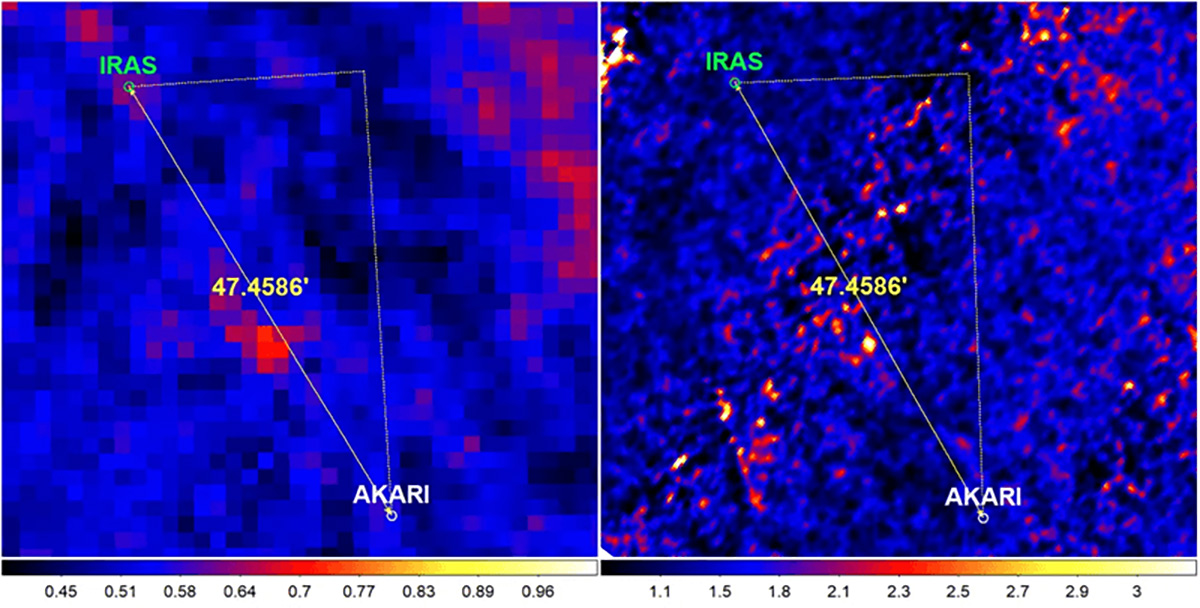
This might be the best Planet 9 candidate we have. Captured as a thermal signal by the AKARI space telescope in 2006, a team of scientists in Taiwan linked it to an anomaly from the 1983 IRAS survey. They tracked its slow movement across 23 years, but here is the catch: they need a "triplet"—a 3rd, modern observation to confirm the Keplerian orbit and secure one of history's biggest discoveries. To do that, they are fighting for time on massive telescopes like the Dark Energy Camera. With so much public interest, you'd think pointing a scope at these coordinates would be top priority, but securing observatory time is a brutal waiting game. The hunt is paused in a queue!
#Astronomy #Planet9 #SolarSystem #AKARI #AstroTwitter #Astrophysics #Astrometry #CitizenScience #DobsonianPower #planetx #nibiru #NTHU
Saturn last night from my observatory in case you missed the live stream. From raw live views with my 16" telescope to the stacked image #Saturn#Space#Astronomy
🚨 BREAKING: FIRST OFFICIAL PICTURES OF PLANET 9 CANDIDATE RELEASED!
Astronomers analyzing historical infrared data from IRAS (1983) and AKARI (2006) have flagged direct photographic evidence of a massive body shifting 47.5 arcminutes across the deep sky over a 23-year baseline.
Estimated at 7–17 Earth masses, this unseen giant could be acting as a cosmic bulldozer—altering outer solar system orbits and redirecting comets into near-Earth trajectories.
Is the long-debated "Planet X" / Nibiru hypothesis finally being confirmed by raw telemetry?
Full breakdown on the channel 🔭👇
#Planet9 #PlanetX #Astronomy #SpaceNews #SolarSystem #DobsonianPower