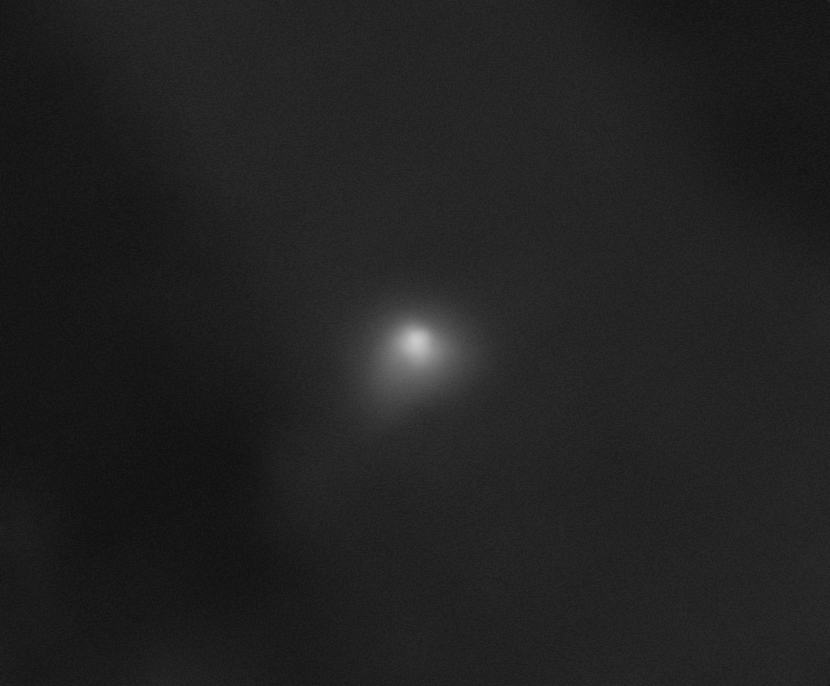
Here is a 2 hour and 8 minutes time lapse of @NASAArtemis 2 Orion spacecraft Integrity this morning from Florida, trailed by the ICPS! Captured with an 11" Celestron NexStar GPS and SBIG ST-2000XCM binned 2x. I streamed the capture of these images here:
https://t.co/5237cuV0LW
Here's my footage of the launch of Artemis 2! There's a double flash of something I can't positively identify near the rocket at about t+ 1:10, and it's visible in both my cameras and telescopes.
https://t.co/FXSw59To6s
We're going around the Moon. Come watch with us. Artemis II's four-astronaut crew is lifting off from @NASAKennedy on an approximately 10-day mission that will bring us closer to living on the Moon and Mars. The launch window opens at 6:24pm ET (2224 UTC). https://t.co/X27QJejNDt
❓Why so blurry❓
Lots of reasons…but in short, it’s not what these spacecraft were designed to do. As comet 3I/ATLAS swooped by, we jumped on the opportunity to turn our instruments its way and see what we could get. Take HiRISE as an example.👇
The left is what it was designed to take: images of the Martian surface which is bright, close, and stable. The right is what it was able to capture of the faint, distant, fast-moving comet 3I/ATLAS. True, it’s not magazine cover material – but it is very useful scientifically!
@Gaetan_Jobin@surajit_ghosh2 The photograph is called A Measure of Eternity and it was taken by Nature by JJ. I suspect he would not consent to the use of his work with his logo cropped out and without any attribution like this...
https://t.co/3Gt2D4kjZy
We've just released the latest images of the interstellar comet 3I/ATLAS, as observed by eight different spacecraft, satellites, and telescopes.
Here's what we've learned about the comet — and how we're studying it across the solar system: https://t.co/ZIt1Qq6DSp
Due to high winds, we are standing down from today's launch of the RRT-1 mission. Teams will continue to keep a close eye on the weather as we work toward the next best launch opportunity. A new target launch date will be shared once available
Polaris Dawn Flight Day 3 Update
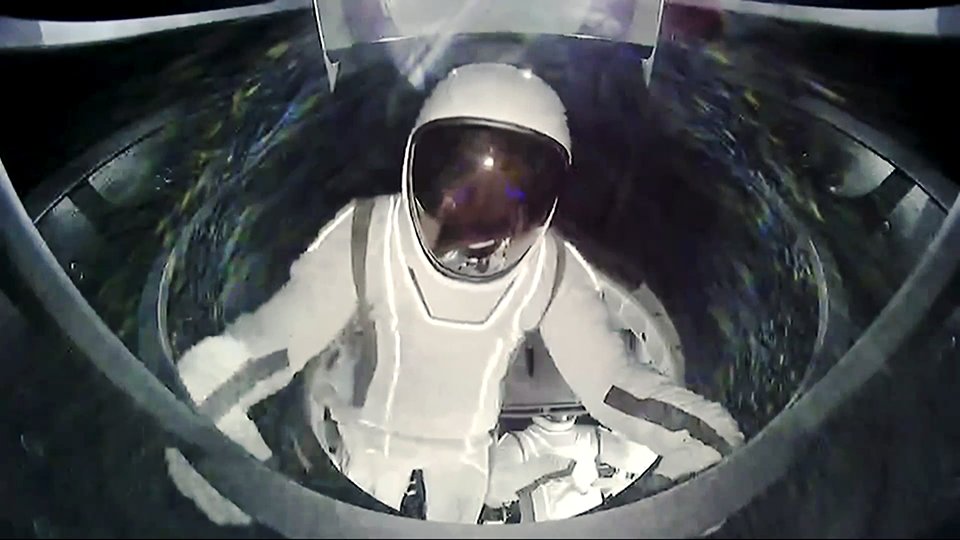
Early Thursday morning at 7:58 a.m. ET, the Polaris Dawn crew successfully completed the world’s first spacewalk – also known as an extravehicular activity (EVA) – from Dragon at 732.2 km above Earth.
Shortly after arriving in space on Tuesday, the crew began a two-day pre-breathe process, designed to prevent decompression sickness while also preparing the crew for the environment inside the EVA suits by gradually lowering Dragon’s cabin pressure and increasing the oxygen concentration.
Then on Thursday, the crew donned their suits and initiated Dragon seat rotation, suit tare, and the heads-up display and helmet camera checkouts. The 106-minute spacewalk officially began at 6:12 a.m. ET when suit pressurization started, the nitrogen purge was initiated, and pure oxygen (O2) was flowing into the suits. A secondary flow of oxygen primarily helped provide cooling to the suits, which would come in handy during the spacewalk.
Once suit leak checks were complete, the crew and ground teams gave the go for Dragon to initiate venting, which took the cabin’s pressure down from ~8 psi to below 1 psi – nearly to the vacuum of space. Simultaneously, Dragon repositioned its trunk to face the sun ahead of the hatch opening.
Mission Commander Jared Isaacman opened the hatch and for the first time, four astronauts were simultaneously exposed to the vacuum of space. Jared and Mission Specialist Sarah Gillis separately exited the spacecraft and individually performed a series of suit mobility demonstrations to test the performance of the spacesuit in the vacuum environment of space. Mission Pilot Kidd Poteet and Mission Specialist Anna Menon remained seated, managing suit umbilicals and monitoring vital support systems and telemetry on Dragon’s displays.
Upon completion of their individual EVAs, the hatch was closed, Dragon re-pressurized to 14 psi, cabin oxygen and pressure levels confirmed, officially completing the suit testing alongside the first commercial spacewalk and the first EVA from a Dragon spacecraft.
Throughout the EVA, stunning visuals were afforded by Dragon’s cameras and the spacesuits helmet cameras as the crew orbited between 184.9 x 732.2 km above Earth.
Following the spacewalk, the crew took time to rest and recuperate, enjoying a well-deserved meal before posting from space for the first time on X using Starlink high-speed internet. The crew concluded the day by connecting with their families and settling in for their sleep period ahead of Flight Day 4.
Polaris Dawn Flight Day 2 Update
The Polaris Dawn crew began Flight Day 2 with an incredible milestone – Dragon reached an apogee of more than 1,400 kilometers, marking the farthest humans have traveled in space since the completion of the Apollo program over 50 years ago. Mission Specialist Sarah Gillis and Mission Specialist and Medical Officer Anna Menon also became the first two women to have travelled this far in space! Mission Commander Jared Isaacman also passed the torch to the NASA Artemis crew, saying he’s looking forward to their upcoming flight.
After completing six orbits of Earth at this altitude, Dragon performed a series of descent burns to reach an orbit of ~190 x 700 km for Thursday’s spacewalk while simultaneously continuing to safely lower its interior’s pressure, bringing the cabin environment closer to conditions required for the EVA. The crew also spent a few hours demonstrating the suit’s pressurized mobility, verifying positions and accessibility in microgravity along with preparing the cabin for the EVA.
In addition to EVA prep, the crew conducted a series of activities on-orbit, including time dedicated to science and research. The crew focused on monitoring initial changes to eye sight and ocular health, studying how fluid shifts and exposure to microgravity affect blood flow, and assessed how medications are processed by the body while on-orbit.
The entire crew met with representatives from Folds of Honor — an organization providing educational scholarships to spouses and children of America's fallen and disabled military service-members and first responders — honoring those who have made the ultimate sacrifice in service of the United States.
Anna then read her book, Kisses from Space, to a group of St. Jude patients and her family, followed by a Q&A session. Olympic gold medalist Shawn Johnson East joined the crew via video transmission to host the book reading.
Jared, Kidd, Sarah, and Anna ended their day with individual family calls conducted over Starlink connections and preparing a special message for fans later in the mission before settling in for a good night’s sleep ahead of tomorrow’s world-first commercial spacewalk.
Timelapse of the moon setting into streams of red and green aurora followed by a sunrise lighting up Soyuz with a light blue.
The aurora have been amazing the past few days. Great timing for trying out a new lens that recently arrived on Cygnus.
15mm, T1.8, 1/3s exposure, 1/2 s interval
@TKA1026@jimcolbertshow And we'd be listening to music if done that. Corporate doesn't care. At least this way the remaining people can still be loyal to and maintain the contracts they've signed, not just with the company but also advertisers.