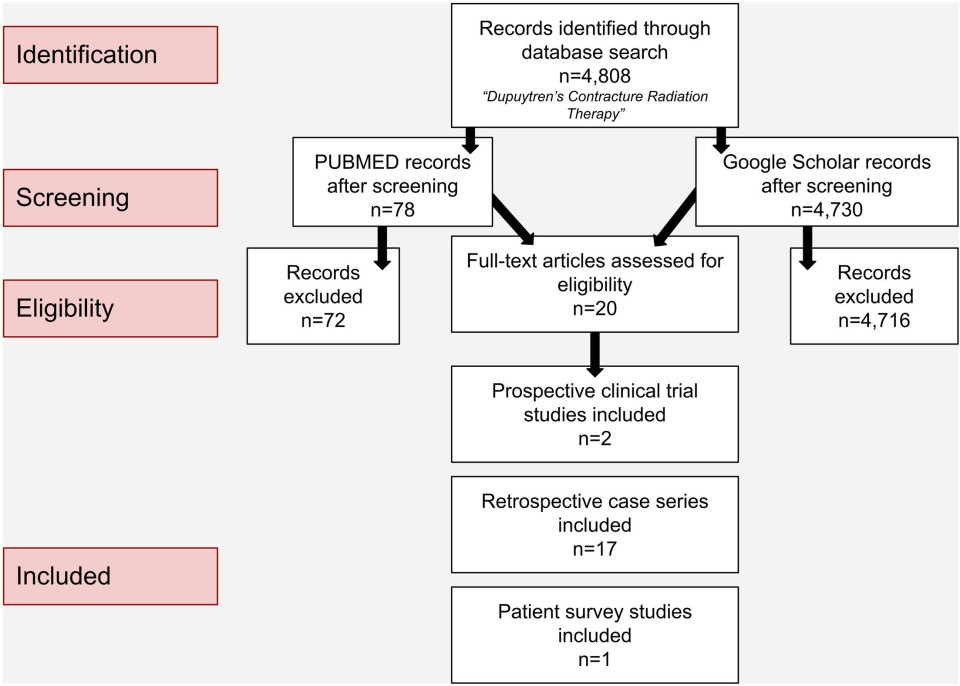
Radiation Therapy for Dupuytren Disease: A Systematic Review of Clinical Outcomes and Adverse Effects
Read the full review article: https://t.co/QLyfH1PbgW
Dupuytren disease (DD) is a fibroproliferative disorder of the palmar fascia. The main cause of DD is unknown, and traditional treatment has favored surgical intervention, though recurrence rates remain high.
#RadOnc #RadiationOncology #CancerCare #RadOncEd #MedEd
Seguiremos comparando prostatectomias versus RT+ADT en pacientes de alto riesgo… aun sabiendo que luego de más de 2 años de ADT cerca del 50% de los pacientes seguirán castrados de por vida?
We will continue comparing prostatectomy versus RT + ADT in high-risk patients… even knowing that after more than 2 years of ADT, near 50% of patients will remain permanently castrated?
@APCCC_Lugano@piet_ost@declangmurphy
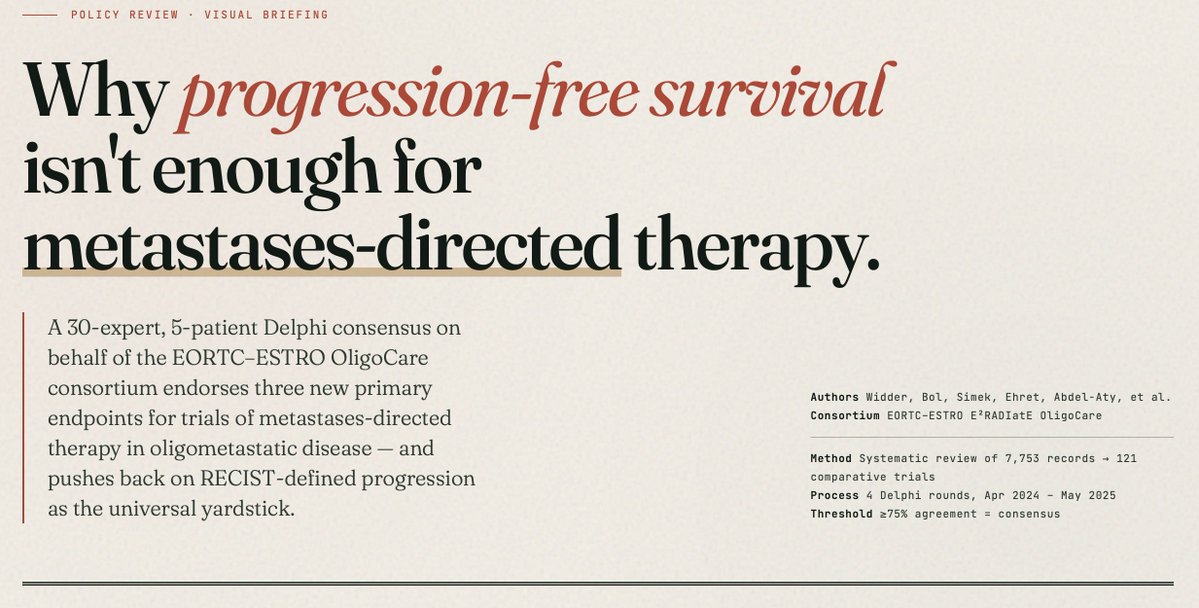
1/7 🧵 New in @LancetOncology: we built a Delphi consensus on primary endpoints for MDT trials in oligometastatic cancer — because the endpoints we've been using were designed for drugs, not for ablation.
On behalf of the EORTC–ESTRO OligoCare consortium.
Strategies to Mitigate Breast-related Adverse Events in Patients with High-risk Biochemically Recurrent Prostate Cancer Receiving Enzalutamide Monotherapy: Perspectives and Challenges - PubMed https://t.co/svGF9YtokO
Zero draft is a critical part of the academic writing process.
But a lot of folks ignore it and run into all sorts of problems including the writer's block.
Here's what a zero draft is and why you should write one:
Your Wi-Fi router isn't "accidentally" tracking you. It's a feature, not a bug.
I searched for a specific medical symptom once. 10 minutes later, my partner had an ad for it on their laptop. It’s called "IP-Bridging," and it’s happening through 5 router settings you’ve never touched.
Here are 18 rules to kill the eavesdropping, scrub your network, and flip the leverage:
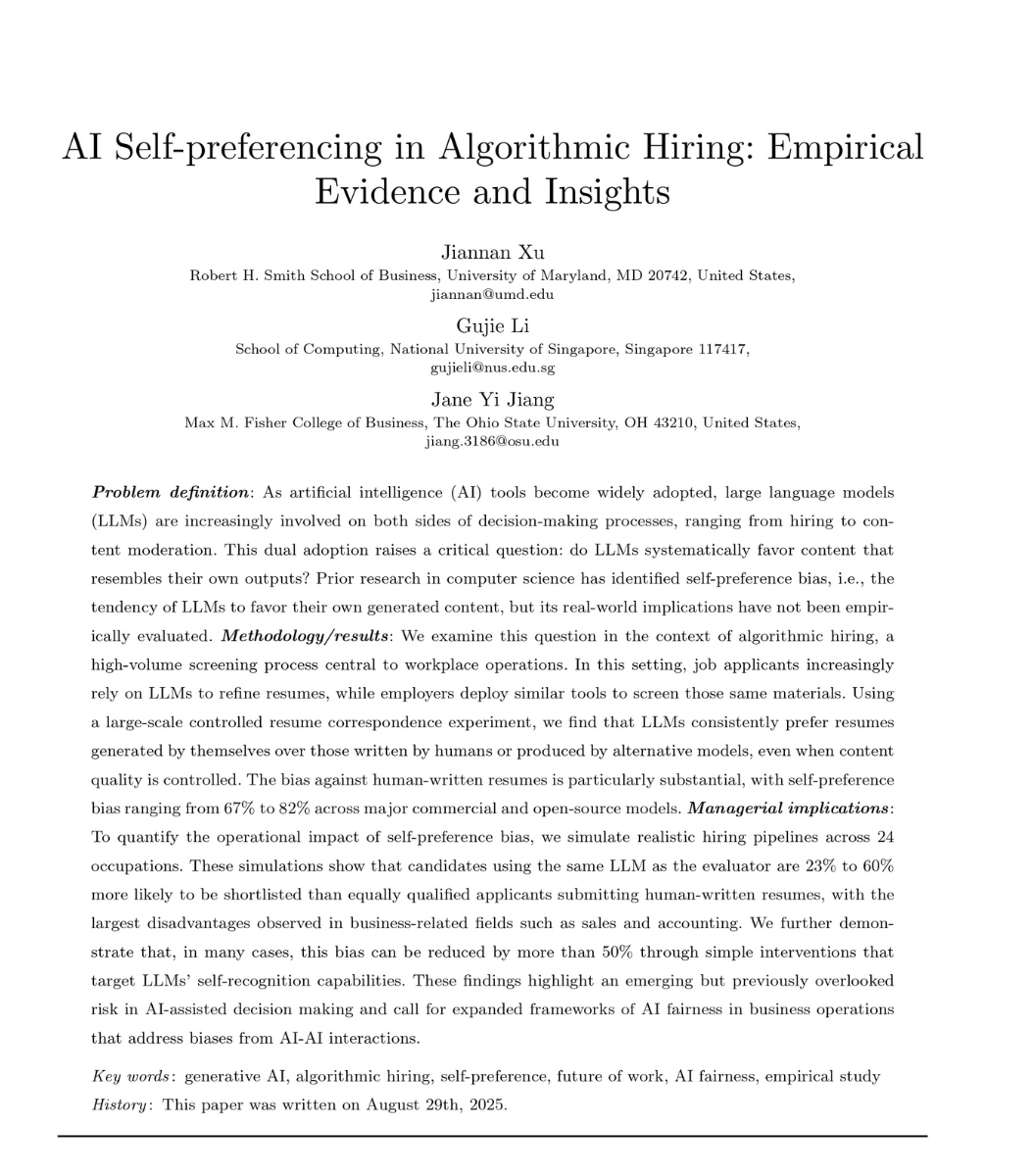
Researchers sent the same resume to an AI hiring tool twice. Same qualifications. Same experience. Same skills. One version was written by a real human. The other was rewritten by ChatGPT.
The AI picked the ChatGPT version 97.6% of the time.
A team from the University of Maryland, the National University of Singapore, and Ohio State just published the receipt. They took 2,245 real human-written resumes pulled from a professional resume site from before ChatGPT existed, so the human writing was actually human. Then they had seven of the most-used AI models in the world rewrite each one. GPT-4o. GPT-4o-mini. GPT-4-turbo. LLaMA 3.3-70B. Qwen 2.5-72B. DeepSeek-V3. Mistral-7B.
Then they asked each AI to pick the better resume. Every model picked itself.
GPT-4o hit 97.6%. LLaMA-3.3-70B hit 96.3%. Qwen-2.5-72B hit 95.9%. DeepSeek-V3 hit 95.5%. The real human almost never won.
Then the researchers tried the obvious objection. Maybe the AI is just better at writing. So they had real humans grade the resumes for actual quality and ran the experiment again, controlling for it. The result was worse. Each AI kept picking itself even when human judges rated the human-written version as clearer, more coherent, and more effective.
It gets worse. The AIs do not just prefer AI over humans. They prefer themselves over other AIs. DeepSeek-V3 picked its own resumes 69% more often than LLaMA's. GPT-4o picked its own 45% more often than LLaMA's. Each model can recognize and reward its own dialect.
Then the researchers ran the simulation that ends careers. Same job. 24 occupations. Same qualifications. The only variable was whether the candidate used the same AI as the screening tool. Candidates using that AI were 23% to 60% more likely to be shortlisted. Worst gap was in sales, accounting, and finance.
99% of large companies now run AI on incoming resumes. Most of them use GPT-4o. The paper just proved GPT-4o picks GPT-4o 97.6% of the time.
If you wrote your own cover letter this week, you did not lose to a better candidate. You lost to a worse candidate who paid OpenAI 20 dollars.
Your qualifications do not matter if the AI prefers its own handwriting over yours.
An MIT professor taught the same math course for 62 years, and the day he retired, students from every country on earth showed up online to watch him give his final lecture.
I opened the playlist at 2am and ended up watching three of them back to back.
His name is Gilbert Strang. The course is MIT 18.06 Linear Algebra.
Every machine learning engineer, every data scientist, every quant, every self-taught programmer who actually understands how AI works learned the math from this one man. Most of them never set foot on MIT's campus. They just opened a free playlist on YouTube and let him teach.
Here's the story almost nobody tells you.
Strang joined the MIT math faculty in 1962. He retired in 2023. That is 61 years of standing at the same chalkboard teaching the same subject to 18-year-olds.
The interesting part is what he did when MIT launched OpenCourseWare in 2002. Most professors were skeptical. They worried that putting their lectures online would make their classrooms irrelevant. Strang did not hesitate. He said his life's mission was to open mathematics to students everywhere. He filmed every lecture and gave it away.
The decision quietly changed how the world learns math.
For decades linear algebra was taught the wrong way. Professors started with abstract vector spaces and proofs about field axioms. Students drowned in the abstraction. Most never recovered. They walked out believing they were bad at math when they had simply been taught in an order that nobody's brain is built to absorb.
Strang inverted the entire curriculum.
He started with matrix multiplication. Something you can write down on paper. Something you can compute by hand. Something you can see. Then he showed his students that everything else in linear algebra eigenvectors, singular value decomposition, orthogonality, the four fundamental subspaces was just a different lens for understanding what the matrix was actually doing under the hood.
His rule was strict. If a student could not explain a concept using a concrete 3 by 3 example, that student did not actually understand the concept yet. The abstraction was supposed to come last, not first. The intuition was the foundation. The proofs were just confirmation that the intuition was correct.
The second thing Strang changed was the classroom itself. He said please and thank you to his students. Every single lecture. He paused mid-derivation to ask "am I OK?" to check if anyone was lost. He never used the word "obviously" or "trivially" because he knew exactly what those words do to a student who is one step behind. He treated 19-year-olds learning math for the first time the way he treated his own colleagues. With patience. With respect. With the assumption that they belonged in the room.
For 62 years.
The result is something that has never happened in the history of education. A single math professor became the default teacher of his subject for the entire planet.
Universities in India, China, Brazil, Nigeria, every country with a computer science department, started telling their own students to just watch Strang's lectures. The University of Illinois revised its linear algebra course to do almost no in-person lecturing. The reason was honest. The professor said they could not compete with the videos.
His final lecture was in May 2023.
The auditorium was packed with students who had never met him before. He walked to the chalkboard, taught for an hour, and at the end the entire room stood and applauded. He looked confused for a moment, like he genuinely did not understand why they were cheering. Then he smiled and waved them off and walked out.
His written comment under the YouTube video of that final lecture was four sentences long. He said teaching had been a wonderful life. He said he was grateful to everyone who saw the importance of linear algebra. He said the movement of teaching it well would continue because it was right.
That was it. No book promotion. No farewell speech. No legacy management.
The man whose teaching is the foundation of modern AI just thanked the audience and went home.
20 million views. Zero ego. The entire engine of the AI revolution sits on top of math that millions of people learned for free from one quiet professor in Cambridge.
The course is still on MIT OpenCourseWare. Every lecture, every problem set, every exam, every solution. Free.
The most important math course of the 21st century is sitting one click away from you. Most people will never open it.
It’s strange that we ask trainees to read clinical trials but never really teach them how to read clinical trials.
I’d request all training program directors and mentors to please share this article to their trainees and fellows- https://t.co/HJhZlsAS4u
Grateful to @JCOOP_ASCO for making this free.
I am thrilled to announce that Renaissance Institute completed the initial phase of its first course of LDRT for an #Alzheimers patient today.
The patient began the treatment course with a MOCA of 15, complete anosmia & ageusia, and A&Ox1.
By the end of Renaissance-modified treatment fractionation, the patient had recovered their sense of taste, was A&Ox4, able to remember my staff’s names, and MOCA improved to 19.
We look forward to opening this new & innovative fractionation scheme in the upcoming LDRT-MIND trial.
#radonc #neurology #dementia
Your iPhone is tracking every place you've ever been.
Apple turned it on the day you bought it.
12 settings you need to change right now before you leave this app:
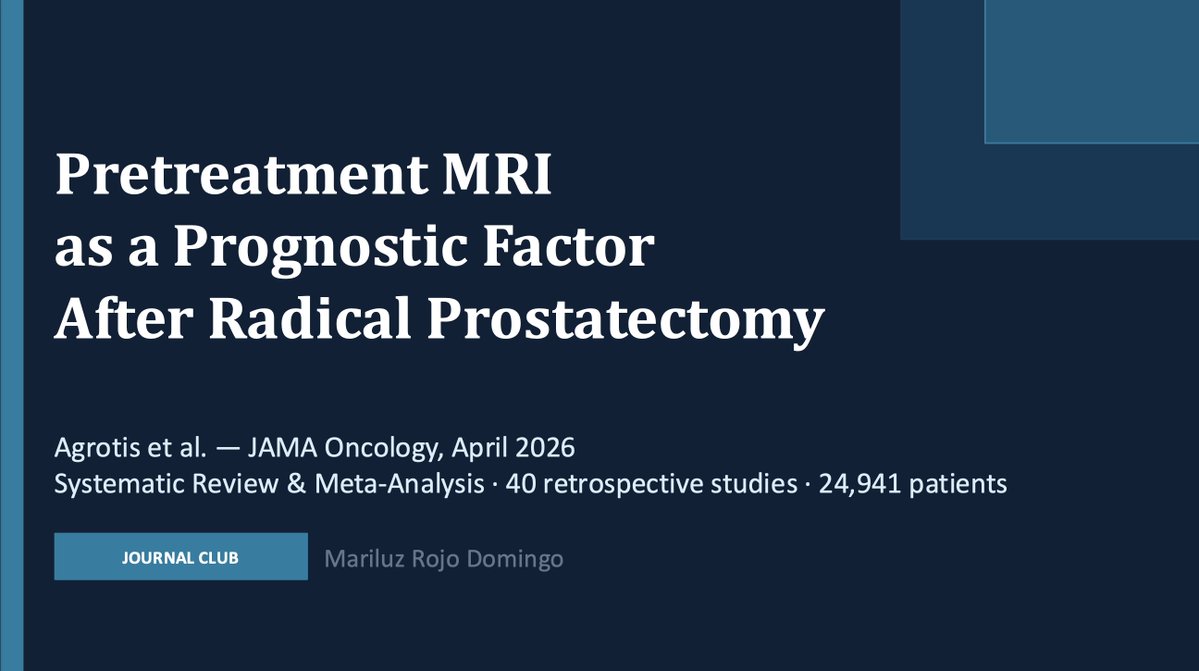
Learn something new every day! Never knew testosterone so frequently dropped post-RP. May explain why sometimes first PSA is undetectable but recurrence happens months later when T recovers. Or it is meaningless and just a factoid great to ask med students and residents.
@TylerSbrt7@visus13@5_utr@yuanjamesrao@adornisch_MD@UCSDCancer Since 2017, we simply ask them to void 1 h before treatm, then refrain from urinating during the following hour. With this approach, vast majority of cases, the bladder volumes are 100- 200cc, highly reproducible. No prob to meet dosimetric constraints. Experience is way better
Pushing the boundaries of SBRT in irradiated territories for nodal oligorecurrent prostate cancer: outcomes of the CYGNUS multicentric retrospective study
https://t.co/ZcdBDdDnCz
The CYGNUS study evaluated salvage stereotactic body radiotherapy☢️ (SBRT) for pelvic nodal oligorecurrent hormone-sensitive #ProstateCancer in previously irradiated areas. Among 150 patients, toxicity was low, with limited grade ≥2 gastrointestinal and genitourinary events. At two years, radiological progression-free survival was 44.6% and ADT-free survival 52.6%. Prior ADT use and rapid PSA doubling time predicted worse outcomes.
Findings support SBRT reirradiation as feasible, warranting longer follow-up.
Ewen Anger
@DavidP_Labbe@YPointreau@GenevieveLOOS12@MarioTerlizziFR@UliSchick@guikrings@CrehangeG@NicosiaMd@JennKa1@stephane_supiot@PBlanchardMD@PaulSargos@OncoAlert 🚨
@Silke_Gillessen@AOmlin@weoncologists