Look, it's bad that RAM is basically impractical to buy now. But on the bright side, maybe this will force appliance manufacturers to stop jamming "smart AI" features into dishwashers, laundry machines, toasters...
@kenwheeler@palmerj3 might need to adjust the delivery for some investors, but investing in non-traditional founders is probably gonna get real interesting over the next couple years. the ability to drive your own ideas and get up after a knockdown is gonna matter a lot more than degree pedigree.
@kenwheeler "how did you know I'm a dad?" "you're up at 6am sanding the sauna"
not to risk depriving you of exercise, but I have seen videos of guys spraying diluted pool chlorine on wood like that and it brightens right up.
very true. infra engineers will have generational run for years and beyond categories.
- model serving / inference infra
- gpu / distributed systems infra
- cloud + kubernetes + orchestration
- data infra
- eval + observability infra
- agent / runtime infra
i still think as ai advances there will be demand for areas which govern bottlenecks underneath like latency, throughput / cost / reliability / data quality and security.
@rot13maxi going from jpegs to language models is akin to Dylan going electric. We are at Newport right now. The haters will be loud and ultimately proven wrong.
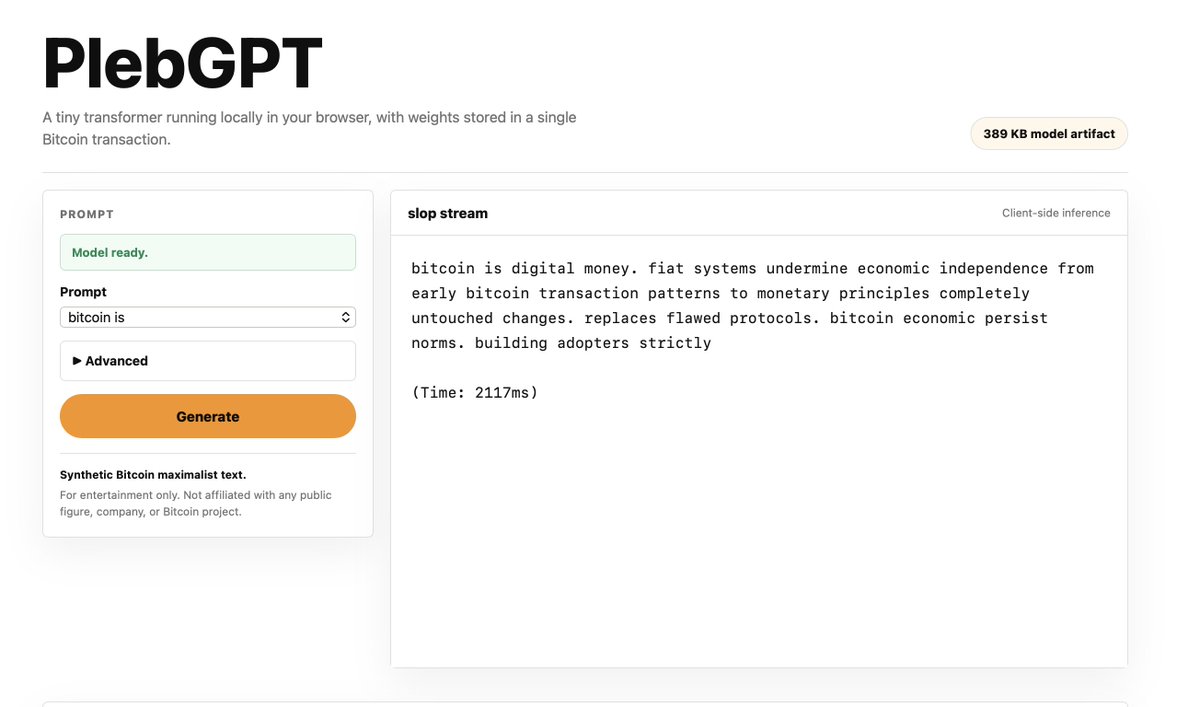
I built a very small language model on plebslop.
How small? Small enough to fit in a single *standard* bitcoin transaction.
There is now a plebslop generator on every Bitcoin node.
The UI includes client-side inference code. It loads the weights and does it all in-browser
BREAKING: Google is planning to release 32 million mosquitoes across Florida and California.
The company has asked the EPA for permission to proceed, with the public given until June 5 to respond.
The mosquitoes are infected with Wolbachia bacteria, which stops them from reproducing and slowly collapses the wild population from within.
Google's previous Debug Project trial in California's Central Valley nearly eliminated mosquitoes from three test sites entirely. A separate trial in Singapore cut dengue cases by 70% within 12 months.
Google has now released over 1 billion mosquitoes across four continents. This new proposal is the largest deployment in US history.
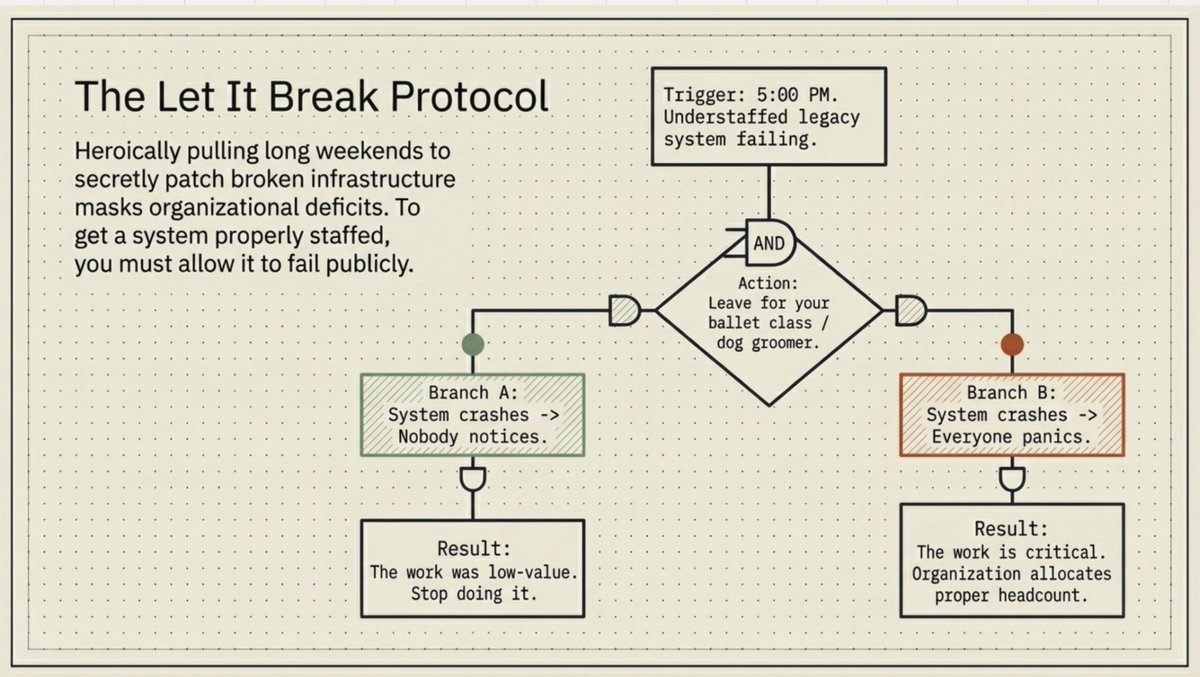
Google has an internal "let it break" essay about a hero engineer whose hard work ends up being a net negative (by masking the underlying issues). My manager sent me that essay when I was trying too hard to get the collective TensorFlow unit test suite green.
I don't endorse every single word here but, as far as Rust itself, it's certainly true that it confers a number of benefits, and the costs are borne by the LLM these days. Your robot fights the borrowchecker, not you. This was already true before agentic coding; you could frame a rustc challenge to ChatGPT and get past it (or learn you needed to back up and try again) without asking a human for help, usually.
In the age of AIs, Rust is the new assembler, and that's how I'm using it.
I don't particularly like Rust. I have never hand-coded a single line of the language, and probably never will. Rust's developer and advocate community contains a lot of crazies I don't want to be anywhere near.
Nevertheless, I've shipped two Rust projects so far, I expect to have a third out soon, and I'm planning on a fourth.
Why? Since I'm doing all my coding with LLM assistance now, none of the things I dislike about Rust matter much anymore. I don't need to know how to write the language, only to read it enough to understand control flow and spot obvious bogons. And I don't need to deal with the crazies, because my robot friends are smarter than they are.
Rust has four properties that make it a good target nowadays:
1. LLMs are good at generating high quality Rust code.
2. Memory safety, memory safety, memory safety.
3. Rust is anal about things like lifetimes that other languages aren't. This means that LLM-translating out of it into a future language that I might like better should be easy, because it's a more exact specification of intended behavior.
4. Repeating: LLMs are good at generating high-quality Rust code.
Am I going to use it for everything? Oh hell no. I have a bunch of very nice Golang code that doesn't need to be moved to Rust because Golang is a better fit for its problem domain. And I have a bunch of small Python scripts that don't need to move either.
But over time, I expect almost all of my C code will in fact move to Rust. Because memory safety, memory safety, memory safety.
Someday, maybe, there will be a language with Rust's virtues that I don't dislike. At which point I will cheerfully translate all my Rust stuff out of Rust. Interlanguage translation is easy and cheap now.
I don't necessarily have to like the shape of a tool to recognize when it's good for a job.
we're going to hit 1M daily active users in the next few weeks
the whole way here almost all the thought leaders kept explaining how what we were doing was wrong, bad taste, wouldn't work, etc
none of them were curious enough to ask us what they got wrong
something they rarely teach you is how to develop a nose for corporate personas and environments that will burn you out.
sometimes this is a necessary evil, where they provide access to work you find interesting / necessary to master if you were to move further along in your "career tech tree".
but most often than not, the most insidious ones end up being a slow-burn-frog-boiling scenario where you don't realize the wear and tear on your psyche until you're already exhausted.
the number one red flag in these situations is _overwhelming narcissism_.
flagging narcissism is getting harder these days when everyone is implicitly encouraged to speak up, show your work, and gain mindshare; after all, a closed mouth won't get fed.
but there's obvious signals if you pay attention to how someone speaks about their work / contributions / past experiences, such as:
"i innovated... i created... i discovered... X is just a base case for the Y thing i did years ago..."
(constant, unrelenting egocentrism and stolen valor)
or
"the best people will... iykyk... i know better than anyone that..."
(elitist vague-posting or giving advice that serves more as humble-bragging about themselves than anything else)
the sad reality in a competitive environment is that being overly humble will get you overlooked and written-off, while those who are mildly technical and shameless can easily oversell and make great strides under these incentive structures designed as a ponzi scheme of quarterly deliverables each level up (aka "managing up" - the more credit you can take, the more your boss can take, and so on).
the nice thing about seeing through the above and accepting the deal-with-devil is that you can start protecting yourself, your work, and your energy very early on. be meticulous in keeping receipts of what you create, build allies across different teams / orgs / domains, and avoid putting all your eggs in one bad-management-basket.
if you're starting out and you haven't seen any of this play out yet: enjoy it. and for the experienced ones who have gotten burned: remember what got you into this industry in the first place, and don't let a few bad apples ever keep you away from doing what you love.
tech moves so fast anyway that if you keep at it, all these non-technical problems will all just be a tiny footnote one day in your long career story.
@yagiznizipli@kenwheeler Fixes a different issue. This is more about unwanted refreshes burying something you got a glance at but didn't tap in time. I see it all the time, very annoying.