"We are interested in what's going on in [the Indo-Pacific]" says Germany's army chief Mais, as #Germany for the first time takes part in #TalismanSabre2023
Also taking part are the UK and France.
The 🇯🇵 🇪🇺 strategic partnership has become "ever closer", with shared views & cooperation on #China, #Ukraine, economic and traditional security.
Most recent Summit established Strategic Dialogue at foreign minister level.
Will individual EU member views hold back closer rel.?
In Hungary, these investments fuel concerns over environmental impact and deepening energy dependence on Russia.
China is now the second largest foreign direct investor in Hungary, worrying some that it will use its economic clout to influence politics.
Hungary continues to welcome Chinese investment in its pursuit to become a global EV battery superpower.
Last year, CATL announced an $8 billion investment in a new plant, and another $1.5 billion investment has just been announced by Huayou Cobalt.
#China#Europe#Hungary#EVs
While overall Chinese FDI in Europe continues to decline, China is betting heavily on the EV battery market, especially in Germany, Hungary, and France, the EU's leading producers.
But it will likely centre on reducing dependencies (critical minerals, preliminary products for pharmaceuticals, and supply chains), as well as building national economic resilience, diversifying partnerships, and protecting critical infrastructure and a narrow set of exports.
It was a great opportunity to share my thoughts on the German-China relationship on the occasion of intergovernmental talks in Berlin for @BBCWorld.
#Germany#China
I made the point that Germany's new (and first) National Security Strategy demonstrates a country still coming to grips with Xi's China, while the concept of "de-risking" isn't yet clearly defined.
We're back! 🗣️🎙️
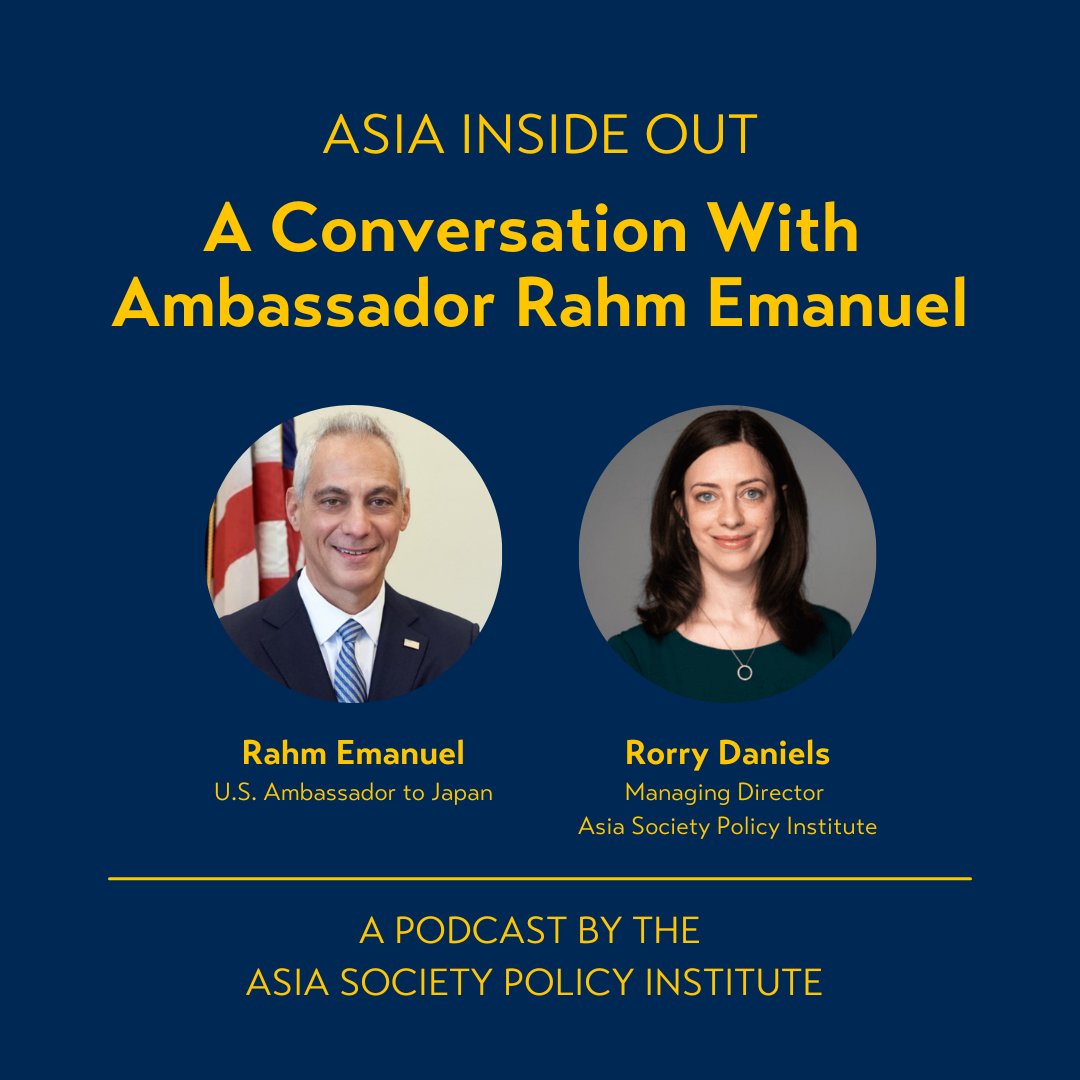
In the relaunch of ASPI's podcast, our @rorrydaniels chats with Rahm Emanuel, @USAmbJapan, on Japan's role in the Asia-Pacific region, and why America’s brand in Asia is strong. 🇺🇸🤝🇯🇵
Listen now: https://t.co/4MgSw6Jolm
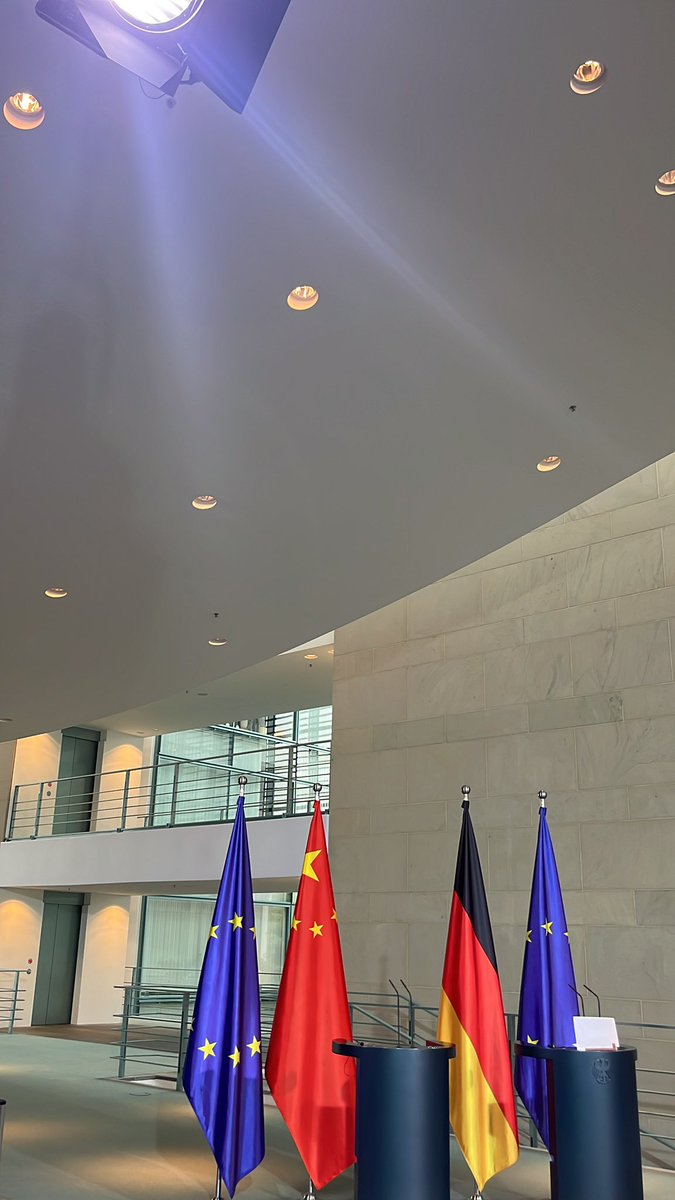
No questions allowed at joint press conference with Germany's Scholz and #China's Permier Li.
Senior journalist says she's never experienced anything like it in #Germany..
Hier im Kanzleramt findet gleich die „Pressebegegnung“ von Kanzler Scholz und Chinas Premierminister Li Qiang am Rande der Regierungskonsultationen statt - offenbar sind keine Fragen der Journalisten zugelassen. So etwas habe ich in Deutschland noch nicht erlebt.
Globalisation is dead: the EU proposes new law to prohibit outsourcing of factories to autocracies (#China) that deal with "advanced technologies": quantum computing, AI, and advanced semiconductors
H/t @POLITICOEurope
More tomorrow after the full strategy has been released.
So excited about this!! The Asia Society Policy Institute is relaunching its podcast, hosted by the brilliant @rorrydaniels.
Make sure you follow Asia Inside Out wherever you get your podcasts.
Coming next week, the relaunch of ASPI's podcast, Asia Inside Out, hosted by our Managing Director @rorrydaniels! 🗣️🌏
Tune into our preview, where you'll learn about what's to come, and our first guest: https://t.co/6wNcMWitSh
Catch me on @BBCWorld in 20 minutes as I talk about the *other* big visit this week: China's Premier Li is in Berlin for inter-govt consultations.
I will talk about what this signals about the broader Germany-China relationship.
#Germany#China#Blinken
This internal tug of war is apparent in the just-released National Security Strategy and will further be revealed in early July, when Germany is expected to (finally!) release its China Strategy.
On the investment side, Chinese investments in Germany are on the decline.
But Germany remains one of the four largest European countries in terms of Chinese FDI, together with the UK, France, and Hungary. @rhodium_group
The political relationship is in flux.
Chancellor Olaf Scholz appears to want to deepen - or at least maintain the current levels - of relations.
The Greens, in charge of the foreign and economy ministries, are pushing for a harder line.
And German automotive companies, some of which have a large share of their profits deriving from China, are losing market share due to their inability to compete with Chinese-made EVs in China.
(As a sidenote, the EU is worried about Chinese EVs in its own market too.)