Head of the of the Research Area China-Taiwan Relations/Director of the Taiwan studies project UZH. Interests: Chinese Politics, Taiwan, Cross-Strait Relations
Thrilled to share my new co-edited volume (w/ @chunyilee1): Changing Dynamics in Geopolitics: Implications for Taiwan 🌏🇹🇼
On Cross-Strait tensions, China–US rivalry & Taiwan’s future in the Indo-Pacific.
👉 https://t.co/VrK7sruUt0
#Taiwan#Geopolitics@UniofNottingham
This issue of @AsiaPolicy’s PLA Watch highlights a PLA undergoing major leadership upheaval while expanding its operational reach and international engagement. Here are the highlights:
-The Fifth Plenum formalized the expulsion of 16 senior military officers and elevated Zhang Shengmin to the Politburo, leaving him its only serving PLA general. The issue argues that Xi continues to prioritize loyalty and discipline, even as the loss of experienced commanders raises questions about readiness ahead of the 2027 modernization milestone.
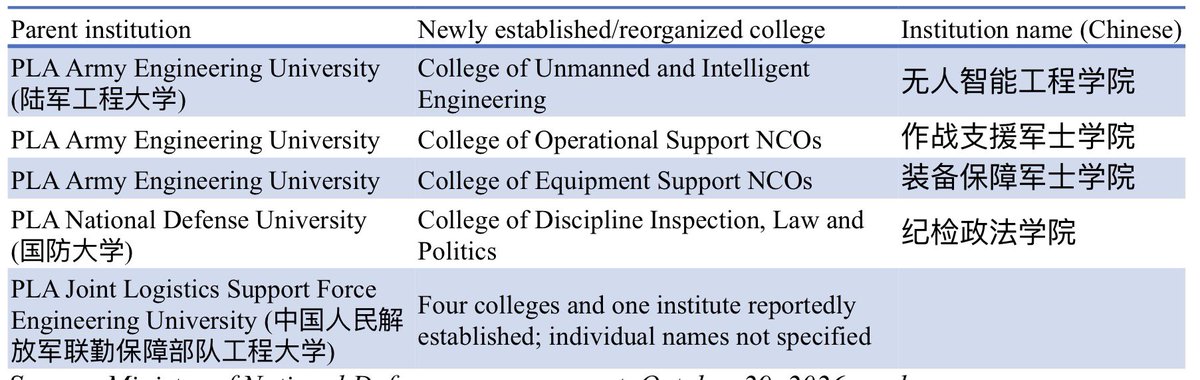
-On October 29, the PRC Defense Ministry of National Defense announced the restructuring of several military educational institutions,including the establishment and reorganization of colleges specializing in unmanned and intelligent engineering, operational support, and military discipline and legal affairs. The two principal institutions explicitly identified were the PLA Army Engineering University and the PLA National Defense University. Other military universities were also reportedly affected.
-The Liaoning’s apparent circuit around the Philippines, alongside widespread surface-ship deployments, demonstrated alternative routes into the Philippine Sea. These activities extended well beyond Taiwan, making direct comparisons with the Taiwan-centered Justice Mission 2025 exercise problematic.
-PLAN replenishment ships crossed the First Island Chain separately under destroyer escort, suggesting experimentation with a more flexible support model. Whether they directly supported Liaoning remains unconfirmed, but the pattern could have significant implications for sustained operations east of Taiwan.
-A mixed PLAN–China Coast Guard formation transited into the Western Pacific, indicating closer coordination beyond the First Island Chain. More broadly, large deployments described as “routine training” could complicate assessments of Chinese intentions and reduce warning time before a crisis.
-PLA engagements with European counterparts, Russia, ASEAN, and African officers continued despite internal turmoil. A record 378-day Gulf of Aden deployment and a hospital-ship mission to Ghana illustrated growing endurance and Beijing’s use of military missions to build diplomatic influence.
Special thanks to @angelo_mlh and @leontw99 for their contributions.
https://t.co/jPciWod3ex
What will the fourth Trump–Xi summit mean for Taiwan?
Join @GranoSimona, Dennis Weng & @LyleJMorris on Nov. 19 at 10 AM ET to discuss cross-Strait stability, U.S.–Taiwan relations & Taiwan’s political future.
Register: https://t.co/bHuYCZcMOK
How does Trump’s negotiating strategy affect Taiwan? When might China consider an invasion? And how much protection does 🇹🇼’s semiconductor industry really offer the island? I discuss these questions, in a new interview by Lea Fäh https://t.co/XD67HxHkqK
Photo: Iris C. Ritter
Not a good sign that 2 PRC nationals went across the Strait in a rubber boat, landed near Taipei undetected, and moseyed around Taiwan for a WEEK before being caught.
Interested in contributing to @AsiaPolicy's Center for China Analysis' work on the PLA, cross-Straits and Chinese foreign policy? If so, come work for me!
I am hiring an intern for the Winter/Spring in Washington, DC. Fluency in Mandarin a must.
https://t.co/GL0lGfdYqQ
*Webinar alert*
Join us on Thursday, Nov. 19, from 10-11am US ET for a panel discussion on "How the Fourth Trump-Xi Summit Will Affect Taiwan, and What This Means for Taiwan's Future." We will unpack the role of Taiwan in U.S.-China relations as President Trump and Xi prepare to meet again at APEC in Shenzhen. We will also touch on the upcoming local elections in Taiwan and what the results might mean for cross-Straits and US-Taiwan relations.
I will be joined by Dr. Dennis Lu-Chung Weng, Associate Professor and Graduate Director of Political Science at Sam Houston State University, and the founding Director of the Asia Pacific Peace Research Institute, and Dr. @GranoSimona, Managing Director of the Taiwan Studies Project at the University of Zurich and Senior Fellow at @AsiaPolicy's Center for China Analysis.
https://t.co/rcJyhErvvc
@jcmittelstaedt 🇨🇭 hasn’t “joined” anything. It has consistently followed a 1CP since recognising the PRC in 1950. This is explicitly confirmed by the FDFA and even reaffirmed in the 2025 Swiss–Chinese MoU. The Chinese readout’s wording does not signal a change in policy.
@jcmittelstaedt There is an important distinction here. The Swiss official readout makes no mention of Taiwan or the one-China policy. Only the Chinese readout attributes to Parmelin a general reaffirmation of Switzerland’s existing one-China policy. This is hardly a “Taiwan statement”
Mbappé's apology sends the wrong signal. Calling Mao a dictator is a historical judgement, not an insult to the Chinese people. By conflating the two, he adopts the Party's framing. Apologising will only deepen self-censorship on anything touching 'official China'.
This controversy is absolutely nuts. The Mao revisionism is *wild*, with state media demanding that foreigners bend the knee to an excrescence who killed tens of millions of their own ancestors. This ridiculous headline, together the humiliating capitulation of the sports world. Mbappe said something that anyone who has had a passing glance at history knows: Mao was not merely a dictator, but the biggest killer of the last century.
In case anyone was wondering about PRC influence in sport, you have your answer. And in case anyone was wondering about how quickly “private” Chinese companies (sponsors) can be mobilised to do the bidding of the Party State, voilá. Getting the picture yet?
This is the Whole-of- State approach in action people. Everything is the Party, and nothing can challenge it.
Over the last few months, China has intensified its pressure campaign against Taiwan, imposing sanctions on officials from two of Taiwan's remaining diplomatic allies, blocking Taiwanese representatives from taking part in an international conference in Kenya, and expanding the scope of its maritime grey zone operations to waters east of Taiwan.
"These are all forms of Beijing’s intensified pressure campaign aimed at isolating Taiwan internationally and limiting middle powers’ and smaller countries’ engagement with Taipei," I told @leahyjoseph at @FT.
Beijing wanted to “cultivate a sense of helplessness within Taiwan” while demonstrating to the Chinese public that it was making progress towards “unification”.
@CrisisGroup
https://t.co/4HwQIVfDPM
Minulý týden jsem strávil v Taipei, kde jsme pořádali další simulaci čínské strategické eskalace.
Tady pár veřejný dat, co by čínský útok na Taiwan znamenal:
⚬ Podle analýz Bloomberg Economics by čínská invaze na Tchaj-wan stála globální ekonomiku v prvním roce 10 bilionů USD (cca 10 % světového HDP), přičemž samotné státy Evropské unii by zaznamenaly propad HDP přesahující 5 %, což je hlubší pokles než během finanční krize v roce 2008 nebo pandemie covidu-19.
⚬ Tchaj-wan kontroluje přes 90 % celosvětové kapacity výroby nejvyspělejších mikročipů (pod 7 nm) a více než 60 % celkové světové produkce čipů. Přerušení dodávek by v EU ze dne na den způsobilo akutní nedostatek komponentů pro automobilový průmysl, zdravotnickou techniku i spotřební elektroniku.
⚬ Tchajwanským průlivem ročně propluje přes 21 % celosvětového námořního obchodu (zboží v hodnotě 2,45 trilionu USD) a téměř polovina světové kontejnerové flotily. Námořní blokáda nebo konflikt by znamenaly okamžitou paralyzaci přímých dodavatelských tras mezi Evropou a Východní Asií.
⚬ Výzkumné centrum CSIS a Rhodium Group odhadují, že kvůli kombinaci západních sankcí, námořních blokád a přerušení financování obchodu s Čínou by celosvětový objem obchodu klesl o dvouciferné procentní hodnoty, což by v EU vyvolalo skokovou inflaci a výpadky v dodávkách průmyslových meziproduktů.
⚬ Vzhledem k tomu, že 10 největších odběratelů tchajwanské TSMC reprezentuje tržní kapitalizaci blízkou 14 trilionům USD, výpadek výroby by okamžitě vedl k masivní korekci na evropských i globálních akciových trzích a k dlouhodobému znehodnocení majetku.
The sanctions are not isolated incidents but part of Beijing's coordinated pressure campaign to isolate Taiwan internationally by imposing costs on those that continue to engage with Taipei. Other recent examples include China's sanctions against four lawmakers from New Zealand for traveling to Taiwan and Beijing's ongoing hybrid coercion against Japan.
https://t.co/UVyZfew39N
SCMP reports that several of China's main Taiwan-focused research institutes have completed or nearly completed a first set of plans for governing Taiwan after unification, with scholars saying peaceful unification could grant Taiwan the widest autonomy available under 'one country, two systems', graded according to how unification occurs. It is the first systematic output to surface since Xi Jinping called in 2019 for concrete proposals.
https://t.co/MEUBasbcRz
Just in case there is any confusion about my stance: this is a complete waste of time by PRC academics keen to show "thought-leadership" on a post-Taiwan annexation political environment. Sure to please Xi and Beijing. Has zero influence in Taipei.
If anything, it lays bare the complete failure by Beijing to propose a political framework for "unification" beyond 1C2S that is at all palpable to the people of Taiwan.
Important commentary by my @AsiaPolicy colleague @GranoSimona in @Diplomat_APAC, titled "What Would Europe Do in a Taiwan Crisis?"
Simona asks a question diplomats and policy-makers in Europe have long-contemplated: how would Europe respond to a military crisis over Taiwan?
That question should be discussed more openly in Brussels and EU capitals with the general public.
https://t.co/rD2tQU9nle
Nine years of Taiwan Studies at UZH — and now five more! 🇹🇼🇨🇭 UZH and Taiwan’s Ministry of Education have renewed the Taiwan Studies Project for 2026–2031. Since 2017, it has supported teaching, research and academic exchange. Delighted to continue! 🔗 https://t.co/mmt5fQDtw6