In 2013, Mariano Rivera announced it was his last season.
Every team in baseball lined up to give him retirement gifts. A gold record. A rocking chair made from broken bats. A fire hose nozzle from the FDNY.
He accepted all of it.
But at every single ballpark, he asked for something else first.
He wanted to meet the employees.
Not the executives. Not the owners. The ushers, the ticket sellers, the custodians, the grounds crew. The people who show up at 6 a.m. and leave at midnight and never get thanked by anybody.
The Yankees' media relations director helped coordinate it, working with each team to pull together a group.
And Rivera did it at stop after stop, all season long, in his final year, at 43 years old, while still closing games.
Here's what he told about 20 Rangers employees in Arlington:
"We would never have a chance to see you guys, and that's why I wanted to do this. That was important to me, to make sure to thank those that work behind the scenes. No one sees them."
In Cleveland, he sat down with 25 staff members for half an hour before a game.
And partway through, he stopped and asked a question.
"Where's the drummer?"
For forty years, a man named John Adams had sat at the top of the bleachers in Cleveland with a bass drum, pounding out a beat to start rallies. Every home game. Four decades. He bought his own ticket for the seat next to him so the drum could sit there.
Adams raised a drumstick from the back of the room so Rivera could find him.
Rivera's response: "Hey, you the man. Being loyal, being there day in and day out. I really respect that."
At Fenway, he finally met a man named Baz who had been a fixture in that ballpark for decades. Baz afterward: "Pretty special. I've got tears in my eyes."
In Anaheim, where Rivera made his major league debut in 1995 and got his first career save in 1996, he sat with longtime Angels staffers and listened to their stories.
At every one of these, he took a photo with every single person and handed each of them a signed baseball.
His explanation of the whole thing:
"I want to be remembered as a player that gave for others. It's not that I'm better than anyone else; that's not true. I have been blessed and treat everybody the same because I wanted to be treated like that. With respect."
And this wasn't a farewell lap by a guy limping to the finish.
He saved 44 games that season with a 2.11 ERA at 43 years old. He pitched a scoreless inning at the All-Star Game, which kept his career All-Star ERA at 0.00 across thirteen appearances.
He finished with 652 saves, the most in the history of baseball, and a 0.70 postseason ERA that will probably never be approached.
In 2019 he became the first player ever elected to the Hall of Fame unanimously. Every single ballot.
Not Ruth. Not Mays. Not Aaron. Mariano Rivera.
The greatest closer who ever lived spent his last season making sure the people nobody notices got to be noticed once.
For more stories like this, follow us on any platform @thesportsontap
@pedroj86 Una precisión. La restauración de la Victoria en 1957 estuvo a cargo de Ramón Bonfil; en ese entonces, Jorge Jiménez Cantú, era Secretario General de Gobierno del Edomex, durante la administración del Dr. Gustavo Baz. A menos que un homónimo también participara en aquella obra…
When simulation becomes the norm, it weakens the human capacity for discernment. As a result, our social bonds close in upon themselves, forming self-referential circuits that no longer expose us to reality. We thus come to live within bubbles, impermeable to one another. Feeling threatened by anyone who is different, we grow unaccustomed to encounter and dialogue. In this way, polarization, conflict, fear and violence spread. What is at stake is not merely the risk of error, but a transformation in our very relationship with truth.
That's us! 🌍
The Artemis II crew captured beautiful, high-resolution images of our home planet during their journey to the Moon. As @Astro_Christina put it: "You guys look great."
Liftoff.
The Artemis II mission launched from @NASAKennedy at 6:35pm ET (2235 UTC), propelling four astronauts on a journey around the Moon.
Artemis II will pave the way for future Moon landings, as well as the next giant leap — astronauts on Mars.
Todo país que colapsa económicamente sigue el mismo patrón. No importa si es europeo, africano o latinoamericano.
No es coincidencia. No es mala suerte. No es incompetencia.
Es un mecanismo de 5 fases que se repite con precisión mecánica.
Gran Bretaña, India, Ghana, Grecia, Argentina, México, Venezuela. Todos pasaron por las mismas etapas.
A powerful scene in the Odyssey happens when Odysseus finally returns to Ithaca after twenty years of war and wandering.
You would expect the story to end with celebration, with the hero coming home, the family reunited, and order restored.
Homer does something far stranger.
Odysseus arrives disguised as a beggar, because Athena warns him that the palace has been taken over by more than a hundred suitors who have been living there for years, eating his food, drinking his wine, and pressuring his wife Penelope to marry one of them.
They believe Odysseus is dead and in their minds the kingdom is already theirs.
So the king of Ithaca walks through his own halls dressed in rags while the men stealing his house sit comfortably at his tables. They mock him, throw scraps at him, and one of them even strikes him, and Odysseus takes it. That is the remarkable part, because the same man who blinded the Cyclops and survived twenty years of disasters now stands quietly while strangers insult him in his own home. Homer tells us his heart burns inside his chest and that he wants to attack them immediately, yet he restrains himself and waits.
Instead of striking, Odysseus studies the room carefully. He counts the men, watches their habits, and quietly observes which servants remain loyal and which have betrayed him. The hero of the Odyssey does something most people cannot do, which is delay revenge until the moment is right.
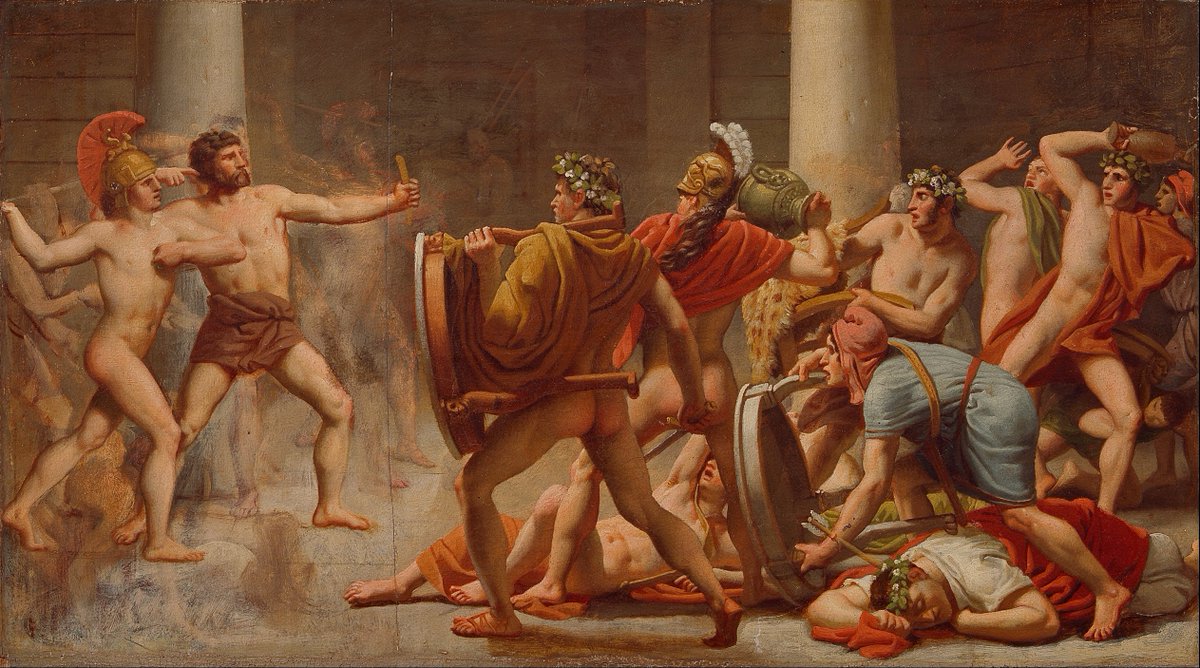
Eventually Penelope announces a contest and brings out Odysseus’ great bow, declaring that she will marry the man who can string it and shoot an arrow through twelve axe heads lined up in a row. One by one the suitors try and fail, because none of them can even bend the bow. Then the beggar asks for a turn. The suitors laugh at first, but the bow is eventually handed to him.
Odysseus takes it in his hands and strings it effortlessly. Homer says the sound of the bowstring tightening rings through the hall like the note of a swallow. Then he places an arrow on the string and sends it cleanly through all twelve axe heads.
In that moment the beggar disappears. Odysseus turns the bow toward the suitors and reveals who he is.
What follows is one of the most brutal scenes in Greek literature. The doors are sealed and the suitors realize too late that they are trapped inside the hall. Odysseus, his son Telemachus, and two loyal servants begin killing them one by one. There is no escape, no mercy, and no negotiation. The men who spent years consuming another man’s house die inside it.
It is a violent ending, but Homer wants you to understand something important. The real danger to Odysseus was never just the monsters and storms on the long journey home. It was the possibility that someone else might take his place while he was gone. When Odysseus finally returns, he reminds everyone in Ithaca of a simple truth: a man’s home is not truly his unless he is willing to fight for it.
@gomez_avl Sin duda! La bronca ahora será, cuando se replique, que se encarecerán los espacios en el ya insuficiente estacionamiento… Y ahora batallaremos otros. El espiral que se forma entre la ineptitud/corrupción de la autoridad y la búsqueda de soluciones del ciudadano… Lo que hay!
@ceciliasotog Sin duda! La bronca ahora será, cuando se replique, que se encarecerán los espacios en el ya tan insuficiente estacionamiento… Y ahora batallaremos otros. El espiral que se forma entre la ineptitud/corrupción de la autoridad y la búsqueda de soluciones del ciudadano…