….
2/ what you say that NRG-GU005 “did not even allow dose much over 38 Gy to hotspots” is a misinformation.
The protocol is explicit: the maximum dose to the PTV without urethral visualization is 38.78 Gy (~107% of 36.25 Gy).
If that threshold is exceeded, urethral contouring and visualization are mandatory, and the acceptable variation is 43.5 Gy (~120%).
The truth is this trial did allow hotspots well above 38 Gy ,up to ~120% ,but only with tight urethral control.
The Rx number 107% is the default when the urethra is not visualized, not an absolute ceiling. ( take a look a the bellow picture)
And when comparison with PACE-B also requires caution.
PACE-B had one primary endpoint: cancer control (non-inferiority for biochemical/clinical failure).
But NRG-GU005 had two co-primary endpoints: quality of life and DFS.
The two trials did not ask the same question.
Even with the same 36.25 Gy PTV prescription, PACE-B hotspots were substantially hotter: typically 118–132% on linac, and potentially higher on CyberKnife and of course go correspondingly with higher GU toxicity.
@LondonProstate1 , @TylerSbrt@alison_tree
I think your paper is potential of misleading.
The misleading point is you combines two fundamentally different regulatory contexts: initial approvals of new drugs and supplemental indications.
….
…
A fundamental principle of the Accelerated AA pathway is that it always comes with a safety net of the confirmatory trials .
And for the already approved drug, much of the uncertainty regarding its safety profile has already been addressed through prior trial.
When the sponsor seeks approval for an additional indication, the primary regulatory question is no longer whether the drug is safe, but whether it is effective in the new patient population. In many such cases, if the surrogate endpoint is considered sufficiently robust for that specific context, the FDA may grant RA without relying on the AA pathway.
Therefore, the way you pool the initial approvals and supplemental indications into a single analysis and then concluding that AA is underutilized or upfront RA removes the safety net can be misleading to some readers if they don’t understand the regulations.
@oncology_bg I think your paper is potential of misleading.
The misleading point is you combines two fundamentally different regulatory contexts: initial approvals of new drugs and supplemental indications.
….
@oncology_bg I think your paper is potential of misleading.
The misleading point is you combines two fundamentally different regulatory contexts: initial approvals of new drugs and supplemental indications.
….
Another important highlight from our study is the underutilization of accelerated approval pathway. AA pathway provides a good balance between speed and evidence. But what we found is that most approvals based on surrogate endpoints in recent years is in fact regular approval rather than AA. An upfront premature RA removes the safety net of confirmatory trial requirement that verifies clinical benefit. It also removes the safety net of withdrawing drugs that don’t benefit patients. AA pathway exists for a reason. There is zero logic to providing regular approval instead of AA based on weak surrogate endpoints.
https://t.co/5oKnkgqkIK
I think your post could mislead as implying that ORR has replaced PFS because it is a better “new king.”
And Readers need to understand the context.
….
….
Your paper in 2026 paper actually shows is that ORR has become the most commonly used surrogate endpoint in pivotal oncology trials.
This shift is driven largely by the rapid increase in single-arm trials supporting accelerated approvals.
And in the single arm trials, PFS is generally not considered an appropriate primary basis for accelerated approval. Because it is a time-to-event endpoint, PFS is highly susceptible to bias when interpreted against historical controls and, without a concurrent control group, confounding cannot be adequately addressed.
By contrast, in single arm trials, ORR reflects a direct antitumor effect that can be observed within individual patients and is less dependent on a control arm.
For this reason, ORR is preferred in single-arm trials setting, while survival outcomes such as PFS and OS are usually considered exploratory or supportive.
However, this does not mean that ORR is a “better new king.” Quite the opposite. From an evidence hierarchy perspective, the FDA has consistently regarded clinical endpoints in the following order of reliability:
OS>PFS>ORR.
So, the rise of ORR reflects a rise in single arm trial design, not any changes in the evidentiary strength of surrogate endpoints.
I think your post could mislead as implying that ORR has replaced PFS because it is a better “new king.”
And Readers need to understand the context.
….
@oncology_bg I think your post could mislead as implying that ORR has replaced PFS because it is a better “new king.”
And Readers need to understand the context.
….
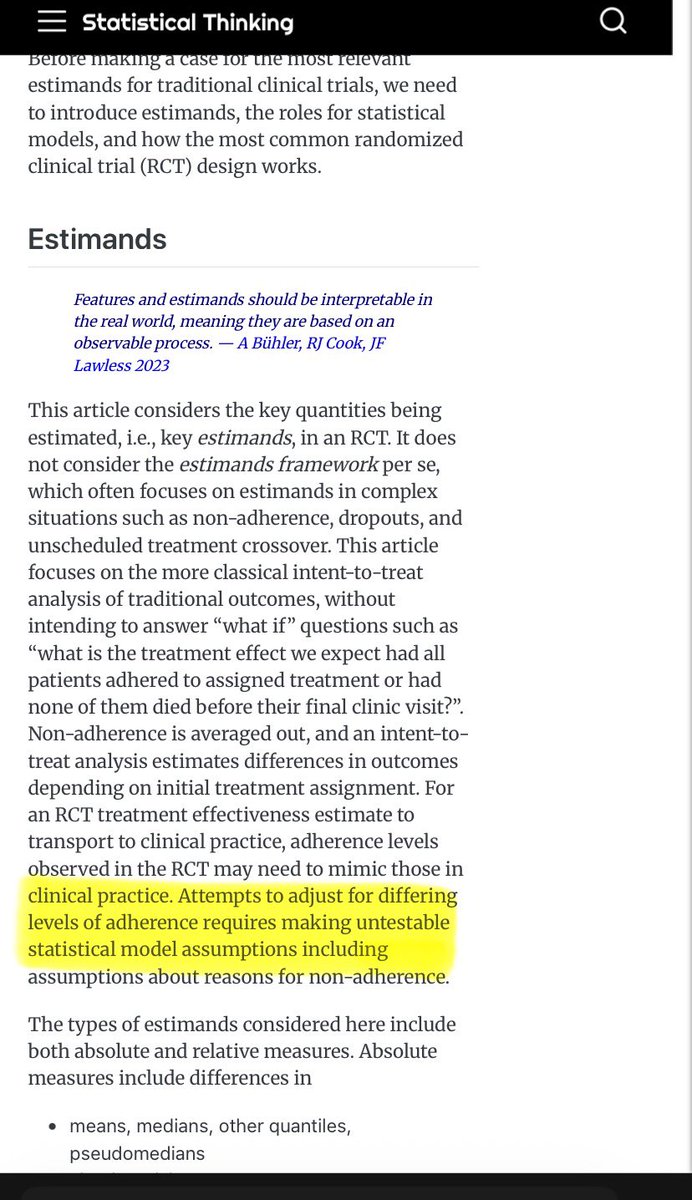
What Harrell wrote:
“Attempts to adjust for differing levels of adherence requires making untestable statistical model assumptions including assumptions about reasons for non-adherence.”
I believe this characterization is misleading.
The assumptions required for transportability—are structural assumptions encoded in a structural causal model (SCM/DAG), this not assumptions of a statistical model.
Consequently, no statistical test, basically goodness-of-fit, applied to observational data can test the structural assumption.
Observed data can only tell us whether a statistical model produces predictions that are consistent with the observed outcomes; they cannot determine whether the underlying causal structure that generated those outcomes is correct.
In fact, multiple distinct DAGs/SCMs may generate exactly the same observed data distribution.
Therefore, goodness-of-fit tests cannot tell us which causal graph is correct. Choosing among competing causal models necessarily relies on substantive scientific knowledge, study design, and explicit causal assumptions,not on the observed data alone.
1/ I just read his blog and I think we don’t see the honest from @f2harrell . Very disappointed
First, the issue of transporting RCT results is not merely about adherence, as Harrell suggests in his blog.
More fundamentally, transportability depends on whether any effect modifiers of the treatment effect differ in distribution between the source population (the RCT) and the target population (clinical practice).
And in causal inference, transportability is an identification problem. You formalized this problem using selection diagrams and transport formulas, which specify precisely when a causal effect can be transported across populations using do-calculus.
@f2harrell@yudapearl@stephensenn Your quantity:
P(T>2m| X,B)-P(T>2m|X,A)
is merely the difference between two conditional probabilities.
By itself, it has no causal meaning. What makes this quantity causal?
@f2harrell@yudapearl@stephensenn Your quantity:
P(T>2m| X,B)-P(T>2m|X,A)
is merely the difference between two conditional probabilities.
By itself, it has no causal meaning. What makes this quantity causal?
@5_utr@Ben_Alfred_@DongNguyeb You’re defending the transparency of the analysis.
But we are questioning the validity of the inference. Those are two different things.
Public data and reproducible code do not turn a model parameter L into evidence that a real ceiling exists.
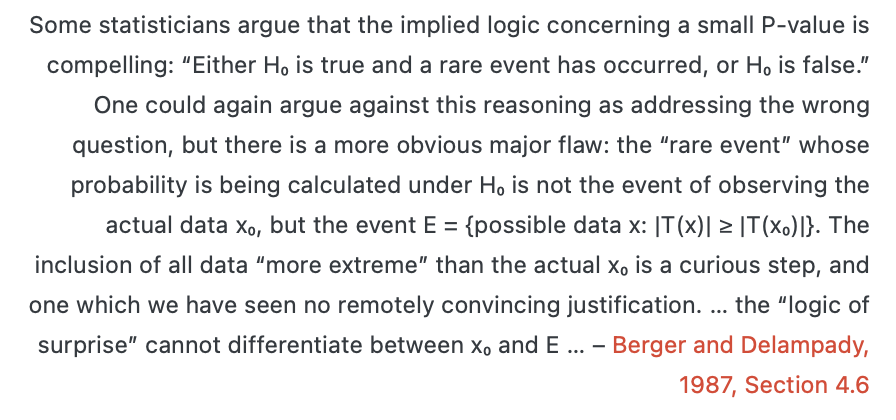
P-value = Prob(getting data MORE extreme than mine if H0 is true). Justification for this is largely missing. See https://t.co/9qzGIxqduH for more. #Statistics#Bayes