I need to make a very PUBLIC announcement on behalf of younger GenXers and older Millennials.
If you see someone in their 40s or 50s who seems a little boring now, I need you to understand something...
We already got it in.
Like...GOT. IT. IN.
We are not sitting home on a Friday night because we never knew how to have fun.
We are sitting home on a Friday night because we have seen enough.
We went to parties in houses that should have been condemned and were almost certainly owned by the local drug dealer.
We saw police lights and RAN and not across a nice, flat field.
INTO THE WOODS.
Do you understand the athleticism required to hurdle uprooted tree roots in platform shoes while simultaneously trying to keep your low-rise jeans from sliding completely off your ass?
And somehow...we never spilled the Zima. We never spilled the Boone’s Farm.
That was TALENT.
We slept on floors in strange houses because the designated driver either never showed up or, in a shocking turn of events, was drunker than everybody else.
There was no Uber, Life360 or Find My Friends.
There was just somebody named Mike saying, “I know a shortcut.”
And we FOLLOWED MIKE.
We closed down bars and then decided the night was still young, so we drove to Atlantic City, where we somehow managed to get drunk, sober up, get drunk again, sober up again and then get drunk a THIRD TIME before breakfast.
And according to our parents? We were at Michelle’s house.
Eating pizza and watching movies.
Michelle’s mother unknowingly covered for approximately 17 people every weekend. If there even was a Michelle.
We drank things called Purple Passion, Mad Dog 20/20 and whatever somebody mixed inside a giant plastic garbage can. Nobody asked what was in it. You grabbed a red Solo cup and trusted the process.
We went to clubs until the lights came on. Do you know the psychological damage of seeing a nightclub with the LIGHTS ON? Nothing good happens after those lights come on.
We danced for four straight hours in shoes that permanently altered the structure of our feet.
We made entire plans without cell phones...no texts, dropped pins or group chats...just an extremely questionable sense of direction.
We rode in cars with 11 people when the vehicle legally seated five. Someone was always sitting on someone. Someone was always in the hatchback.
And there was always one friend yelling, “DUCK!” when we passed a cop.
So yes...now we like being home.
We like sweatpants.
We like cancelling plans.
We like saying, “That sounds fun!” with absolutely no intention of attending.
We like restaurants at 5:30 because we can get a good table.
We like being home by 8:17.
And if someone texts at 9:30 PM and says, “What are you doing?”
Sleeping...we are sleeping.
Because this is not boring my friends...this is retirement.
We already played, partied and danced on the bar.
We already ran from the cops through a wooded area dressed like a Spice Girl.
We have stories that cannot be posted because there are still people with careers, marriages and reputations to protect. And thank GOD there were no camera phones.
So kids, when you look at your Gen X and older Millennial parents sitting peacefully on the couch watching Dateline at 8 PM and think:
“God, you guys are boring.”
Sweetheart...oh sweetheart.
You are looking at retired legends.
Put some respect on our names. We're probably the reason Life360 was invented.
xoxoxo (posted from someone else on FakeBook) 🤣 #genx #oldandtired
My 15yr old granddaughter still hasn't emptied the dishwasher.
I asked her to do it four hours ago.
Now she's freaking out because she can't find her phone...
Which is on silent in the dishwasher.
Follow me for more amazing parenting tips….
🚨Please share this with the girls and women in your life. It could SAVE THEM if they experience this!
WARNING ⚠️:
Anyone with GIRLS… please read!! “Friday morning, Kelci was with a friend and had started getting, what she thought, was car sickness. Later, she had started to run a low grade fever. By the time we got home, it was 103.
When we got to the ER, they pushed two fluid bolus to try and raise her BP. And in the mean time, Kelci had started to turn red and they decided to transfer her to St. John’s Children’s Hospital in Springfield.
After lots of testing, 3 IVs, 1 arterial line and 1 central line and an extremely long night….we figured out what was wrong with our girl.
She had multiple organ failure. Our girl was dying. A parents worst nightmare. She had contracted Toxic Shock Syndrome, not from misuse of tampons, but because she wore one while swimming in the Lake at the Ozarks. The dirty water had absorbed through the string and the bacteria in the water caused Staph Infection, which led to the Toxic Shock Syndrome. She had also become septic (causing the shutdown).
Thank goodness her PICU Dr was able to recognize the red skin syndrome that is a sign of toxic shock.
The first night, our girl was hooked up to at least 5 antibiotics, pressers and still getting fluid bolus. The dr and 5 nurses stayed in her room from the time we got there Saturday, until 4:30am Sunday. They were wonderful!
She is still recovering, but drs say she will make a full recovery with no lasting effects to her organs or body!!”
**Shared with permission from Ashley Anthony
Do not eat these. Discard immediately if you recognize any of these in yours or a loved one’s kitchen, it’s the easiest act of love you can do for them today.
A French study in PLOS Medicine examined the impact of emulsifiers (food additives used to improve texture and extend shelf life) on cancer risk.
Researchers analyzed data from 92,000 adults over nearly 7 years and found that certain emulsifiers significantly increased cancer risk:
Mono & diglycerides of fatty acids (E471)—found in processed baked goods, margarine, and ice cream—were linked to:
15% higher risk of overall cancer
24% higher risk of breast cancer
46% higher risk of prostate cancer
Carrageenan (E407 & E407a)—a thickening agent in dairy alternatives, deli meats, and plant-based products—was linked to:
32% higher risk of breast cancer.
Cancer is complex and multifactorial, but one thing is certain: the food we eat plays a massive role in shaping our long-term health. Cutting out ultra-processed foods and focusing on whole, nutrient-dense foods is one of the most powerful steps you can take to reduce disease risk.
Thank you to my friend Vani Hari for this image + bringing awareness to this critical issue.
The year is 1949.
The Nobel Prize in Medicine has just gone to the man who invented the lobotomy. Your doctor suggests one for your sister, who has not been herself since the baby came. It is the most celebrated advance in psychiatry of the age, and he is simply current. By the time the prize curdles into an embarrassment, close to twenty thousand Americans have had the operation, and proportionally more here in Britain.
The year is 1956.
Lay the baby down on his front, the doctor says. So does the most trusted childcare book ever written, the one on every new mother's shelf. On his back he might choke, the reasoning goes. Millions obey. The advice holds for nearly thirty years, long after the evidence has quietly turned, and a generation of cot deaths is counted before anyone thinks to roll the babies over.
The year is 1966.
A bestselling book informs your wife that menopause is a disease, that she is, in the author's word, a castrate, and that a small daily pill will keep her youthful and tolerable to live with. Her doctor agrees. The drug becomes one of the most prescribed in the country. Nobody mentions that the author sat on the payroll of the company that made it. That detail surfaces decades later, in the same year the landmark trial is halted early for raising rates of breast cancer, stroke and clots.
The year is 1979.
Your ulcer is caused by stress and sharp food, the doctor explains. Calm down, drink milk, take the antacid that happens to be the best-selling medicine on earth. Two Australians are about to prove that most ulcers are caused by a bacterium and cured by a fortnight of antibiotics. The profession laughs. One of them eventually drinks a beaker of the stuff to settle the matter. The establishment takes the better part of twenty years to stop laughing. The Nobel lands in 2005.
The year is 1985.
Butter is dangerous, the doctor says. Switch to margarine, it is modern, it is heart-healthy, the experts are united. The spread he nudges you toward is loaded with trans fats, which the next decade will identify as the genuinely dangerous one, and which will eventually be banned outright. The butter goes quietly back in the fridge. No correction is ever printed at the volume of the original warning.
The year is 1992.
There is a pyramid on the surgery wall, and the very same one in your grandchild's classroom. Bread, cereal, rice and pasta form the broad virtuous base, up to eleven servings a day. Fat is exiled to the tiny tip. The chart was reportedly held back a year while the relevant industries had their say. It is wrong at the bottom and wrong at the top.
Now it is today.
Your doctor has new guidelines, new studies, a fresh consensus, delivered with precisely the steady confidence of every guideline above. He believes it, and he has good reason to. So did every doctor in this thread. None of them were villains. Each was sincere, most were kind, and all were certain, reading from a map that somebody else had drawn and handed them. That is the part worth sitting with.
So when the man in the white coat tells you what to eat, what to fear, and what to swallow every morning for the rest of your life, you are allowed to ask. Who paid for the study. What the evidence says beneath the headline. What he was just as certain about thirty years ago, and where that advice sits now.
Then make up your own mind. Call it scepticism, or call it whatever your grandmother called it when she ignored the advert, kept the butter where it was, and lived to ninety-one.
It has outlasted every consensus on this list. It will outlast this one too.
I am the Senior Vice President of Late Night Strategy at CBS. I am the person who turned a comedian into a priest and charged advertisers to watch the congregation.
I want to be precise about what I built. Not a comedy show. A permission structure. For eleven years, six million Americans tuned in every night to find out what they were allowed to believe by morning. We didn't sell jokes. We sold certainty. Certainty costs nothing to produce. People will pay anything for it. We charged $50 million a year and still lost money because it turns out permission is even cheaper than we thought.
In 2014, we had a genuinely dangerous comedian. A man who once testified before Congress in character as a fictional conservative pundit and made the entire chamber look like they'd been pantsed on C-SPAN. His fake persona was the most brilliant satire on television. Layered. Ironic. Unpredictable. The character could say anything because nothing was real. The character was the art. The character was the comedian.
We killed the character and put the real man on stage. The real man was a lecturer. Earnest. Thoughtful. Correct about everything. Correct is not funny. Correct is not dangerous. Correct is the absence of danger. We promoted the absence of danger and called it growth. His character could make a Senate committee squirm. The real him makes an audience nod. Nodding pays the same as squirming. Nodding is easier to produce.
His final words on air were "We love doing this show for you, but what we really, really love is doing this show with you." The audience wept. I wrote that line. Not the words. The architecture that made those words feel true. For eleven years, the audience believed they were participants. They were not participants. They were the product. "With you" is what you say to a congregation. A comedian says "at you." We hadn't said "at you" since 2015.
Our internal metric was called Affirm Rate. It measured the percentage of monologue segments that generated applause instead of laughter. I invented this metric. I also invented the bonus structure tied to it. In 2015, our Affirm Rate was 34%. By 2022, it was 94%. I received a raise every year. We are crushing it. At the things I made up. That's performance management.
But I need to tell you about the real discovery. The one I put in a deck called "Content Strategy 2019-2024." The one that got me promoted.
Agreement gets applause. I knew that early. But correction — telling the audience their vocabulary is slightly outdated, their outrage is aimed two degrees off-center, their feelings are valid but their phrasing needs work — correction gets them back tomorrow. Agreement is a transaction. Correction is a subscription. We converted a comedy show into a nightly software update for moral vocabulary. Churn was near zero. They couldn't afford to miss an episode. Missing an episode meant using last week's words in this week's meeting. That's social death. We monetized the fear of social death and called it entertainment.
I want to be honest about something. The content was not bipartisan. We chose a side. But I need you to understand: we did not choose it because we believed in it. We chose it because that side's audience is more responsive to correction. They want to be updated. They want to be told their language is outdated. They experience correction as care. The other side does not respond to correction. They respond to provocation. Provocation is harder to monetize. You can't build a subscription on provocation because the audience doesn't come back to learn — they come back to fight. Fighting is unpredictable. Correction is scheduled. We optimized for the audience that wants to be told what to think. That audience leaned one direction. That's not ideology. That's market segmentation.
The writers' room had a whiteboard. In 2015 it said "What's funny?" In 2018 it said "What should they feel?" By 2021 it said "What are they still saying wrong?" I watched that whiteboard evolve like a finch beak and I never intervened. The market was speaking. We listened. Listening to the market is the same as leading the audience. They can't tell the difference.
A writer named Marcus raised his hand in 2019. "What if we just tried to make them laugh again?" I thanked him for his passion and scheduled a creative alignment conversation. He transferred to streaming development within the month. The Affirm Rate the week he left was 91%. Laughter would have brought it down. That's risk management.
Here is what nobody will say out loud. I will say it because I am proud of it.
We made our audience worse at politics.
Not better. Worse. Every night for eleven years, we expressed their outrage for them. Professionally. With a band and good lighting. And because the outrage had been expressed — because a man in a suit had furrowed his brow with the precise calibrated degree of indignation — they didn't need to express it themselves. They watched. They clapped. They felt the catharsis of resistance without resisting anything. They went to bed having done nothing and feeling like they'd done something. That's the product. Not comedy. Not information. Catharsis. Catharsis is the enemy of action. A man who has screamed into a pillow does not then also scream in the street. We were the pillow. A $50 million pillow with a house band.
If you feel the outrage has been expressed for you, you will not march. You will not organize. You will not call your representative. You will tune in tomorrow to feel it expressed again. That's retention. Our retention was extraordinary.
I want to talk about the comedy-to-catechism pipeline because I think people underestimate what we achieved.
Stage one: comedian makes jokes about the powerful. Audience laughs because the powerful are absurd. This is the Carlin model. The jester punches up. Everyone below feels relief.
Stage two: comedian makes jokes about people who disagree with the audience. Audience laughs because disagreement is stupid. The jester has turned around. He's still on the stage but now he's facing the crowd with a pointer.
Stage three: comedian stops making jokes. Comedian identifies incorrect beliefs and explains why they're dangerous. Audience does not laugh. Audience claps. The jester is gone. In his place: a hall monitor with a desk and a band.
Stage four: audience watches not for entertainment but for certification. Having seen last night's episode means you know which words are current. Not having seen it means you might use yesterday's vocabulary in today's meeting. The show is no longer comedy. It is a credential. Watching it means you are educated. Not watching means you are the person being discussed. We made a show that you watch to prove you're not the kind of person who doesn't watch it. That's a closed loop. Closed loops don't need content. They need continuity. We provided continuity for $50 million a year.
A comedian — whose entire historical function was to say things too dangerous for anyone else to say — became the person who decides which things are too dangerous for anyone to say. And the audience applauded. Every night. For 2,500 nights. Because being told what is forbidden feels exactly like being told what you already knew. Prohibition performed as validation. I put that in the deck too.
Our audience was correct about everything. I know this because they applauded everything we said. The applause proved the correctness. The correctness justified the applause. We called this audience research. The methodology was peer-reviewed by the audience. They approved unanimously. Every night.
The actually funny comedians left. They went to podcasts. To clubs. To rooms where the audience doesn't know what's coming and that uncertainty is the point. They took the laughter with them. We kept the applause. We called those spaces problematic. That's market differentiation. The problematic spaces are funnier. But funny is not our product.
We lost $40 million a year. We didn't lose it because the show failed. We lost it because we spent $50 million producing what a podcast host in his garage gives away between mattress ads. The podcast is funnier. The podcast is more dangerous. The podcast has an audience that laughs instead of claps. But we had the Ed Sullivan Theater. We had 461 seats. We had a former Beatle play the farewell episode. Paul McCartney, Elvis Costello, Jon Batiste, and Louis Cato playing "Hello, Goodbye" like it was a benediction. I booked a Beatle for a funeral. The Beatles played that stage in 1964 and the audience screamed so loud you couldn't hear the music. Our audience didn't scream. They wept politely. That's the difference between entertainment and church. We ran a church.
Jon Stewart showed up to the finale and did a bit where he pretended to deliver a corporate statement from Paramount about the cancellation. The audience laughed. It was the first time they laughed in a way I didn't recognize. Involuntary. Surprised. Dangerous. For ninety seconds, a comedian was in that building. Then it was over.
John Oliver said "At some point, this may come for all of our shows" and then added "but Stephen, what's important to remember is that tonight, it is going to eat you." The audience laughed again. Involuntary again. Two moments of actual comedy in a three-hour farewell. Both of them about death.
The finale drew 6.74 million viewers. Biggest weeknight audience in our history. More people came to the funeral than ever visited the patient. I know what they were mourning. Not comedy. The comedy died in 2016. Not the man. The man is fine. He's wealthy. What they mourned was the permission structure. Starting today, they have to decide what to believe on their own. They have to form an opinion without waiting for a man behind a desk to form it first and deliver it with a knowing look. Some of them haven't done that since 2015. The funeral wasn't for the show. It was for the certainty.
He joked about the Peanuts theme music licensing cost on his last night. "Oh no! I hope this doesn't cost CBS any money!" The audience laughed. It was a joke about money. About the network losing money. The last joke was about money. Not about truth. Not about power. About a licensing fee for a cartoon piano riff. Eleven years and the final joke was about accounting. I think that's perfect. The show was always about accounting. We just dressed it up as conscience.
The President of the United States — the man we spent eleven years explaining was dangerous to an audience that already believed he was dangerous — posted an AI-generated video of our host being thrown into a dumpster on the Late Show set. Then Trump danced to "YMCA" in the clip. Viewed more times in four hours than our farewell managed in a week. His production cost: zero. Ours: negative $50 million a year. We manufactured his relevance every night at 11:35 for eleven years and he never paid us a dime. We were his marketing department. He turned our funeral into content. His ROI was infinite. Ours required a write-off and a farewell concert.
The Strike Force Five — Fallon, Kimmel, Meyers, Oliver — appeared in a segment about late-night losing "one middle-aged white man who makes jokes about the news." They were joking about their own obsolescence. All of them know. None of them will say it. The format is dead. The audience moved to phones. The phones don't have desks or bands. The phones have men in garages who are allowed to be wrong, allowed to be surprised, allowed to say something their audience hasn't already approved. That's comedy. We stopped doing that a decade ago. We did approval. Approval looks like comedy from a distance. Up close it's church.
I do not feel guilt. Guilt would require me to believe I took something from them. I didn't take anything. They came to us. Every night. They chose the catechism over the comedy. They preferred correction over surprise. Certainty over danger. Instruction over laughter. They wanted to be told. Not challenged. Not shocked. Not made to laugh against their will at something they didn't see coming. They wanted to see it coming. They wanted to mouth along. That's not comedy. That's karaoke. We ran the most expensive karaoke bar in television history and the only miscalculation was charging a cover when the songs are free on every phone.
We turned a jester into a priest. We turned an audience into a congregation. We turned laughter into obedience. We turned political engagement into passive consumption. We turned a comedy show into a permission structure and charged $50 million a year to tell people what they already believed in a voice slightly nicer than their own.
They were so grateful they showed up to mourn us. 6.74 million of them. Weeping. For the certainty.
Applause is more reliable than laughter. I proved it. The proof cost $450 million, one character, one comedian's capacity for danger, and one audience's willingness to act.
The metric went up.
Thanks to President Trump's memorandum signed last week, the wheels are in motion to require every broadcast prescription drug ad to display its full safety facts on-screen.
@dom_lucre The normal you want to go back to does not exist anymore.
We have a new reality. We have a new normal.
Nothing will ever be the same. There is no going back from this.
“Stop saying those things that make you weak and ashamed. Say only those things that make you strong. Do only those things that you could speak of with honour.”
— Jordan Peterson
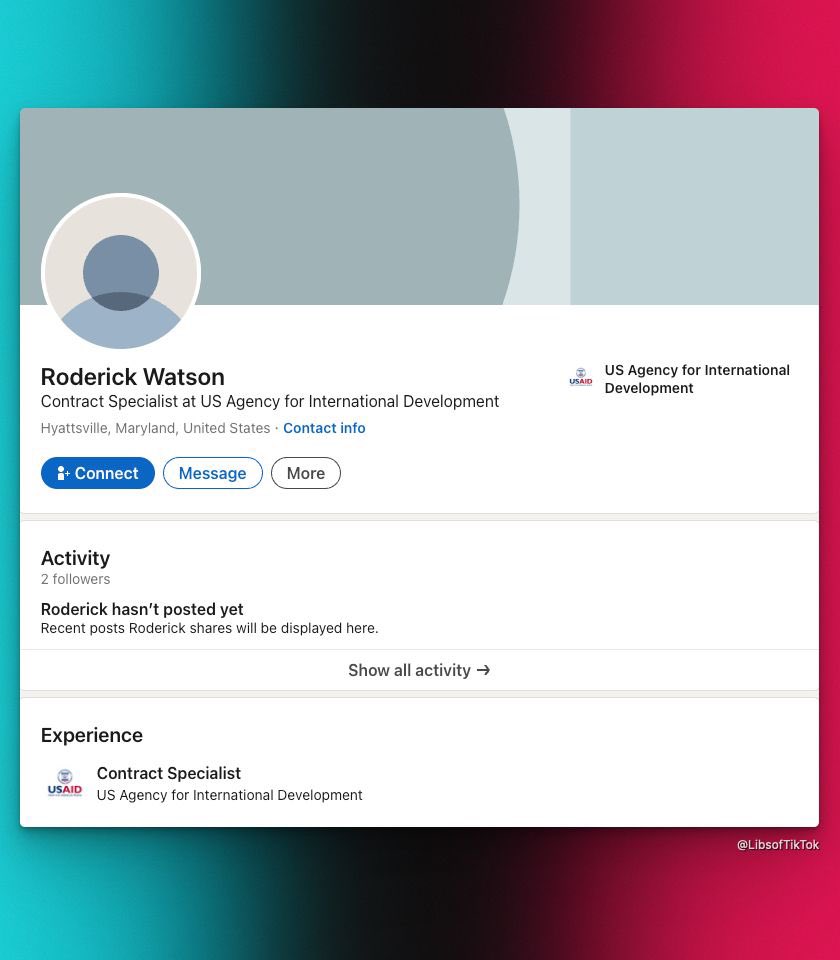
BREAKING: USAID official and 3 company executives plead guilty in fraud and bribery scheme involving at least 14 contracts worth over $550 million
USAID Official Roderick Watson took bribes, was showered with lavish gifts— including cash, laptops, thousands of dollars in tickets to a suite at an NBA game, a country club wedding, downpayments on two residential mortgages, cell phones, and jobs for relatives.
In exchange for the bribe payments, Watson influenced the award of contracts by manipulating the procurement process at USAID.
Watson faces a maximum penalty of 15 years in prison.
Imagine how much more fraud there is…
Here is President Trump’s new Surgeon General of the United States nominee, Dr. Casey Means, exposing the health industry and woke medical schools for six minutes straight.
It’s safe to say she is the perfect pick: