.@bhorowitz on how a game studio turned it's last $6 million into Slack:
"Stewart calls me. He says, 'Ben, I've got $6 million left. I have no way to raise money because I've made really no progress. So I've got three choices. I can pray for rain and try and finish it, I can shut down the company and give you your $6 million back, or we built this tool that we use in our engineering team to communicate with each other, and I could just put that out as a product.'"
"I'm like, 'What? You just built some tool to talk to each other and you want to put that out as a product? And you're a consumer guy, and you want to become an enterprise software guy?'"
"$6 million is not gonna make any difference in my life. If you really think it's a good idea, go ahead."
Ben Horowitz Talks Honesty, Failure, and Secrets at UC Berkeley (2016)
One of the weird constants about YC is that the disses are always the same. Investors always claim valuations have become impossibly high. Competitors always claim we've jumped the shark because the batch sizes are now too big. Historically both have always been mistaken.
Introducing Ground, the Money Infrastructure Company, supercharging banking and finance.
We have been quiet, building with design partners. Today, we launched out of stealth, alongside a $3.6 million pre-seed funding round, to embed onchain finance everywhere, starting with yield.
Ground turns any stablecoin or cash balance into a yield-bearing balance through one API. One integration provisions wallets, deploys into configurable on-chain yield sources, and emits ledger-ready accounting your end-user UI and internal systems can use on day one.
The bar is fintech UX, not blockchain UX. Yield should feel like a native balance feature, not a gas-and-retries engineering project. You pick allocations, set policies, and stay in control of funds. Ground hides blockchains and complex onchain mechanics.
Built for any financial platform or asset manager like neobanks, fintechs, corporate treasuries, and wealth managers. Founded by fintech and digital asset veterans from @stripe, @SuperstateInc, @hifibridge, and @compoundfinance. Backed by @BainCapCrypto, @paraficapital, @nascent , @robotventures, @chapterone, and Consonant Ventures.
- @rmcuming, CEO and @realsamyoon, CTO
Paul Graham published “Startups in 13 sentences” back in 2009.
I reread them after being accepted into YC.
The advice is still relevant today.
Here’s the summary:
1. Pick good cofounders.
You can swap your idea overnight, but you're stuck with your cofounders, so pick them like you're picking a marriage.
2. Launch fast.
You haven't actually started until you ship, because launching is what teaches you what you should've been building.
3. Let your idea evolve.
Launch, then iterate. Most of the good ideas only show up once you're building.
4. Understand your users.
Growth comes from how much you improve people's lives, and you can't do that until you understand them better than they understand themselves.
5. Better to make a few users love you than a lot stay ambivalent.
Win a small group completely instead of half-winning everyone. It's easier to add users than to fake real love.
6. Offer surprisingly good customer service.
Treat your first users absurdly well, even in ways that don't scale, because that's how you learn what to build.
7. You make what you measure.
Track the one number that matters every single day and you'll start doing more of whatever moves it.
8. Spend little.
Most startups die by running out of cash, so staying cheap just buys you more shots on goal.
9. Get ramen profitable.
Make enough to cover the founders' rent and you flip the power dynamic with investors overnight.
10. Avoid distractions.
The deadliest ones are the things that pay you now: day jobs, consulting, even fundraising. You'll always take the call that pays today.
11. Don't get demoralized.
Most startups don't die from money. They die because smart founders got worn down. Protect your morale on purpose.
12. Don't give up.
In startups, sheer persistence usually wins, as long as you keep reshaping the idea while you hang on.
13. Deals fall through.
Treat every deal as dead until it closes. Depending on it kills your morale and somehow makes it less likely to happen.
Second for second, @tylercowen packs more substance into a talk than anyone I'm aware of. This is a clear, non-hysterical, and somewhat soothing discussion of our AI future.
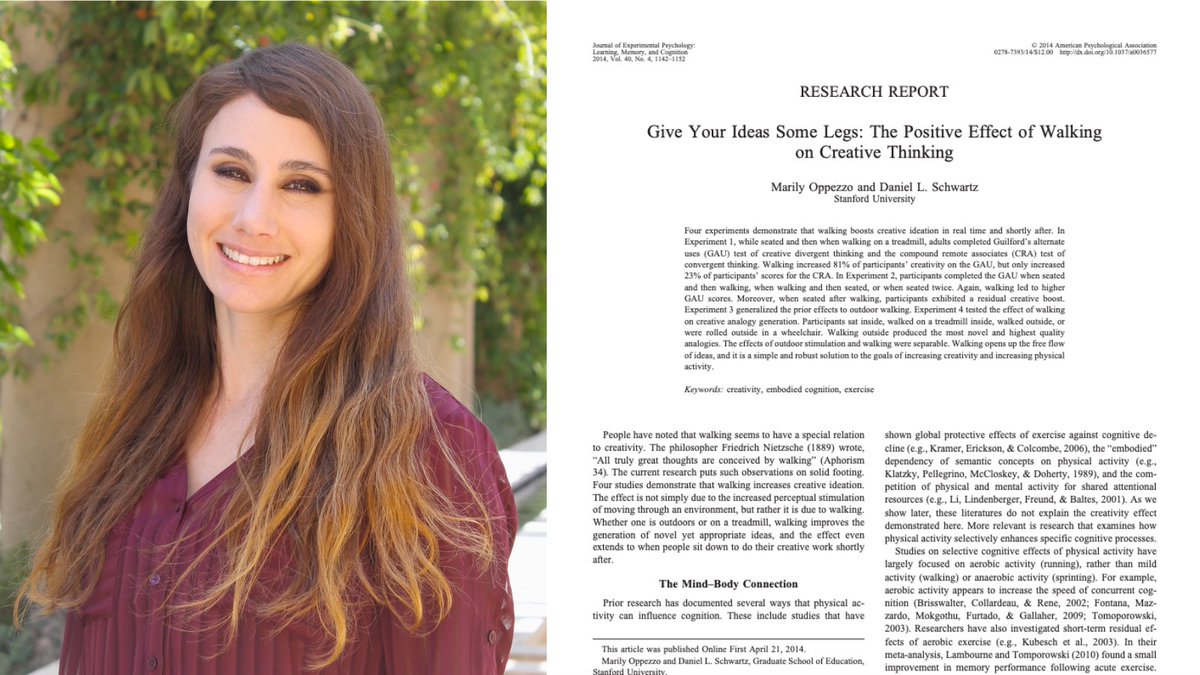
A Stanford psychologist spent 4 years proving that the simple act of walking generates 60% more creative ideas than sitting, and the experiment she designed to kill every alternative explanation is one of the most decisive findings in modern psychology.
Her name is Marily Oppezzo.
She got the idea for the study while walking with her advisor at Stanford to discuss her thesis topic, and the paper she eventually published in the Journal of Experimental Psychology in 2014 is sharp enough that it should have ended the seated meeting on the day it came out.
She ran 4 experiments on 176 people. Same person tested twice. Once sitting, once walking. The creativity tasks were the standard ones psychologists have used for decades to measure how good a brain is at generating novel useful ideas.
The result was almost too clean to publish.
81% of participants in the first experiment produced more creative ideas while walking than while sitting. In the second experiment, 88%. In the third, 100%. Every single person walked into a more creative version of themselves.
On average, people generated 60% more novel useful ideas the moment their legs started moving.
The skeptical question is the obvious one. Maybe it was the fresh air. Maybe it was the scenery passing by. Maybe it was the change of environment doing the work, not the walking itself.
Oppezzo killed every one of those explanations with one experimental decision.
She put people on a treadmill facing a blank wall. No scenery. No fresh air. No environmental change. Just legs moving in place while staring at white drywall. The 60% boost held.
Then she ran the experiment that closed the case completely. She took participants outside in two conditions. Half of them walked through a Stanford courtyard. The other half were pushed through the exact same courtyard in a wheelchair. Same outdoor stimulation. Same scenery passing at the same speed. The only difference was whether the legs were moving.
The walkers produced dramatically more novel high-quality ideas than the wheelchair group. The outdoors did almost nothing on its own. The walking did everything.
This is the part of the study that hit hardest when I read it the first time.
She also tested the opposite kind of thinking. Convergent thinking. The kind where there is one right answer and you have to narrow down to it.
Word puzzles where 3 words share a hidden fourth word that connects them. The seated participants did slightly better on these. Walkers got slightly worse.
Walking is not a general intelligence enhancer. It does one specific thing. It opens up the divergent search inside your brain. The part that generates options. The part that produces unexpected connections. The part that takes a problem and finds five ways into it instead of one.
When you need to converge on the single right answer, sit down. When you need to find the answer in the first place, get up.
The mechanism is now well understood. Walking selectively activates what neuroscientists call the default mode network, the system inside your brain that runs when you are not consciously focused on anything. The DMN is where mind-wandering happens. Where memories cross-reference each other. Where ideas that have been sitting in separate folders inside your head finally bump into each other.
When you sit at a desk and force yourself to concentrate, you suppress the DMN. When you walk at a natural pace, the executive part of your brain gets just busy enough handling the walking that the DMN comes online and starts doing the work that focus was blocking.
The most useful finding in the entire paper is the one almost nobody quotes.
The boost did not turn off the moment people stopped walking. Participants who walked first and then sat back down stayed elevated. Their next round of seated creativity work was still significantly better than people who had been sitting the whole time. The rest lingered for at least several minutes after the legs stopped moving.
You do not need to do creative work while walking. You need to walk before the creative work. The brain holds the state.
The history of this is the part that should haunt anyone who still does meetings in chairs.
Charles Darwin built a gravel loop behind his house in Kent called the Sandwalk and walked it 3 times a day for the rest of his life. The theory of evolution was developed one lap at a time on that path.
Nietzsche walked up to 10 hours a day during the years he wrote his most important books and openly said the work was conceived on his feet.
Beethoven composed for the morning and walked for 5 hours every afternoon with a pencil in his pocket for when something landed.
Kahneman said the best thinking of his Nobel Prize-winning career happened on leisurely walks with Amos Tversky. Steve Jobs refused to take important conversations sitting down. He held them on foot.
Every one of them was using the system Oppezzo would not measure until 2014. They just did not know what to call it.
The question worth sitting with is the one almost nobody asks.
Every meeting you have ever attended sitting around a table was a meeting held at a fraction of the brain power that was actually available to the people in the room. Every brainstorm that got stuck inside a conference room. Every problem you tried to solve at a desk and gave up on. Every idea you could not quite get to.
The intervention is the easiest one in modern science. No supplement. No app. No subscription. No training program. Just a pair of legs and 15 minutes.
The Stanford lab proved it. The philosophers knew it. The neuroscience explains it.
And almost everyone reading this is still trying to think their way out of problems sitting completely still.
new model for engineering team structure in 2026:
2 people only
one pirate and one architect
the pirate's job is to move as fast as possible to develop valuable, shipped product features by vibe coding.
the architect's job is to turn the product surface discovered by the pirate into a reliable, structured machine—also by vibe coding, but at a slower, more well-reasoned pace.
every product needs a pirate but most product's only need an architect once they some form of PMF, and in that case they usually don't need one full-time. architects can work across many codebases and solve interesting technical challenges. pirates go hard on a product that they own end-to-end.
Proud to be an investor in Binti and thrilled to see them featured in Forbes today! 🚀 The article highlights how they’re using AI to save social workers valuable time across government services.
https://t.co/zzdu7M9wzK
Thrilled to see @BintiFamily featured in @Forbes today alongside Anthropic on using AI to save social worker time across government social services, so they can spend less time on paperwork and more time with children and families <3
Read here 👉https://t.co/CXe9ai8KnT
@100kAintNoMoney 1. Pay off debt and out 5k as a emergency fund
2. Buy a piece of real estate (preferably a 2-4 unit)
3. Get into options/crypto
4. Side business
Financial freedom path.
1/⛓️Superstate is going multichain.
We’re excited to announce that in the coming weeks and months, $USTB & $USCC will be deployed on multiple blockchain networks, unlocking new use cases and DeFi integrations.
⚠️ Some Personal News ⚠️
Today, we're revealing the new and improved $AMKT.
It's never been easier to get exposure to the crypto market –– now including staked ETH.
Here's what's new with $AMKT, along with the launch of our Match program ↓